Executive Snapshot
Artificial intelligence is not a single product or model. It is a family of technologies that helps computers analyze information, recognize patterns, generate content, and support decisions. In P&C insurance, AI is most valuable when it improves the speed, consistency, and quality of human judgment without transferring accountability away from insurance professionals.
THE EXECUTIVE BOTTOM LINE
AI should be evaluated as a business capability, not as a technology experiment. The central questions are whether it improves decisions, fits existing workflows, produces explainable evidence, protects data, and can be governed at enterprise scale.
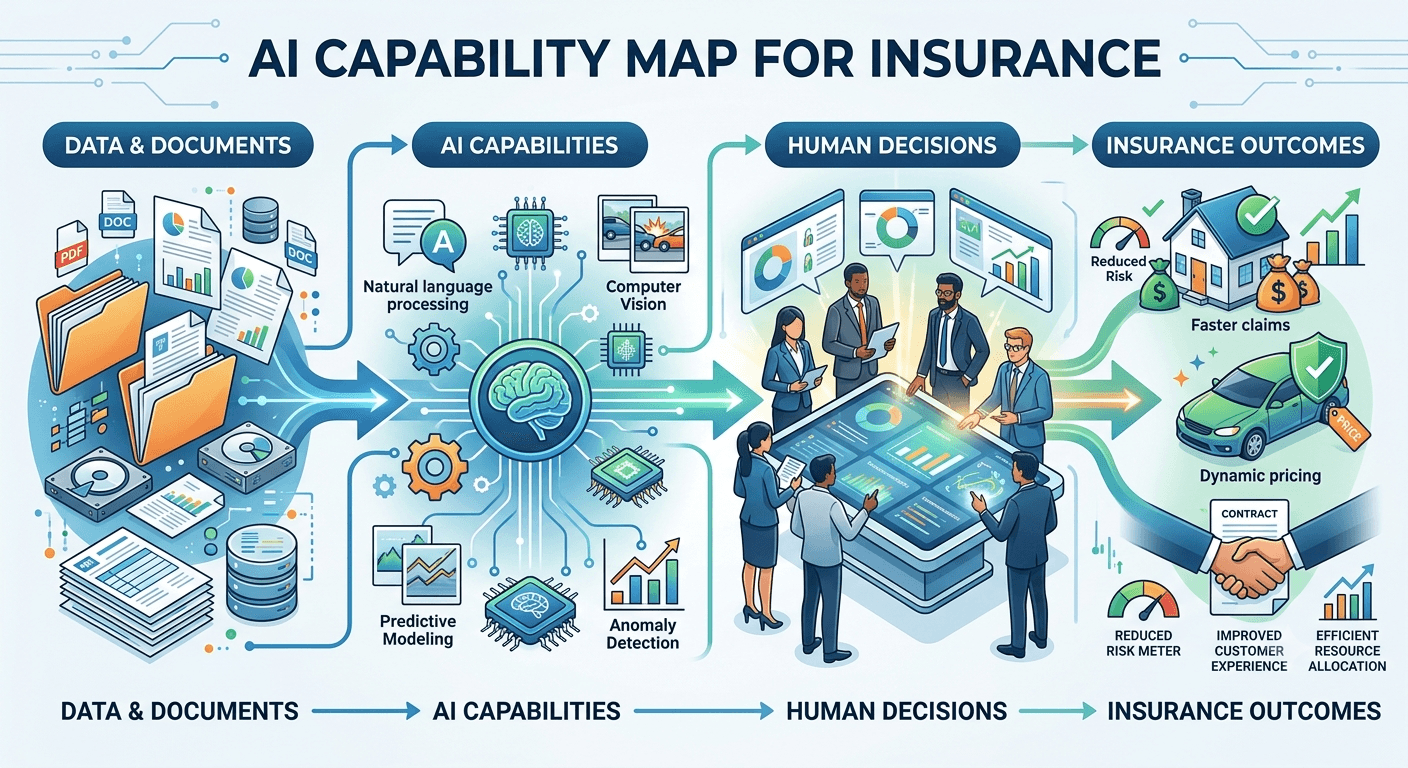
BUSINESS PROBLEM
Too much information, inconsistent review, delayed signals
AI CAPABILITY
Analyze data, documents, images, language, and patterns
INSURANCE WORKFLOW
Claims, underwriting, fraud, reserving, service, portfolio management
HUMAN DECISION
Professional review, judgment, approval, and documentation
BUSINESS OUTCOME
Earlier insight, greater consistency, better productivity, improved outcomes
Chapter Roadmap
- What AI is—and is not
- How AI works in insurance
- Where AI creates value across P&C
- Practical claims and underwriting scenarios
- Risks, governance, and human oversight
- Executive decision guidance
- SEO, FAQs, and publication assets
Definitions
Executive Definition
Artificial intelligence is the use of computer systems to perform tasks that normally require human cognitive abilities, such as interpreting information, recognizing patterns, making predictions, generating language, and recommending actions.
Technical Definition
Artificial intelligence is an interdisciplinary field that combines computer science, mathematics, statistics, data engineering, optimization, and domain knowledge to build systems capable of perception, reasoning, learning, prediction, generation, or action.
Insurance Definition
In P&C insurance, AI refers to technologies that analyze policy data, claim data, documents, images, notes, medical information, repair estimates, legal events, and other signals to help professionals make faster and better-informed decisions.
What AI Is Not
Not a single technology: AI includes machine learning, natural language processing, computer vision, generative AI, rules, optimization, and other techniques.
Not inherently autonomous: Most insurance applications are designed to support people, not act independently.
Not automatically objective: AI reflects its data, design choices, operating context, and governance.
Not a substitute for accountability: Material insurance decisions still require appropriate human authority and documentation.
Not valuable merely because it is advanced: A simpler method may be better when it is more accurate, explainable, maintainable, or cost-effective.
Why Artificial Intelligence Matters to P&C Insurance
Insurance is an information-intensive business. Every policy and claim generates structured data, unstructured documents, communications, images, transactions, and changes over time. The challenge is not simply storing information; it is recognizing what matters early enough to improve the outcome.
| Value dimension | Insurance impact |
|---|---|
| Scale | AI can evaluate large portfolios and document sets that no individual could review continuously. |
| Speed | AI can surface potential severity, litigation, fraud, or underwriting concerns earlier in the workflow. |
| Consistency | AI can apply the same analytical framework across many files while allowing professionals to exercise judgment. |
| Context | AI can connect signals across notes, documents, events, policy terms, medical records, and historical outcomes. |
| Productivity | AI can reduce administrative work and direct professional attention toward files requiring expertise. |
| Learning | AI can use historical outcomes and operational feedback to improve future analysis when models are governed and monitored. |
How AI Works
AI systems turn data and content into outputs that people can use. The precise method varies by application, but a well-governed insurance AI workflow usually contains the following stages.
1. Define the business purpose — Specify the decision, workflow, user, expected benefit, and limits of the system.
2. Govern the data — Identify permitted sources, ownership, quality rules, privacy requirements, retention, and access controls.
3. Prepare information — Clean, normalize, label, structure, or retrieve relevant data and documents.
4. Build or configure the AI — Train a model, configure a foundation model, apply rules, or combine multiple techniques.
5. Validate performance — Test accuracy, reliability, explainability, bias, security, robustness, and business usefulness.
6. Embed into workflow — Present outputs where claims professionals, underwriters, or managers already work.
7. Require human review — Give the professional evidence, explanation, and authority to accept, reject, or investigate.
8. Monitor and improve — Track performance, drift, user behavior, incidents, outcomes, and controlled changes.
The Major AI Capabilities
| Capability | Primary role |
|---|---|
| Machine learning | Learns patterns from historical examples to classify, predict, rank, or estimate outcomes. |
| Natural language processing | Interprets, extracts, categorizes, and analyzes human language in notes and documents. |
| Computer vision | Analyzes photographs, scans, video, and other visual information. |
| Generative AI | Produces summaries, drafts, explanations, structured outputs, or conversational responses. |
| Knowledge retrieval and RAG | Retrieves relevant enterprise information and uses it to ground generated responses. |
| Optimization and decision support | Recommends allocations, priorities, schedules, or next-best actions under constraints. |
| Rules and expert logic | Encodes deterministic business policies and can be combined with statistical AI. |
AI Across the P&C Insurance Value Chain
| Insurance function | Potential AI contribution |
|---|---|
| Distribution and service | Classify inquiries, summarize interactions, retrieve policy information, and draft responses for review. |
| Underwriting | Extract submission data, validate information, assess appetite, summarize risk, support referrals, and monitor portfolio patterns. |
| FNOL and triage | Classify loss type, detect missing information, identify urgency, route work, and surface early risk indicators. |
| Claims investigation | Analyze notes, reports, documents, photos, and third-party data to identify inconsistencies or follow-up needs. |
| Medical review | Build medical chronologies, identify treatment escalation, summarize records, and support professional review. |
| Severity and reserving | Estimate potential outcome ranges, monitor emerging changes, and flag cases requiring reserve review. |
| Litigation | Identify attorney involvement, legal escalation, venue concerns, demand developments, and litigation patterns. |
| Fraud and SIU | Detect anomalies, networks, suspicious patterns, or inconsistencies for investigator review. |
| Subrogation | Identify responsible parties, preserve evidence, and prioritize recovery opportunities. |
| Management and portfolio oversight | Summarize portfolio changes, compare trends, prioritize interventions, and support resource planning. |
Practical Insurance Scenarios
Claims Scenario: Early Identification of Escalating Exposure
A commercial auto bodily injury claim initially appears routine. During the first several weeks, new information arrives through adjuster notes, medical reports, a police report, and an attorney letter. An AI system continuously analyzes the evolving file and identifies a combination of signals associated with higher severity: delayed reporting, disputed liability, escalating diagnostics, attorney involvement, and treatment inconsistent with the initial injury description.
AI contribution: The system prioritizes the claim, explains the contributing signals, and links the user to the relevant source content.
Professional role: The adjuster validates the facts, investigates liability, coordinates medical review, evaluates coverage, and determines the handling strategy.
Management value: Supervisors gain earlier portfolio visibility and can allocate expertise before the claim becomes more difficult to manage.
Outcome principle: AI improves the timing and completeness of information; the claim professional retains decision authority.
Underwriting Scenario: Faster Submission Review
An underwriter receives a submission containing applications, schedules, loss runs, inspection reports, email correspondence, and supplemental questionnaires. AI extracts key facts, validates consistency, compares the risk with appetite guidance, highlights missing information, and produces a draft risk summary with source references.
AI contribution: Reduce document handling and organize the information required for evaluation.
Professional role: Assess risk quality, negotiate terms, apply judgment, and make the risk selection decision.
Portfolio value: Capture consistent risk attributes and support visibility across the book of business.
Outcome principle: AI accelerates preparation; the underwriter retains authority over selection, pricing, terms, and referral.
Business Value and Measurement
AI programs should be measured against business outcomes, not model novelty. The appropriate measures depend on the use case and should be established before deployment.
| Value area | Example measures |
|---|---|
| Claims productivity | Time spent reviewing documents, time to complete triage, files handled per professional, rework rate |
| Decision quality | Referral precision, missed-signal rate, consistency, override patterns, audit findings |
| Financial outcomes | Severity development, reserve adequacy, recovery yield, leakage reduction, expense impact |
| Customer outcomes | Response time, cycle time, communication quality, complaint rate |
| Underwriting outcomes | Submission turnaround, referral quality, hit ratio, risk selection consistency, portfolio mix |
| Risk and governance | Model drift, incident rate, unsupported output rate, source-citation coverage, human-review compliance |
Risks, Limitations, and Governance
Data quality: Incomplete, inconsistent, stale, or poorly labeled information can produce unreliable outputs.
Bias and fairness: Historical patterns may contain inequities or may not represent the current business context.
Explainability: Users need understandable reasons and supporting evidence, especially for material decisions.
Hallucination or unsupported generation: Generative systems can produce plausible but incorrect content unless grounded and reviewed.
Model drift: Performance may decline as claims, legal, medical, economic, or operational conditions change.
Privacy and security: Sensitive personal, medical, financial, and proprietary information requires strong controls.
Overreliance: Users may accept outputs without appropriate review if workflows and accountability are poorly designed.
Vendor and change risk: Models, dependencies, and platform behavior can change and require controlled testing and documentation.
Regulatory and legal risk: Use cases must be assessed against applicable insurance, privacy, employment, consumer protection, and recordkeeping obligations.
Responsible AI Control Framework
- Approved purpose and accountable owner
- Permitted and governed data
- Validated performance and documented limitations
- Explanation and source evidence
- Human review and override capability
- Security, privacy, and access controls
- Monitoring, feedback, and incident response
- Controlled model and workflow changes
Best Practices and Common Mistakes
| Best practices | Common mistakes |
|---|---|
| • Begin with a measurable business problem | • Starting with a model and searching for a use case |
| • Design the human decision and workflow first | • Treating predictions as final decisions |
| • Use domain experts throughout development | • Ignoring data readiness and workflow integration |
| • Require evidence and explainability | • Measuring only model accuracy |
| • Pilot with representative data and users | • Allowing users to rely on unsupported generated text |
| • Monitor both technical and business performance | • Failing to plan for drift, retraining, or vendor change |
| • Document ownership, limitations, changes, and incidents | • Scaling before governance and user adoption are proven |
Executive Decision Guide
EXECUTIVE DECISION POINT
Do not ask only whether the AI works. Ask whether the organization can use it responsibly, whether professionals trust it, whether it improves the target workflow, and whether the economic value can be sustained after implementation.
| Decision area | Questions to ask |
|---|---|
| Business fit | What decision or workflow improves? Who owns the outcome? What happens if the AI is unavailable? |
| Data readiness | What data is required? Is it permitted, complete, representative, and maintained? |
| Performance | How is success measured? What are false-positive and false-negative consequences? |
| Explainability | Can users understand why an output was produced and examine supporting evidence? |
| Human authority | Where is review required? Who can override the system? How are overrides documented? |
| Integration | Does the capability fit the core platform, document flow, security model, and daily user experience? |
| Governance | Who approves, monitors, changes, and retires the system? How are incidents handled? |
| Economics | What is the full cost of implementation, data preparation, integration, operations, monitoring, and change management? |
| Vendor evaluation | What is proprietary, what is third-party, what changes without notice, and what evidence supports claimed performance? |
Readiness Levels
Explore: Business problem is defined; data and governance are being assessed.
Pilot: A limited use case is tested with representative users, controls, and outcome measures.
Operationalize: The capability is integrated into workflow with ownership, training, monitoring, and support.
Scale: The organization expands proven patterns across products or functions using standardized controls.
Optimize: Performance, adoption, economics, and governance are continuously improved.
Common Myths and Misconceptions
“AI will replace insurance professionals.”
The more practical near-term value is augmenting professionals with faster access to relevant information, consistent analysis, and better prioritization.
“AI is only as good as the amount of data.”
Volume matters less than relevance, quality, representativeness, governance, and connection to the business outcome.
“A highly accurate model is automatically valuable.”
A model can be technically strong yet fail because it is late, difficult to explain, poorly integrated, or aimed at the wrong decision.
“Generative AI and predictive AI are interchangeable.”
They solve different problems. Generative AI creates content; predictive AI estimates outcomes. Many insurance workflows benefit from both.
“Once deployed, AI keeps working the same way.”
Performance and context change. Monitoring, feedback, testing, and controlled updates are required.
“Human-in-the-loop means a person merely clicks approve.”
Meaningful oversight requires authority, information, time, training, and the ability to challenge or override the output.
Charlee.ai Perspective
For P&C insurance, the most valuable AI is not isolated in a laboratory or dashboard. It is embedded into the claim, underwriting, and management workflows where professionals make decisions. It should identify what changed, explain why it matters, point to the supporting evidence, and help the user determine the appropriate next action.
CHARLEE.AI INSIGHT
The winning model for insurance AI is people plus intelligence: governed enterprise data, validated analysis, source evidence, and experienced professionals working together. AI amplifies judgment; it does not transfer accountability.
The People-Plus-AI Operating Model
Enterprise information: Claims, policies, documents, notes, images, events, and external context.
AI analysis: Prediction, extraction, summarization, anomaly detection, retrieval, and prioritization.
Evidence and explanation: Source references, contributing factors, confidence, and known limitations.
Professional review: Claims, underwriting, medical, legal, SIU, and management expertise.
Decision and documentation: Action, rationale, authority, and audit trail.
Continuous learning: Outcome measurement, user feedback, monitoring, incident response, and controlled change.
Key Takeaways
- Artificial intelligence is a broad family of technologies, not a single model or product.
- Insurance AI creates value by interpreting information, recognizing patterns, prioritizing work, generating content, and supporting decisions.
- Predictive AI, generative AI, machine learning, NLP, computer vision, and rules can be combined within one workflow.
- The best use cases solve a measurable business problem and fit the way professionals already work.
- Accuracy alone is not enough; explainability, evidence, security, governance, adoption, and economics determine real-world value.
- Human professionals should retain meaningful authority over material claim, underwriting, and management decisions.
- AI should be monitored and improved as data, business conditions, law, medicine, and user behavior change.
- The strongest operating model is people plus AI: human judgment amplified by timely, governed intelligence.
Artificial intelligence is not a single product or model. It is a family of technologies that helps computers analyze information, recognize patterns, generate content, and support decisions. In P&C insurance, AI is most valuable when it improves the speed, consistency, and quality of human judgment without transferring accountability away from insurance professionals.
Frequently Asked Questions
Artificial intelligence is technology that helps computers perform tasks involving interpretation, learning, prediction, generation, or decision support.
AI is used to analyze submissions, triage claims, summarize documents, identify severity or litigation signals, detect anomalies, support reserving, assist service, and provide portfolio insight.
No. Machine learning is one important subset of AI. AI also includes natural language processing, computer vision, generative AI, optimization, knowledge retrieval, and other methods.
AI can recommend, prioritize, or explain, but material decisions should remain subject to appropriate professional review, authority, and governance.
Predictive AI estimates an outcome or risk. Generative AI creates new content such as summaries, explanations, or drafts. They are complementary.
Depending on the purpose, it may use policies, claims, notes, documents, images, medical records, loss runs, transactions, legal events, weather, geospatial information, and other permitted data.
Accuracy varies by use case, data, model, population, and time. Organizations should evaluate multiple measures and understand the business cost of errors.
Many systems can provide contributing factors, source evidence, confidence, or other explanations. The required level of explainability should match the decision and risk.
It is a design in which a qualified person reviews AI output, examines evidence, exercises judgment, and retains authority over the decision.
Responsible AI is the governance, design, validation, security, transparency, oversight, and monitoring required to use AI appropriately.
Start with a high-value, clearly defined workflow; assess data and governance readiness; pilot with representative users; measure business outcomes; then scale proven patterns.
Common causes include unclear business purpose, poor data, weak workflow integration, insufficient user trust, lack of governance, unrealistic expectations, and failure to measure outcomes.
Review frequency should reflect the risk and rate of change. Performance, drift, incidents, user behavior, and business outcomes should be monitored continuously or on a defined schedule.
Yes. AI can be connected through APIs, batch processes, messages, secure data access, or document-based integrations without requiring immediate replacement of the core platform.
Ask about the business outcome, training and operating data, validation, explainability, security, human oversight, integrations, monitoring, change control, total cost, and evidence supporting performance claims.