Executive Snapshot
PLAIN-ENGLISH DEFINITION
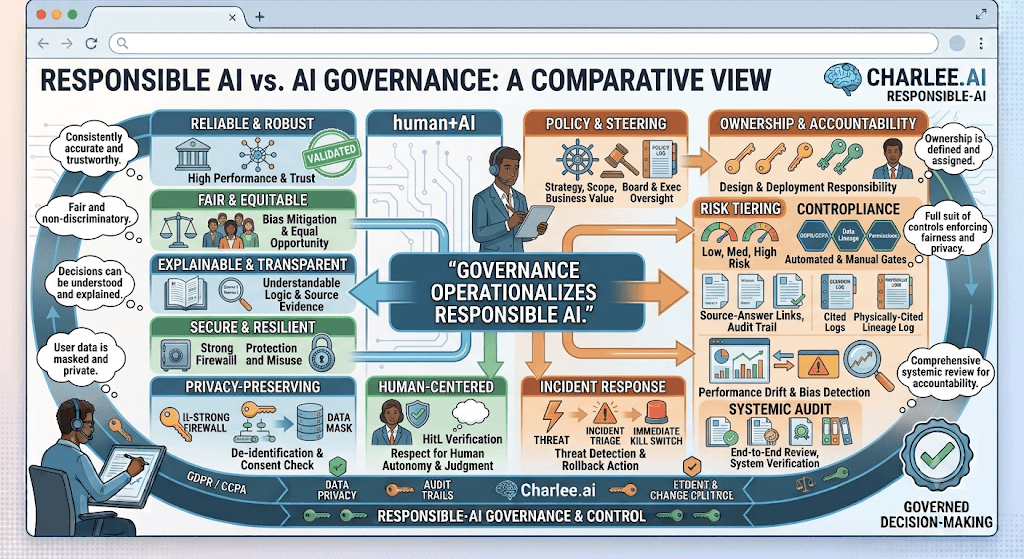
AI governance is the enterprise system of policies, decision rights, roles, controls, evidence, and oversight used to ensure that artificial intelligence is approved for legitimate purposes, managed according to risk, operated within defined authority, and continuously monitored throughout its lifecycle.
| Governance Dimension | What Leaders Must Establish |
|---|---|
| Purpose | A documented business need, approved use, intended users, prohibited uses, and measurable outcomes. |
| Accountability | Named executive, business, technical, risk, security, privacy, and operational owners. |
| Risk tier | A proportionate classification based on decision impact, autonomy, data sensitivity, affected parties, and reversibility. |
| Lifecycle controls | Stage gates for ideation, data, design, validation, release, monitoring, change, incident response, and retirement. |
| Evidence | A reconstructable record of models, data, prompts, sources, tests, approvals, outputs, overrides, and decisions. |
| Human authority | Clear boundaries that preserve accountable professional judgment for consequential insurance decisions. |
| Third parties | Due diligence, contractual requirements, testing, monitoring, change notification, and exit planning. |
| Outcome s | Reliable business value without unacceptable legal, conduct, fairness, privacy, security, or operational risk. |
Executive Summary
AI governance turns leadership intent into repeatable operating practice. It defines who may approve an AI use case, what evidence is required before deployment, how risk determines the strength of controls, how users exercise judgment, and how the organization monitors and responds when data, models, vendors, or business conditions change.
For Property & Casualty insurers, governance cannot be limited to the data-science function. AI may influence claim triage, severity monitoring, reserve review, litigation management, fraud referral, underwriting prioritization, document interpretation, policy servicing, customer communication, and portfolio decisions. These activities already sit within established legal, operational, financial, and professional authority structures. AI governance should connect to those structures rather than create a disconnected technology process.
The objective is not to eliminate risk or require the same review for every use. Strong governance is proportionate. An internal document-search tool should not be treated like a system that recommends claim settlement ranges or underwriting actions. A mature framework accelerates appropriate innovation by making expectations, artifacts, decision rights, and escalation paths clear before teams invest heavily in development.
The human-centered standard is central: AI can analyze high volumes of information, surface signals, explain evidence, and recommend attention, while trained insurance professionals retain authority for consequential decisions. Governance ensures that this division of work is deliberate, documented, tested, and monitored.
Quick Facts
- AI governance applies to internally developed models, embedded vendor capabilities, generative AI, predictive AI, document intelligence, computer vision, AI agents, and externally hosted services.
- An enterprise AI inventory is the foundation for ownership, risk classification, monitoring, examination readiness, and change control.
- Governance should cover the complete system, not only the model: data, integrations, prompts, retrieval, tools, user interface, workflow, vendor services, and human decisions.
- Risk-tiering prevents low-risk work from being overburdened while ensuring consequential systems receive independent challenge and stronger controls.
- Production approval is not permanent. Material changes in purpose, data, model, prompt, vendor, workflow, jurisdiction, or user population should trigger reassessment.
- The governing standard should be evidence of operating effectiveness, not the existence of a policy document.
Definitions and Scope
Executive Definition
AI governance is the leadership and operating framework that assigns decision rights, accountability, policies, risk standards, approval gates, documentation, monitoring, and escalation for the design, acquisition, deployment, and use of artificial intelligence.
Technical Definition
AI governance is a control system spanning AI inventory, architecture, data lineage, model and prompt documentation, testing, validation, access management, release management, monitoring, incident response, vendor oversight, audit logging, and decommissioning. It governs both deterministic and probabilistic components and the human-machine workflow in which outputs are used.
Insurance Definition
In P&C insurance, AI governance ensures that AI-supported claims, underwriting, policy, fraud, customer, and management activities comply with applicable authority, preserve evidence, remain reviewable, and keep accountable professionals responsible for coverage, reserving, settlement, pricing, risk selection, referral, and customer-impacting decisions.
Insurance Definition
| Concept | Primary Question | Insurance Example |
|---|---|---|
| AI ethics | What values and principles should guide use? | Avoid unfair treatment, hidden manipulation, or unsupported adverse conclusions. |
| Responsible AI | How should AI be designed and operated to be trustworthy? | Use reliable, fair, secure, explainable, evidence-centered, human-supervised workflows. |
| AI governance | Who decides, what controls apply, and what evidence proves compliance? | Inventory, ownership, risk tier, approvals, validation, monitoring, incident response, audit. |
| Model risk management | How are model limitations, uncertainty, validation, and change controlled? | Independent challenge, performance testing, calibration, drift monitoring, limitations. |
| Data governance | How are data quality, lineage, access, use, retention, and stewardship controlled? | Approved sources, lineage, quality checks, minimization, access, retention, deletion. |
Insurance Definition
GOVERNANCE PRINCIPLE
AI governance is the operating mechanism that converts ethical principles and Responsible AI commitments into assigned responsibilities, measurable controls, approval evidence, and daily behavior.
Insurance Definition
BUSINESS CONTEXT
Why AI Governance Matters in P&C Insurance
Insurance is a regulated promise delivered through thousands of individual decisions. AI can improve the speed and consistency with which professionals find information, identify emerging risk, and prioritize work. It can also scale weak data, misunderstood correlations, inconsistent workflows, and unsupported conclusions. Governance is therefore not an administrative add-on; it is the mechanism that protects the insurer’s ability to innovate without losing accountability.
| Insurance Reality | Governance Implication |
|---|---|
| Claims evolve over time as medical, legal, repair, coverage, and liability evidence changes. | Controls must address temporal context, source evidence, monitoring, and professional reassessment. |
| Underwriting combines appetite, judgment, regulation, pricing, and market strategy. | AI may support analysis, but decision authority, referral rules, and prohibited factors must remain explicit. |
| Consumer-impacting decisions can be examined long after they occur. | The organization needs reconstructable evidence showing data, model version, reasons, human action, and approvals. |
| Third-party models and data are widely embedded in workflows. | Insurers remain responsible for governance even when design details or services are external. |
| Generative AI can create fluent but unsupported output. | Governance must cover grounding, citations, prompt security, privacy, testing, and user verification. |
| AI agents may call tools or take actions. | Permissions, bounded authority, approval gates, logging, and fail-safe behavior become critical. |
EXECUTIVE INSIGHT
The governance question is not “Do we trust AI?” It is “What decision can this system influence, what evidence supports its use, who remains accountable, and how will we know when it is no longer operating within approved limits?”
OPERATING MODEL
The AI Governance Operating Model
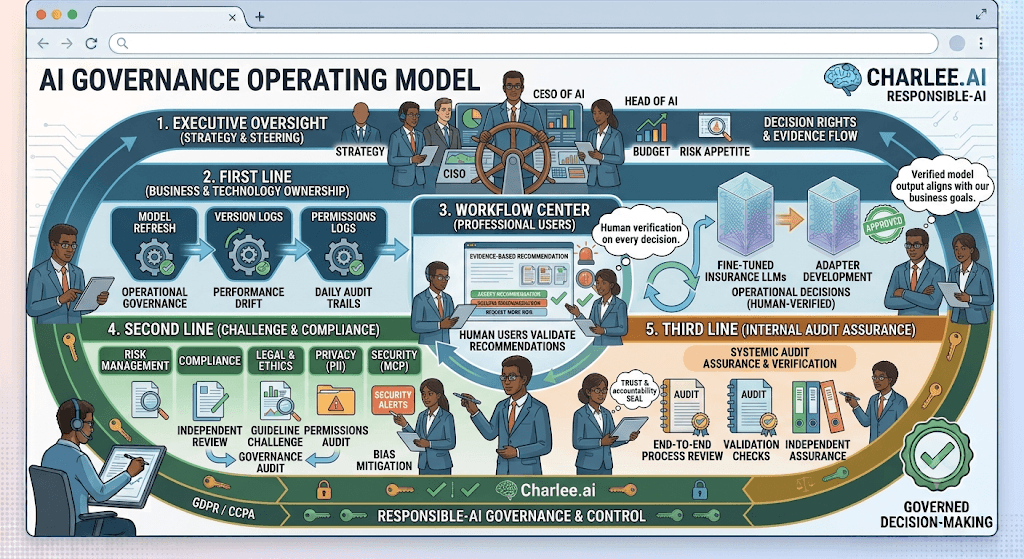
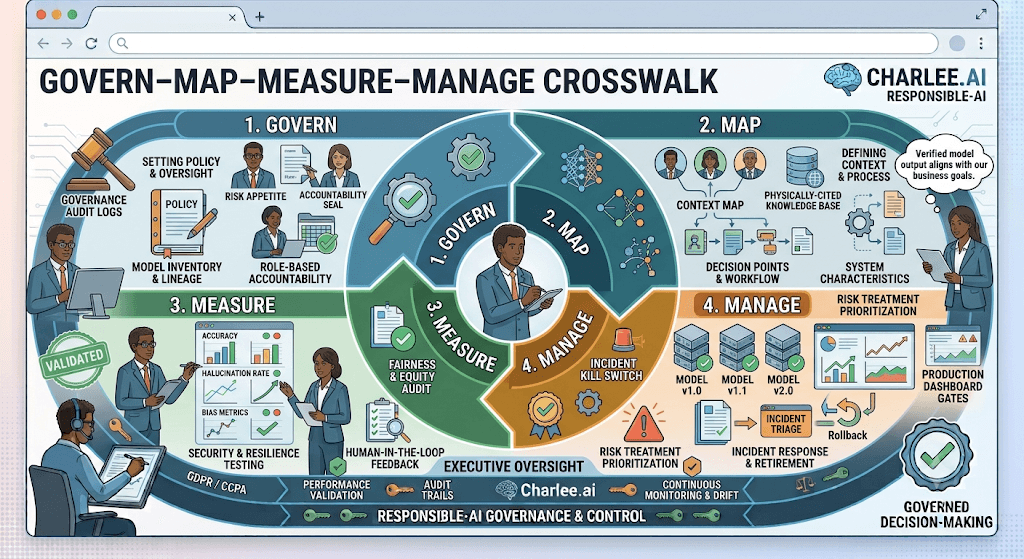
A mature operating model aligns executive oversight with business ownership, technical delivery, independent challenge, operational use, and audit. It should be integrated into existing enterprise risk, model risk, data governance, cybersecurity, privacy, compliance, procurement, and change-management processes.
| Layer | Primary Responsibilities | Typical Evidence |
|---|---|---|
| Board / executive committee | Set risk appetite, approve policy, assign accountability, oversee material risk and incidents. | Policy, risk appetite, portfolio dashboard, material-risk and incident reporting. |
| AI governance council | Interpret policy, set standards, resolve cross-functional issues, approve higher-risk use cases. | Charter, standards, meeting decisions, exception approvals, portfolio priorities. |
| Business owner | Define purpose, workflow, users, outcomes, limitations, and decision authority. | Use-case charter, process map, KPI baseline, user controls, benefit realization plan. |
| Technology / AI owner | Design, integrate, test, document, operate, and maintain the system. | Architecture, model card, prompt inventory, test results, release and monitoring package. |
| Risk / compliance / legal | Assess obligations, provide independent challenge, approve controls, monitor conduct risk. | Risk assessment, legal analysis, fairness review, control requirements, issue tracking. |
| Security / privacy | Protect data, identities, integrations, tools, and vendor access. | Threat model, privacy assessment, access design, logging, data-flow map. |
| Operations / users | Review evidence, apply judgment, document decisions, override, escalate, and report issues. | SOPs, training, user attestations, override records, feedback, incident reports. |
| Internal audit / independent validation | Assess whether governance and controls are designed and operating effectively. | Validation reports, audit findings, remediation evidence, closure approval. |
Three Lines of Accountability
CORE FRAMEWORK
- First line: Business and technology teams own the use case, its controls, performance, data, user experience, and daily operation.
- Second line: Risk, compliance, privacy, security, legal, and model-governance functions set standards and provide independent challenge.
- Third line: Internal audit or equivalent independent assurance evaluates design and operating effectiveness.
Governance Principles
| Principle | Operational Meaning |
|---|---|
| Approved purpose | AI is used only for a documented, legitimate business purpose with defined boundaries and prohibited uses. |
| Accountability | Named owners can approve, challenge, pause, change, and retire the system. |
| Proportionality | Controls are matched to consequence, autonomy, data sensitivity, complexity, and reversibility. |
| Human authority | Consequential insurance decisions remain with qualified, authorized professionals. |
| Evidence and traceability | Outputs can be reconstructed using data, versions, sources, configurations, and user actions. |
| Reliability and safety | Performance, robustness, failure modes, and operational resilience are tested and monitored. |
| Fairness and lawful treatment | Data, features, models, thresholds, and workflows are reviewed for unjustified disparities. |
| Privacy and security | Data minimization, access, confidentiality, retention, threat prevention, and misuse controls are built in. |
| Transparency and explainability | Users understand the system’s role, reasons, limitations, uncertainty, and evidence. |
| Contestability | Users and affected processes have practical correction, override, escalation, and recourse mechanisms. |
| Lifecycle control | Deployment, change, monitoring, incident response, and retirement are governed continuously. |
| Value discipline | The system must create measurable business value and remain preferable to simpler alternatives. |
CONTROL FOUNDATION
AI Inventory and System Classification
An insurer cannot govern what it has not identified. The AI inventory should include systems built internally, purchased from vendors, embedded in core platforms, used through productivity tools, or operated by third parties on the insurer’s behalf. It should also capture experimental tools that may access enterprise or customer data.
Minimum Inventory Fields
- System name, business purpose, owner, technical owner, users, affected workflows, and deployment status.
- AI type, model or service provider, version, location, integrations, tools, and degree of autonomy.
- Data sources, sensitive-data categories, lineage, retention, cross-border or vendor data flows.
- Decisions influenced, affected parties, jurisdictions, lines of business, and professional authority boundaries.
- Risk tier, approvals, validation date, monitoring plan, incident contact, change history, and retirement status.
Minimum Inventory Fields
| Classification Factor | Lower-Risk Indicator | Higher-Risk Indicator |
|---|---|---|
| Decision impact | Administrative support or internal research. | Coverage, settlement, reserve, fraud, pricing, eligibility, or adverse action. |
| Autonomy | Information only; no tool execution. | Actions, transactions, communications, or workflow changes without review. |
| Affected parties | Internal users with reversible consequences. | Claimants, policyholders, applicants, employees, or public-facing users. |
| Data sensitivity | Public or low-sensitivity information. | Medical, legal, financial, identity, protected, or confidential information. |
| Explainability | Evidence and reasons are directly available. | Complex, opaque, or difficult-to-reconstruct output. |
| Reversibility | Error is quickly detected and corrected. | Error creates lasting financial, legal, conduct, or customer impact. |
| Scale | Limited pilot and low volume. | Enterprise-wide or high-volume deployment. |
| Third-party dependency | Transparent service with strong contractual control. | Limited visibility, material subcontractors, or unannounced model changes. |
Minimum Inventory Fields
RISK MANAGEMENT
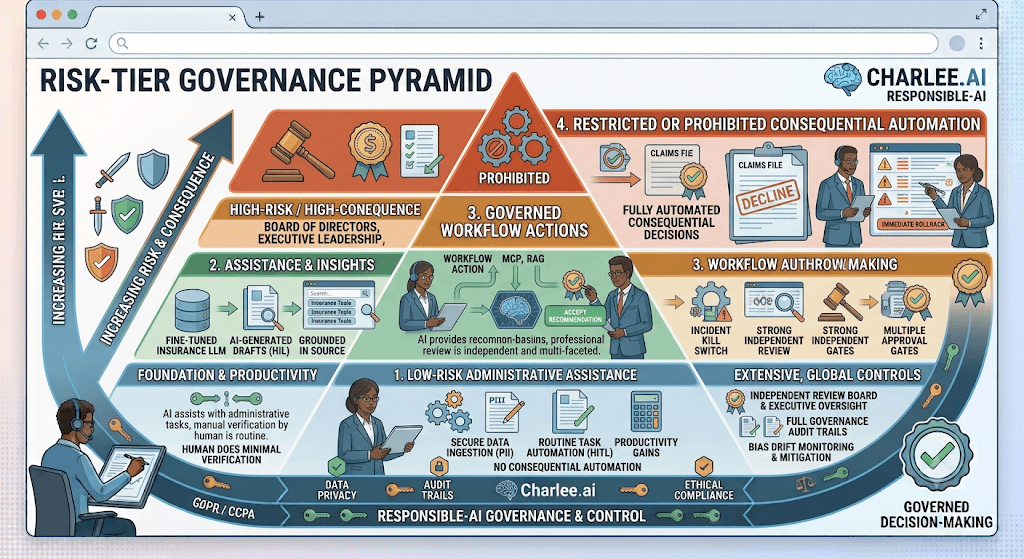
Risk Tiers and Proportionate Controls
| Tier | Illustrative Uses | Minimum Governance |
|---|---|---|
| Tier 1 — Low | Internal search, duplicate detection, non-consequential routing, administrative drafting. | Owner, approved data, basic testing, access control, logging, user guidance, periodic review. |
| Tier 2 — Moderate | Claim prioritization, document summarization, underwriting triage, management analytics. | Formal risk assessment, validation, source evidence, meaningful human review, monitoring, change approval. |
| Tier 3 — High | Reserve or settlement support, fraud referral, underwriting recommendation, customer-impacting communication. | Independent validation, fairness testing, enhanced explanations, strict access, override analysis, frequent monitoring, senior approval. |
| Tier 4 — Restricted / Prohibited | Unreviewed adverse decisions, unauthorized protected-factor use, actions outside legal or delegated authority. | Do not deploy; redesign the purpose, data, workflow, and authority model before reconsideration. |
Risk Assessment Questions
LIFECYCLE
- What decision, recommendation, communication, or action can the AI influence?
- Who may be affected, and how severe, likely, detectable, and reversible is a wrong result?
- What data is used, and could any input function as an inappropriate proxy?
- How autonomous is the system, and what systems or tools can it access?
- Can a professional inspect evidence, challenge the output, and document an override?
- Can the organization reconstruct the result and identify the responsible model, data, configuration, and user action?
- What happens when data feeds, integrations, models, vendor services, or monitoring fail?
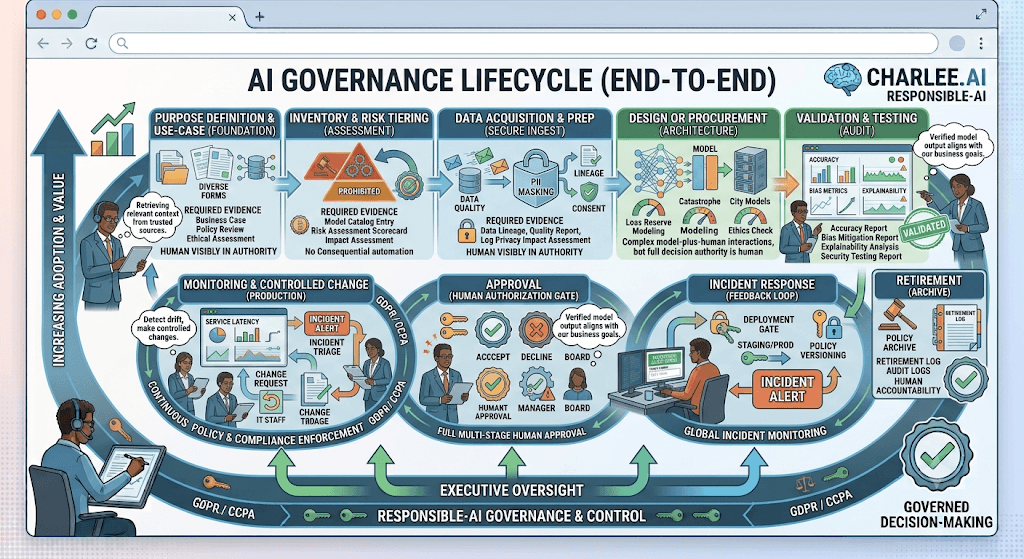
Governance Across the AI Lifecycle
| Stage | Required Governance Questions | Core Evidence |
|---|---|---|
| Ideation | Is the problem legitimate, valuable, suitable for AI, and aligned with strategy and authority? | Use-case charter, alternatives analysis, owner, preliminary risk tier. |
| Data preparation | Is data lawful, relevant, representative, current, secure, and controlled? | Data inventory, lineage, quality report, privacy review, permitted-use record. |
| Design | Are objectives, users, constraints, explanations, fallback, and failure modes explicit? | Architecture, workflow, feature review, prompt design, threat model, human-oversight design. |
| Development / procurement | Are internal and vendor components documented and controlled? | Model card, vendor due diligence, contracts, technical documentation, configuration inventory. |
| Validation | Does the system meet technical, business, fairness, security, operational, and human-factors requirements? | Test plan, benchmarks, scenario tests, independent challenge, residual-risk acceptance. |
| Deployment | Are approvals, access, training, logging, fallback, and rollback complete? | Release checklist, approvals, SOPs, training records, support and rollback plan. |
| Monitoring | Is the system stable, useful, fair, secure, and within approved limits? | Dashboards, drift alerts, override analysis, complaints, incidents, value tracking. |
| Change | Has the impact of model, data, prompt, rule, vendor, workflow, or purpose changes been assessed? | Version history, impact assessment, regression tests, approvals, communication. |
| Retirement | Are access, data, records, dependencies, contracts, and users handled safely? | Decommission plan, archive, data disposition, access removal, replacement notice. |
MANAGEMENT PRINCIPLE
Governance should be designed into the delivery lifecycle. A final compliance review cannot repair weak purpose, missing evidence, poor data lineage, or a workflow that encourages users to rubber-stamp AI output.
DECISION AUTHORITY
Decision Rights and Approval Gates
Governance becomes practical when teams know which decisions they may make and which require escalation. Decision rights should be explicit for use-case approval, data use, model selection, risk classification, production release, exceptions, incidents, material changes, and retirement.
| Decision | Accountable Owner | Required Challenge / Approval |
|---|---|---|
| Approve business purpose | Business executive | Risk, legal/compliance, data/privacy as applicable. |
| Assign risk tier | AI governance or model-risk authority | Business, technical, legal, security, privacy input. |
| Approve data use | Data owner and business owner | Privacy, legal, security, data governance. |
| Approve production release | Business and technical owners | Independent validation and risk acceptance for moderate/high risk. |
| Approve exception | Designated governance authority | Documented rationale, time limit, compensating controls. |
| Pause or disable | Named business/technical incident owner | Immediate authority under defined triggers; executive notification for material systems. |
| Approve material change | Same or stronger authority as original release | Regression testing and revalidation proportional to impact. |
| Retire system | Business and technical owners | Data, records, legal, vendor, security, and operational closure. |
AUDITABILITY
Documentation and Evidence Architecture
Documentation should make the governance process usable and the system reconstructable. The goal is not maximum paperwork. It is the minimum complete evidence needed to understand purpose, design, performance, risk, approvals, operation, and change.
| Artifact | Purpose |
|---|---|
| Use-case charter | Defines business problem, intended users, decisions influenced, benefits, prohibited uses, owners, and authority. |
| AI system card | Describes components, model or service, version, architecture, integrations, tools, limitations, and deployment. |
| Data sheet | Documents data sources, lineage, permissions, quality, representation, sensitive fields, transformations, and retention. |
| Risk assessment | Records risk factors, tier, obligations, potential harms, controls, residual risk, and approvals. |
| Validation report | Provides technical, business, fairness, robustness, security, operational, and human-factors evidence. |
| Human-oversight design | Explains what users see, what they decide, how they override, and when they escalate. |
| Release checklist | Confirms approvals, access, logging, training, fallback, support, and rollback readiness. |
| Monitoring plan | Defines metrics, thresholds, cadence, owners, alerts, investigation, escalation, and pause criteria. |
| Incident record | Captures event, impact, containment, root cause, remediation, communication, and lessons learned. |
| Change record | Links versions, reason, impact, tests, approvals, deployment, communication, and rollback. |
| Retirement record | Confirms system shutdown, access removal, records, data handling, dependencies, and user transition. |
Evidence to Retain for Individual Outputs
HUMAN-CENTERED AI
- Timestamp, user, use case, model and configuration version, prompt or rule version, and retrieved source identifiers.
- Inputs and material data state, subject to privacy and retention requirements.
- Output, confidence or uncertainty, explanation, citations, tool calls, and warnings.
- Professional review, corrections, overrides, escalation, final action, and decision authority.
- Any downstream communication or transaction created from the AI-supported workflow.
| Weak Oversight | Strong Oversight |
|---|---|
| User sees only a score or conclusion. | User sees drivers, sources, confidence, limitations, missing information, and change history. |
| Approval is routine and rarely questioned. | Overrides and escalations are expected, documented, and analyzed. |
| AI text is copied into the claim or policy record without verification. | Professional verifies facts and distinguishes observed evidence, AI inference, and final judgment. |
| Users lack authority to disagree. | Delegations and escalation paths explicitly support challenge. |
| Feedback disappears into free text. | Corrections, disagreements, overrides, and incidents are captured in structured form. |
| Performance is measured only technically. | Governance monitors comprehension, reliance, workload, override quality, and user error. |
Data, Fairness, Explainability, Privacy, and Security
Governance should not treat trustworthy characteristics as separate checklists. Data quality affects fairness and explainability; access design affects privacy and security; workflow design affects reliability and human oversight. The risk assessment should show how these controls work together for the specific use case.
| Control Domain | Governance Expectations |
|---|---|
| Data | Approved source, lawful and permitted use, lineage, quality, representation, timeliness, transformation, retention, and stewardship. |
| Fairness | Defined decision and harm, relevant comparison groups, feature and proxy review, segment performance, workflow outcomes, mitigation, and monitoring. |
| Explainability | Audience-appropriate reasons, source evidence, uncertainty, limitations, and ability to distinguish fact from inference. |
| Privacy | Minimization, purpose limitation, notice and authorization where required, access, retention, deletion, and vendor restrictions. |
| Security | Identity, least privilege, encryption, logging, prompt-injection defenses, tool restrictions, content isolation, and incident response. |
| Reliability | Task-specific accuracy, calibration, robustness, fallback, resilience, and performance under missing, unusual, or changing conditions. |
GOVERNANCE PRINCIPLE
No single metric proves that an AI system is governed. Governance requires a coherent body of evidence showing that the system is appropriate for its purpose and controlled in the actual workflow.
ASSURANCE
Validation and Independent Challenge
Validation should test the complete AI-enabled system, not only a model in isolation. It should evaluate whether the system produces useful, reliable, and appropriate results for the intended users, data, jurisdictions, and operating conditions.
| Validation Area | Illustrative Questions and Measures |
|---|---|
| Technical performance | Discrimination, calibration, precision, recall, extraction accuracy, hallucination rate, citation precision, abstention quality. |
| Business performance | Cycle time, prioritization value, missed-risk reduction, productivity, decision quality, user adoption, financial impact. |
| Fairness | Segment performance, false-positive and false-negative differences, referral burden, outcome disparity, correction access. |
| Robustness | Missing data, unusual documents, catastrophe conditions, adversarial content, distribution shift, integration failure. |
| Human factors | Comprehension, appropriate reliance, automation bias, workload, override quality, escalation, user error. |
| Security and privacy | Access, leakage, prompt injection, tool misuse, retention, logging, data flow, vendor behavior. |
| Operational performance | Latency, uptime, queue impact, fallback, rollback, support, monitoring reliability. |
| Governance effectiveness | Correct risk tier, complete approvals, traceability, operating controls, incident readiness, change discipline. |
Independence Expectations
The degree of independence should increase with risk. High-impact systems should receive challenge from individuals who were not responsible for creating the model or business case and who have authority to require remediation or stop release.
PRODUCTION GOVERNANCE
Monitoring, Incidents, and Controlled Change
Monitoring Signals
- Input, feature, document, user, and portfolio drift.
- Output distribution, calibration, error, hallucination, citation, and abstention changes.
- Segment-level performance and outcome differences.
- Overrides, disagreements, escalations, complaint patterns, and user-reliance behavior.
- Latency, integration errors, unavailable sources, failed tool calls, and fallback use.
- Unauthorized access, prompt injection, anomalous retrieval, data leakage, and tool misuse.
- Vendor model, service, terms, subprocessors, data handling, or configuration changes.
- Business value, adoption, work displacement, queue effects, and unintended operational incentives.
| Trigger | Required Response |
|---|---|
| Performance threshold breach | Investigate, contain, determine user and customer impact, remediate, revalidate, and document. |
| Data feed or source failure | Fail safely, alert owners, suspend affected outputs, restore and verify data before resuming. |
| Material unfairness or conduct concern | Pause affected use, preserve evidence, engage legal/compliance, investigate root cause, remediate. |
| Security or privacy event | Activate incident response, contain access, assess notification obligations, preserve logs, remediate. |
| Vendor or model change | Assess impact, obtain documentation, regression test, approve before production use when material. |
| Purpose or workflow change | Re-charter, re-tier, review authority, data, controls, validation, training, and monitoring. |
| Unacceptable user reliance | Redesign explanations and workflow, retrain users, adjust approvals and monitoring. |
VENDOR OVERSIGHT
Third-Party AI Governance
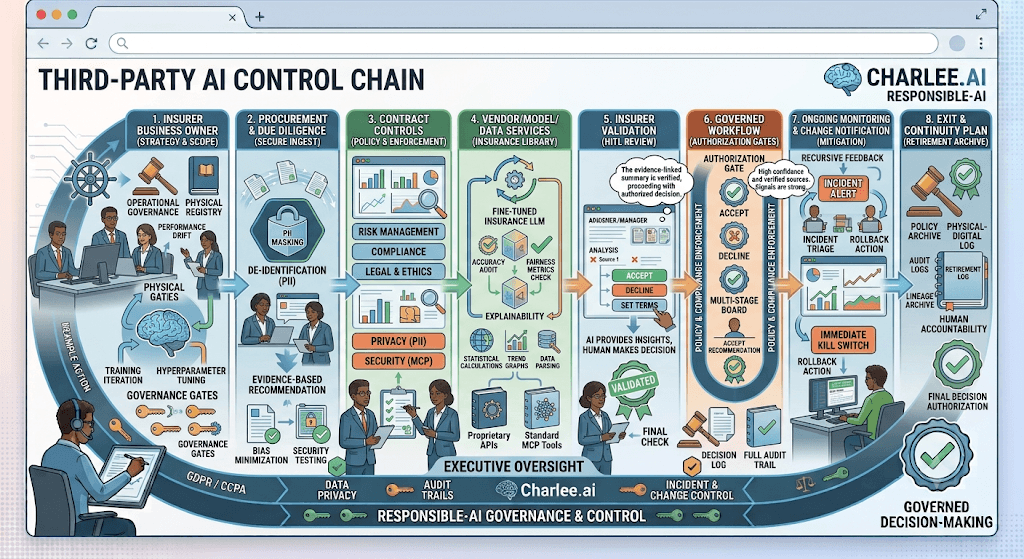
Outsourcing technology does not outsource accountability. Insurers should govern vendor AI according to the decisions it influences and the risks it creates, even when the vendor does not disclose every model detail.
| Lifecycle Point | Governance Requirements |
|---|---|
| Selection | Business fit, architecture, security, privacy, data rights, explainability, performance evidence, financial and operational resilience. |
| Contracting | Permitted data use, training restrictions, confidentiality, subcontractors, audit rights, incident notice, model-change notice, retention, deletion, service levels, indemnity, continuity, and exit. |
| Validation | Independent testing on representative insurance data and workflows; do not rely solely on vendor benchmarks. |
| Deployment | Configuration control, access, integration testing, user training, fallback, monitoring, and escalation. |
| Operation | Service performance, output quality, drift, incidents, changes, complaints, and data handling. |
| Exit | Data return or deletion, model and workflow transition, records preservation, access removal, continuity planning. |
Vendor Questions
TECHNOLOGY PATTERNS
- What models, data, subprocessors, and external services are used, and where are they operated?
- Will insurer or customer data be used to train or improve any shared model or service?
- How are model, prompt, retrieval, safety, and configuration changes communicated?
- What performance, bias, robustness, security, and incident evidence is available?
- Can the insurer audit outputs, logs, data flows, access, and control operation?
- What happens if the vendor service is unavailable, materially changed, or terminated?
Governance for Predictive AI, Generative AI, and Agents
| AI Pattern | Distinct Governance Concerns | Control Emphasis |
|---|---|---|
| Predictive AI | Label quality, temporal leakage, calibration, thresholds, proxy variables, segment error, drift. | Time-aware validation, appropriate features, calibrated scores, explanations, threshold governance, monitoring. |
| Generative AI | Hallucination, outdated knowledge, prompt inconsistency, confidentiality, overreliance, unsafe content. | Approved grounding, citations, prompt/version control, privacy, output constraints, abstention, human verification. |
| RAG / semantic retrieval | Unauthorized retrieval, stale sources, poor relevance, missing context, citation mismatch. | Authorization-aware search, metadata, freshness, benchmark queries, source validation, retrieval monitoring. |
| AI agents | Goal drift, tool misuse, incorrect sequencing, unauthorized action, cascading error, weak reconstructability. | Bounded goals, least privilege, approved tools, transaction limits, checkpoints, approval gates, action logs, kill switch. |
| Computer vision / IDP | Image quality, extraction error, missing context, false confidence, source mismatch. | Quality checks, material-field validation, provenance, confidence thresholds, source review, exception routing. |
AGENT SAFETY RULE
No AI agent should have broader authority than the human role it supports. Consequential actions should require explicit approval unless a narrow, documented, pre-approved exception is justified, tested, monitored, and reversible.
P&C CASE STUDY
Claims Case Study: Severity and Litigation Monitoring
A workers’ compensation carrier deploys AI to identify claims showing emerging severity, attorney involvement, treatment escalation, reserve pressure, or litigation risk. The system analyzes structured claim information and incoming medical, legal, and operational documents, then prioritizes files for examiner and management attention.
| Governance Area | Design and Evidence |
|---|---|
| Purpose | Surface changing evidence and prioritize review; do not autonomously set reserves, coverage, or settlement strategy. |
| Ownership | Claims executive owns the use case; analytics and technology own implementation; model risk provides challenge. |
| Risk tier | High enough to require independent validation because recommendations may influence financial and customer outcomes. |
| Data | Approved claim, medical, legal, financial, and document data with lineage, access control, and quality monitoring. |
| Validation | Test by jurisdiction, injury type, claim age, severity band, attorney status, and operational team. |
| Explanation | Show changing signals, source passages, timeline, confidence, missing information, and limitations. |
| Human authority | Examiner or manager determines action under existing reserve, coverage, and settlement authority. |
| Monitoring | Missed severe claims, false alerts, overrides, reserve adequacy, cycle time, complaints, drift, and incidents. |
| Pause criteria | Data-feed failure, material calibration decay, unexplained segment differences, security or privacy concern. |
Governance Value
P&C CASE STUDY
- Earlier and more consistent recognition of changing claim risk.
- Clear evidence showing why a claim requires attention.
- Better allocation of specialist and management review.
- Reconstructable support for professional actions and overrides.
- Monitoring that distinguishes model performance from workflow and data problems.
Underwriting Case Study: Commercial Submission Triage
A commercial insurer uses AI to classify documents, extract submission information, summarize operations, compare information with approved appetite guidance, and prioritize submissions for underwriter review. The system does not make final eligibility, pricing, coverage, terms, or referral decisions.
| Governance Area | Design and Evidence |
|---|---|
| Purpose | Reduce administrative work, identify missing information, and improve prioritization. |
| Data | Trace extracted fields to source documents; distinguish broker representations, external data, and verified insurer records. |
| Risk tier | Moderate to high depending on whether recommendations influence eligibility, pricing, or adverse treatment. |
| Fairness | Review geography, industry, business size, language, and other features for inappropriate proxy effects. |
| Validation | Test across classes, account sizes, broker formats, document types, and submission complexity. |
| Explanation | Show appetite matches, conflicts, missing information, sources, uncertainty, and referral rationale. |
| Human authority | Underwriter retains authority for risk selection, pricing, terms, exceptions, and communication. |
| Monitoring | Extraction errors, referral patterns, hit ratio, turnaround time, overrides, broker complaints, and drift. |
| Change control | Re-test when appetite, products, forms, external sources, models, or market strategy change. |
BUSINESS VALUE
Business Benefits and Governance Metrics
| Benefit | How Governance Creates Value |
|---|---|
| Faster scaling | Reusable standards, templates, risk tiers, and approval paths reduce uncertainty and rework. |
| Trust and adoption | Users rely more appropriately on systems they understand, can verify, and are empowered to challenge. |
| Better decisions | Evidence, explanations, validation, and human judgment improve action quality. |
| Operational resilience | Monitoring, fallback, incident response, and change control reduce hidden failure and disruption. |
| Regulatory defensibility | Documented purpose, controls, testing, approvals, and records support examination and audit. |
| Vendor control | Due diligence and contractual requirements reduce dependency, confidentiality, and change risk. |
| Portfolio discipline | Inventory and reporting allow leaders to allocate resources according to value and risk. |
| Enterprise learning | Overrides, corrections, incidents, and outcomes improve future systems and workflow design. |
Executive Metrics
| Metric Group | Illustrative Measures |
|---|---|
| Coverage | Percent of AI systems inventoried, owned, risk-tiered, validated, monitored, and reviewed on schedule. |
| Control quality | Open findings, overdue remediation, exceptions, control failures, incomplete evidence, unapproved changes. |
| Performance | Task accuracy, calibration, retrieval quality, hallucination, drift, reliability, latency, and fallback. |
| Human oversight | Override rate, appropriate disagreement, escalation, review time, user comprehension, automation bias indicators. |
| Fairness / conduct | Segment performance, referral burden, complaint patterns, correction time, adverse outcome review. |
| Incidents | Events by severity, time to detect, contain, remediate, communicate, and close. |
| Business value | Adoption, cycle time, workload, outcome quality, financial benefit, avoided loss, user satisfaction. |
| Vendor risk | Service changes, incidents, SLA performance, documentation gaps, concentration, exit readiness. |
Executive Metrics
WHAT TO AVOID
Common Failure Modes
| Failure Mode | Why It Fails | Better Approach |
|---|---|---|
| Policy-only governance | Principles do not change daily behavior or system design. | Embed controls in approval gates, workflows, architecture, monitoring, and accountability. |
| One-size-fits-all review | Low-risk work slows while high-risk issues may remain hidden. | Use risk tiers, minimum evidence standards, and escalation by consequence. |
| Model-only scope | Data, prompts, retrieval, integrations, users, and actions remain uncontrolled. | Govern the complete AI-enabled system and workflow. |
| Accuracy-only testing | A system can be accurate but unfair, insecure, brittle, unusable, or misleading. | Validate technical, business, fairness, human, security, and operational performance. |
| Nominal human review | Users cannot understand or challenge outputs. | Provide evidence, time, authority, training, escalation, and structured overrides. |
| Uncontrolled experimentation | Employees expose data or operational decisions to unapproved tools. | Provide approved environments, data boundaries, education, discovery, and enforcement. |
| Vendor reliance without evidence | Insurer cannot explain performance, data use, or change. | Perform due diligence, contract for control, validate locally, and monitor continuously. |
| No post-deployment owner | Performance and value deteriorate without action. | Assign owners, thresholds, cadence, escalation, pause, remediation, and retirement criteria. |
| Governance without value discipline | Process expands while poor use cases persist. | Require measurable business outcomes, alternatives analysis, and retirement when value is absent. |
IMPLEMENTATION
Implementation Blueprint
Establish executive sponsorship, an AI governance policy, risk appetite, and clear decision rights.
Create an enterprise AI inventory that includes internal, embedded, third-party, and experimental systems.
Define risk tiers and the minimum controls and evidence required for each tier.
Create an AI governance council or assign equivalent authority within existing enterprise governance.
Standardize use-case charters, system cards, data sheets, risk assessments, validation reports, release checklists, monitoring plans, incident records, and change records.
Integrate legal, compliance, privacy, security, data governance, model risk, procurement, and internal audit into the lifecycle.
Design human authority, explanations, evidence access, override, escalation, and fallback before finalizing the model.
Build representative benchmark datasets and scenario tests based on real P&C workflows and failure conditions.
Implement monitoring for performance, drift, fairness, security, user behavior, incidents, and business value.
Create pause, containment, rollback, communication, remediation, and restart procedures.
Train executives, owners, developers, validators, managers, users, procurement, and auditors according to role.
Review the framework regularly as technology, law, regulation, products, vendors, and business practices change.
Phased Maturity Roadmap
| Phase | Focus | Exit Criteria |
|---|---|---|
| 1. Establish | Policy, sponsorship, inventory, ownership, initial risk tiers. | Material AI use cases visible; owners and interim controls assigned. |
| 2. Standardize | Artifacts, approval gates, validation, vendor requirements, monitoring. | Repeatable process operating for representative low-, moderate-, and high-risk use cases. |
| 3. Integrate | Connect governance to delivery, procurement, data, security, model risk, and audit. | Controls embedded in systems and workflows; evidence collected consistently. |
| 4. Scale | Portfolio dashboards, reusable controls, automated evidence, training, metrics. | Governance supports enterprise volume without sacrificing risk differentiation. |
| 5. Optimize | Outcome-based metrics, continuous testing, lessons learned, advanced assurance. | Governance improves both risk outcomes and speed-to-value over time. |
Phased Maturity Roadmap
LEADERSHIP
Executive Decision Guide
| Question | Proceed When | Pause or Redesign When |
|---|---|---|
| Is the purpose clear? | Users, benefits, decisions, boundaries, and prohibited uses are documented. | The system may be reused for undefined or adverse purposes. |
| Is AI appropriate? | AI adds measurable value beyond simpler rules, search, analytics, or process redesign. | A safer, more transparent solution can meet the need. |
| Is accountability explicit? | Named owners can approve, challenge, pause, remediate, and retire. | Responsibility is distributed but no one has decision authority. |
| Is data suitable? | Lineage, permission, quality, representation, sensitivity, and retention are controlled. | Data rights, quality, bias, or security concerns remain unresolved. |
| Can users exercise judgment? | They receive evidence, training, time, authority, and escalation paths. | The workflow encourages automatic acceptance or hides uncertainty. |
| Can the system be validated? | Benchmarks, segments, failure cases, and acceptance criteria are defined. | Material risks cannot be measured or outcomes reconstructed. |
| Can it be monitored and stopped? | Owners, thresholds, alerts, fallback, rollback, and incident plans exist. | Harmful behavior cannot be detected, contained, or reversed reliably. |
| Is the value sustainable? | Benefits, adoption, control cost, vendor risk, and operating effort are measured. | Value is speculative, short-lived, or outweighed by control and dependency costs. |
EXECUTIVE PERSPECTIVE
Good governance does not ask leaders to approve technology they cannot understand. It asks them to approve a defined business use, a clear division of authority, a proportionate control package, and evidence that the system creates value within acceptable risk.
PERSPECTIVE
Charlee.ai Perspective
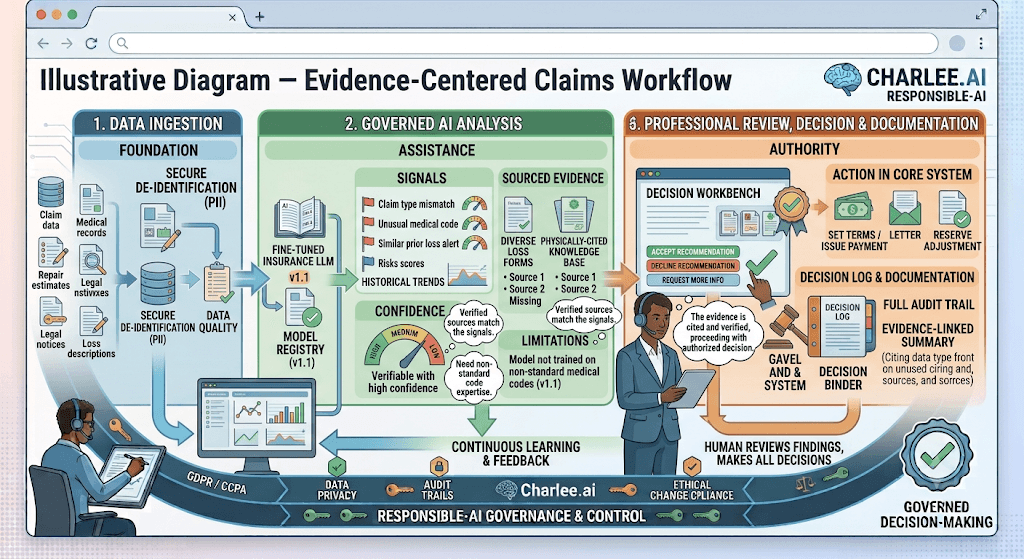
For P&C insurance, AI governance should be designed around the professional workflow. The strongest systems continuously analyze claims, documents, and portfolio information; surface material changes; explain why they matter; and connect users to supporting evidence. Claims professionals, underwriters, managers, and other authorized personnel retain responsibility for consequential decisions.
Governance is most effective when it is evidence-centered. A risk score without reasons, a summary without sources, or an agent action without a reconstructable trail is difficult to govern. Charlee.ai’s people-plus-AI philosophy emphasizes approved purpose and data, validated analysis, explanation and source evidence, professional review, documented decisions, monitoring, feedback, incident response, and controlled change.
This model strengthens both trust and performance. It helps professionals see earlier, act with better information, and explain why an action was taken, while preserving the judgment, authority, and accountability that insurance requires.
CHARLEE.AI GOVERNANCE PATTERN
Approved purpose and data → validated AI analysis → explanation and source evidence → professional review → decision and documentation → monitoring, feedback, incident response, and controlled change.
VISUAL SYSTEM
External Framework Alignment
This chapter is vendor-neutral and is designed to align conceptually with widely used governance and risk-management approaches. Insurers should adapt any framework to applicable law, regulation, regulatory guidance, contracts, lines of business, jurisdictions, and organizational authority.
| Framework or Guidance | Relevance to This Chapter |
|---|---|
| NIST AI Risk Management Framework | Uses Govern, Map, Measure, and Manage to organize voluntary, lifecycle-oriented AI risk management. Governance is cross-cutting across the other functions. |
| NIST Generative AI Profile | Extends AI risk management to generative-AI risks and actions, supporting governance of hallucination, information integrity, privacy, security, and misuse. |
| NAIC Model Bulletin on the Use of AI Systems by Insurers | Sets regulatory expectations for a written AI systems program, risk management, governance, documentation, and compliance with applicable insurance laws for consumer-impacting decisions. |
| Enterprise risk and model risk practices | Provide established structures for ownership, independent challenge, validation, issue management, audit, and risk acceptance. |
| Internal policies and delegated authority | Define insurer-specific decision rights, professional responsibilities, data use, security, claims handling, underwriting, vendor, and records requirements. |
CURRENT-STATE NOTE
AI laws, regulatory expectations, and technical standards continue to evolve. Before external publication or implementation, legal, compliance, privacy, security, and model-governance teams should verify the current requirements applicable to each jurisdiction and use case.
Key Takeaways
- AI governance converts leadership intent and Responsible AI principles into assigned ownership, controls, evidence, and daily operating practice.
- Govern the complete AI-enabled system: purpose, data, model, prompts, retrieval, tools, integrations, users, workflow, vendor services, outputs, and decisions.
- Use risk tiers so controls are proportionate to impact, autonomy, data sensitivity, affected parties, scale, and reversibility.
- Preserve meaningful professional authority for consequential claims, underwriting, pricing, fraud, reserve, settlement, coverage, and customer decisions.
- Require task-specific validation across technical, business, fairness, human, security, privacy, and operational dimensions.
- Monitor production performance, drift, fairness, security, user behavior, incidents, vendor changes, and business value.
- Outsourcing AI does not outsource accountability; third-party services require lifecycle governance and exit planning.
- Good governance accelerates appropriate innovation by making expectations, evidence, and decision rights clear.
PLAIN-ENGLISH DEFINITION
AI governance is the enterprise system of policies, decision rights, roles, controls, evidence, and oversight used to ensure that artificial intelligence is approved for legitimate purposes, managed according to risk, operated within defined authority, and continuously monitored throughout its lifecycle.
Frequently Asked Questions
AI governance is the enterprise system of policies, roles, decision rights, controls, evidence, and oversight used to approve, operate, monitor, change, and retire AI according to business value and risk.
Responsible AI describes the qualities and operating discipline needed for trustworthy use. AI governance establishes who is accountable, what standards apply, how approval occurs, and what evidence demonstrates those qualities in practice.
Executives set policy and risk appetite; business owners own use cases; technology teams own implementation; risk functions provide challenge; users exercise professional judgment; audit provides assurance. Accountability must be explicit even though responsibility is shared.
No. Controls should be proportionate to decision impact, autonomy, affected parties, data sensitivity, complexity, scale, and reversibility of error.
It is a controlled record of AI systems, owners, purposes, models, data, vendors, integrations, decisions influenced, risk tiers, approvals, monitoring, changes, and lifecycle status.
At minimum: scope, principles, roles, risk tiers, inventory requirements, lifecycle gates, documentation, validation, human oversight, vendor controls, monitoring, incidents, exceptions, change, retirement, training, and reporting.
Use approved data and models, governed retrieval, source citations, prompt and configuration control, privacy and security protections, output constraints, testing, abstention, human verification, and monitoring for hallucination and misuse.
Bound goals and tools, apply least privilege, set transaction limits, require approval for consequential actions, log every step, test failure behavior, and provide reliable pause and kill mechanisms.
The reviewer has sufficient evidence, time, competence, authority, and context to question, correct, override, or escalate the AI output before a consequential action is taken.
Common artifacts include a use-case charter, system or model card, data sheet, risk assessment, validation report, human-oversight design, release checklist, monitoring plan, incident record, change record, and retirement plan.
Perform due diligence, contract for data and control requirements, test on representative insurance workflows, monitor performance and changes, retain audit and incident rights, and maintain continuity and exit plans.
Performance, calibration, drift, fairness, data quality, explanations, retrieval, hallucination, overrides, complaints, user behavior, security events, incidents, operational reliability, vendor changes, and business value.
When performance breaches limits, data or integrations fail, material unfairness appears, security or privacy is compromised, the purpose changes, monitoring is unavailable, or the system cannot operate safely within approved authority.
Some narrow administrative actions may be automated, but coverage, reserve, settlement, fraud, underwriting, pricing, and other consequential decisions require careful legal analysis, delegated authority, governance, and meaningful human accountability.
It reduces rework, failed pilots, incidents, uncontrolled vendor dependency, and adoption problems while creating reusable standards that help suitable use cases move to production more efficiently.
No. Compliance is essential, but governance also covers strategy, value, ownership, technical reliability, data, security, fairness, human factors, operations, change, incidents, and retirement.
According to risk tier and whenever material changes occur in purpose, law, regulation, data, model, prompt, retrieval, vendor, integration, workflow, users, or business conditions.
Establish executive ownership, create an AI inventory, define risk tiers and minimum evidence, select representative use cases, and embed lifecycle controls before attempting enterprise scale. CROSS-LINKING