Executive Snapshot
IN ONE SENTENCE
Retrieval-Augmented Generation is an architecture that retrieves relevant information from approved sources and supplies it to a generative AI model so the model can produce a more grounded, contextual, and traceable response.
What executives should know
- RAG does not retrain a large language model on every internal document; it retrieves relevant content at the time of the request.
- RAG can materially improve relevance and traceability, but it does not guarantee factual accuracy.
- The quality of retrieval, content governance, permissions, and source freshness often matters as much as the language model.
- Insurance-grade RAG should preserve source citations, document identity, effective dates, and user entitlements.
- RAG is most valuable when it is embedded in a defined workflow with clear human accountability.
Executive decision point
Do not evaluate a RAG solution only by how polished its answers sound. Evaluate whether it retrieves the right insurance evidence, respects access controls, distinguishes authoritative from non-authoritative content, cites sources at a useful level, and fails safely when evidence is incomplete or conflicting.
Executive decision point
BUSINESS VALUE SNAPSHOT
Problem: professionals spend significant time locating and synthesizing information across fragmented systems. Capability: retrieve relevant approved content and generate a source-linked answer. Outcome: faster research, more consistent summaries, improved access to institutional knowledge, and better-supported professional decisions. Measures: search time, review time, citation accuracy, retrieval quality, adoption, correction rate, and business outcome metrics.
Executive Summary
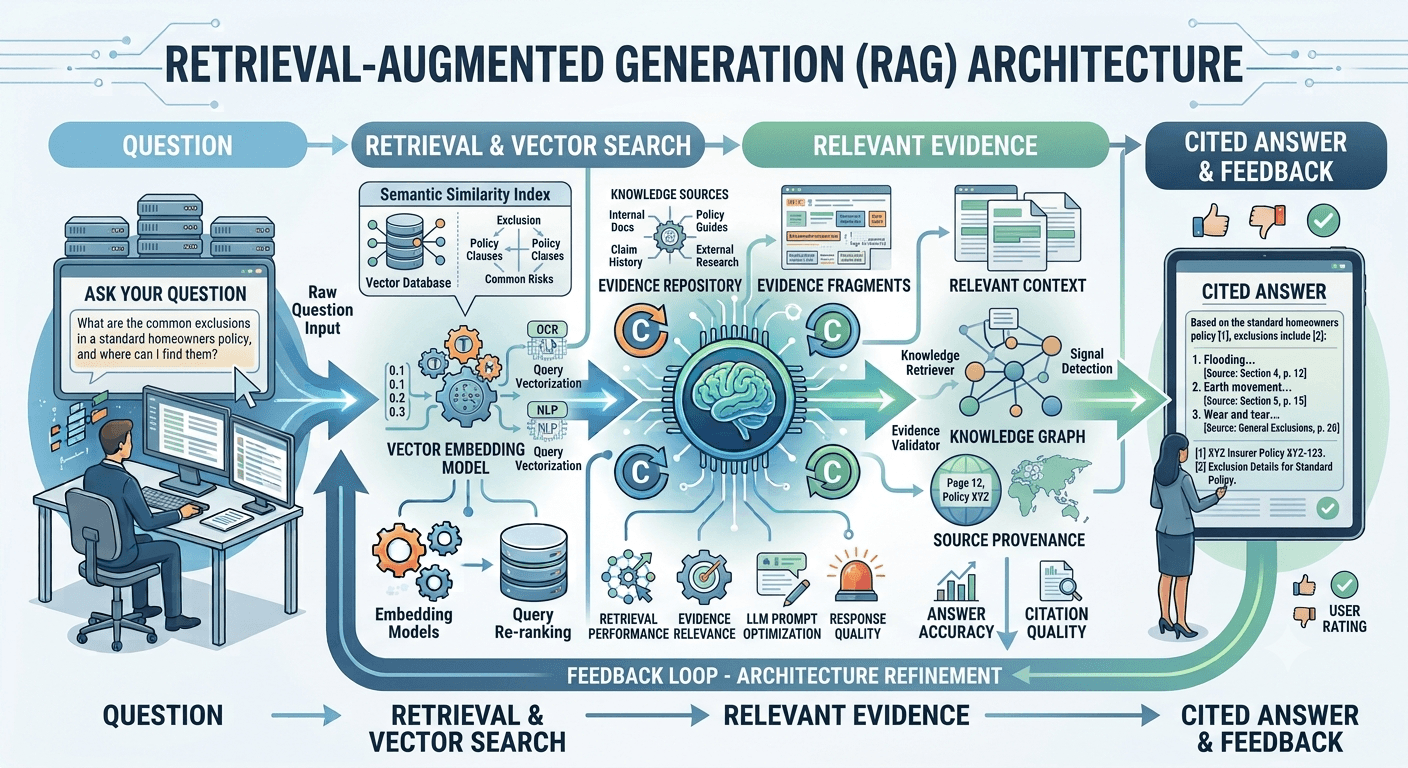
Retrieval-Augmented Generation, commonly called RAG, is a method for improving generative AI by connecting a large language model to trusted information outside the model. When a user asks a question, the system searches approved sources, retrieves the most relevant passages, places those passages into the model context, and instructs the model to answer using that evidence.
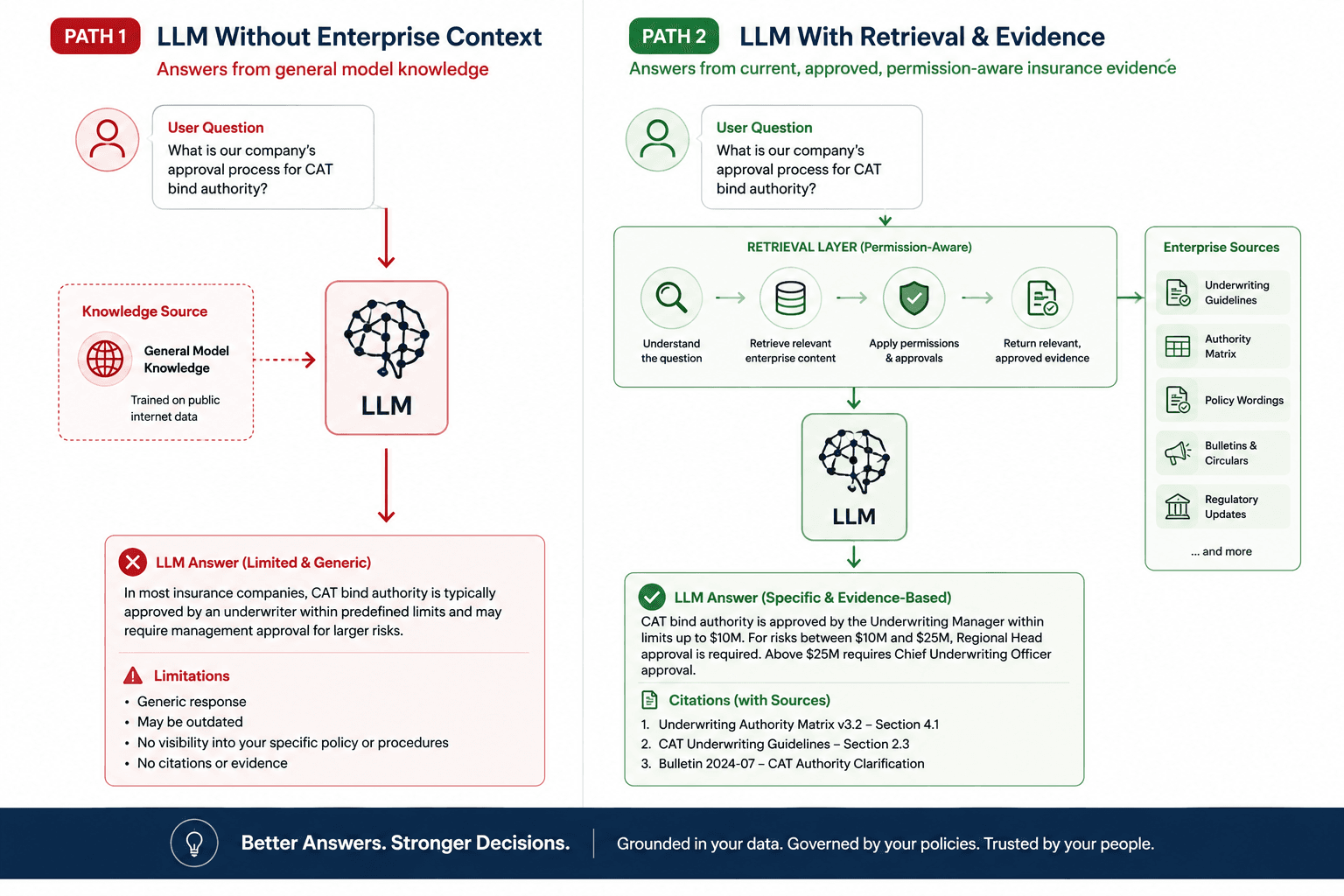
For P&C insurers, this approach addresses a central limitation of general-purpose language models: an LLM may be fluent but may not know the carrier’s current policies, claim-handling guidelines, underwriting appetite, product forms, jurisdictional procedures, customer-specific rules, or the contents of a particular claim file. RAG gives the model access to selected enterprise knowledge without requiring the organization to retrain the model every time a document changes.
RAG is especially useful in document-intensive workflows. It can help a claims professional locate relevant medical facts, summarize a demand package with citations, compare claim notes with handling guidelines, or find policy language. In underwriting, it can organize submission materials, retrieve appetite guidance, and build a source-linked risk summary. In management, it can answer questions across approved operational documentation and portfolio information.
RAG should not be treated as an automated decision-maker or as a guarantee of truth. Retrieval can miss relevant evidence, retrieve stale or conflicting information, or provide context that the model interprets incorrectly. Production use therefore requires content governance, permission-aware retrieval, validation, monitoring, source evidence, and professional review.
Quick Facts
| Topic | What to know |
|---|---|
| Full name | Retrieval-Augmented Generation |
| Primary purpose | Ground generative AI responses in retrieved external knowledge |
| Core components | Content sources, ingestion, chunking, embeddings or search index, retrieval, reranking, prompt assembly, LLM, citations, monitoring |
| Common insurance sources | Policies, endorsements, claim files, medical records, demand packages, underwriting manuals, appetite guides, loss-control reports, procedures, knowledge bases |
| Primary value | More relevant, contextual, and traceable generative AI outputs |
| Key risk | Incorrect, incomplete, stale, unauthorized, or poorly interpreted retrieved content |
| Human oversight | Required for material insurance decisions |
| RAG versus fine-tuning | RAG supplies knowledge at query time; fine-tuning changes model behavior or task performance through additional training |
| Success measures | Retrieval precision and recall, citation correctness, groundedness, answer quality, latency, cost, adoption, business outcomes |
Definitions
Executive definition
RAG is a way to make generative AI more useful for the enterprise by giving it relevant, approved information before it answers a question.
Technical definition
Retrieval-Augmented Generation is an architecture in which a retrieval system identifies relevant information from one or more external knowledge sources and supplies that information as context to a generative model. The model then produces an answer conditioned on both the user request and the retrieved evidence. A production architecture may use lexical search, vector similarity, hybrid retrieval, metadata filtering, reranking, query transformation, citation mapping, and validation.
Insurance definition
In insurance, RAG connects generative AI with approved policy, claim, underwriting, regulatory, operational, and customer-specific information so professionals can receive answers or summaries grounded in the evidence available for the task.
Plain-language definition
RAG lets an AI look up the right insurance information before it responds.
Plain-language definition
WHAT RAG IS NOT
RAG is not a database, a single model, a replacement for enterprise search, a substitute for data governance, or proof that an answer is correct. It is an orchestration pattern that combines retrieval with generation.
Why RAG Matters in Insurance
Insurance decisions depend on context. General knowledge is not enough. A useful answer may depend on the exact policy edition, jurisdiction, claim facts, effective date, underwriting authority, medical chronology, customer program, or internal handling standard. This information changes over time and is often distributed across systems and documents.
RAG creates a practical bridge between generative AI and this changing body of enterprise knowledge. Instead of expecting the model to memorize everything, the architecture retrieves the information needed for the current question. That distinction is central to safe and scalable insurance use.
- Claim files contain evolving evidence, not one static record.
- Policy meaning depends on forms, endorsements, exclusions, limits, and applicable facts.
- Underwriting appetite and authority can vary by product, geography, class, and effective period.
- Medical and legal documents contain time-sensitive, sometimes conflicting evidence.
- Operating procedures and regulatory requirements may change faster than an LLM can be retrained.
- Access rights differ by role, business unit, customer, claim, and jurisdiction.
How Retrieval-Augmented Generation Works
Prepare and govern content
The organization identifies authoritative sources, removes duplicates, applies retention and privacy controls, captures metadata, and determines who may access each item. Content quality problems should be addressed before indexing because retrieval will amplify whatever the knowledge base contains.
Break content into retrievable units
Documents are divided into chunks or passages that can be retrieved independently. Chunk size and boundaries matter. A chunk that is too small may lose context; a chunk that is too large may dilute relevance and consume unnecessary model context. Insurance documents often require structure-aware chunking by section, form, endorsement, medical encounter, claim note, or document type.
Create an index
The system creates a searchable representation of the content. This may include a traditional keyword index, vector embeddings that represent semantic meaning, or a hybrid index combining both. Metadata such as document type, policy form, jurisdiction, claim number, date, authority level, and source system enables more precise filtering.
Interpret the request
The system analyzes the user’s question, role, workflow, and available context. It may rewrite the query, identify entities, apply date or product filters, or split a complex question into subqueries. In insurance, the query may need to distinguish between a general procedural question and a request about a specific claim or policy.
Retrieve and rerank evidence
Candidate passages are retrieved and ranked for relevance. A reranker may then evaluate which passages best answer the question. Permission checks should occur before content reaches the model. Production systems may also require diversity, recency, authority, and conflict-handling rules rather than relying on similarity alone.
Assemble the prompt and context
The system packages the user request, retrieved passages, instructions, metadata, and output requirements into the model context. Good prompt assembly tells the model to rely on the provided evidence, identify uncertainty, avoid unsupported conclusions, and cite sources.
Generate, cite, and validate
The LLM creates a response using the retrieved context. The system maps statements back to sources, applies validation rules, and presents the answer for review. Depending on the workflow, it may require a professional to confirm the answer, open the source passages, or correct the result before it can be used.
Monitor and improve
Teams monitor retrieval quality, answer groundedness, citation accuracy, latency, cost, user behavior, and downstream outcomes. Failed or corrected answers become feedback for improving content, metadata, chunking, search, prompts, and workflow controls.
Core Components of an Insurance-Grade RAG Architecture
| Component | Role | Insurance design consideration |
|---|---|---|
| Source connectors | Access approved content | Support claims systems, policy repositories, document stores, data warehouses, underwriting platforms, knowledge bases, and secure APIs. |
| Ingestion pipeline | Extract and normalize content | Preserve document identity, page references, tables, effective dates, versions, and source-system lineage. |
| Document intelligence | Convert complex documents into usable text and structure | Handle scans, OCR, forms, handwriting, tables, medical records, and multi-document packages. |
| Metadata and taxonomy | Describe and filter content | Capture line of business, jurisdiction, policy form, claim, document type, authority, date, customer, and confidentiality. |
| Search index | Make content retrievable | Use lexical, semantic, or hybrid search appropriate to insurance terminology and exact references. |
| Retriever and reranker | Select the best evidence | Balance relevance with authority, date, coverage, diversity, and permission constraints. |
| LLM and prompt layer | Generate the response | Require evidence-based answers, uncertainty disclosure, structured output, and role-appropriate language. |
| Citation layer | Connect statements to sources | Provide document, page, section, note, date, and direct evidence where feasible. |
| Security and entitlement layer | Enforce access | Apply user, claim, customer, business-unit, and data-classification permissions before generation. |
| Evaluation and monitoring | Measure quality and risk | Track retrieval, groundedness, citations, omissions, latency, cost, corrections, and business outcomes. |
Retrieval Methods
Keyword or lexical retrieval
Lexical search finds exact words and phrases. It is useful for policy form numbers, statutory citations, claim numbers, medical codes, names, and precise insurance terminology. It may struggle when the user and source use different words for the same concept.
Semantic or vector retrieval
Semantic retrieval uses embeddings to find passages with similar meaning even when wording differs. It can connect “lawyer involved” with “letter of representation,” for example. It may, however, retrieve conceptually similar passages that are not authoritative or factually applicable.
Hybrid retrieval
Hybrid retrieval combines lexical and semantic methods. For many insurance use cases, this is stronger than either method alone because the workflow needs both exact references and conceptual similarity.
Metadata-filtered retrieval
Metadata filters narrow the search space by factors such as line of business, jurisdiction, policy edition, loss date, claim number, product, customer, or effective period. Filters are often essential to avoid retrieving plausible but inapplicable content.
Graph or relationship-aware retrieval
Some architectures use knowledge graphs or entity relationships to connect claims, parties, policies, providers, locations, and events. This can improve multi-hop questions, but it requires careful entity resolution and governance.
Graph or relationship-aware retrieval
CHARLEE.AI INSIGHT
The most accurate insurance RAG systems rarely depend on one retrieval technique. They combine semantic understanding, exact search, domain metadata, document structure, permissions, and workflow context.
RAG Across the P&C Insurance Value Chain
| Function | Example use | Human responsibility |
|---|---|---|
| FNOL and triage | Retrieve policy, loss, prior claim, and handling guidance to create an initial source-linked summary. | Confirm facts, coverage context, priority, assignment, and next action. |
| Claim investigation | Find relevant notes, reports, photographs, statements, and procedures for a specific issue. | Assess credibility, liability, evidence gaps, and investigative plan. |
| Medical review | Retrieve treatment events, diagnoses, prior conditions, and medical guidelines. | Evaluate causation, necessity, prognosis, and claim strategy. |
| Demand package review | Find damages, chronology, allegations, bills, and supporting documents. | Validate evidence, assess value, authority, and negotiation posture. |
| Coverage analysis support | Retrieve applicable forms, endorsements, and internal guidance. | Perform legal and coverage analysis; approve communications. |
| Litigation monitoring | Retrieve pleadings, events, deadlines, expert materials, and strategy notes. | Direct counsel, assess exposure, and make litigation decisions. |
| Underwriting submission review | Retrieve submission evidence, appetite guidance, prior experience, and risk controls. | Select risk, set terms, price, refer, or decline within authority. |
| Loss control | Retrieve recommendations, inspections, and industry guidance. | Determine recommendations, urgency, and account action. |
| Customer service | Retrieve policy and service information to draft an answer. | Confirm accuracy and communicate appropriately. |
| Management and audit | Retrieve evidence supporting operational questions and exceptions. | Interpret trends, confirm controls, and decide corrective action. |
Detailed Claims Scenario: Source-Grounded Demand Review
Situation
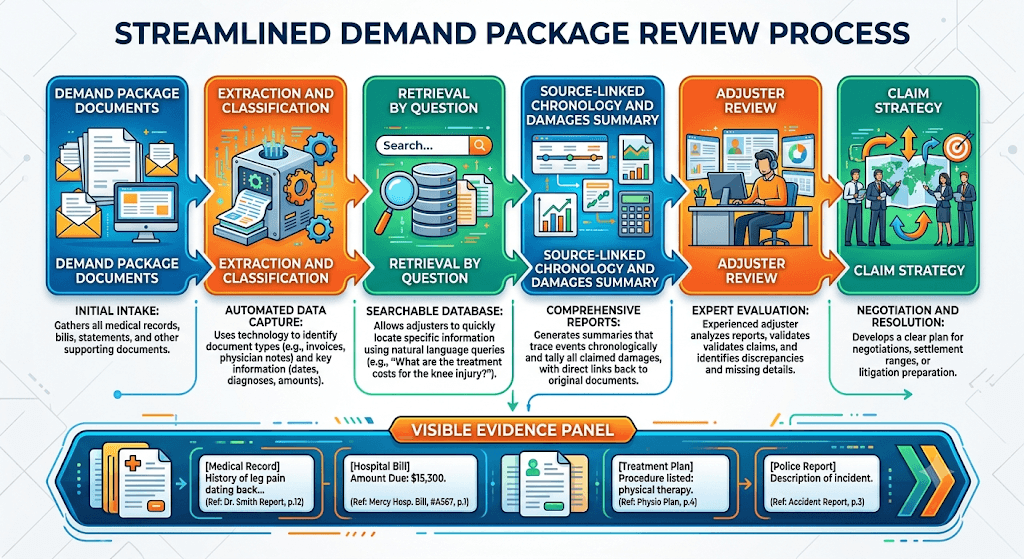
A bodily injury adjuster receives a 900-page demand package containing medical records, bills, wage documentation, photographs, correspondence, and a settlement demand. The package includes duplicate records, conflicting dates, and references to prior treatment.
Step 1: Ingestion and structure
Document intelligence classifies the files, extracts text and tables, identifies page boundaries, captures provider and service-date metadata, and links each passage to its source location. Duplicate documents are marked rather than silently discarded.
Step 2: Retrieval
The adjuster asks for a chronology of treatment after the loss, the evidence supporting wage loss, references to prior similar complaints, and the basis for the demand amount. The RAG system retrieves passages from medical records, bills, employer statements, and the demand letter using a combination of semantic search, date filters, and document-type filters.
Step 3: Generated work product
The system produces a structured summary with separate sections for liability allegations, treatment chronology, diagnoses, procedures, claimed damages, wage evidence, prior-condition references, missing records, and inconsistencies. Each material statement links to a page or source passage. Unsupported allegations are labeled as allegations rather than facts.
Step 4: Professional review
The adjuster opens the cited records, corrects a duplicated bill, notes that one diagnosis predates the accident, and identifies a gap in treatment. The adjuster then integrates liability, jurisdiction, credibility, policy limits, authority, negotiation strategy, and professional judgment. The RAG output accelerates review but does not establish value or determine settlement.
Operational value
The carrier can measure time to initial review, percentage of material statements with valid citations, correction rate, missed-document rate, adjuster adoption, time to strategy, and downstream claim outcomes. These measures are more meaningful than simply counting generated summaries.
Underwriting Scenario: Appetite and Submission Intelligence
A commercial property underwriter receives an application, statement of values, loss runs, inspection report, broker email, catastrophe model output, and engineering recommendations. The underwriter asks whether the submission fits current appetite and which unresolved issues require referral.
The RAG system retrieves account-specific evidence together with the current appetite guide, authority matrix, jurisdictional rules, and product guidance. It creates a risk summary that separates submission facts from internal guidance, cites both, and identifies missing information. The underwriter verifies construction, occupancy, protection, catastrophe exposure, loss history, valuations, and authority before deciding whether to quote, refer, modify terms, or decline.
CONTROL PRINCIPLE
Account evidence and internal guidance should be labeled separately. The system should not blur “what the submission says” with “what the carrier requires.”
RAG Versus Fine-Tuning
RAG and fine-tuning solve different problems. RAG is generally preferred when the primary requirement is to answer using current, private, or frequently changing information. Fine-tuning is useful when the organization needs the model to follow a specialized task, style, classification scheme, or output pattern more consistently.
| Question | RAG | Fine-tuning |
|---|---|---|
| Does it update factual knowledge quickly? | Yes, by updating the indexed sources. | Not directly; retraining is required. |
| Can it cite source evidence? | Yes, if designed to preserve citations. | Not inherently. |
| Does it change model behavior? | Mostly through context and prompts. | Yes, through additional training. |
| Does it handle private enterprise content? | Yes, with secure retrieval and permissions. | Possible, but requires careful training-data governance. |
| Can both be used together? | Yes. | Yes. A tuned model can operate within a RAG architecture. |
Benefits and Business Value
| Value area | Potential benefit | Suggested measure |
|---|---|---|
| Research efficiency | Less time locating and reading fragmented evidence. | Search time, review time, time to first strategy. |
| Consistency | More standardized access to approved knowledge and output structure. | Variance, completeness, template adherence, correction rate. |
| Traceability | Statements linked to evidence. | Citation coverage, citation correctness, evidence-open rate. |
| Knowledge access | Institutional knowledge available within workflow. | Adoption, successful query rate, escalation rate. |
| Decision support | Professionals receive relevant context earlier. | Time to action, referral quality, outcome metrics. |
| Onboarding | New professionals can find procedures and examples faster. | Time to proficiency, supervision needs, error rate. |
| Compliance support | Approved guidance can be retrieved consistently. | Use of current guidance, exception rate, audit findings. |
Value should be evaluated against a defined baseline. A polished answer is not itself a business outcome. Production programs should connect technical quality measures to operational measures and then to claim, underwriting, customer, compliance, or financial outcomes.
Risks and Failure Modes
| Failure mode | What can happen | Control response |
|---|---|---|
| Retrieval miss | Relevant evidence is not retrieved. | Improve indexing, metadata, query transformation, recall tests, and escalation behavior. |
| False relevance | Plausible but inapplicable content is retrieved. | Use reranking, authority rules, effective dates, jurisdiction and product filters. |
| Stale knowledge | Superseded guidance appears current. | Version control, effective dating, source ownership, expiration and reindexing. |
| Permission leakage | User receives content they should not access. | Pre-retrieval entitlement checks, tenant isolation, audit logs, red-team testing. |
| Citation mismatch | Citation does not support the statement. | Statement-level citation validation, user access to source passages, QA sampling. |
| Context conflict | Sources disagree. | Detect conflicts, present both, prioritize authority, and require review. |
| Hallucination | Model adds unsupported content. | Constrained prompts, evidence-only mode, abstention, verification, monitoring. |
| Overreliance | Professional accepts answer without review. | Workflow controls, training, visible uncertainty, required approvals. |
| Poor document extraction | OCR or structure errors corrupt evidence. | Document quality checks, confidence thresholds, original-image access. |
| Prompt injection | Malicious or irrelevant instructions embedded in documents manipulate output. | Content sanitization, instruction separation, policy filters, testing, least privilege. |
| Privacy exposure | Sensitive information enters logs or model context. | Data minimization, encryption, private deployment controls, retention and audit policies. |
| Model or vendor change | Behavior changes without business validation. | Change control, regression testing, versioning, rollback and approval. |
Governance and Responsible AI Controls
A production RAG program requires governance across content, technology, workflow, and people. The following controls should be explicit rather than assumed.
- Approved purpose and prohibited-use definitions for each workflow.
- Named owners for source content, taxonomy, retrieval configuration, prompts, models, and business outcomes.
- Content classification, retention, versioning, effective dating, and source-of-truth rules.
- Permission-aware retrieval and tenant or customer isolation.
- Evaluation sets that reflect real insurance terminology, documents, edge cases, and user roles.
- Citation and groundedness testing at statement level where practical.
- Human review requirements tied to risk and decision materiality.
- Logging, incident response, correction workflows, and controlled change management.
- Periodic testing for drift, stale content, access failures, prompt injection, and vendor/model changes.
- Clear communication that the output is decision support, not an independent professional conclusion.
RESPONSIBLE AI PRINCIPLE
Approved purpose and data -> validated retrieval -> explanation and source evidence -> professional review -> decision and documentation -> monitoring, feedback, incident response, and controlled change.
Evaluation: How to Know Whether RAG Works
Evaluation should separate retrieval quality from generation quality. A system can generate a strong answer from poor evidence or a poor answer from strong evidence. Testing both layers helps teams locate the actual failure.
| Measure | Question answered |
|---|---|
| Retrieval precision | How much of the retrieved content is relevant? |
| Retrieval recall | Did the system retrieve the material evidence needed to answer? |
| Reranking quality | Did the most useful passages appear first? |
| Groundedness | Are material statements supported by retrieved evidence? |
| Citation correctness | Does each citation actually support the related statement? |
| Completeness | Did the response address the important parts of the question? |
| Abstention quality | Does the system decline or qualify answers when evidence is insufficient? |
| Permission accuracy | Were only authorized sources considered? |
| Latency and cost | Is the experience operationally sustainable? |
| Business impact | Did the workflow improve speed, consistency, quality, or outcome? |
Evaluation sets should include normal cases, difficult cases, outdated documents, conflicting sources, ambiguous questions, negation, jurisdictional differences, missing evidence, unauthorized content, and adversarial or injected instructions. Business professionals should participate in defining acceptable performance.
Implementation Blueprint
Phase 1: Define the decision and workflow
Start with a bounded, high-value use case. Define the user, question types, source systems, expected output, professional decision, prohibited uses, and success measures.
Phase 2: Establish the knowledge foundation
Identify authoritative sources, owners, versions, permissions, quality problems, and update cadence. Create a taxonomy and metadata model that reflects insurance context.
Phase 3: Build and test retrieval
Test lexical, semantic, hybrid, and metadata-filtered approaches using representative questions. Evaluate both precision and recall before optimizing generated answers.
Phase 4: Design generation and evidence
Specify prompt rules, output structures, citations, uncertainty language, and abstention. Make original evidence easy to open from the answer.
Phase 5: Integrate human review
Place the capability inside the existing claim, underwriting, or management workflow. Define what the professional must verify and what actions require approval.
Phase 6: Pilot with controlled scope
Use a representative user group and compare results with baseline performance. Capture corrections, not just satisfaction scores.
Phase 7: Govern scale and change
Expand only after quality, access controls, ownership, monitoring, support, and business value are demonstrated. Treat changes to content, retrieval, prompts, models, and workflows as controlled production changes.
Best Practices
- Begin with authoritative, well-governed sources rather than indexing everything.
- Use hybrid retrieval and domain metadata for insurance terminology and exact references.
- Preserve document lineage, version, date, and page-level evidence.
- Apply permissions before retrieval and generation, not only in the user interface.
- Design for uncertainty, conflict, and abstention rather than forcing an answer.
- Keep generated work products separate from source records until reviewed and approved.
- Create evaluation sets with real documents, questions, and edge cases from the target workflow.
- Monitor user corrections and evidence-opening behavior as important feedback.
- Use deterministic rules where the requirement is deterministic; do not force every control into the LLM.
- Tie deployment to measurable business outcomes and professional accountability.
Common Mistakes to Avoid
- Assuming RAG eliminates hallucinations.
- Indexing stale, duplicate, draft, or unauthorized documents without source governance.
- Using semantic similarity without effective-date, jurisdiction, product, or authority filters.
- Treating a citation as valid without checking whether it supports the statement.
- Evaluating only the final prose and ignoring retrieval failures.
- Giving the model more context than necessary and diluting the evidence.
- Failing to distinguish claim facts, allegations, model inferences, and internal guidance.
- Deploying a chatbot outside the workflow instead of integrating the capability where work occurs.
- Using generic benchmarks that do not reflect insurance language or decisions.
- Scaling before establishing ownership, monitoring, incident response, and change control.
Executive Decision Guide
Questions to ask the business
- Which decision or work product will this improve?
- What is the current baseline for time, quality, consistency, and outcome?
- Which source is authoritative when information conflicts?
- What must the professional verify before use?
- What is the acceptable failure and escalation behavior?
Questions to ask technology and data teams
- How are documents parsed, chunked, indexed, versioned, and deleted?
- How are permissions enforced before retrieval?
- Which retrieval methods and metadata filters are used?
- How are citations generated and validated?
- How are model, prompt, index, and content changes tested and rolled back?
Questions to ask vendors
- Can the platform show retrieval evidence and citation mappings?
- How is customer data isolated, encrypted, retained, and excluded from general model training?
- What insurance-specific evaluation results can be demonstrated on representative data?
- How does the system handle conflicting, stale, incomplete, or unauthorized information?
- What operational monitoring, incident response, and audit evidence are available?
Deployment readiness test
| Ready when... | Not ready when... |
|---|---|
| The workflow, source owners, professional reviewer, and success measures are defined. | The project is framed only as “deploy a chatbot.” |
| Authoritative sources and permissions are known and tested. | The knowledge base contains uncontrolled drafts and duplicates. |
| Retrieval and citations perform acceptably on representative cases. | Evaluation relies on demos or generic benchmark questions. |
| The system can abstain, show uncertainty, and open source evidence. | The system always returns a confident answer. |
| Monitoring, incident response, and change control are operational. | Ownership after pilot is unclear. |
Charlee.ai Perspective
RAG is not valuable merely because it lets an LLM answer questions about documents. Its value comes from placing trusted evidence, source context, and professional review into an insurance workflow where timing and judgment matter.
In claims, the strongest architecture combines document intelligence, natural language processing, predictive analytics, and retrieval. Document intelligence makes complex records usable. NLP identifies insurance concepts and relationships. Predictive models identify risk or opportunity. RAG retrieves the evidence needed to explain and investigate those signals. Generative AI then organizes the information into a useful work product. The professional retains authority over the decision.
This people-plus-AI model is essential. A carrier should be able to understand what information was used, where it came from, why it was relevant, what remains uncertain, and who reviewed the output. The objective is not to produce more text. It is to help insurance professionals see the right information earlier and act with greater confidence.
CHARLEE.AI INSIGHT
A production RAG system should make it easier to inspect the evidence, not easier to hide it behind fluent language.
Common Myths and Misconceptions
| Myth | Reality |
|---|---|
| RAG eliminates hallucinations. | RAG can reduce unsupported answers, but retrieval and generation can still fail. |
| RAG means putting all documents into a vector database. | Production RAG also requires source governance, metadata, permissions, retrieval design, citations, evaluation, and workflow controls. |
| More retrieved content always improves accuracy. | Excess context can add noise, conflicts, cost, and attention dilution. |
| RAG replaces fine-tuning. | They address different needs and can be combined. |
| A cited answer is automatically correct. | The citation may be irrelevant, incomplete, or misunderstood. |
| RAG is only for chatbots. | It can support summaries, reports, work queues, document review, recommendations, and embedded workflow actions. |
| The LLM is the most important component. | For enterprise insurance use, content quality and retrieval design are often equally or more important. |
| RAG can make coverage or claim decisions autonomously. | It can support analysis, but material decisions require appropriate professional authority and review. |
Key Takeaways
- RAG connects generative AI with relevant external knowledge at the time of the request.
- It is particularly valuable in insurance because facts, forms, guidance, and claim evidence change and vary by context.
- RAG can improve relevance and traceability, but it does not guarantee accuracy or eliminate hallucinations.
- Content quality, metadata, permissions, retrieval design, and citations are as important as the LLM.
- Hybrid retrieval is often useful because insurance needs both exact references and semantic understanding.
- Production success requires evaluation of retrieval and generation separately.
- Human review remains essential for material claims, underwriting, coverage, legal, and financial decisions.
- The strongest implementations are embedded in workflows and measured by business outcomes, not answer fluency.
IN ONE SENTENCE
Retrieval-Augmented Generation is an architecture that retrieves relevant information from approved sources and supplies it to a generative AI model so the model can produce a more grounded, contextual, and traceable response.
Frequently Asked Questions
Retrieval-Augmented Generation. It refers to retrieving relevant external information and supplying it to a generative model before the model creates a response.
An LLM may not know current or private enterprise information. RAG gives it access to relevant approved knowledge at query time and can provide source evidence.
Not necessarily. In the standard pattern, documents are indexed for retrieval and selected passages are placed into the model context. They do not automatically become part of the model weights.
No. It can reduce them, especially when the model is constrained to evidence, but the system can still retrieve the wrong content or generate unsupported statements.
It is a system that stores and searches vector representations, often called embeddings, so content with similar meaning can be retrieved. A RAG system may use a vector database, but RAG is broader than the database.
Yes. Exact terms, form numbers, codes, names, citations, and claim identifiers are important in insurance. Hybrid retrieval often combines keyword and semantic methods.
Start with authoritative, bounded, high-value content for a defined workflow. Avoid indexing every available document before ownership, permissions, versioning, and quality are established.
The retrieval layer should enforce the user’s permissions before content is sent to the model. Interface-level hiding is not sufficient.
The organization updates, reindexes, versions, or removes source content. Effective dating and source ownership are essential so the system does not treat superseded guidance as current.
Yes, provided documents and structured data are securely ingested, permissions are enforced, evidence is preserved, and outputs are reviewed within the claim workflow.
It can retrieve and organize potentially relevant policy forms and endorsements, but legal and coverage conclusions require qualified professional review and the applicable facts and law.
Chunking divides documents into retrievable units. Good chunking preserves enough context for meaning while keeping passages focused and traceable.
Reranking uses an additional method or model to reorder retrieved candidates so the passages most useful for the question appear first.
Measure retrieval precision and recall, groundedness, citation correctness, completeness, abstention, permissions, latency, cost, user corrections, and business outcomes.
RAG can support information gathering and analysis, but automated decisions require separate legal, regulatory, risk, governance, and control assessment. Material insurance decisions should retain appropriate human authority.
Yes. A system can retrieve from databases, APIs, data warehouses, knowledge graphs, and documents. Structured values should retain source, date, and business meaning.
A long-context model can receive a large body of content directly. RAG selects the most relevant evidence first, which may reduce cost and noise and improve traceability. The approaches can also be combined.
Treating RAG as a model demo rather than an enterprise information and workflow capability. Weak content governance, permissions, evaluation, and professional review can undermine otherwise strong technology.