Executive Snapshot
In one sentence Natural language processing converts human language into structured, searchable, and evidence-linked information that supports insurance workflows and professional decisions.
| Business problem | NLP capability | Insurance workflow | Business outcome |
|---|---|---|---|
| Critical facts are buried in documents | Entity extraction, classification, summarization | Claims, underwriting, litigation, medical review | Earlier insight and less manual review |
| Language varies across people and systems | Normalization and semantic analysis | Data quality, reporting, integration | More consistent analytics and routing |
| Teams cannot read every file immediately | Event detection and prioritization | Triage and exception management | Faster attention to important developments |
What executives should know
- NLP is the language-understanding layer behind many insurance AI applications.
- It is valuable because much of insurance information is unstructured.
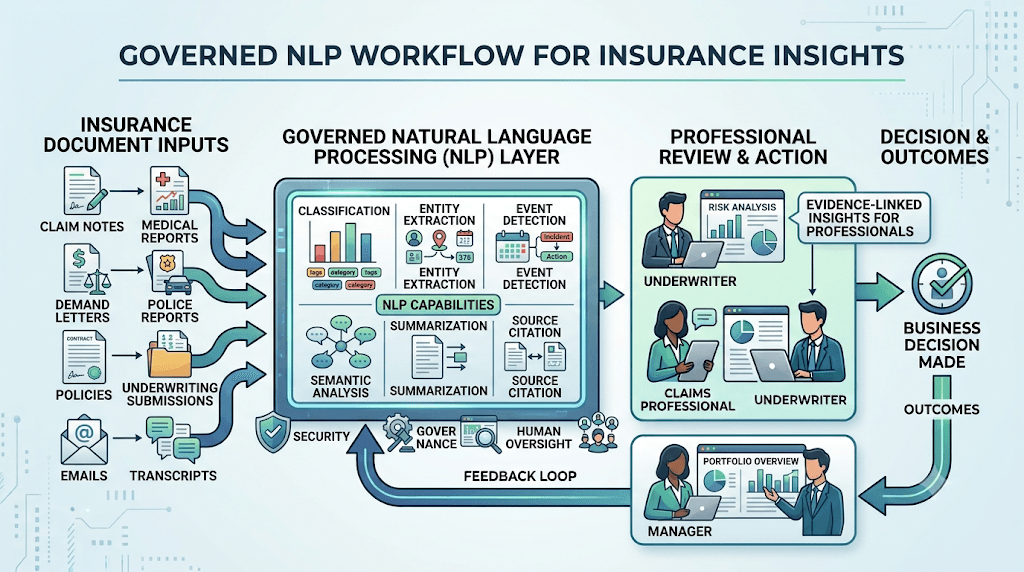
- Outputs should be linked to source evidence and reviewed in context.
- Performance depends on domain terminology, document quality, data governance, and workflow design.
- NLP and large language models overlap, but they are not the same.
Executive decision point
The key question is not whether an NLP model can process text. It is whether the model can reliably identify the insurance-specific facts, relationships, changes, and evidence that matter in a defined workflow.
Executive Summary
Natural Language Processing, or NLP, is the field of artificial intelligence focused on enabling computers to work with human language. It includes methods for reading text, identifying meaning, extracting facts, classifying content, detecting relationships, generating summaries, and supporting questions and answers.
For P&C insurers, NLP addresses a fundamental operating challenge: important information is often embedded in unstructured language rather than clean database fields. Claim notes, medical records, demand packages, police reports, legal correspondence, policy forms, inspection reports, underwriting narratives, emails, and recorded conversations can contain decisive signals that are difficult to capture consistently at scale.
NLP turns this language into usable intelligence. It can identify parties, injuries, treatments, attorney involvement, liability facts, policy provisions, dates, monetary amounts, locations, causes of loss, changes in condition, and other concepts. It can also organize documents, create summaries, compare statements, and highlight developments that warrant professional review.
NLP does not make insurance decisions by itself. It provides structured information and language-based insight that professionals can validate and apply. Strong implementations combine insurance-domain models, source evidence, workflow integration, model governance, and human oversight.
Charlee.ai Insight Language is where many claims begin to change. A new diagnosis, attorney notice, surgery recommendation, demand, policy interpretation, or reserve rationale may first appear in a document or note. NLP helps surface those changes while there is still time to act.
Quick Facts
| Topic | Summary |
|---|---|
| Full name | Natural Language Processing |
| Abbreviation | NLP |
| Primary purpose | Enable computer systems to analyze, understand, organize, and generate human language |
| Core insurance data | Claim notes, documents, policies, medical records, legal correspondence, submissions, emails, transcripts |
| Common outputs | Extracted entities, classifications, summaries, timelines, topics, relationships, alerts |
| Human oversight | Required for material interpretations and decisions |
| Related technologies | Machine learning, deep learning, transformers, LLMs, RAG, embeddings, document intelligence |
| Primary risk | Misinterpreting context, terminology, negation, ambiguity, or incomplete evidence |
Definitions
Executive definition
Natural Language Processing is the use of artificial intelligence to convert human language into information that can be searched, organized, analyzed, summarized, and used to support business decisions.
Technical definition
NLP combines computational linguistics, machine learning, statistics, and software engineering. Systems transform text or speech into representations used for tokenization, named-entity recognition, classification, semantic similarity, relation extraction, summarization, question answering, and text generation.
Insurance definition
In P&C insurance, NLP identifies and interprets insurance-relevant information in unstructured content and connects it to workflows such as triage, severity review, reserve monitoring, litigation management, fraud detection, subrogation, and risk selection.
Plain-language definition
NLP helps a computer read insurance language and turn it into organized facts and useful signals.
Why NLP Matters in Insurance
Insurance operations depend on language. Even highly structured platforms contain free text, attachments, scanned records, correspondence, and narrative explanations. These materials often provide context that structured fields cannot capture.
Without NLP, organizations rely heavily on manual reading, keyword search, and inconsistent interpretation. NLP creates a more scalable and repeatable approach while preserving access to the source material.
- A claim system may record a generic injury code while a medical report describes worsening neurological symptoms.
- A reserve field may show an amount without explaining the reasoning or new evidence behind a change.
- An underwriting submission may contain risk-control details in attachments rather than standardized fields.
- A demand letter may contain allegations, damages, deadlines, and settlement posture spread across dozens of pages.
- A police report may describe liability facts that are not reflected in a dropdown field.
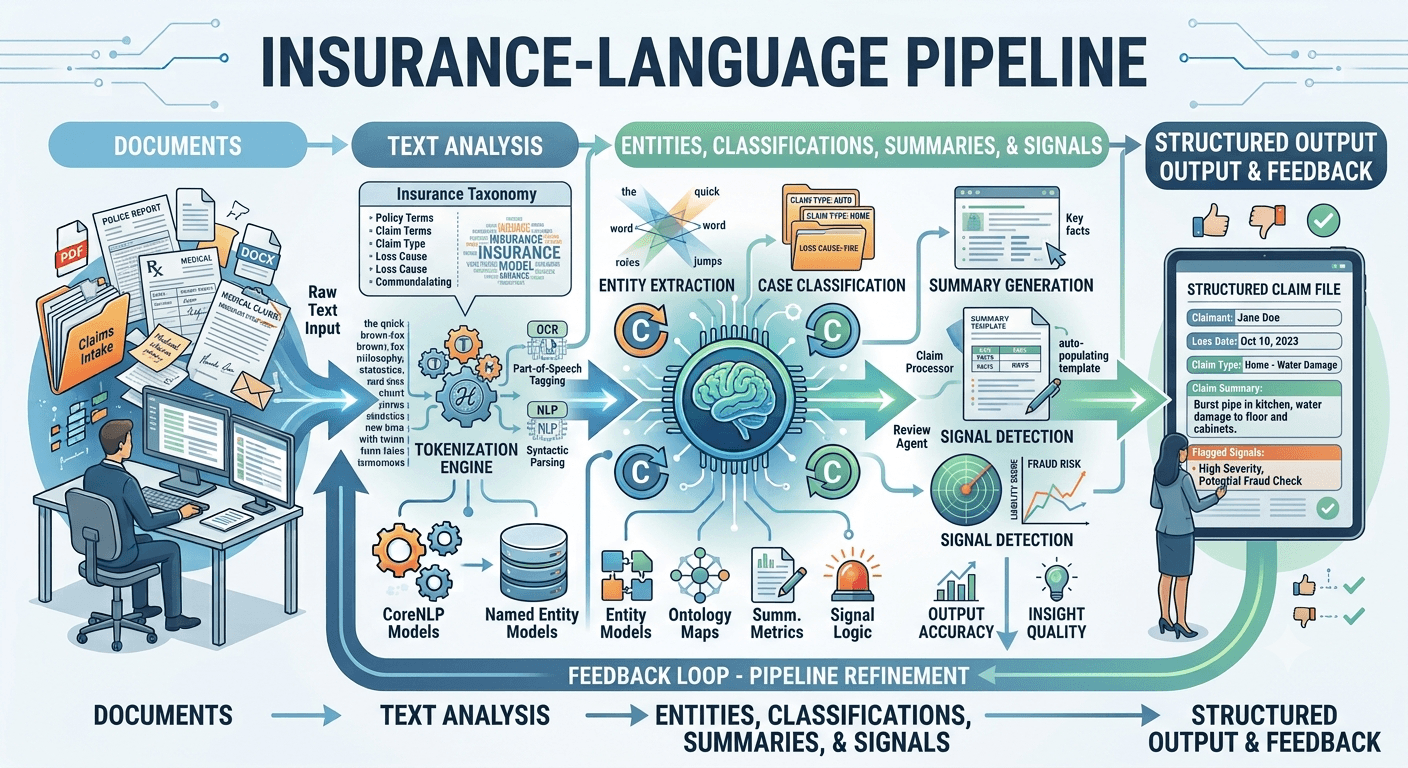
How Natural Language Processing Works
| Stage | What happens | Insurance example |
|---|---|---|
| 1. Ingest | Text is obtained from documents, notes, email, transcripts, or OCR output. | Import a demand package and associated claim notes. |
| 2. Prepare | Language is cleaned, segmented, normalized, and associated with metadata. | Separate pages, dates, document types, and authors. |
| 3. Represent | Words and passages are converted into features or embeddings. | Represent “lumbar fusion recommended” in context. |
| 4. Analyze | Models perform extraction, classification, similarity, summarization, or relation detection. | Identify surgery, attorney, diagnosis, and treatment escalation. |
| 5. Validate | Results are checked against labeled data, source evidence, and business expectations. | Measure whether attorney and surgery events were correctly found. |
| 6. Deliver | Outputs appear in a workflow, dashboard, alert, or API. | Show an adjuster a cited treatment chronology. |
| 7. Monitor | Accuracy, drift, exceptions, and user feedback are reviewed. | Track performance as terminology and formats change. |
Core NLP tasks
| Task | Purpose | P&C example |
|---|---|---|
| Document classification | Determine document type or purpose. | Demand letter, medical record, police report, or policy endorsement. |
| Named-entity recognition | Identify people, dates, amounts, treatments, and other entities. | Claimant, provider, attorney, surgery date, and demand amount. |
| Relation extraction | Identify how facts are connected. | Link a diagnosis to a provider, date, body part, and recommendation. |
| Event detection | Identify meaningful developments. | Attorney representation, surgery recommendation, denial, or demand. |
| Text classification | Assign a category or score. | Classify claim notes by severity or litigation relevance. |
| Summarization | Condense lengthy material. | Produce a medical chronology and claim summary. |
| Semantic search | Retrieve by meaning rather than exact words. | Find loss-of-earning-capacity discussion despite varied terminology. |
| Question answering | Answer using designated sources. | Find where a prior injury is documented and cite the page. |
| Language generation | Create draft text from approved information. | Draft a claim status summary for review. |
Language Challenges Unique to Insurance
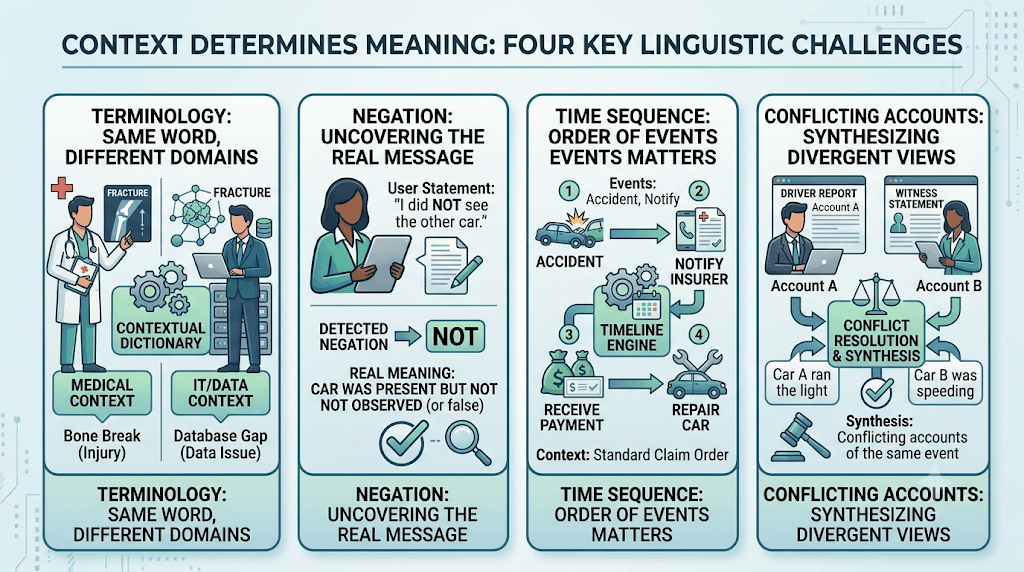
Domain terminology
Terms such as limits, attachment point, compensability, reservation of rights, special damages, indemnity, IME, and SIU have specialized meanings. General-language models need domain context and evaluation.
Negation and uncertainty
The difference between “fracture identified,” “no fracture identified,” and “cannot rule out fracture” is operationally significant.
Temporal context
A condition may predate the loss, appear later, improve, worsen, or be newly alleged. Accurate timelines require more than isolated dates.
Multiple voices and conflicting accounts
Claimants, witnesses, providers, attorneys, adjusters, and experts may describe the same event differently. NLP should preserve attribution.
Document quality
Scans, handwriting, fax artifacts, tables, and poor OCR can reduce accuracy. Document intelligence is often a prerequisite.
NLP Across the P&C Insurance Value Chain
| Function | NLP application | Professional use |
|---|---|---|
| FNOL | Extract loss facts, parties, injuries, vehicles, locations, and initial severity signals. | Improve intake, routing, and triage. |
| Claims | Summarize files, detect changes, build timelines, and compare new information. | Focus adjuster attention and support file review. |
| Medical review | Identify diagnoses, procedures, treatment progression, restrictions, and gaps. | Support clinical and severity evaluation. |
| Litigation | Detect attorney involvement, allegations, deadlines, venue, experts, and demand posture. | Support litigation monitoring and strategy. |
| Reserving | Identify new exposure facts and rationale in notes or reports. | Inform reserve review; professionals retain authority. |
| Fraud/SIU | Detect inconsistencies, repeated narratives, suspicious relationships, and anomaly indicators. | Prioritize investigative review. |
| Subrogation | Identify third parties, contracts, product involvement, or recovery indicators. | Preserve recovery opportunities earlier. |
| Underwriting | Extract risk attributes, summarize submissions, compare documents, and identify missing information. | Accelerate assessment and referral preparation. |
| Policy/service | Retrieve policy language, endorsements, and correspondence. | Support faster research and response drafting. |
| Management | Aggregate themes, emerging issues, and operational trends from narrative data. | Improve portfolio and workforce visibility. |
Detailed Claims Scenario: From Documents to Action
Day 1: Initial report
A commercial auto bodily injury claim is reported after a rear-end collision. NLP extracts parties, vehicles, location, initial treatment, and liability narrative from the police report and FNOL notes.
Day 10: New medical information
A chiropractic record notes persistent symptoms. The system identifies treatment frequency and body parts but does not treat the language as proof of severity. It updates the chronology and links facts to the source.
Day 28: Escalation signal
An MRI report references a disc herniation and specialist consultation. NLP identifies diagnosis, modality, date, and recommended next step. The claim receives a review prompt because the treatment path changed.
Day 41: Attorney involvement
A representation letter arrives. NLP classifies it, extracts attorney details, identifies scope, and alerts the adjuster while preserving the letter for review.
Day 75: Demand package
A large package includes medical records, wage documentation, photographs, and a settlement demand. NLP creates a source-linked chronology, extracts asserted damages, identifies inconsistencies, and summarizes treatment escalation.
Professional decision
The adjuster reviews the evidence, liability, policy limits, damages, jurisdiction, and negotiation posture. NLP reduces organizational burden, but the adjuster determines strategy and authority.
Professional decision
Case-study lesson The value of NLP is not simply faster reading. It is the ability to organize changing language into an evidence-based view of the claim while maintaining professional judgment and source transparency.
Underwriting Scenario: Submission Intelligence
A commercial property submission includes an application, schedules, loss runs, inspection reports, broker emails, and engineering attachments. NLP classifies documents, extracts construction and occupancy details, identifies protective safeguards, summarizes loss history, and flags conflicting values. The underwriter reviews the findings, requests missing information, applies appetite and pricing guidance, and retains authority over risk selection and terms.
NLP, LLMs, Generative AI, and Document Intelligence
| Technology | Primary role | Relationship to NLP |
|---|---|---|
| NLP | Analyze and work with human language. | The broad field that includes extraction, classification, semantic analysis, summarization, and generation. |
| Large Language Model | Model language patterns across large datasets. | A modern class of model used for many NLP tasks. |
| Generative AI | Create summaries, answers, and drafts. | Uses language generation, often built on LLMs and governed workflows. |
| Document Intelligence | Convert complex documents into usable information. | Combines OCR, layout understanding, classification, extraction, and NLP. |
| RAG | Ground generated responses in retrieved enterprise sources. | Adds retrieval and source context to LLM-based NLP applications. |
| Predictive AI | Estimate future outcomes or risk. | Can use NLP-derived features from documents and notes. |
Traditional NLP and Modern Transformer-Based NLP
| Approach | Strengths | Limitations | Typical use |
|---|---|---|---|
| Rules and dictionaries | Transparent and precise for stable terminology. | Brittle, labor-intensive, weak with variation. | Controlled vocabularies and simple event detection. |
| Classical machine learning | Efficient and measurable for focused classification. | Requires labeled examples and has limited context. | Document routing and topic classification. |
| Deep learning | Learns complex patterns and context. | Needs more data and governance. | Entity extraction and semantic similarity. |
| Transformers and LLMs | Strong context and flexible across tasks. | Can hallucinate and require grounding and cost controls. | Summarization, Q&A, extraction, search, and drafting. |
Business Benefits and Measures
| Value area | Potential measure |
|---|---|
| Document productivity | Minutes saved per document, file, submission, or review cycle |
| Triage effectiveness | Time to identify high-priority events; precision and recall of alerts |
| Information quality | Completeness and accuracy of extracted facts |
| Claims management | Time to attorney identification, treatment escalation, demand review, or reserve review |
| Underwriting | Submission turnaround time and missing-information detection |
| User adoption | Usage, acceptance, corrections, and professional satisfaction |
| Risk control | Citation coverage, exception rate, quality findings, and privacy incidents |
| Financial impact | Expense reduction, leakage prevention, improved recoveries, or avoided adverse development |
Risks, Limitations, and Governance
Misinterpretation
Models may misread context, negation, attribution, or temporal relationships. Material outputs should be reviewable against source evidence.
Hallucination
Generative systems may produce unsupported statements. Retrieval, constrained prompting, citations, validation, and human review reduce risk.
Bias and uneven performance
Results may differ by document type, jurisdiction, language, demographic context, or line of business. Testing should reflect the actual use case.
Privacy and security
Insurance documents contain sensitive personal, medical, legal, and financial information. Access controls, encryption, retention limits, and vendor oversight are essential.
Model and language drift
Terminology, formats, legal language, and practices evolve. Monitoring and controlled change are required.
Automation bias
Users may give undue weight to polished summaries or scores. Training and workflow design should reinforce that AI output supports—not replaces—judgment.
Recommended governance loop
Approved purpose and data -> validated NLP analysis -> explanation and source evidence -> professional review -> decision and documentation -> monitoring, feedback, incident response, and controlled change.
Best Practices
- Start with a specific business problem and clearly defined decision-support role.
- Use insurance-domain terminology, representative documents, and subject-matter experts.
- Preserve document identity, authorship, dates, and source location.
- Measure technical performance separately from business impact.
- Use confidence thresholds and route uncertain results for review.
- Ground summaries and answers in approved source material.
- Let professionals inspect, correct, and provide feedback.
- Test negation, history, conflicting accounts, and time sequence.
- Monitor performance by document type, line of business, and use case.
- Document governance, model versions, limitations, and change controls.
Common Mistakes to Avoid
- Ignoring layout, tables, and metadata by treating every document as plain text.
- Using a general-language model without insurance-domain evaluation.
- Measuring success only with technical accuracy scores.
- Presenting summaries without citations or source access.
- Automating material decisions without professional review.
- Failing to test poor scans, uncommon terminology, and exceptions.
- Assuming one model performs equally across every line of business.
- Ignoring privacy, retention, and third-party model requirements.
- Failing to capture corrections and operational feedback.
Executive Decision Guide
Business questions
- Which language-intensive workflow creates the greatest delay, inconsistency, or risk?
- What decision or action will the output support?
- What is the cost of a missed event, false alert, or incorrect summary?
- How will value be measured after deployment?
Technology and data questions
- Which documents, notes, transcripts, and metadata are required?
- How is OCR quality measured and handled?
- Is the solution adapted for insurance terminology?
- Can it preserve time sequence, negation, attribution, and uncertainty?
- Can every material output link to source evidence?
Governance questions
- Where is human review required?
- How are sensitive data and model access controlled?
- How are errors, incidents, and corrections recorded?
- How is performance monitored across populations and document types?
- Who approves model changes and expanded use cases?
Vendor evaluation questions
- What insurance use cases and document types are supported in production?
- What performance metrics are available from representative data?
- How does the platform handle private enterprise data?
- What evidence, explanations, and confidence indicators are shown?
- How does the platform integrate with core systems and repositories?
- What controls exist for model versions, prompts, retrieval, and audit history?
Charlee.ai Perspective
NLP is foundational to claims intelligence because important developments are often expressed in language before they are represented in structured fields. Effective NLP should identify those developments, connect them to claim context, and present them with evidence that a professional can review.
The goal is not to replace adjusters, underwriters, managers, or other insurance professionals. The goal is to help them see the right information sooner, understand why it matters, and act with greater consistency and confidence.
Charlee.ai combines language understanding with document intelligence, predictive analysis, explainability, and human review. This people-plus-AI approach supports practical adoption while preserving professional authority and governance.
Charlee.ai Insight NLP becomes business intelligence only when language is connected to insurance context, evidence, workflow, and accountable human decision-making.
Key Takeaways
- NLP is the language-understanding field within artificial intelligence.
- It is essential because critical insurance information is embedded in documents, notes, and correspondence.
- Core tasks include classification, extraction, event detection, relation extraction, semantic search, summarization, and question answering.
- Insurance NLP must handle terminology, negation, time sequence, uncertainty, attribution, and conflicting accounts.
- LLMs are powerful NLP tools, but they require grounding, governance, security, and human review.
- The greatest value comes from embedding evidence-linked NLP into claims, underwriting, and management workflows.
- NLP should augment professional judgment, not replace it.
In one sentence Natural language processing converts human language into structured, searchable, and evidence-linked information that supports insurance workflows and professional decisions.
Frequently Asked Questions
NLP is a field within AI. AI is broader; NLP focuses on human language.
No. NLP includes many methods and tasks. An LLM is one modern type of model used for NLP.
Claim notes, medical records, demand letters, police reports, legal correspondence, policies, inspection reports, submissions, emails, and transcripts.
It generally requires text. Scans first need OCR and quality processing; poor scans reduce accuracy.
Yes, when models, vocabularies, data, and evaluation are appropriate for the medical and insurance context.
Yes. It can classify representation letters, extract attorney details, and identify related language, with source evidence.
It can identify severity-related facts and feed predictive models. Final assessment requires broader context and professional judgment.
No. It reduces burden and prioritizes information, but professionals should review sources for material decisions.
Accuracy varies by task, data quality, terminology, document type, and model. It must be measured for the production use case.
It retrieves information based on meaning and context rather than exact keywords.
It identifies entities such as people, organizations, dates, locations, amounts, diagnoses, treatments, and policy references.
It identifies how entities are connected, such as a treatment performed by a provider on a date for an injury.
Use approved sources, retrieval, constrained prompts, citations, validation, thresholds, and human review.
Some tasks can run during intake or as documents arrive, depending on integration, volume, and latency.
Choose a bounded workflow, define success, use representative documents, involve experts, establish governance, and pilot with human review.