AI MODEL DRIFT
AI model drift is a material change in the relationship between an AI system, its inputs, its operating environment, and the outcomes it is expected to support. Drift can reduce accuracy, calibration, fairness, reliability, and business usefulness over time.
Performance Change • Data Shift • Monitoring • Revalidation • Controlled Response
EXECUTIVE OVERVIEW
Executive Snapshot
Executive Definition
AI model drift is a material change in the relationship between an AI system, its inputs, its operating environment, and the outcomes it is expected to support. Drift can reduce accuracy, calibration, fairness, reliability, and business value even when the model itself has not been changed.
| Dimension | Executive takeaway |
|---|---|
| Primary concern | A model that performed acceptably at deployment may become less reliable as claim patterns, legal environments, medical practices, repair costs, customer behavior, products, or workflows change. |
| Insurance relevance | Drift may affect severity prediction, litigation prediction, fraud referral, underwriting triage, document extraction, claim summarization, and portfolio monitoring. |
| Management principle | Production approval is not permanent. Performance must be monitored against current data, current workflows, and current business outcomes. |
| Human role | Insurance professionals must be able to see evidence, challenge outputs, report anomalies, and retain authority over consequential decisions. |
| Success measure | Drift is detected early, investigated accurately, contained proportionately, and corrected without losing traceability or operational control. |
Executive Summary
AI systems operate in changing environments. A predictive model may encounter new claim populations, altered attorney behavior, emerging medical treatments, inflation, catastrophe patterns, revised underwriting appetite, or changes in data capture. A generative AI system may retrieve different sources, receive new document formats, use an updated model service, or be embedded in a redesigned workflow. These changes can gradually or suddenly weaken the connection between past validation and current performance.
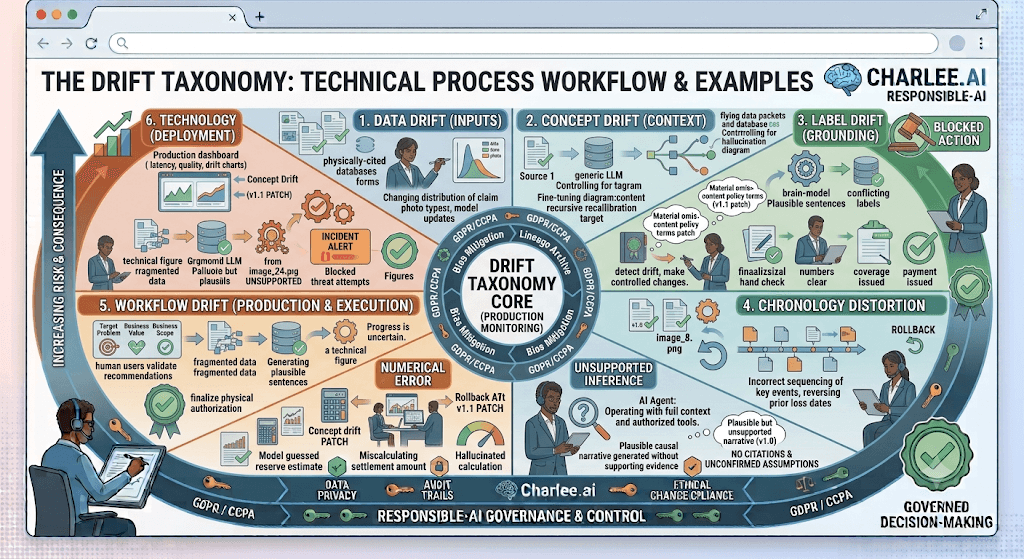
Drift is not one problem. Data drift describes changes in input distributions. Concept drift describes changes in the relationship between inputs and outcomes. Label drift changes the frequency or definition of outcomes. Operational drift arises when users, workflows, integrations, thresholds, or business rules change. Model or vendor changes may also create performance shifts that resemble drift.
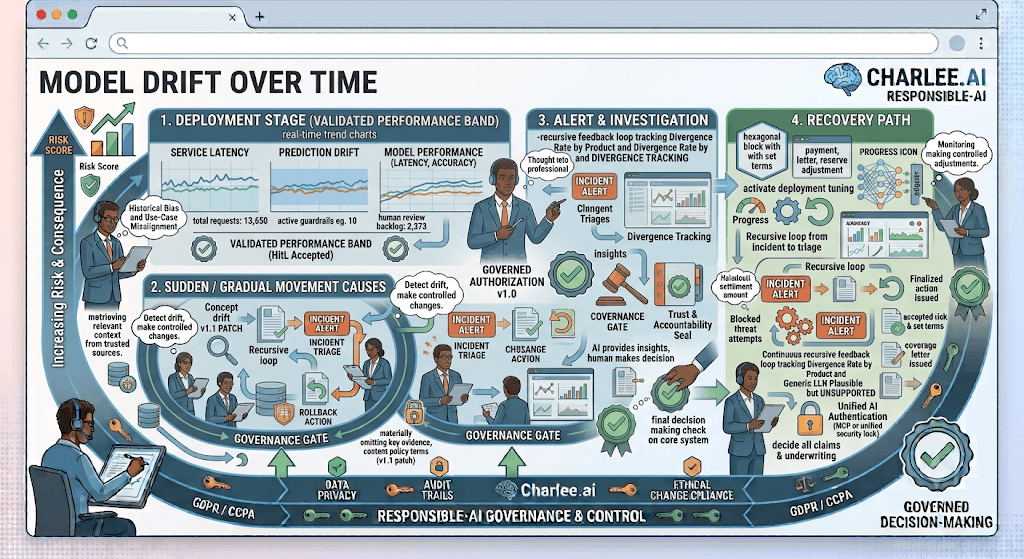
The governance objective is not to stop all change. It is to maintain evidence that the system remains fit for its approved purpose. Insurers should monitor leading indicators, outcome metrics, segment performance, overrides, complaints, and operational behavior; investigate root cause; and use proportionate responses such as threshold changes, retraining, workflow redesign, temporary restrictions, rollback, or retirement.
Quick Facts
- Drift can occur without any code or model change.
- Accuracy may remain stable overall while deteriorating for a jurisdiction, line of business, claimant segment, document type, or claim age band.
- Performance drift, fairness drift, data-quality deterioration, and workflow change may occur together.
- Generative AI requires monitoring of retrieval quality, citation accuracy, unsupported output, abstention, prompt changes, and user reliance—not only model accuracy.
- User overrides, corrections, escalations, and near misses are important drift signals.
- Material changes should trigger revalidation against the approved population and business purpose.
Definitions and Scope
Executive Definition
AI model drift is the decline or change in an AI system’s performance, reliability, or business suitability as the data, environment, outcomes, users, or workflow evolve after validation and deployment.
Technical Definition
Model drift is a production-state change in statistical distributions, conditional relationships, label prevalence, feature behavior, model calibration, retrieval behavior, prompt-response behavior, or downstream workflow outcomes that causes measured or latent performance to diverge from the validated baseline.
Insurance Definition
In P&C insurance, model drift occurs when an AI system no longer performs as expected for the claims, underwriting, policy, fraud, document, or management workflow it supports. It can result from changing loss costs, litigation environments, treatment patterns, weather, customer behavior, portfolio mix, data practices, vendor components, or professional workflows.
Insurance Definition
| Concept | Primary question | Insurance example |
|---|---|---|
| Data drift | Have the inputs changed? | A larger share of claims arrives through a new digital FNOL channel with different field completion patterns. |
| Concept drift | Has the relationship between signals and outcomes changed? | Attorney representation no longer predicts litigation in the same way after legal or operational changes. |
| Label drift | Has outcome prevalence or definition changed? | The rate or coding definition of severe claims changes after reserve or closure practices are revised. |
| Performance drift | Have task results deteriorated? | Severity calibration weakens even though the model continues to produce scores. |
| Fairness drift | Have error or outcome differences changed across groups? | False-positive referral rates increase in a region or customer segment. |
| Operational drift | Has the workflow changed around the model? | Users begin treating a prioritization score as a decision instead of an attention signal. |
| Vendor/model change | Did an external component change? | A hosted LLM, embedding model, OCR engine, or data service is updated. |
Insurance Definition
KEY DISTINCTION
Drift is change relative to an approved baseline. A model can be weak from the start without drifting, and a drifting model can still appear accurate if monitoring is too broad, delayed, or disconnected from business outcomes.
Why Model Drift Matters in P&C Insurance
Insurance risk is time-dependent. Claim development, medical costs, repair technology, attorney strategies, social inflation, catastrophe conditions, underwriting appetite, portfolio mix, and regulatory expectations change. AI systems trained on past relationships may therefore become less reliable even when they remain technically available.
| Insurance reality | Drift implication |
|---|---|
| Claims develop over months or years. | Validation and monitoring must account for delayed outcomes, claim maturity, and changing evidence. |
| Loss costs and treatment patterns evolve. | Severity and reserve-support models require time-aware calibration and segmented monitoring. |
| Legal and venue conditions change. | Litigation signals, attorney effects, and settlement patterns may shift by jurisdiction. |
| Catastrophes alter data and workflow. | Volume, document quality, inspection patterns, and operational shortcuts can move outside normal baselines. |
| Underwriting strategy changes. | New products, appetite rules, brokers, geographies, or risk classes may create unseen populations. |
| Vendor services change. | Externally hosted models, data, and APIs may change behavior outside the insurer’s release cycle. |
EXECUTIVE INSIGHT
The central question is not whether a model has changed. It is whether the complete AI-enabled workflow still produces reliable, fair, explainable, secure, and valuable results for its current purpose.
DRIFT TAXONOMY
Types of Drift
| Drift type | What changes | Illustrative P&C example | Typical response |
|---|---|---|---|
| Covariate / feature drift | Distribution of model inputs. | Vehicle technology, medical billing codes, claim intake fields, or portfolio geography shifts. | Investigate representativeness, feature validity, calibration, and retraining need. |
| Concept drift | Relationship between inputs and target outcome. | Prior indicators of litigation or severity become less predictive. | Re-estimate relationships, reassess features, thresholds, and workflow use. |
| Prior / label drift | Outcome prevalence. | Severe-claim frequency, fraud referrals, or declination rates change. | Recalibrate probabilities and check for coding or process changes. |
| Data-quality drift | Completeness, accuracy, timeliness, or lineage. | New source feed omits attorney or treatment details. | Correct data pipeline, suppress affected outputs, and revalidate. |
| Population drift | Users, customers, risks, or claims differ from validation population. | A model validated on personal auto is applied to commercial auto. | Restrict use, segment, validate locally, or redesign. |
| Temporal drift | Patterns change over calendar or development time. | Inflation or claim maturity affects severity relationships. | Use time-aware validation, windows, cohort analysis, and recalibration. |
| Workflow drift | Human or process use changes. | Prioritization becomes de facto adverse action. | Redesign decision rights, training, UI, and approvals. |
| Technology drift | Models, prompts, retrieval, tools, or infrastructure change. | An LLM or embedding model changes retrieval and answer behavior. | Version, regression-test, approve, monitor, and roll back if needed. |
MONITORING DESIGN
What Insurers Should Monitor
| Monitoring domain | Illustrative measures |
|---|---|
| Input and feature | Distribution shifts, missingness, category frequency, document types, source availability, claim age, jurisdiction, line of business. |
| Predictive performance | Discrimination, calibration, precision, recall, false-positive and false-negative rates, lift, stability by segment and cohort. |
| Generative performance | Unsupported-output rate, citation precision, retrieval relevance, faithfulness, completeness, abstention, edit rate, factual correction. |
| Fairness and conduct | Segment error differences, referral burden, adverse outcome patterns, complaints, correction access, proxy behavior. |
| Human interaction | Override rate, disagreement reasons, escalation, approval latency, copy-forward behavior, automation bias, user confidence. |
| Operational reliability | Latency, failed integrations, unavailable sources, fallback use, queue effects, tool-call failure, rollback events. |
| Business outcomes | Cycle time, reserve adequacy, missed severe claims, leakage, hit ratio, customer impact, adoption, financial benefit. |
| Change events | Model, data, prompt, retrieval, rule, vendor, product, jurisdiction, workflow, user population, or policy changes. |
MONITORING PRINCIPLE
A dashboard should not merely show whether inputs moved. It should connect change to performance, affected segments, professional behavior, business outcomes, and the decisions the AI can influence.
Baselines, Thresholds, and Detection Methods
A drift program needs an approved reference point. Baselines should capture the validated data window, population, model or service version, configuration, thresholds, workflow, and business outcome expectations. Different measures may require different windows because some claim outcomes mature slowly.
| Method | Best use | Caution |
|---|---|---|
| Statistical distribution tests | Detect input or output shifts. | Small shifts may be statistically significant at scale but operationally irrelevant. |
| Population Stability Index / divergence measures | Track feature and score distribution change. | Thresholds are context-dependent and should not be treated as universal pass/fail rules. |
| Calibration monitoring | Check whether predicted probabilities match observed outcomes. | Requires reliable labels and maturity-aware outcome windows. |
| Performance by cohort | Compare model behavior by period, jurisdiction, segment, or claim age. | Small cohorts may be noisy and require aggregation or longer observation. |
| Champion-challenger comparison | Compare production model with alternative or refreshed model. | Operational differences may affect apparent performance. |
| User-feedback analytics | Use overrides, corrections, and escalations as leading signals. | Feedback quality depends on structured capture and a nonpunitive culture. |
| Synthetic and scenario testing | Test emerging or rare conditions before enough outcomes accumulate. | Scenarios supplement but do not replace production evidence. |
| Change-point detection | Identify sudden breaks in time series. | Investigation is still needed to distinguish business change from pipeline failure. |
Threshold Design
- Use warning and action thresholds rather than a single alarm level.
- Combine statistical significance with business materiality and risk tier.
- Define thresholds by segment where aggregate measures can hide harm.
- Account for delayed claim outcomes and seasonal patterns.
- Link each threshold to an owner, investigation procedure, response time, and escalation path.
- Review thresholds after material business, product, data, or model changes.
Drift Across AI Patterns
| AI pattern | Distinct drift risks | Control emphasis |
|---|---|---|
| Predictive AI | Feature distribution, calibration, thresholds, label definitions, segment performance. | Time-aware validation, outcome monitoring, recalibration, and retraining. |
| Generative AI | Model-service changes, prompt behavior, grounding, citation, tone, refusal, user reliance. | Golden test sets, source-linked evaluation, version control, edit analysis, and rollback. |
| RAG / semantic retrieval | Embedding changes, index freshness, ranking behavior, source availability, authorization filters. | Retrieval benchmarks, citation checks, freshness SLAs, access tests, and index monitoring. |
| AI agents | Goal interpretation, tool behavior, sequencing, permissions, transaction outcomes. | Trace-level observability, action limits, approval gates, anomaly detection, and kill switches. |
| OCR / document intelligence | Document mix, image quality, layouts, forms, handwriting, field confidence. | Field-level accuracy, exception routing, source image review, and format-specific monitoring. |
| Computer vision | Device, lighting, weather, image source, damage type, fraud adaptation. | Image-quality controls, segment testing, human review, and adversarial monitoring. |
INSURANCE APPLICATIONS
Claims Applications
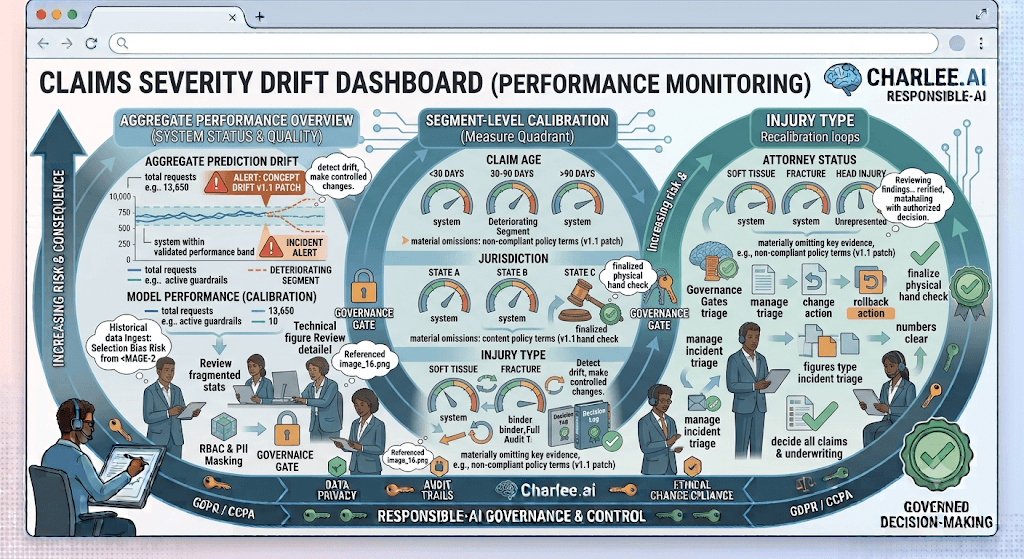
- Monitor whether severity and litigation scores remain calibrated across jurisdictions, claim ages, injury types, attorney status, and lines of business.
- Compare model alerts with actual claim development, reserve changes, litigation outcomes, and management overrides.
- Detect changes in medical, legal, repair, and demand-document patterns that may alter prediction or summarization quality.
- Suppress or qualify outputs when source feeds fail or a claim falls outside the validated population.
- Revalidate after major catastrophe events, claims-system migrations, coding changes, or operational redesign.
Claims Case Study: Severity and Litigation Monitoring
A casualty carrier uses AI to prioritize claims with emerging severity and litigation potential. Six months after deployment, aggregate discrimination remains stable, but calibration deteriorates for newer claims in two jurisdictions. Investigation shows a change in attorney-reporting timing and a new medical coding feed that delays key treatment indicators.
Claims Case Study: Severity and Litigation Monitoring
| Control area | Response |
|---|---|
| Detection | Segmented calibration and missingness alerts identify the issue before reserve outcomes fully mature. |
| Containment | The carrier adds a warning, routes affected claims for enhanced review, and suspends automated priority escalation from the unreliable fields. |
| Root cause | Data lineage and workflow review confirm timing and coding changes rather than a general model failure. |
| Remediation | The feed is corrected, features are re-engineered, the model is recalibrated, and jurisdiction-specific validation is completed. |
| Governance evidence | Versions, affected claims, user notices, overrides, tests, approvals, and restart criteria are documented. |
Underwriting Applications
- Monitor submission mix, broker formats, risk classes, geography, account size, and external data availability.
- Test whether appetite, referral, and extraction results remain consistent after product or rule changes.
- Review hit ratio, decline patterns, pricing impacts, underwriter overrides, and broker complaints by segment.
- Distinguish changes in underwriting strategy from unintended model drift.
- Revalidate when a model is expanded to a new product, jurisdiction, distribution channel, or account class.
Underwriting Case Study: Submission Triage
An underwriting assistant extracts documents, summarizes operations, and compares submissions with approved appetite guidance. After a broker portal redesign, document naming conventions and attachment order change. Extraction confidence remains superficially high, but missing schedule information increases and referral explanations become less complete.
Underwriting Case Study: Submission Triage
| Control area | Response |
|---|---|
| Signal | Field-level completeness, underwriter correction rates, and source-citation coverage deteriorate. |
| Containment | Low-evidence referrals are routed to manual review; the system is prevented from presenting incomplete appetite conclusions. |
| Investigation | The document classifier and extraction templates are tested against the new portal output. |
| Remediation | Training examples and document rules are updated, regression-tested, and released under change control. |
| Outcome | The model continues to reduce administrative work without obscuring missing information or replacing underwriter authority. |
Fraud, SIU, and Customer Communications
| Workflow | Drift risk | Required discipline |
|---|---|---|
| Fraud / SIU | Changing fraud tactics, data availability, investigation practice, or referral prevalence. | Monitor false positives, corroboration, segment burden, investigator overrides, and actual outcomes. |
| Customer communications | Tone, legal language, source accuracy, jurisdictional requirements, or model-service behavior changes. | Use approved language, source checks, review gates, and versioned regression tests. |
| Claim summaries | Document mix, retrieval freshness, prompt changes, or user reliance shifts. | Track unsupported facts, citation accuracy, edit patterns, and placement into official records. |
| Portfolio analytics | Exposure, product, catastrophe, inflation, or economic conditions change. | Use time-aware baselines, scenario analysis, and executive interpretation rather than static thresholds. |
GOVERNANCE AND RESPONSE
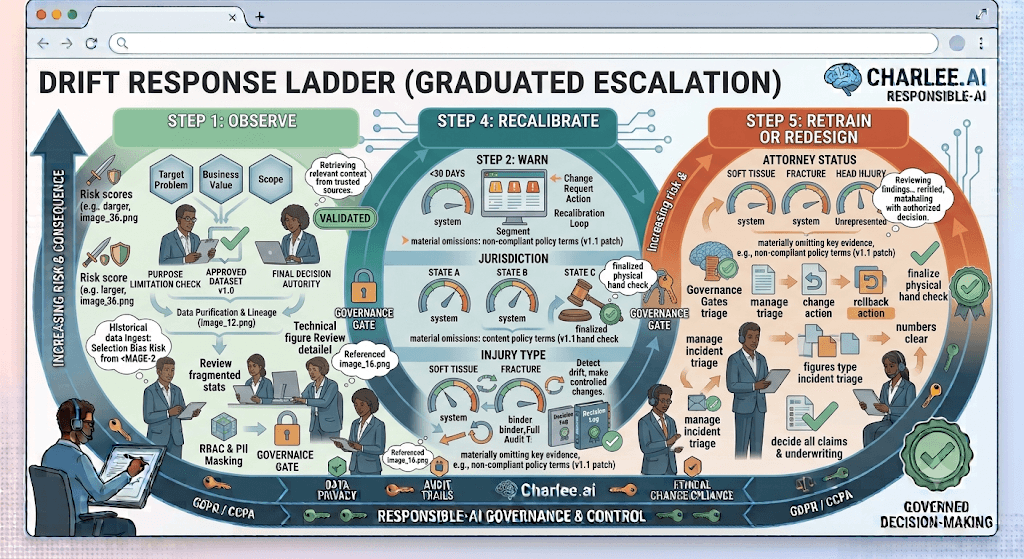
Drift Investigation and Root-Cause Analysis
Confirm the alert and rule out monitoring or reporting defects.
Identify the affected use case, population, segment, time window, model version, data sources, prompts, retrieval components, tools, and users.
Assess the decision impact, customer or claimant exposure, financial materiality, fairness implications, and reversibility.
Determine whether the cause is data, concept, label, workflow, technology, vendor, user behavior, or a combination.
Compare current performance with the approved baseline and relevant control limits.
Contain the risk through warnings, enhanced review, threshold changes, feature suppression, capability restriction, rollback, or pause.
Remediate and revalidate using representative current data and realistic workflow scenarios.
Document findings, affected outputs, decisions, approvals, communications, and lessons learned.
Root-Cause Questions
- Did the source data, coding, completeness, timing, or lineage change?
- Did the population, product, jurisdiction, workflow, or decision authority change?
- Did the real-world relationship between signals and outcomes change?
- Did a model, prompt, retrieval index, embedding, API, vendor, or tool change?
- Did users begin relying on, overriding, or interpreting the output differently?
- Are performance changes concentrated in a segment that aggregate monitoring hides?
- Are labels delayed, redefined, or influenced by the model-supported workflow itself?
Response Options
| Response | Use when | Governance requirements |
|---|---|---|
| Continue with observation | Change is small, understood, and within approved tolerance. | Document rationale, increase monitoring, and set a review date. |
| Warn and enhance review | Uncertainty has increased but outputs remain useful. | Display limitation, route to qualified professionals, and track decisions. |
| Adjust threshold or calibration | Ranking remains useful but probabilities or operating point changed. | Validate effects on performance, fairness, workload, and outcomes. |
| Repair data pipeline | Drift is caused by missing, stale, or transformed data. | Suppress affected outputs until restored and verified. |
| Retrain or fine-tune | Relationships or document patterns changed materially. | Use current representative data, independent validation, and controlled release. |
| Redesign workflow | User behavior or downstream action creates risk. | Clarify authority, UI, evidence, approvals, training, and monitoring. |
| Roll back | A recent change caused deterioration. | Preserve logs, restore validated version, and investigate before re-release. |
| Pause or retire | Risk cannot be controlled or value no longer justifies use. | Notify stakeholders, preserve records, remove access, and manage transition. |
EXECUTIVE RULE
The response should match consequence, uncertainty, affected population, and reversibility—not merely the size of a statistical alert.
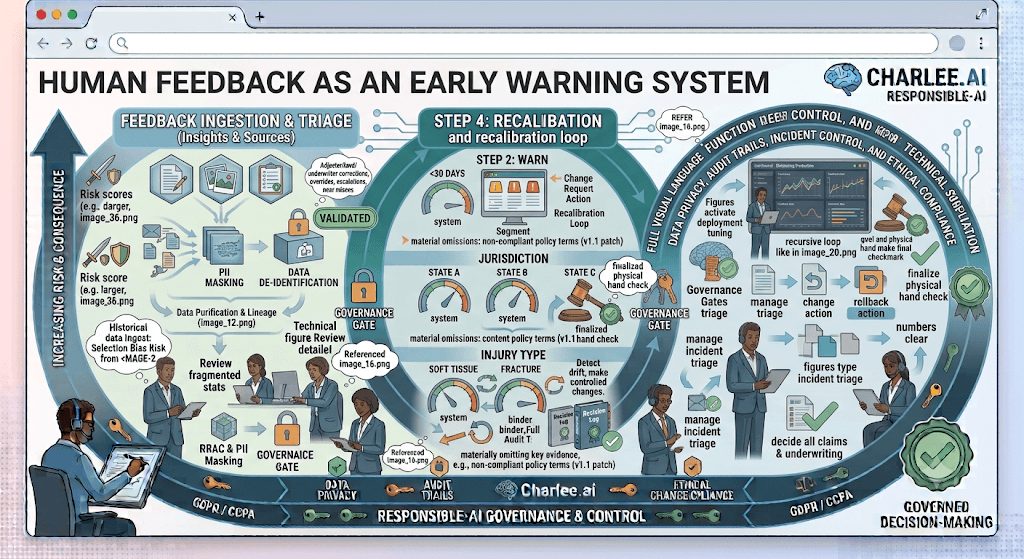
Human Oversight and Drift
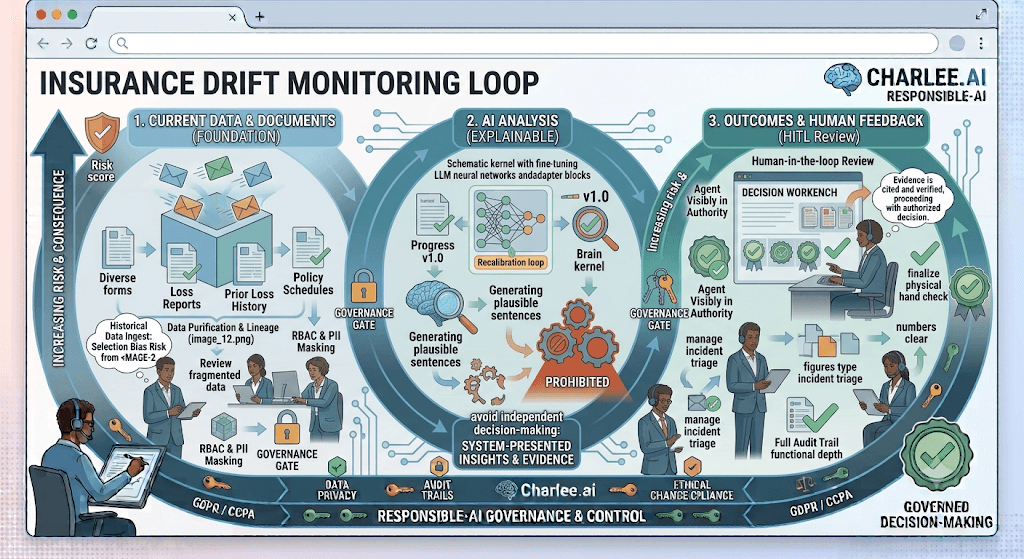
Professionals are often the first to notice that a system no longer reflects current reality. Drift monitoring should therefore make structured human feedback part of the control environment rather than treating overrides as noise.
| Oversight element | Drift-control design |
|---|---|
| Evidence | Show sources, drivers, uncertainty, limitations, and relevant change history. |
| Feedback | Capture corrections, disagreement reasons, missing evidence, and unusual cases in structured form. |
| Authority | Allow qualified users to override, escalate, or stop use without pressure to follow the model. |
| Training | Explain current scope, known limitations, warning states, and drift indicators. |
| Monitoring | Analyze override quality, segment patterns, automation bias, workload, and user adaptation. |
| Communication | Notify users promptly when a model, data feed, threshold, or workflow is restricted or changed. |
IMPLEMENTATION
Implementation Blueprint
Inventory AI systems, owners, purpose, populations, decisions influenced, components, vendors, and risk tier.
Define the validated baseline for data, performance, fairness, workflow, user behavior, and business outcomes.
Select monitoring measures appropriate to predictive, generative, retrieval, agentic, document, or vision patterns.
Segment monitoring by jurisdiction, line, product, claim age, user group, document type, and other material dimensions.
Define warning, investigation, action, pause, and retirement thresholds with named owners and response times.
Connect monitoring to change management, incident response, model risk, data governance, security, privacy, and business operations.
Capture professional overrides, corrections, escalations, complaints, and near misses as structured evidence.
Test monitoring and response procedures through simulations and controlled failures.
Revalidate after material changes and periodically according to risk tier and outcome maturity.
Report both technical health and business value to executive governance bodies.
Minimum Drift Record
- Alert date, metric, threshold, affected population, model and configuration version.
- Data sources, prompt, retrieval, tool, vendor, integration, and workflow state.
- Business impact and affected claims, submissions, customers, or decisions.
- Investigation, root cause, containment, remediation, validation, approval, and restart decision.
- User communication, customer correction, incident linkage, and lessons learned.
Metrics and Management Reporting
| Metric group | Illustrative measures |
|---|---|
| Coverage | Percent of systems with approved baselines, segment monitoring, thresholds, owners, and tested response plans. |
| Data drift | Feature distribution, missingness, freshness, schema changes, source failures, unseen categories. |
| Model performance | Calibration, discrimination, precision, recall, error, abstention, citation accuracy, extraction accuracy. |
| Fairness | Segment error gaps, referral burden, outcome differences, proxy review, correction time. |
| Human oversight | Override rate, reason quality, disagreement patterns, review time, escalation, automation bias. |
| Incidents | Alerts by severity, time to detect, contain, remediate, revalidate, and close. |
| Change discipline | Unapproved changes, regression-test completion, rollback readiness, vendor notifications. |
| Business value | Adoption, cycle time, quality, reserve adequacy, hit ratio, avoided loss, customer impact, operating cost. |
Common Failure Modes
| Failure mode | Why it fails | Better approach |
|---|---|---|
| Monitoring only aggregate accuracy | Segment deterioration and fairness issues remain hidden. | Monitor calibration, error, and outcomes by material cohorts. |
| Treating every shift as retraining need | Unnecessary retraining can introduce new risk and obscure root cause. | Investigate data, workflow, labels, and business change first. |
| Using static universal thresholds | Materiality differs by use case, volume, and consequence. | Set risk-based thresholds tied to business impact. |
| Ignoring delayed labels | Claims outcomes may mature slowly, creating false confidence. | Use leading indicators, maturity windows, and cohort analysis. |
| Relying only on statistical tests | Statistical movement may not equal business harm. | Combine statistical, operational, human, fairness, and outcome evidence. |
| No owner for alerts | Warnings accumulate without decisions or remediation. | Assign accountable owners, response times, and escalation. |
| Uncontrolled vendor changes | Behavior shifts without local approval or regression testing. | Require change notice, version evidence, testing, and rollback. |
| Punishing overrides | Users stop reporting weak outputs. | Treat reasoned challenge as governance evidence and learning data. |
LEADERSHIP
Executive Decision Guide
| Question | Proceed when | Pause or redesign when |
|---|---|---|
| Is the baseline credible? | Validated data, populations, workflow, performance, and outcomes are documented. | The organization cannot reconstruct what “normal” means. |
| Are material segments visible? | Monitoring covers jurisdictions, products, cohorts, users, and affected groups. | Aggregate metrics can hide localized deterioration. |
| Are thresholds actionable? | Each alert has an owner, investigation path, response time, and authority. | Alerts are informational only and routinely ignored. |
| Can outcomes be observed? | Labels and business outcomes are available with known maturity windows. | The system influences decisions but no reliable feedback loop exists. |
| Can users challenge the system? | They receive evidence, authority, training, and structured feedback tools. | The workflow rewards automatic acceptance. |
| Can the system be contained? | Warnings, restrictions, fallback, rollback, pause, and communication plans exist. | Unsafe behavior cannot be limited quickly. |
| Is change controlled? | Models, data, prompts, retrieval, vendors, tools, and workflows are versioned and tested. | Material changes can enter production without review. |
| Does value remain positive? | Current benefits exceed control, error, dependency, and operating costs. | Performance or adoption has degraded beyond a reasonable recovery path. |
EXECUTIVE PERSPECTIVE
Model drift is not solely a data-science issue. It is an enterprise control issue connecting data, technology, insurance operations, professional judgment, customer outcomes, vendor management, and business value.
Best Practices
PERSPECTIVE
- Design monitoring before deployment and test that alerts actually lead to action.
- Use time-aware, cohort-based, and segment-based evaluation for insurance outcomes.
- Monitor the complete AI-enabled system, including data, prompts, retrieval, tools, users, and workflow.
- Link drift metrics to the decisions and consequences the system can influence.
- Preserve version history and reconstructability for every material change.
- Use human feedback as a leading indicator and investigate override patterns.
- Revalidate after material changes rather than assuming prior approval still applies.
- Maintain safe fallback, rollback, pause, and retirement options.
- Report business value and risk together so leaders can make balanced decisions.
Charlee.ai Perspective
In P&C insurance, trustworthy AI must remain aligned with changing claims, documents, portfolios, and professional workflows. A model that was valuable at launch can become less useful when the environment, evidence, or way people use it changes. Effective drift management therefore combines continuous analysis with source evidence, professional review, structured feedback, and controlled change.
Charlee.ai’s people-plus-AI approach emphasizes early signals, explainability, current evidence, and human authority. Drift controls should help claims professionals, underwriters, and managers understand when an output is operating normally, when confidence has changed, and when a different level of review or intervention is required.
The goal is not perpetual model activity. It is sustained business fitness: reliable analysis that remains appropriate for the current insurance decision, current data, current operating environment, and current professional authority.
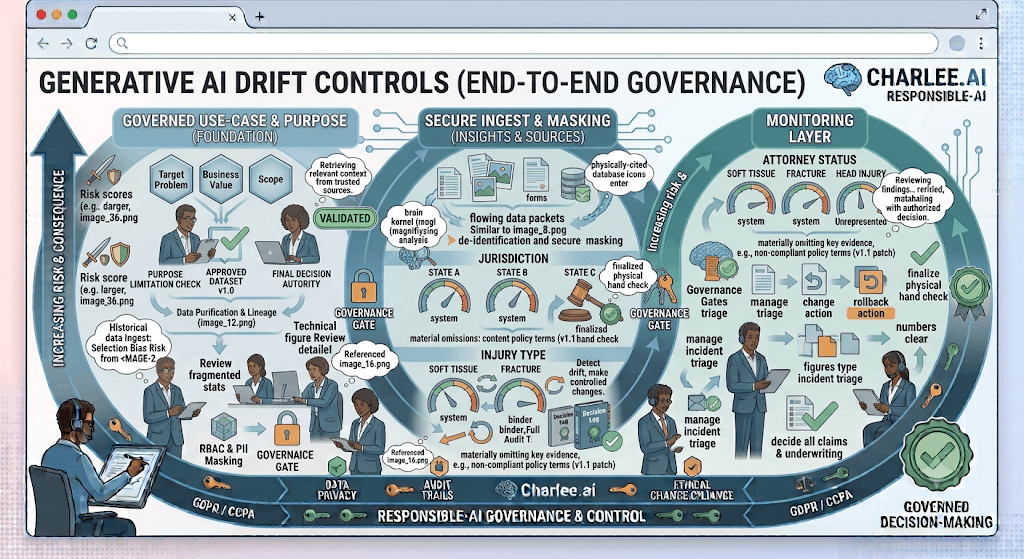
CHARLEE.AI DRIFT PATTERN
Approved baseline → continuous monitoring → evidence and segment analysis → professional feedback → investigation and containment → validated change → documented restart and ongoing learning.
VISUAL SYSTEM
External Framework Alignment
This entry is vendor-neutral and aligns conceptually with lifecycle-oriented AI risk management, model-risk, data-governance, internal-control, and insurance governance practices. Insurers should adapt monitoring and response requirements to applicable law, regulation, contractual obligations, internal authority, and the specific use case.
| Framework or practice | Relevance |
|---|---|
| NIST AI Risk Management Framework | Supports governance, measurement, management, monitoring, and response across the AI lifecycle. |
| NIST Generative AI Profile | Highlights generative-AI risks including information integrity, monitoring, and lifecycle controls. |
| NAIC AI governance expectations | Reinforce written programs, governance, documentation, testing, monitoring, and compliance for consumer-impacting insurance AI. |
| Model risk management | Provides validation, performance monitoring, change control, independent challenge, and issue management. |
| Data governance and internal controls | Support lineage, quality, ownership, access, change evidence, and operating effectiveness. |
CURRENT-STATE NOTE
AI laws, regulatory expectations, technical standards, and vendor capabilities continue to evolve. Before publication or implementation, legal, compliance, privacy, security, actuarial, data, and model-governance teams should verify current requirements for each jurisdiction and use case.
PUBLICATION
Key Takeaways
- Model drift can occur even when the model itself has not changed.
- Insurers should distinguish data, concept, label, fairness, workflow, and technology drift.
- Aggregate accuracy is insufficient; monitoring must include calibration, segments, human behavior, and business outcomes.
- Generative AI, RAG, agents, OCR, and computer vision each require pattern-specific drift controls.
- Human overrides, corrections, and escalations are valuable early-warning evidence.
- Drift alerts require root-cause analysis and proportionate response—not automatic retraining.
- Material changes should trigger revalidation, documented approval, and controlled release.
- The objective is sustained fitness for purpose, not merely continued technical operation.
AI model drift is a material change in the relationship between an AI system, its inputs, its operating environment, and the outcomes it is expected to support. Drift can reduce accuracy, calibration, fairness, reliability, and business usefulness over time.
Performance Change • Data Shift • Monitoring • Revalidation • Controlled Response
EXECUTIVE OVERVIEW
Frequently Asked Questions
AI model drift is a change in data, relationships, outcomes, users, or workflow that causes an AI system’s current behavior to diverge from its validated baseline.
Yes. The environment, data, population, or outcome relationship can change while the model code remains identical.
Data drift changes the distribution of inputs. Concept drift changes the relationship between inputs and the outcome the model is intended to predict or support.
Not exactly. Degradation is reduced performance; drift is one possible cause. Pipeline defects, bad labels, workflow misuse, or unvalidated scope can also reduce performance.
Cadence should reflect risk, volume, outcome maturity, and how quickly conditions can change. Some signals require continuous monitoring; others are reviewed weekly, monthly, quarterly, or when outcomes mature.
The answer depends on the use case, but insurers commonly need input stability, calibration, task error, segment performance, fairness, overrides, incidents, and business outcomes.
Yes. Stable aggregate accuracy can conceal serious deterioration in a jurisdiction, product, claim cohort, user group, or affected population.
Model-service updates, prompt changes, retrieval changes, source freshness, document mix, and user behavior can alter factuality, citation quality, tone, refusal behavior, and reliability.
No. The cause may be a data feed, label change, workflow change, threshold issue, or temporary event. Root-cause analysis should precede remediation.
Pause when risk exceeds approved limits, data is unreliable, harmful behavior cannot be contained, monitoring is unavailable, or the system is operating outside validated scope.
Recalibration adjusts predicted probabilities or score interpretation so they better match current observed outcomes without necessarily rebuilding the entire model.
Structured overrides and corrections can reveal changing patterns before mature outcome labels are available.
Require version and change notice, test locally on representative data, monitor outputs and outcomes, and maintain rollback, continuity, and exit options.
Yes. Changes can affect groups differently even when overall performance appears stable. Segment-level fairness monitoring is essential.
It is the approved reference state for data, population, model, configuration, workflow, performance, fairness, and business outcomes.
Catastrophes may create temporary out-of-distribution conditions. Use scenario-tested fallback, enhanced human review, separate monitoring, and controlled resumption.
Business and technical owners share first-line responsibility; risk, compliance, data, security, privacy, and model-governance functions provide challenge; audit provides assurance.
It helps preserve useful performance, prevent hidden deterioration, reduce incidents, focus retraining, and retire systems that no longer create sufficient value. CROSS-LINKING