What Is Artificial Intelligence in Insurance Claims?
A practical executive foundation for Property & Casualty insurers
Chapter Purpose This chapter explains artificial intelligence in business terms, shows how it supports the claims lifecycle, and establishes the management principles required for responsible adoption. It is designed for executives, claims leaders, operational managers, technology teams, and professionals evaluating how AI can improve claim outcomes without displacing human accountability.
Executive Summary
Property & Casualty claims are information-intensive. Every file accumulates structured data, adjuster notes, photographs, repair estimates, medical records, legal correspondence, invoices, policy information, and communications. Within that information are signals that can influence severity, litigation potential, reserve adequacy, customer experience, and total claim cost.
Artificial intelligence helps claims organizations convert large volumes of fragmented information into timely, usable insight. It can organize documents, recognize patterns, summarize developments, estimate future outcomes, identify changing conditions, and prioritize work. The purpose is not to make autonomous claim decisions. The purpose is to strengthen the speed, consistency, and quality of human decision-making.
The most successful insurers do not treat AI as an isolated technology purchase. They connect AI to clearly defined business problems, reliable data, governed processes, existing workflows, measurable outcomes, and accountable claims professionals. This chapter provides the foundation for making those connections.
Learning Objectives
After reading this chapter, you should be able to:
- Define artificial intelligence in the context of P&C insurance claims.
- Explain the major AI technologies used to analyze claims information.
- Distinguish AI from rules-based automation, reporting, and traditional analytics.
- Describe how AI can support work from FNOL through investigation, settlement, and closure.
- Identify operational, financial, customer, and management value created by AI.
- Recognize limitations, misconceptions, governance needs, and the continuing role of human judgment.
- Apply practical criteria when evaluating AI opportunities, vendors, and implementation plans.
Why This Chapter Matters
Artificial intelligence is now widely discussed across insurance, but the term is often used imprecisely. Some organizations equate AI with automation. Others focus exclusively on generative AI. Still others assume that predictive models can replace professional judgment. These misunderstandings create unrealistic expectations and weaken implementation decisions.
A practical foundation allows executives and claims leaders to ask better questions: What business problem are we solving? What information is required? How will the capability fit into existing work? Who remains accountable? How will outcomes be measured? What governance is needed before and after deployment?
Chapter Roadmap
Foundational Principle AI should improve the information available to claims professionals, not transfer accountability away from them. Coverage interpretation, investigation strategy, reserve changes, negotiation, settlement, and customer communication remain human responsibilities.
| Section | Focus | Executive Value |
|---|---|---|
| Major AI Technologies | The capabilities that interpret language, documents, images, and patterns. | Clarifies what different AI methods can and cannot do. |
| AI Across the Claims Lifecycle | How intelligence supports work from FNOL through closure. | Connects technology to operating workflows. |
| Business Value | Operational, financial, customer, and management outcomes. | Defines how value should be measured. |
| Real-World Applications | Examples across major P&C lines. | Translates concepts into practical scenarios. |
| Best Practices and Misconceptions | Implementation disciplines and expectation setting. | Reduces risk and supports adoption. |
| Executive Perspective | Leadership, governance, investment, and accountability. | Frames AI as an enterprise capability. |
How to Use This Chapter
Readers can use the chapter as an executive briefing, a claims leadership discussion guide, or a foundation for evaluating AI investments. Each section combines practical explanation with management questions, implementation considerations, and a concise takeaway. Together, the sections establish a shared language for the strategy work that follows in Chapter 1.2.
Chapter Outcome By the end of this chapter, leaders should be able to explain AI in claims without technical jargon, identify where it can create measurable value, and define the conditions required for responsible implementation.
Executive Premise
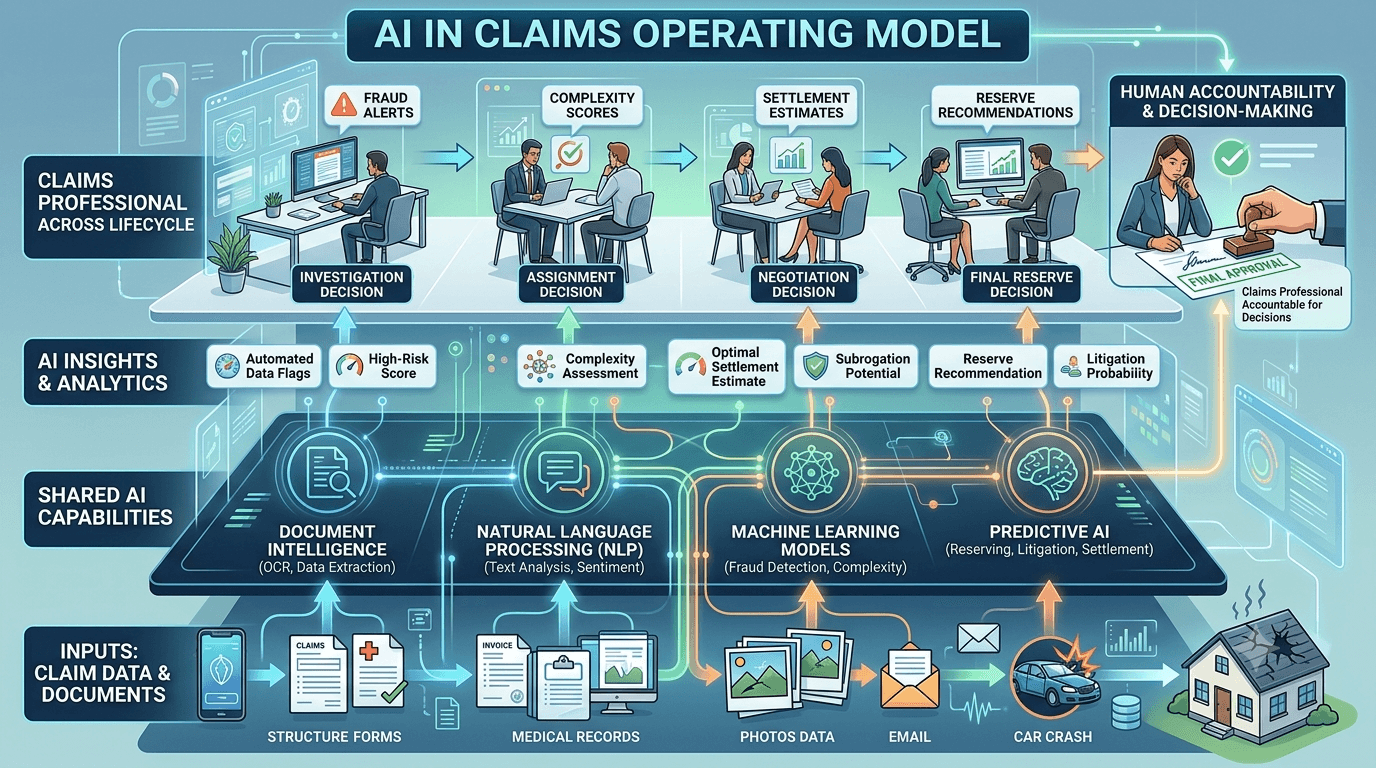
Artificial Intelligence in claims is best understood as a scalable decision-support capability: it helps people process information, recognize patterns, and identify developments that deserve attention while qualified professionals retain authority for claim decisions.
Executive Framework
| Dimension | What AI Contributes | What People Retain |
|---|---|---|
| Information | Processes documents, notes, images, estimates, and records at scale. | Validate context and determine relevance. |
| Patterns | Finds relationships and changes that may be difficult to see manually. | Investigate causes and exceptions. |
| Predictions | Estimates probabilities and prioritizes review. | Make coverage, reserve, strategy, and settlement decisions. |
| Communication | Summarizes complex claim activity. | Exercise empathy, negotiation, and accountability. |
A Practical Definition of AI
A Practical Definition of AI
AI refers to computer-based methods that perform tasks commonly associated with human intelligence, including language interpretation, pattern recognition, prediction, summarization, and recommendation. In claims, the purpose is not to imitate an adjuster. It is to make large, fragmented bodies of information easier to understand and act upon.
AI differs from conventional software because it is not limited to a fixed set of explicit instructions. Models identify relationships from examples or apply language models to interpret content. The result is a recommendation, classification, probability, or summary—not an autonomous claim determination.
Why Claims Are Well Suited to AI
A claim file may contain FNOL data, policy information, adjuster notes, photographs, repair estimates, police reports, medical records, legal correspondence, reserve history, and communications. The volume and variety of this information create delays and make significant developments easy to overlook.
AI can continuously review incoming information, connect related facts, flag missing or inconsistent documentation, and present a concise view of what changed. This improves operational awareness while allowing claims professionals to spend more time on investigation, judgment, customer communication, and negotiation.
What AI Does Well
AI performs particularly well when work requires repetitive information processing, document classification, entity extraction, summarization, anomaly detection, pattern recognition, continuous monitoring, or probability-based prioritization. Examples include building medical chronologies, identifying attorney involvement, monitoring treatment escalation, and ranking claims for supervisory review.
Its value comes from consistency and scale. The same analytical process can be applied across a portfolio, helping organizations recognize developments earlier and reduce variation caused by manual information overload.
Where Human Expertise Is Essential
AI cannot independently determine fairness, interpret ambiguous coverage in context, manage a distressed policyholder relationship, negotiate a settlement, or accept accountability for an outcome. It may also produce incomplete or incorrect outputs when data is missing, unusual, or inconsistent.
Claims professionals must review recommendations, investigate exceptions, apply policy and legal knowledge, consider customer circumstances, and document decisions. Human oversight is not a temporary safeguard; it is part of the operating model.
Characteristics of Effective Claims AI
Trustworthy AI should be accurate enough for its intended use, timely enough to influence handling, explainable enough for users to evaluate, secure enough for sensitive claim information, and integrated into the systems where work occurs. Performance should be monitored for drift, changing claim patterns, and unintended effects.
The organization should also know who owns the model, who validates performance, how users provide feedback, when recommendations require escalation, and how the capability will be retired or replaced.
EXECUTIVE INSIGHT
The most useful definition of claims AI is operational: a governed capability that converts complex claim information into timely, reviewable insight for people who remain accountable for the decision.
MANAGEMENT PRINCIPLE
Use AI to expand human capacity and awareness—not to obscure or transfer human responsibility.
Executive Responsibilities
Executives and accountable owners should:
- Define the business purpose before selecting a technology.
- Require clear human ownership for every AI-supported decision.
- Establish performance, security, explainability, and monitoring expectations.
- Ensure insights appear within the normal claims workflow.
Executive Checklist
Use this checklist to assess readiness and control:
- The business problem and intended users are clearly defined.
- AI outputs are recommendations or decision support, not unreviewed determinations.
- Data quality and access controls are appropriate for the use case.
- Users understand capabilities, limitations, and escalation procedures.
- Performance and business outcomes are reviewed on an ongoing basis.
Executive Discussion Questions
Use these questions to test whether the organization has translated a general interest in AI into an appropriate claims operating model.
KEY TAKEAWAY
Artificial Intelligence is a force multiplier for claims expertise. It creates value by processing information at scale and surfacing relevant patterns, while people provide judgment, empathy, investigation, negotiation, and accountability.
Machine Learning
Machine learning identifies statistical relationships within historical claims data. It can estimate severity, litigation likelihood, treatment escalation, fraud indicators, subrogation potential, reserve movement, and operational workload. Its output is usually a probability, score, classification, or forecast—not a final claim decision. Performance depends on relevant historical examples, stable definitions, representative data, and ongoing monitoring.
Natural Language Processing
Natural language processing interprets written language in adjuster notes, police reports, medical records, emails, legal correspondence, demand packages, estimates, and witness statements. It can identify entities such as injuries, diagnoses, providers, dates, attorneys, locations, and procedures while considering context. In claims, context matters: the same term may describe an allegation, a confirmed fact, a past condition, or a denied event.
Document Intelligence
Document intelligence combines text recognition, layout analysis, classification, extraction, and language understanding. It can identify document types, capture index information, organize medical chronologies, detect missing documents, extract key fields, and summarize lengthy files. This capability is especially valuable because much of the claim record exists outside structured claim-system fields.
Predictive Artificial Intelligence
Predictive AI uses current and historical information to estimate future developments. Examples include the probability of litigation, increasing severity, prolonged treatment, reserve inadequacy, or claim complexity. Predictions are most useful when they arrive early enough to change action and when users understand the factors contributing to the result.
Computer Vision
Computer vision interprets photographs, scans, video, drone imagery, and other visual evidence. Claims applications include vehicle-damage assessment, property-damage classification, roof inspection, catastrophe triage, and document-image quality checks. Results should be reviewed when coverage, causation, repair scope, or liability depends on visual interpretation.
Generative Artificial Intelligence
Generative AI can summarize claim histories, create medical or legal briefs, answer questions about a file, draft communications, and explain complex information. It is valuable for reducing synthesis time, but generated content may omit facts, overstate confidence, or introduce unsupported language. Source grounding, clear citations, role-based access, and human review are essential.
7. How the Technologies Work Together
A typical workflow may classify incoming documents, extract entities and dates, analyze narrative context, combine those findings with structured claim data, estimate risk, and generate a concise explanation for the adjuster. The value comes from orchestration: each capability performs the task for which it is best suited, while the claims professional receives one coherent view of the claim.
Executive Insight No single AI technique is sufficient for the full claims lifecycle. The strongest solutions combine specialized methods and present their outputs in a form that supports a specific human decision.
| Technology | Primary Role | Representative Claims Uses | Key Control |
|---|---|---|---|
| Machine Learning | Find patterns and estimate outcomes | Severity, litigation, fraud, reserve and workload scoring | Validation and drift monitoring |
| NLP | Understand narrative language | Notes, records, reports, correspondence | Context review |
| Document Intelligence | Organize and extract documents | Classification, indexing, chronology, missing items | Source traceability |
| Computer Vision | Interpret images | Vehicle, property and catastrophe evidence | Human visual review |
| Generative AI | Summarize and explain | File briefs, Q&A, drafting | Grounding and approval |
First Notice of Loss
First Notice of Loss
At FNOL, AI can evaluate initial facts, identify missing information, classify complexity, detect injury or commercial exposure, and recommend triage. The goal is not to settle the claim automatically; it is to route the claim appropriately and ensure the right professional becomes involved early.
Investigation
As reports, photographs, estimates, witness statements, notes, and communications arrive, AI can organize evidence, highlight inconsistencies, identify unanswered questions, and summarize the developing fact pattern. The adjuster determines the investigative strategy and evaluates credibility, causation, liability, and coverage.
Medical Review
AI can extract providers, diagnoses, procedures, medications, imaging, treatment gaps, work restrictions, surgical recommendations, and chronology from large medical records. Claims professionals evaluate relevance, reasonableness, causation, and the effect on exposure.
Reserve Monitoring
Claims change over time. AI can detect events that may warrant reserve review, including new treatment, surgery, attorney representation, escalating utilization, prolonged disability, or changes in liability information. The system should prompt review; authorized professionals approve reserve changes.
Litigation Monitoring
AI can identify attorney involvement, summarize pleadings and demands, track deadlines, organize expert materials, and detect developments associated with increasing exposure. Legal strategy remains the responsibility of claims leadership and counsel.
Settlement Preparation
Before negotiation, AI can assemble a concise history of facts, treatment, damages, prior offers, reserve movement, and unresolved issues. This reduces preparation time and helps teams enter settlement discussions with a consistent view of the file.
7. Claim Closure and Learning
AI can check documentation completeness, open tasks, approvals, payment status, recoveries, and closure requirements. After closure, aggregated results can support training, process improvement, and model refinement without changing the accountability for the original claim decision.
Executive Insight The value of lifecycle AI is continuity. It helps the organization notice when the claim has changed, not merely what the claim looked like at intake.
| Lifecycle Stage | AI Contribution | Human Responsibility |
|---|---|---|
| FNOL | Triage, missing information, complexity signals | Validate facts and assign handling |
| Investigation | Organize evidence and highlight inconsistencies | Determine strategy and findings |
| Medical Review | Extract chronology and treatment developments | Evaluate relevance and exposure |
| Reserve Monitoring | Detect meaningful change | Approve reserve action |
| Litigation | Track legal developments and summarize materials | Direct strategy with counsel |
| Settlement | Prepare file history and unresolved issues | Negotiate and approve |
| Closure | Check completion and capture learning | Authorize closure |
Operational Efficiency
Operational Efficiency
AI reduces time spent locating documents, reviewing repetitive material, creating summaries, and monitoring large inventories. The resulting capacity should be redirected toward investigation, customer communication, negotiation, and complex decision-making rather than treated only as head-count reduction.
Earlier Risk Identification
Continuous analysis can surface developing severity, litigation indicators, reserve pressure, prolonged treatment, fraud concerns, or subrogation opportunity earlier. Value is created when the signal leads to timely action that changes the trajectory of the claim.
Improved Claim Quality and Consistency
AI can identify missing activities, inconsistent information, documentation gaps, and departures from expected handling. Used responsibly, it supports more consistent execution while preserving professional discretion for claim-specific circumstances.
Better Customer Experience
Faster access to information can shorten response time, reduce repeated requests, support clearer communication, and help adjusters focus on the policyholder. Customer outcomes should be measured directly rather than assumed from faster processing.
Financial Performance
Potential financial value includes improved reserve adequacy, lower leakage, earlier recovery opportunities, better litigation management, and more informed settlement strategy. Financial claims require disciplined measurement because many external factors also affect loss outcomes.
Management Visibility
Portfolio-level intelligence helps supervisors identify changing claims, balance workload, monitor service standards, and direct specialist resources. Better visibility improves control even when an individual prediction does not change a claim outcome.
7. Workforce Capacity and Organizational Learning
AI can help less-experienced employees find relevant information and apply established practices while giving senior professionals more time for complex work. Aggregated insights can reveal recurring trends that improve training, workflows, and future product or underwriting decisions.
Executive Insight The strongest AI value cases explain not only what the technology does, but how that change in information or workflow produces a measurable business result.
| Value Dimension | Example KPI | Evidence of Value | Common Measurement Risk |
|---|---|---|---|
| Efficiency | Review time, cycle time, claims per adjuster | Sustained improvement versus baseline | Counting logins instead of outcomes |
| Quality | Audit score, missed activity rate | Fewer material handling gaps | Ignoring claim complexity |
| Financial | Reserve accuracy, leakage, recovery dollars | Validated impact over sufficient time | Attributing all change to AI |
| Customer | Response time, CSAT, complaints | Improved service indicators | Assuming speed equals satisfaction |
| Adoption | Active use, action rate, override patterns | Appropriate use in target workflow | Rewarding use regardless of quality |
Personal Auto
Personal Auto
AI can review FNOL details, police reports, estimates, photographs, total-loss indicators, medical records, and attorney correspondence. It may highlight escalating treatment, inconsistent damage descriptions, new representation, or changes in exposure. Adjusters remain responsible for liability, coverage, repair, injury evaluation, and settlement.
Workers’ Compensation
AI can create medical and disability timelines, identify new diagnoses, surgery recommendations, treatment gaps, work restrictions, return-to-work delays, and changing provider patterns. Claims professionals coordinate benefits, medical management, employer communication, and jurisdiction-specific requirements.
Commercial Auto
Large commercial losses may involve multiple vehicles, injured parties, telematics, driver records, experts, regulatory materials, and significant litigation. AI can organize the file, summarize relationships among parties, identify severe exposures, and help supervisors prioritize complex investigations.
Property and Catastrophe
AI can classify inspection reports, analyze photographs, organize estimates, summarize adjuster findings, and triage claims following severe weather. Computer vision and document intelligence may accelerate review, but coverage, causation, scope, depreciation, and repair decisions require qualified professionals.
General Liability
AI can review incident reports, contracts, photographs, witness statements, demands, medical materials, and legal correspondence. It may identify liability themes, attorney activity, contractual relationships, missing evidence, or inconsistent accounts that warrant investigation.
Cyber
Cyber claims evolve rapidly and include technical, legal, regulatory, and business-interruption materials. AI can summarize forensic reports, breach notifications, counsel updates, vendor invoices, restoration timelines, and loss documentation. Specialists must evaluate coverage, privilege, causation, reasonableness, and regulatory implications.
Start with the Business Problem
Start with the Business Problem
Define the operational challenge, affected population, current baseline, desired outcome, and responsible owner before selecting a solution. Avoid broad goals such as “use AI” or “improve claims” that cannot guide design or measurement.
Keep Claims Professionals at the Center
Include adjusters, supervisors, specialists, quality teams, and leaders in design and validation. Users should understand what the output means, what action is expected, when to override it, and how to provide feedback.
Establish Data Readiness
Evaluate completeness, consistency, access, lineage, security, and the quality of both structured and unstructured information. A pilot can expose data problems, but poor data should not be disguised as a model issue.
Integrate into Existing Workflows
Insights should appear inside the claim, task, diary, or supervisor environment where work already occurs. Separate portals and excessive notifications increase friction and reduce sustained adoption.
Require Explainability and Traceability
Users should be able to understand the reason for a flag, review supporting source information, and distinguish confirmed facts from model inference. The level of explanation should match the risk of the decision being supported.
Establish Governance Before Deployment
Assign ownership for validation, access, privacy, security, change control, performance monitoring, incident response, and retirement. Governance should be proportionate to the use case but never absent.
Measure Outcomes and Adoption
Track business KPIs, model performance, usage, action rates, overrides, false positives, user feedback, and unintended effects. Adoption without value is not success; value without responsible use is not sustainable.
Scale in Controlled Phases
Begin with a focused population, validate performance in real workflows, incorporate lessons, and expand through defined gates. Scaling should follow evidence, readiness, and capacity—not enthusiasm alone.
9. Train, Communicate, and Improve
Training should address capabilities, limitations, appropriate use, and human accountability. Ongoing communication and feedback help the program respond to changing claims patterns, regulations, products, and user needs.
Executive Insight Implementation quality determines whether AI becomes an operating capability or remains a demonstration.
| Implementation Pitfall | Likely Effect | Recommended Practice |
|---|---|---|
| Technology without a business goal | Weak ROI and disconnected activity | Define outcomes and ownership first |
| Poor data quality | Unreliable results and low trust | Assess and govern data before scale |
| Standalone workflow | Low adoption and duplicate work | Embed insights into core processes |
| Autonomous positioning | User resistance and control risk | Keep professionals accountable |
| Pilot without scale criteria | Permanent experimentation | Use stage gates and an enterprise roadmap |
| Technology-only metrics | Inability to prove value | Measure operational and financial outcomes |
Common Misconceptions About Artificial Intelligence in Insurance Claims
Myth 1: AI Will Replace Claims Adjusters
Myth 1: AI Will Replace Claims Adjusters
AI can automate information processing and support prioritization, but claims handling requires coverage interpretation, investigation, empathy, negotiation, documentation, and accountable judgment. The more realistic objective is to reduce administrative burden and improve the information available to professionals.
Myth 2: AI Always Produces the Correct Answer
Models generate classifications, probabilities, extractions, or language based on available information. They can be incomplete, wrong, or overconfident. Material decisions require review of source evidence, professional judgment, and escalation when the output conflicts with the file.
Myth 3: Generative AI Understands the Claim Like a Human
Generative AI can produce fluent summaries and answers, but fluent language is not proof of factual accuracy or legal understanding. Grounding, citations, controlled prompts, restricted data access, and user verification are necessary.
Myth 4: AI Needs Little Data Preparation
Claims information may be fragmented, inconsistent, duplicated, poorly indexed, or missing. Strong models cannot fully compensate for unreliable inputs. Data governance, mapping, access, and quality monitoring are core implementation work.
Myth 5: More AI Is Always Better
Applying AI to every activity can create noise, complexity, cost, and user fatigue. The better approach is to prioritize decisions where improved information can produce measurable value and where the organization can act on the result.
Myth 6: AI Is Only About Reducing Costs
Efficiency is one benefit, but AI can also improve claim quality, consistency, reserve awareness, customer response, management visibility, workforce capacity, and organizational learning.
Myth 7: A Successful Pilot Proves Enterprise Readiness
A pilot may demonstrate technical feasibility in a controlled population. Enterprise deployment also requires integration, support, security, governance, training, operational ownership, scale performance, and benefit realization.
Myth 8: AI Can Be Implemented Once and Left Alone
Claims patterns, products, data, regulations, workflows, and user behavior change. Models and processes require monitoring, feedback, validation, controlled updates, and eventual retirement.
Myth 9: Explainability Is Only a Technical Requirement
Explanation is also an operational and management requirement. Users need to know why a claim was flagged, what evidence supports the output, and what action is expected. Executives need to understand performance, limits, and risk exposure.
Myth 10: AI Value Appears Immediately
Some benefits, such as document-review time, may be visible quickly. Financial and claim-outcome effects may require longer measurement periods and careful attribution. Realistic timelines preserve credibility and improve investment decisions.
Executive Insight Education is a risk control. It enables employees and executives to distinguish useful capability from marketing language, fear, and overconfidence.
| Misconception | Reality | Executive Response |
|---|---|---|
| AI replaces adjusters | AI augments expertise | Design for human accountability |
| AI is always correct | Outputs require validation | Require source review and controls |
| More AI is better | Only high-value use cases should scale | Prioritize outcomes |
| A pilot proves readiness | Operations and governance must also work | Use deployment gates |
| AI is a one-time project | Performance and context change | Fund lifecycle management |
1. Earlier Recognition of Emerging Risk
Earlier Recognition of Emerging Risk
AI can continuously monitor new documents, notes, treatments, attorney activity, reserve movement, and other developments. This can help teams identify claims that may warrant earlier review, specialist involvement, or a change in handling strategy.
The limitation is that a signal is not a conclusion. A model may miss an unusual pattern or flag a benign development. The organization needs thresholds, escalation procedures, and human investigation before action is taken.
Greater Productivity and Capacity
Document classification, summarization, chronology creation, information extraction, and work prioritization can reduce the time professionals spend locating and organizing information. This may increase capacity and allow experienced employees to focus on complex decisions.
Productivity gains can disappear if users must switch systems, correct poor summaries, or process excessive alerts. Workflow integration, usability, and signal quality are therefore as important as model accuracy.
Improved Consistency and Claim Quality
AI can apply the same analytical approach across a large portfolio, highlighting missing documentation, inconsistent facts, incomplete tasks, or departures from expected handling patterns. It can also give supervisors a broader view of changing claims and workload.
Consistency should not become rigidity. Claims differ by jurisdiction, policy language, facts, customer circumstances, and legal environment. Exceptions must remain visible, and professionals must be able to override recommendations with documented reasons.
Better Customer and Management Outcomes
Faster access to relevant information can support more timely policyholder communication and fewer repeated requests. Portfolio intelligence can help supervisors allocate resources, identify bottlenecks, and direct expertise toward claims with the greatest potential impact.
AI does not provide empathy, trust, or relationship management. A faster process that feels impersonal or produces an inappropriate response can damage the customer experience. People remain responsible for communication and service recovery.
Data and Model Limitations
AI depends on the completeness, accuracy, representativeness, and timeliness of the information it receives. Historical data may reflect inconsistent practices, missing fields, changing definitions, or past bias. Models can also degrade as claim patterns, medical practices, economic conditions, or operating processes change.
Organizations should document data sources, test performance by relevant segments, monitor false positives and false negatives, and define when retraining or recalibration is required.
Explainability, Reliability, and Generative AI
Predictive outputs should provide enough context for users to understand why a claim was prioritized. Generative AI can create useful summaries and explanations, but it may omit facts, combine unrelated information, or state an unsupported conclusion confidently.
Generated content should be grounded in the claim file, linked to source material where possible, and reviewed before it influences a decision or customer communication. High-impact uses require stronger validation and auditability.
Governance, Privacy, and Accountability
Claims data may include medical, financial, legal, and personal information. Access controls, encryption, retention rules, audit logging, vendor oversight, and incident response must be designed into the implementation.
Most importantly, accountability cannot be delegated to a model. Leaders must identify who owns the use case, who reviews performance, who responds to issues, and who remains responsible for the final claim decision.
EXECUTIVE INSIGHT
AI is neither inherently transformative nor inherently risky. Its value depends on how deliberately the organization matches each capability to a business need, surrounds it with controls, and combines it with professional expertise.
MANAGEMENT PRINCIPLE
Evaluate AI as part of a human-and-technology operating system. Optimize the combined process, not the model in isolation.
An Insurance-Specific Application of AI
Charlee.ai combines multiple AI capabilities rather than treating AI as a single model. Structured claim fields can be analyzed alongside adjuster notes, medical records, demand packages, police reports, estimates, and other documents. This broader view can produce a more complete picture of claim development.
The platform’s role is decision support. It can identify information and patterns that deserve attention, but claims professionals remain responsible for interpreting policy, investigating facts, setting reserves, negotiating, and approving outcomes.
How the Workflow Can Operate
A claim may begin with FNOL data, a police report, an estimate, and initial medical information. As new documents arrive, the platform can classify them, extract relevant facts, update summaries, identify changes in treatment or representation, and surface claims that meet defined review criteria.
Insights should be delivered where adjusters and supervisors already work. Integration with the core claims environment reduces context switching and makes it easier to act on new information.
Illustrative High-Value Use Cases
Document intelligence can reduce the burden of reading large files and assembling chronologies. Severity and litigation models can help prioritize early review. Reserve-monitoring insights can highlight developments that may warrant discussion. Subrogation or fraud indicators can point to opportunities for specialist evaluation.
Organizations should not deploy every capability at once. A focused use case with defined users, baseline measures, target outcomes, and governance provides a stronger foundation for expansion.
Human-Centered Design and Explainability
Users need to understand what changed, why a claim was highlighted, and which source information supports the insight. Recommendations should be concise, reviewable, and connected to the underlying claim content.
Professionals should be able to accept, reject, or investigate an insight without surrendering decision authority. Feedback from users can also help improve thresholds, workflow design, and future model performance.
Integration, Data, and Security
Successful deployment depends on access to reliable claim data and secure connections to the systems that hold it. Integration design should address data mapping, document ingestion, identity and access, audit logging, retention, and operational support.
The implementation should also define how model outputs are written back to the claims workflow, how errors are handled, and how service continuity is maintained.
Governance and Performance Management
The insurer should establish ownership for use-case approval, model validation, user access, monitoring, change control, and issue response. Performance should be reviewed across model quality, user adoption, workflow utilization, business KPIs, and unintended effects.
Charlee.ai should operate within the insurer’s broader responsible-AI framework. The technology does not replace the organization’s obligations for governance, regulatory compliance, or claim decisions.
A Phased Adoption Approach
A practical sequence is to define the business problem, validate data readiness, configure and integrate a focused use case, train users, measure performance, and then expand based on demonstrated value.
This approach allows the organization to learn from operational feedback, refine governance, and build confidence before adding lines of business or additional capabilities.
EXECUTIVE INSIGHT
The platform creates the most value when its capabilities are connected to a clearly defined claims problem, delivered inside the normal workflow, and governed as part of the insurer’s operating model.
MANAGEMENT PRINCIPLE
Select the use case before the feature. A platform should be evaluated by the quality of the decisions and outcomes it enables—not by the number of AI capabilities it contains.
Executive Evaluation Questions
Before expanding a Charlee.ai deployment, leadership should confirm that the platform is improving the combined claims process rather than merely adding another source of alerts or information.
KEY TAKEAWAY
Charlee.ai illustrates how insurance-specific AI can translate complex claim information into actionable insight. Sustainable results require business alignment, secure integration, responsible governance, trained users, and continued human accountability.
Key Takeaways
- What executives and claims leaders should retain from Chapter 1.1
Executive Action Agenda
Management Principle AI should be introduced where better information can improve a human decision, where the organization can act on the result, and where value and risk can be measured.
| Priority | Recommended Action | Evidence of Completion |
|---|---|---|
| Immediate | Define the business problems and decisions where improved information could create value. | Approved problem statements and baseline KPIs. |
| Immediate | Clarify human decision rights and risk tolerance. | Documented accountability and escalation rules. |
| Near term | Assess data, workflow, integration, security, and governance readiness. | Readiness findings and remediation plan. |
| Near term | Select a focused, measurable use case and representative claim population. | Pilot charter and evaluation criteria. |
| Medium term | Deploy in workflow, train users, and monitor value, adoption, and performance. | Operational scorecard and user feedback. |
| Ongoing | Improve, expand, pause, or retire capabilities based on evidence. | Governance decisions and lifecycle records. |
Leadership Self-Assessment
- Can we explain the business purpose of each AI initiative without describing model features?
- Do users understand what the output means, what action is expected, and when to override it?
- Can every material insight be traced to source information or a documented model process?
- Are data quality, privacy, security, validation, and monitoring responsibilities assigned?
- Have we established baselines and targets for operational, financial, customer, and quality outcomes?
- Is workflow integration reducing effort rather than creating another place to work?
- Do scale decisions follow evidence rather than enthusiasm?
- Is ongoing ownership funded after initial deployment?
Looking Ahead
Looking Ahead
Final Key Insight AI delivers its greatest value when it enhances human expertise, improves decision quality, and becomes an integrated, governed part of everyday claims operations.
Treat AI as a Strategic Capability
AI should be connected to claims strategy, customer commitments, financial objectives, workforce plans, data strategy, and core-platform investments. A portfolio view prevents isolated pilots from competing for resources without contributing to a coherent future state.
Establish Executive Sponsorship and Decision Rights
A named business executive should own the outcome, while claims, technology, data, security, legal, compliance, and risk leaders contribute defined responsibilities. Committees should clarify which decisions they make, which they recommend, and which remain with operational management.
Require a Credible Investment Case
Funding decisions should include the business problem, baseline, expected benefit, total cost of ownership, integration effort, change requirements, assumptions, risks, and measurement plan. Vendor demonstrations should not substitute for operational evidence.
Govern Risk Proportionately
Controls should reflect the significance of the supported decision, sensitivity of the data, degree of automation, customer impact, and regulatory exposure. Executives should expect documented validation, security, privacy, monitoring, auditability, issue management, and retirement procedures.
Prepare the Organization
Employees need a clear explanation of why AI is being introduced, how it changes work, what remains under human control, and how performance will be evaluated. Training, workflow design, incentives, and leadership communication determine whether the capability is used appropriately.
Measure Return Beyond Cost Reduction
Executive scorecards should combine operational efficiency, claim quality, financial performance, customer outcomes, adoption, model health, and governance indicators. Short-term productivity should not obscure longer-term quality, control, or customer effects.
Scale Through Evidence
Enterprise expansion should follow proven value, acceptable performance, user adoption, workflow stability, support readiness, and governance maturity. Executives should be willing to pause, redesign, or retire capabilities that do not meet expectations.
Build Continuous Improvement into the Operating Model
AI requires ongoing ownership. Leaders should fund monitoring, controlled updates, data stewardship, user feedback, retraining where appropriate, and periodic review of whether the use case remains relevant.
Executive Questions Before Investment
Executive Insight Executives create the conditions for success by aligning strategy, governance, people, data, technology, and measurement.
Management Principle Delegate technical execution, but never delegate accountability for business purpose, risk tolerance, and realized value.
| Strategic Objective | Executive KPI | Supporting Indicator | Executive Interpretation |
|---|---|---|---|
| Operational efficiency | Cycle time; review time | Usage and action rate | Is capacity being converted into better work? |
| Claim quality | Audit score; missed activity | Override and exception patterns | Are outcomes more consistent without suppressing judgment? |
| Financial performance | Reserve accuracy; leakage; recoveries | Early-risk identification | Is the financial effect credible and attributable? |
| Customer experience | Response time; CSAT; complaints | Communication timeliness | Is service improving, not merely processing speed? |
| Governance | Issues, drift, access exceptions | Validation and review completion | Is risk remaining within approved tolerance? |
Applying These Concepts with Charlee.ai
These concepts become most valuable when AI is embedded in daily insurance workflows, uses structured and unstructured information, and gives professionals timely insight without removing their authority or accountability.
Charlee.ai applies document intelligence, predictive analytics, and generative assistance so teams can identify risk earlier and make more informed decisions.
Earlier Risk Identification
Document Intelligence
Predictive Insights
Adjuster Copilot
A practical executive foundation for Property & Casualty insurers
Chapter Purpose This chapter explains artificial intelligence in business terms, shows how it supports the claims lifecycle, and establishes the management principles required for responsible adoption. It is designed for executives, claims leaders, operational managers, technology teams, and professionals evaluating how AI can improve claim outcomes without displacing human accountability.
Frequently Asked Questions
Artificial intelligence in insurance claims is the use of machine learning, natural language processing, document intelligence, predictive analytics, and generative AI to analyze claim information and support better decisions. It can identify patterns, summarize documents, flag emerging severity or litigation risk, recommend priorities, and monitor changes throughout the claim lifecycle. AI should provide decision support rather than replace the professional judgment, accountability, and empathy of claims personnel.
AI can support first notice of loss, triage, investigation, document review, medical analysis, reserve monitoring, litigation monitoring, fraud detection, subrogation, settlement preparation, and claim closure. The greatest value often comes from continuous analysis across stages rather than a single isolated use case. This allows new information to update risk signals and work priorities as the claim develops.
Personal auto, commercial auto, workers compensation, property, general liability, cyber, and specialty claims can all benefit from AI. The specific use cases vary by line, but the common objective is to transform large volumes of structured and unstructured information into timely, explainable insights that help claims teams focus attention where it matters most.
Claims AI may analyze policy and exposure data, first notice of loss information, claim notes, reserve history, payments, medical records, demand packages, legal correspondence, photographs, estimates, reports, and external data. The quality, completeness, timeliness, and governance of that data strongly influence the reliability of AI outputs.
No. AI should augment claims professionals by reducing manual review, surfacing important changes, and providing recommendations or explanations. Adjusters, supervisors, nurses, investigators, attorneys, and executives remain responsible for decisions. Effective programs define where human review is required and make the basis for AI-supported recommendations understandable.
Claims AI can improve cycle time, reserve accuracy, early severity detection, litigation management, fraud and subrogation identification, adjuster productivity, customer experience, and loss-cost control. Organizations should connect each use case to measurable operational and financial outcomes instead of treating AI adoption as a technology objective by itself.
The main risks include poor data quality, biased or unstable outputs, weak explainability, privacy and security failures, overreliance on automation, and lack of monitoring after deployment. These risks can be managed through governance, human oversight, testing, documentation, access controls, performance monitoring, and clear escalation procedures.
An insurer should begin with a clearly defined business problem, a measurable baseline, and a use case that has sufficient data and operational sponsorship. The organization should validate data readiness, define human-review requirements, test the solution in the real workflow, measure outcomes, and scale only after the value and controls are demonstrated.
Next step
Request a Demonstration
Explore how Charlee.ai can help claims organizations turn complex claim data and documents into timely, explainable decision intelligence while keeping claims professionals responsible for decisions.
Request a Demonstration