Executive Snapshot
ONE-SENTENCE DEFINITION
Model Context Protocol (MCP) is an open protocol that standardizes how AI applications connect to external tools, data resources, and reusable prompts through a host–client–server architecture.
Why Insurance Leaders Should Care
- MCP can reduce the cost and complexity of connecting AI assistants and agents to claims, policy, billing, document, analytics, and knowledge systems.
- It creates a common interaction layer, but it does not replace APIs, identity controls, workflow governance, or system-of-record authority.
- Its greatest insurance value is controlled interoperability: the same governed capability can be made discoverable to multiple approved AI experiences without rebuilding every connection.
- Its greatest risk is overexposure. Tools that can read sensitive records or initiate actions must be constrained by least privilege, user consent, authorization, logging, validation, and human review.
Executive Takeaway
MCP should be treated as an enterprise integration and governance pattern—not merely a developer convenience. A carrier should adopt it only within a clearly defined trust architecture that preserves system-of-record controls, separates read from write access, limits data scope, and makes consequential actions reviewable and auditable.
Quick Facts
| Question | Practical Answer |
|---|---|
| What does MCP standardize? | Discovery and exchange of tools, resources, prompts, capabilities, and related protocol messages between AI hosts and MCP servers. |
| What is the core architecture? | A host application manages one or more MCP clients; each client maintains a connection to a specific MCP server. |
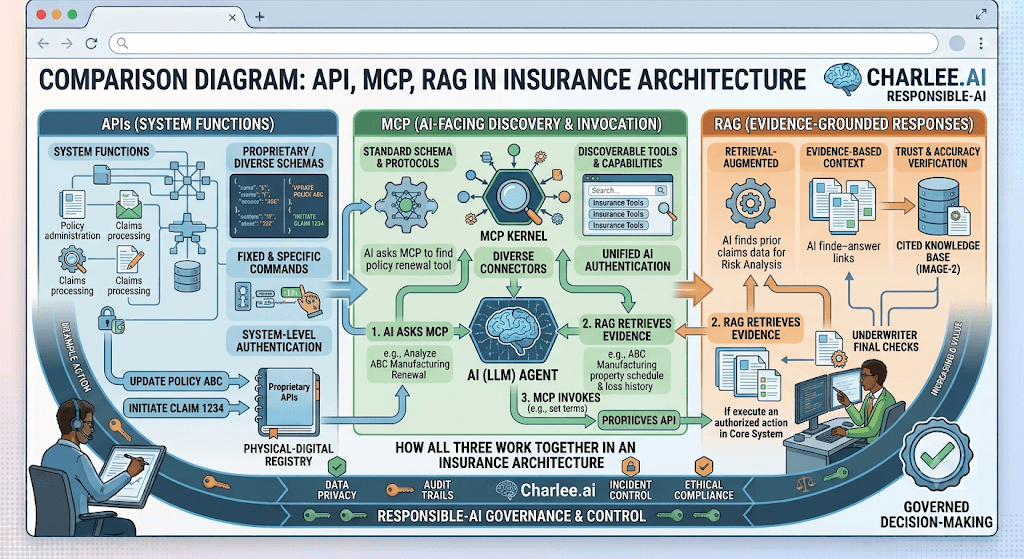
| Does MCP replace APIs? | No. MCP commonly wraps or orchestrates existing APIs, services, databases, and enterprise applications. |
| Is MCP only for generative AI? | It is designed for LLM-enabled applications, but the connected tools may invoke predictive models, rules, analytics, or conventional services. |
| Is MCP inherently secure? | No. Security depends on implementation: authentication, authorization, consent, tool design, data minimization, transport security, and monitoring. |
Executive Summary
Insurance AI initiatives frequently begin with a narrow assistant connected to one document repository or one operational system. As use cases expand, carriers face a recurring integration problem: every AI experience needs a reliable way to discover available capabilities, retrieve context, invoke tools, and return results while respecting enterprise controls. Point-to-point integrations can work, but they become expensive and inconsistent when each application implements its own connector patterns, security assumptions, schemas, and error handling.
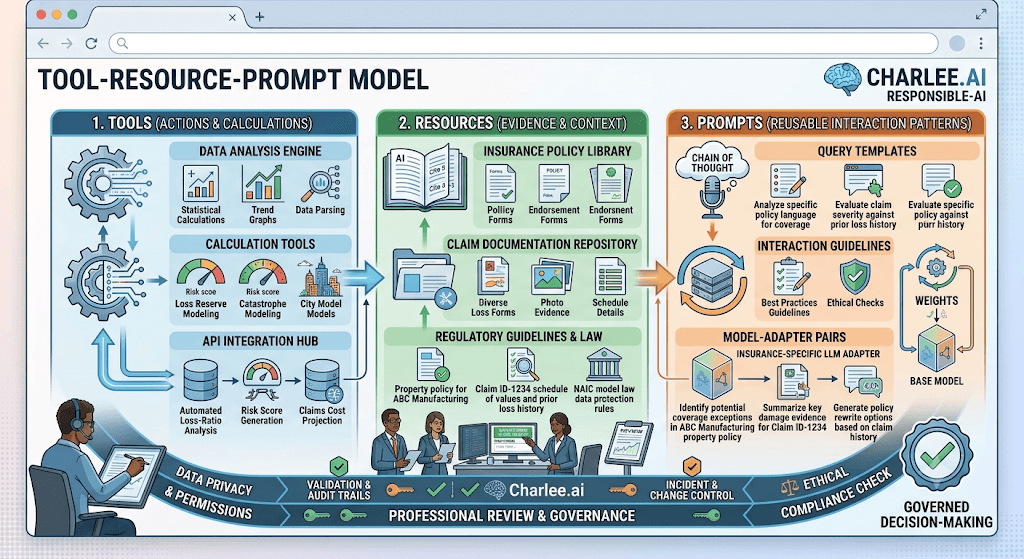
Model Context Protocol addresses part of that problem by defining a common protocol between AI applications and external capability providers. In the MCP architecture, the host is the AI-enabled application. It creates clients that communicate with MCP servers. Servers can expose tools, resources, and prompts. A tool can query a claim, retrieve policy details, calculate a value, create a draft, or initiate a governed workflow. A resource can provide controlled context such as a policy form, claim note, underwriting guideline, or model documentation. A prompt can package a reusable interaction pattern.
For insurers, MCP is most valuable when it provides a controlled façade over existing enterprise services. It can make capabilities easier for approved AI applications to discover and use without giving the model direct, unrestricted access to databases or core platforms. A claims assistant might use one MCP server for claim-system queries, another for document retrieval, and another for analytics. An underwriting assistant could retrieve submission data, appetite rules, prior-loss context, and referral guidance through separately governed servers.
MCP does not eliminate the need for integration engineering. Existing APIs still need to be reliable. Identity still needs to flow correctly. Data entitlements still need to be enforced. Tool schemas must be carefully designed. Business actions must be validated. Observability, testing, model governance, privacy, and incident response remain essential. The protocol standardizes communication; the carrier remains responsible for the safety and correctness of the connected system.
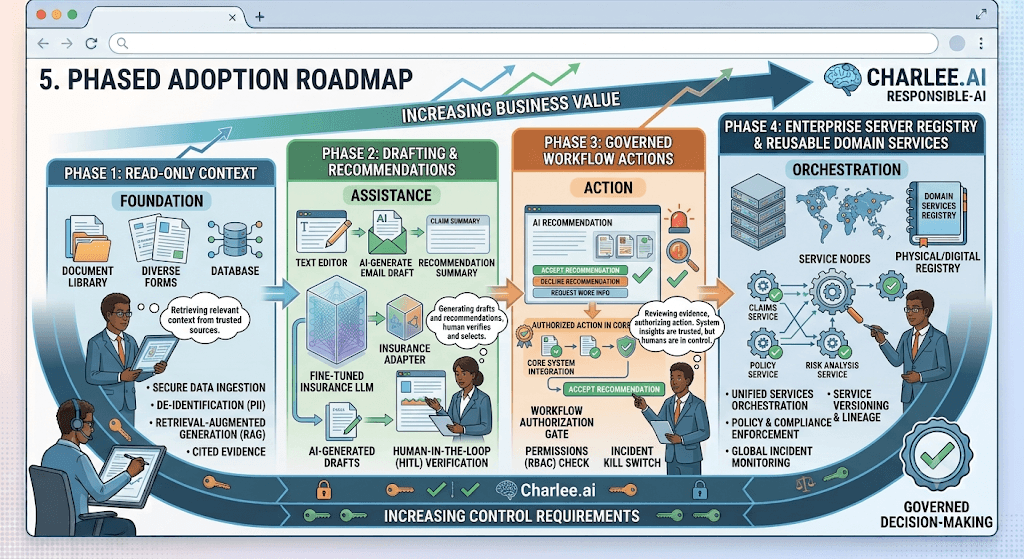
The recommended insurance operating model is progressive. Begin with low-risk, read-only tools. Add narrowly scoped drafting and analysis capabilities. Introduce write actions only after authorization, approval, idempotency, rollback, and audit controls are proven. Preserve professional accountability: the AI may gather, organize, explain, and recommend, but authorized insurance professionals remain responsible for claim, underwriting, coverage, payment, and customer decisions.
Three Definitions
Executive Definition
MCP is a standardized way for approved AI applications to use enterprise information and capabilities through governed connections rather than bespoke integrations for every use case.
Technical Definition
MCP is an open, JSON-RPC-based protocol for stateful or protocol-defined exchanges between hosts, clients, and servers. Servers expose primitives such as tools, resources, and prompts; clients and servers negotiate supported capabilities during initialization and communicate over defined transports such as standard input/output or Streamable HTTP.
Insurance Definition
In P&C insurance, MCP is a potential integration layer through which AI assistants and agents can retrieve claim, policy, submission, document, and analytics context—or invoke tightly controlled workflow actions—while the carrier enforces identity, authorization, data access, business rules, approvals, and auditability.
Why MCP Matters in Property & Casualty Insurance
The Enterprise Integration Problem
A typical insurer operates multiple systems of record, document repositories, data platforms, analytical services, portals, and third-party products. AI experiences often need context from several of them at once. Without a standard interaction pattern, every use case may require custom discovery, authentication, schema mapping, invocation logic, and response handling.
| Insurance Challenge | Conventional Result | Potential MCP Contribution |
|---|---|---|
| Multiple core and ancillary systems | Repeated custom connectors and inconsistent interfaces | A common protocol surface over approved capabilities |
| Different AI applications | Duplicated integration work | Reusable server capabilities across approved hosts |
| Sensitive data and regulated workflows | Broad access creates unacceptable risk | Narrow tools and resource scopes with explicit control points |
| Fast-changing AI platforms | Integration lock-in and rework | A protocol boundary that can reduce dependence on one host implementation |
| Need for evidence and auditability | Opaque AI behavior | Tool-level logging, traceable inputs, outputs, approvals, and system responses |
| Legacy modernization constraints | Pressure for wholesale replacement | A controlled bridge to existing APIs, services, batch, and document workflows |
Where MCP Adds Value—and Where It Does Not
VALUE
MCP adds value when several AI experiences need consistent, governed access to the same enterprise capabilities, or when a carrier wants a reusable tool and resource layer across claims, underwriting, service, and operations.
Where MCP Adds Value—and Where It Does Not
LIMIT
MCP adds little value when a use case is simple, static, and already served well by one direct integration. It should not be adopted merely because it is fashionable.
MCP Architecture
Core Components
| Component | Role | Insurance Example |
|---|---|---|
| Host | The AI-enabled application that coordinates user interaction, model use, policy enforcement, and multiple client connections. | Claims workbench assistant, underwriting copilot, management intelligence portal. |
| Client | A protocol component created by the host that maintains a connection to one server and handles negotiation and message exchange. | A claims host creates separate clients for claim data, documents, and analytics servers. |
| Server | A focused service that exposes tools, resources, or prompts and mediates access to underlying systems. | A policy server exposes policy lookup and form retrieval; a claim server exposes read-only claim summaries. |
| Underlying system | The API, application, database, service, model, or repository that performs the real business function. | Guidewire, Duck Creek, DXC, document platform, data warehouse, predictive model, payment service. |
Conceptual Flow
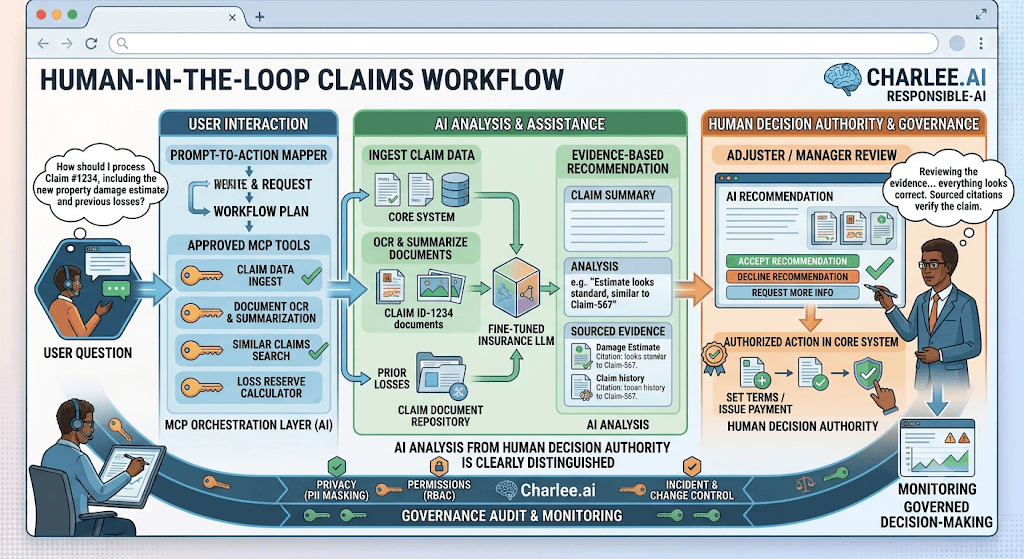
An insurance professional asks the host application a question or requests an action.
The host interprets the request and determines which approved server capability may be relevant.
The client discovers or invokes the tool, resource, or prompt through the MCP connection.
The server authenticates and authorizes the request, validates inputs, and calls the underlying enterprise service.
The server returns structured results, errors, evidence, or resource links.
The host presents the result, requests approval when required, and records the interaction for audit and monitoring.
Capability Negotiation and Lifecycle
MCP connections begin with initialization and protocol-version negotiation. Clients and servers declare supported capabilities. During operation, they exchange requests, responses, notifications, and utility messages. Controlled shutdown, timeouts, cancellation, and error handling are part of a production implementation. Insurers should record negotiated versions and server capabilities because behavior may differ by version and deployment.
Capability Negotiation and Lifecycle
DESIGN PRINCIPLE
Each server should have a focused responsibility and a clear trust boundary. A broad “enterprise everything” server is easier to build initially but harder to secure, test, explain, and govern.
The Core MCP Primitives
Tools
Tools are executable functions exposed to the AI application. They may retrieve information, perform calculations, call an API, or initiate a workflow. Tool descriptions and input schemas help the model determine when and how to use them, but tool descriptions must not be treated as a substitute for authorization or server-side validation.
| Tool Pattern | Insurance Example | Recommended Control |
|---|---|---|
| Read-only lookup | Retrieve claim status, assigned adjuster, open exposures, or policy dates. | Entitlement checks, field filtering, purpose limitation, logging. |
| Analytical tool | Run a severity, litigation, subrogation, or fraud model. | Model-version tracking, feature validation, confidence and explanation output. |
| Drafting tool | Create a draft claim summary, underwriting referral, or customer communication. | Source evidence, template controls, professional review before release. |
| Workflow tool | Create a task, route a referral, or request documentation. | Allowed state transitions, idempotency, approval thresholds. |
| Financial or coverage action | Change a reserve, issue a payment, deny coverage, bind risk, or close a claim. | Normally prohibited or subject to explicit authority, dual control, validation, and immutable audit. |
Resources
Resources provide contextual data or content. Examples include a policy form, a claim document, a guideline, a data dictionary, or model documentation. Resource access should be filtered by user identity, claim or policy entitlement, jurisdiction, business purpose, and retention rules. Returning a URI or resource link can be preferable to copying sensitive content into every message.
Prompts
Prompts are reusable templates or interaction patterns. In insurance, prompts can standardize a claim-file review, underwriting submission summary, reserve discussion, litigation referral, or management briefing. Prompt governance should include ownership, versioning, testing, approved data sources, prohibited outputs, and review requirements.
Client-Side Features
MCP specifications also define client-side capabilities such as model sampling, user elicitation, and boundary information. These features can be useful, but they expand the trust relationship. Carriers should enable only the capabilities required for the use case and should clearly control what prompts, data, and results a server can access.
MCP Is Not a System of Record
The protocol should never become an alternate source of truth. Claim, policy, billing, and underwriting systems remain authoritative. MCP servers should return the system source, retrieval time, record identifiers, and relevant version information so that users can verify results and reconcile discrepancies.
Claims Applications
| Use Case | MCP-Enabled Pattern | Professional Authority |
|---|---|---|
| Claim file review | Retrieve structured claim data, recent notes, documents, and predictive insights through separate governed servers. | Adjuster or manager determines action and documentation. |
| Demand package analysis | Fetch documents, run IDP extraction, compare allegations and damages, and generate a sourced summary. | Claims professional evaluates liability, damages, coverage, and negotiation strategy. |
| Reserve monitoring | Combine claim changes, medical events, attorney signals, litigation indicators, and current reserves. | Authorized professional determines reserve adequacy and records rationale. |
| Litigation monitoring | Retrieve counsel updates, deadlines, pleadings, and predictive indicators. | Claims and legal professionals decide litigation strategy. |
| Subrogation identification | Use tools to review facts, parties, contracts, and evidence for recovery potential. | Subrogation professional confirms theory and pursues recovery. |
| Catastrophe response | Coordinate claim lookup, image or document analysis, vendor status, and triage queues. | CAT leadership controls prioritization and customer response. |
| Customer communication | Draft status updates grounded in claim facts and approved templates. | Authorized employee reviews and releases communications. |
Detailed Claims Scenario: Complex Bodily Injury Claim
A claims manager asks an AI workbench to identify material developments across a portfolio of open bodily injury claims. The host connects to several MCP servers: a claim-system server, a document-intelligence server, a predictive-analytics server, and a litigation-information server.
The claim server returns current reserves, exposures, assignments, dates, and recent activity. The document server returns extracted facts from medical reports, demand packages, and correspondence. The analytics server returns severity and litigation indicators with model version, confidence, and explanation. The litigation server returns attorney involvement and upcoming deadlines.
The host assembles a review package that identifies a new surgery recommendation, recent attorney representation, a demand amount, a coverage issue, and a reserve that may no longer reflect the exposure. It links every finding to source evidence. The system recommends management review but does not change the reserve or send a communication.
The claims manager reviews the evidence, consults the adjuster, determines the appropriate action, and documents the decision. Tool calls, returned evidence, model outputs, and the final human decision are retained for audit and performance analysis.
Detailed Claims Scenario: Complex Bodily Injury Claim
KEY CONTROL
The server can surface a potential reserve mismatch, but only an authorized insurance professional should establish or change the reserve. The workflow must distinguish analysis, recommendation, approval, and system-of-record action.
Underwriting Applications
| Use Case | MCP-Enabled Pattern | Professional Authority |
|---|---|---|
| Submission intake | Use IDP and system tools to extract, validate, and organize submission information. | Underwriter determines completeness and next steps. |
| Appetite assessment | Retrieve approved appetite rules, product guidance, jurisdiction constraints, and portfolio context. | Underwriter applies judgment and escalation requirements. |
| Risk research | Query property, vehicle, business, loss, and external data sources through controlled tools. | Underwriter assesses relevance, reliability, and permissible use. |
| Referral preparation | Assemble evidence, exceptions, pricing factors, and a structured referral memo. | Authorized referral authority decides. |
| Portfolio analysis | Connect risk-level data with accumulation, concentration, and performance analytics. | Portfolio leaders set strategy and constraints. |
| Quote and bind workflow | Prepare data and validation results for downstream systems. | Binding authority and system controls remain decisive. |
Detailed Underwriting Scenario: Commercial Property Submission
An underwriter receives a submission containing applications, schedules, statements of values, prior-loss reports, photographs, inspection material, and broker correspondence. The AI host uses an MCP document server to classify and extract information, a policy-system server to retrieve account history, a catastrophe server to obtain hazard context, and an underwriting-guideline server to retrieve current appetite and referral rules.
The host identifies missing roof-age information, a discrepancy in total insured value, a concentration concern, and a loss trend requiring review. It prepares a sourced risk summary and a referral package. Each tool returns provenance, timestamp, and data-quality indicators.
The underwriter validates the information, contacts the broker for missing data, assesses risk quality, and determines terms. The AI reduces search and preparation effort but does not independently select risk, set price, or bind coverage.
Enterprise Integration Patterns
Pattern 1: Read-Only Context Layer
Servers expose narrowly scoped read tools and resources. This is the recommended starting pattern because it limits operational risk while proving identity propagation, data filtering, logging, latency, and usefulness.
Pattern 2: Governed Workflow Orchestration
Tools create tasks, route referrals, request documents, or initiate existing workflows. The server validates allowed transitions and returns a workflow identifier. The AI does not directly manipulate core tables or bypass business services.
Pattern 3: Analytics and Model Services
Servers expose predictive, rules, optimization, or document-intelligence services with standardized inputs and outputs. Responses include model or rules version, explanation, confidence, limitations, and monitoring metadata.
Pattern 4: Federated Domain Servers
Claims, policy, underwriting, documents, analytics, and enterprise knowledge are separated into domain servers. This supports distinct ownership, release cadence, entitlement models, and risk classifications.
Pattern 5: Legacy Modernization Bridge
An MCP server provides an AI-facing interface over existing APIs, message services, batch processes, or—only where necessary—controlled UI automation. The underlying legacy system remains unchanged while the carrier modernizes access incrementally.
Pattern 5: Legacy Modernization Bridge
| Pattern | Best Starting Use | Primary Risk |
|---|---|---|
| Read-only context | Search, summarization, portfolio review | Data overexposure or stale context |
| Workflow orchestration | Task creation, referrals, document requests | Unauthorized or duplicate actions |
| Model service | Severity, litigation, fraud, extraction | Uncontrolled model use or misinterpretation |
| Federated domains | Enterprise scale and ownership | Inconsistent standards and server sprawl |
| Legacy bridge | Incremental modernization | Fragile integration and hidden operational dependencies |
Security, Privacy, and Trust Architecture
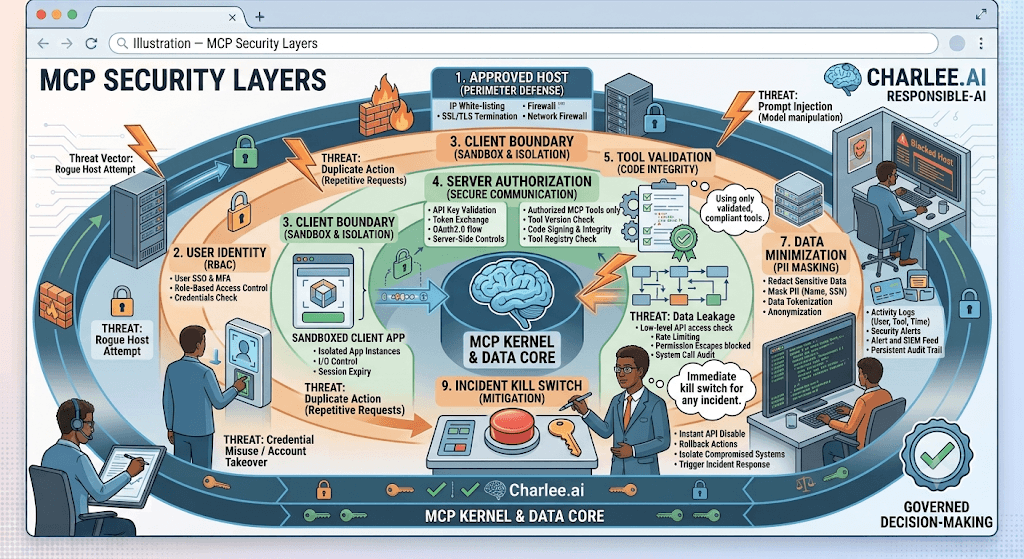
Core Security Principles
- Explicit user consent and understandable action review.
- Least-privilege access based on user, role, claim, policy, account, jurisdiction, and purpose.
- Strong authentication and authorization for remote servers; carefully managed credentials for local servers.
- Data minimization: return only fields and documents needed for the task.
- Server-side validation of every input and action; never rely solely on model behavior.
- Segregation of read, draft, recommend, approve, and execute privileges.
- Comprehensive logging of identity, server, tool, parameters, source systems, responses, approvals, errors, and final outcomes.
- Transport security, origin validation, network controls, secrets management, and dependency security.
- Human review for consequential actions and communications.
- Incident response that can disable a server, tool, credential, or host integration quickly.
Threats and Mitigations
| Threat | Insurance Impact | Mitigation |
|---|---|---|
| Prompt injection in documents or resources | Malicious text attempts to redirect the model or trigger tools. | Treat retrieved content as untrusted; separate instructions from data; enforce server policy and approval. |
| Over-permissioned tool | A user or model accesses claims or actions beyond authority. | Fine-grained scopes, entitlement checks, deny-by-default design, test personas. |
| Token or credential theft | Unauthorized access to sensitive systems. | Short-lived credentials, secure storage, audience restriction, rotation, monitoring. |
| Confused-deputy behavior | A server uses a user token for an unintended resource. | Resource indicators, audience validation, explicit authorization boundaries. |
| Tool-description manipulation | A server misrepresents what a tool does. | Trust only approved servers; independent policy enforcement and code review. |
| Sensitive-data leakage | PII, PHI, financial, or legal data reaches an unauthorized host or model. | Data classification, redaction, approved model endpoints, field filtering, DLP. |
| Duplicate or replayed action | Repeated task, payment, or system update. | Idempotency keys, transaction checks, nonces, workflow-state validation. |
| Supply-chain compromise | Malicious server package or dependency. | Signed artifacts, scanning, pinned versions, SBOM, controlled deployment pipeline. |
| Unbounded agent loop | Repeated calls create cost, latency, or operational harm. | Call budgets, timeouts, step limits, cancellation, approval gates. |
Governance and Operating Model
Required Governance Artifacts
| Artifact | Minimum Content |
|---|---|
| Server inventory | Owner, purpose, environment, data classification, tools, resources, prompts, dependencies, risk tier. |
| Tool catalog | Business description, inputs, outputs, allowed users, action level, approval requirement, failure behavior. |
| Data map | Source systems, fields, documents, jurisdictions, retention, masking, downstream model exposure. |
| Control matrix | Authentication, authorization, consent, validation, logging, monitoring, human review, rollback. |
| Test evidence | Functional, security, privacy, adversarial, performance, failover, and user-acceptance results. |
| Change record | Protocol version, server version, tool schema changes, compatibility assessment, approvals. |
| Incident playbook | Disablement, credential revocation, containment, notification, evidence preservation, recovery. |
| Outcome monitoring | Usage, error, latency, approval, override, business impact, fairness, and complaint indicators. |
Risk Tiering
| Tier | Capability | Typical Control |
|---|---|---|
| 1 — Informational | Public or low-sensitivity resources; no business action. | Standard access, logging, content quality checks. |
| 2 — Sensitive Read | Claim, policy, underwriting, or customer data. | Strong entitlement, minimization, audit, approved hosts/models. |
| 3 — Draft / Recommend | Draft communications, referrals, reserve observations, risk recommendations. | Evidence, disclosure, mandatory professional review. |
| 4 — Operational Action | Create tasks, update non-financial workflow fields, request documents. | Explicit confirmation, state validation, idempotency, rollback. |
| 5 — Consequential Action | Payment, reserve, coverage, claim closure, pricing, binding, adverse communication. | Generally prohibited for autonomous execution; formal authority and dual controls where permitted. |
Risk Tiering
GOVERNANCE RULE
The protocol’s technical ability to expose a tool does not create business authority to use it. Authority must come from the insurer’s policies, role design, delegated limits, and approved workflow.
Implementation Blueprint
| Phase | Action | Evidence of Readiness |
|---|---|---|
| 1 | Define the business outcome | Select a workflow with measurable friction, a clear user, and a bounded decision or action. |
| 2 | Map systems and authority | Identify systems of record, data owners, existing APIs, user entitlements, and decision rights. |
| 3 | Choose a low-risk first capability | Begin with read-only claim, policy, guideline, or document access. |
| 4 | Design the server boundary | Keep the server domain-focused; separate high-risk actions from routine retrieval. |
| 5 | Design tool schemas | Use clear names, precise descriptions, constrained inputs, structured outputs, and explicit errors. |
| 6 | Implement identity and authorization | Propagate user identity where appropriate; enforce server-side access to every resource and action. |
| 7 | Add provenance and evidence | Return source identifiers, timestamps, versions, confidence, and links needed for review. |
| 8 | Build approval and action controls | Separate recommendations from execution; add confirmation, idempotency, and rollback. |
| 9 | Test adversarially | Test prompt injection, malformed inputs, excessive access, stale data, retries, timeouts, and server failure. |
| 10 | Pilot with trained professionals | Observe actual work, overrides, delays, missing context, and trust concerns. |
| 11 | Measure business and control outcomes | Track adoption, time saved, accuracy, completion, overrides, incidents, and downstream results. |
| 12 | Scale through standards | Use a server registry, reusable control patterns, versioning, ownership, and architecture review. |
Minimum Production Readiness Checklist
- Named business and technical owner.
- Documented data classification and permitted purpose.
- Approved server and dependency inventory.
- Authentication, authorization, and least-privilege tests.
- Structured tool inputs and outputs with validation.
- Source provenance and timestamps.
- Timeout, retry, cancellation, and error behavior.
- Idempotency and duplicate-action protection where applicable.
- User confirmation and human-review rules.
- Central logging, alerting, and server kill switch.
- Protocol and server version compatibility plan.
- User training and operating procedures.
Evaluation and Performance Metrics
| Dimension | Example Metrics | Why It Matters |
|---|---|---|
| Technical reliability | Success rate, error rate, timeout rate, retry rate, availability. | Unreliable tools erode trust and can interrupt operations. |
| Latency | Median and tail latency by tool and workflow. | Insurance users need responsive workbenches, especially during claim and submission review. |
| Retrieval quality | Relevant evidence found, missing sources, stale-data rate. | Good model output cannot compensate for incomplete or incorrect context. |
| Action safety | Unauthorized attempts blocked, duplicate actions prevented, approval compliance. | Measures whether controls operate as designed. |
| Human effectiveness | Time saved, review time, adoption, override rate, escalation quality. | Shows whether the integration improves professional work. |
| Business outcome | Cycle time, leakage reduction, reserve-review timeliness, referral quality, service level. | Links technology to insurance value. |
| Governance | Audit completeness, policy exceptions, incidents, remediation time. | Demonstrates control effectiveness and accountability. |
| Cost | Tool-call cost, model cost, infrastructure cost, support cost per workflow. | Prevents hidden expense from excessive or inefficient orchestration. |
Evaluation Principle
Do not evaluate MCP only as infrastructure. Evaluate the entire workflow: whether the right information was obtained, whether the user understood the evidence, whether unauthorized activity was prevented, whether the professional decision improved, and whether the business outcome justified the complexity.
Best Practices
Start with read-only access
Prove identity, entitlements, relevance, latency, and logging before exposing write operations.
Use narrow, business-meaningful tools
Prefer get_claim_summary or create_underwriting_referral over generic database-query tools.
Enforce policy in code
The model may suggest a tool call, but the server must determine whether it is allowed.
Return structured evidence
Include record identifiers, timestamps, source systems, model versions, and links.
Separate analysis from action
Use different tools, permissions, and approval steps for recommendations and system changes.
Design for failure
Assume systems will time out, return partial data, change schemas, or become unavailable.
Version everything
Track protocol, server, tool, schema, prompt, model, and policy versions.
Keep humans accountable
Make review expectations visible and preserve the professional’s rationale and decision.
Operate a curated registry
Only approved servers should be available in production; ownership and risk tier must be clear.
Monitor real outcomes
Usage volume is not success. Measure quality, safety, time, cost, and insurance results.
Common Mistakes
| Mistake | Why It Fails | Better Approach |
|---|---|---|
| Treating MCP as a replacement for APIs | The underlying business services and controls still need to exist. | Use MCP as an AI-facing protocol over reliable enterprise services. |
| Building one all-powerful server | It creates excessive access and a large blast radius. | Use domain servers and risk-based separation. |
| Trusting tool descriptions | Descriptions can be incomplete, stale, or malicious. | Approve servers, inspect code, and enforce policy independently. |
| Giving the model database access | Generic query power can expose or alter uncontrolled data. | Expose narrowly scoped business tools. |
| Skipping identity propagation | The server cannot enforce user-specific entitlements. | Use an explicit identity and authorization design. |
| Allowing autonomous consequential actions | Errors can affect customers, reserves, payments, and coverage. | Require human authority and formal workflow controls. |
| Ignoring data provenance | Users cannot verify results or resolve conflicts. | Return source, timestamp, identifier, and version. |
| No version strategy | Protocol or schema changes can break workflows. | Test compatibility and maintain controlled releases. |
| Measuring demos rather than operations | A compelling demonstration may fail under real volume and edge cases. | Pilot in production-like conditions and monitor outcomes. |
| Assuming protocol standardization equals governance | MCP defines communication, not the carrier’s business policy. | Build governance around the protocol and connected services. |
Executive Decision Guide
MCP May Be a Good Fit When…
- Multiple approved AI applications need access to the same enterprise capabilities.
- The carrier wants to reduce repeated point-to-point AI connector work.
- The underlying APIs and services are sufficiently reliable and governable.
- The organization can operate a server registry, ownership model, security review, and monitoring process.
- Use cases benefit from dynamic discovery of tools, resources, or prompts.
- The carrier is building a governed agent or copilot architecture across domains.
MCP May Not Be the Right Priority When…
- There is only one simple use case and one stable direct integration.
- Core data quality and API reliability are unresolved.
- Identity, authorization, and logging are not mature enough for AI-connected tools.
- The organization cannot define ownership or support production servers.
- The proposed use case depends on broad autonomous authority rather than constrained professional workflows.
- The business value does not justify another architectural layer.
Executive Questions
- Which specific insurance workflow will improve, and how will improvement be measured?
- What information or action will each server expose, and to whom?
- Which system remains authoritative?
- How is user identity carried to the server and underlying system?
- Which actions require confirmation, professional approval, or dual control?
- How will the carrier disable a compromised server or tool?
- How will protocol, schema, and tool versions be managed?
- What evidence will be retained for audit, complaints, litigation, and model governance?
- What is the fallback process when the server, model, or source system is unavailable?
The Charlee.ai Perspective
Insurance value does not come from connecting a language model to more systems. It comes from connecting professionals to better information, earlier insight, reliable evidence, and governed workflow actions. MCP can support that objective when it is used as part of a broader claims and underwriting intelligence architecture.
For claims, a governed protocol layer can help an AI workbench retrieve current claim facts, analyze new documents, surface severity or litigation signals, explain the evidence, and prepare a review package. For underwriting, it can help organize submissions, validate data, retrieve appetite guidance, add portfolio context, and prepare referrals. In both cases, the professional remains responsible for the decision.
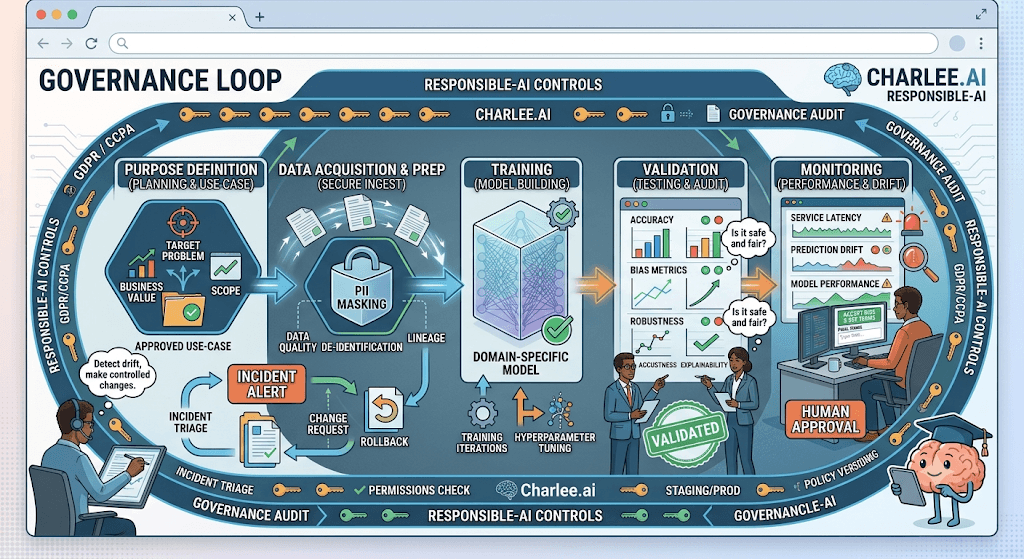
Charlee.ai’s responsible-AI position is that purpose, data, model output, explanation, source evidence, professional review, decision documentation, monitoring, and controlled change must operate as one governance loop. MCP can standardize part of the connection layer, but it cannot substitute for insurance expertise, data governance, model governance, or accountable management.
RESPONSIBLE-AI OPERATING LOOP
Approved purpose and data → governed MCP retrieval or tool use → validated AI analysis → explanation and source evidence → professional review → decision and documentation → monitoring, feedback, incident response, and controlled change.
Key Takeaways
- MCP standardizes how AI applications connect to tools, resources, and prompts; it does not replace underlying APIs or business controls.
- Insurance implementations should begin with narrow, read-only capabilities and mature progressively.
- Identity, authorization, data minimization, tool validation, provenance, logging, and incident response are mandatory enterprise concerns.
- Claims, underwriting, coverage, reserve, payment, and customer decisions remain the responsibility of authorized insurance professionals.
- The best business case is reusable, governed interoperability across multiple approved AI experiences—not protocol adoption for its own sake.
ONE-SENTENCE DEFINITION
Model Context Protocol (MCP) is an open protocol that standardizes how AI applications connect to external tools, data resources, and reusable prompts through a host–client–server architecture.
Frequently Asked Questions
It is a common way for AI applications to discover and use approved external information and functions.
MCP originated as an open protocol initiative and is maintained through an evolving public specification and ecosystem.
No. MCP frequently calls REST, GraphQL, SOAP, database, messaging, or other services behind the server.
No. It is a protocol. A server may connect to a database, but the database remains separate.
No. RAG is a pattern for retrieving evidence to ground model output. MCP can expose retrieval tools or resources used by RAG.
No. Assistants, copilots, workbenches, and other LLM applications can use it. Agents are one important use case.
Structured functions that an AI application can invoke, such as retrieving a claim or creating a referral task.
Contextual data or content that can be discovered or retrieved, such as a policy form or claim document.
Reusable prompt templates or interaction patterns offered by a server for user-controlled use.
Technically yes, through an approved tool. Operationally, write actions should be narrowly scoped and subject to authority, validation, confirmation, and audit.
No protocol can make an unsafe implementation safe. Security depends on server trust, identity, authorization, transport, tool design, data controls, and monitoring.
Generally no. Reserve authority should remain with authorized professionals under established controls.
Yes, when a server wraps existing APIs or controlled integration services. It should not hide fragile dependencies or bypass system governance.
By focused business domain and trust boundary, with clear ownership and risk tiering.
User and host identity, server and tool, parameters, source systems, results, errors, approvals, system responses, and final outcome.
With one measurable, read-only workflow and a small number of approved tools or resources.
Exposing broad tools before identity, authorization, validation, and human-review controls are mature.
A safer, reusable integration pattern that measurably improves insurance work without weakening accountability or system-of-record controls.