Fine-Tuning
Fine-tuning is the controlled process of further training a pre-trained model on curated examples so that its behavior becomes more consistent for a defined domain, task, style, or decision-support workflow. In insurance, it adapts foundation models for specialized language and tasks without confusing customization with control.
How insurers adapt foundation models for specialized language, tasks, and operating contexts—without confusing customization with control.
A practical executive and technical guide for claims, underwriting, data, technology, legal, compliance, and AI governance leaders.
| Publication field | Details |
|---|---|
| Edition | Production Edition 1.0 |
| Audience | P&C insurance executives, claims and underwriting leaders, AI product owners, data scientists, risk and compliance teams |
| Primary focus | Responsible adaptation of foundation models for insurance-specific behavior |
| Editorial principle | AI augments professional judgment; governed humans remain accountable for decisions |
| Companion entries | LLMs, RAG, embeddings, vector databases, prompt engineering, model governance |
Executive Snapshot
ONE-SENTENCE DEFINITION
Fine-tuning is the controlled process of further training a pre-trained model on curated examples so that its behavior becomes more consistent for a defined domain, task, style, or decision-support workflow.
| Question | Executive answer |
|---|---|
| What problem does it solve? | Repeated prompting cannot reliably produce the specialized behavior, vocabulary, format, or classification discipline a workflow requires. |
| What does it not solve? | It does not automatically provide current facts, source evidence, authorization controls, or regulatory compliance. |
| When is it most useful? | When an insurer has a stable, high-volume task; strong labeled examples; measurable quality criteria; and a governance process for testing changes. |
| What is the major risk? | Embedding flawed labels, outdated practices, bias, or unsafe behavior into a model that appears authoritative. |
| What is the executive takeaway? | Use fine-tuning selectively. Prefer prompting and RAG first when they can meet the need with lower cost and risk. |
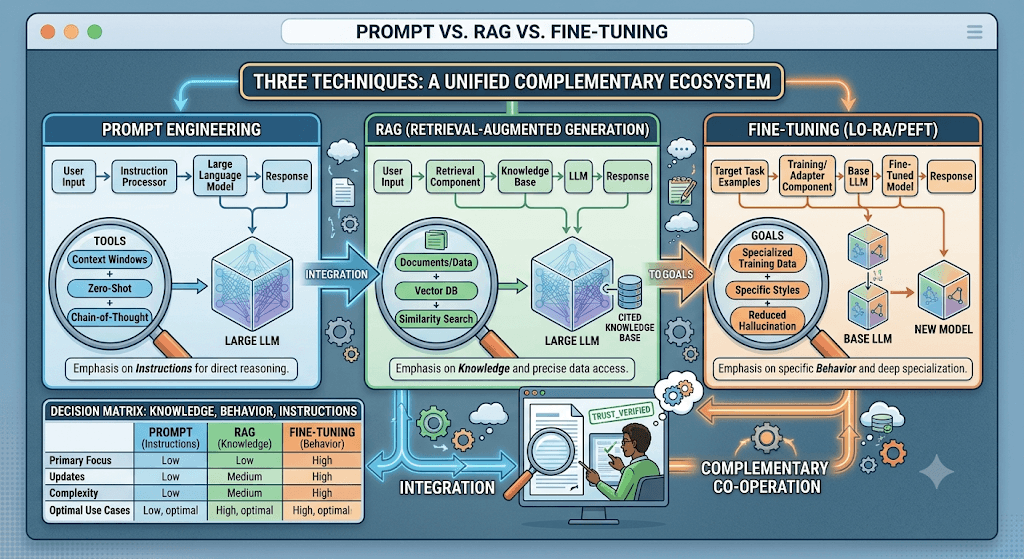
Fine-tuning changes model behavior. RAG changes what information the model can retrieve. Prompt engineering changes how the model is instructed. Most enterprise insurance solutions need a deliberate combination—not a single technique presented as a cure-all.
LEADERSHIP PERSPECTIVE
Executive Summary
Foundation models are broad, capable, and increasingly useful, but they are not born understanding an insurer’s claim taxonomy, underwriting appetite language, preferred explanation style, escalation thresholds, or documentation conventions. Fine-tuning can narrow that gap by adapting a model with curated examples that represent the desired behavior.
For property and casualty insurers, the strongest use cases are rarely “teach the model all insurance knowledge.” More defensible objectives are specific: classify incoming claim correspondence, extract standardized exposure signals, generate a structured claim chronology, normalize underwriting submission language, or produce a consistent referral summary. The narrower the target behavior, the easier it is to evaluate, govern, and improve.
Fine-tuning should be treated as a model change program—not a one-time technical exercise. It requires data rights, label quality, privacy controls, representative evaluation sets, bias testing, versioning, rollback plans, and human review. A model can become more fluent while becoming less accurate, less fair, or less transparent. Business acceptance criteria must therefore be defined before training begins.
CHARLEE.AI PERSPECTIVE
The goal is not to make an AI system sound more like an insurance expert. The goal is to make it produce more reliable, evidence-aware, workflow-ready assistance while preserving professional authority, source traceability, and control.
REFERENCE SUMMARY
Quick Facts
| Dimension | Fine-tuning reality |
|---|---|
| Core input | Curated training examples—typically prompt/response pairs, labels, demonstrations, or preference comparisons |
| Core output | A new model version or adapter that exhibits modified behavior |
| Best fit | Stable, repeated tasks with enough high-quality examples and clear evaluation criteria |
| Weak fit | Rapidly changing facts, one-off questions, poorly defined tasks, or workflows lacking labeled data |
| Common methods | Supervised fine-tuning, instruction tuning, preference tuning, LoRA, QLoRA, adapters |
| Primary measures | Task accuracy, factuality, format adherence, calibration, safety, fairness, latency, and cost |
| Governance need | High: training data, evaluation, approvals, release control, monitoring, incident response, retraining |
| Human role | Define acceptable behavior, label examples, review outputs, handle exceptions, and own decisions |
CORE TERMINOLOGY
Definitions
Executive definition
Fine-tuning is a method for making an existing AI model more dependable for a specific business purpose by training it further on approved examples of the behavior the organization wants.
Technical definition
Fine-tuning updates some or all model parameters—or trains lightweight adapter parameters—using a domain- or task-specific dataset and an optimization objective. The resulting model is evaluated against held-out examples and safety tests before release.
Insurance definition
In P&C insurance, fine-tuning adapts a general model to insurance language, classifications, formats, and workflow conventions, such as identifying litigation indicators, structuring medical chronology, classifying loss descriptions, or drafting referral summaries for human review.
Important distinction
BEHAVIOR VS. KNOWLEDGE
Fine-tuning is usually best for changing patterns of behavior. It is not the best mechanism for keeping a model current on policy forms, claim files, regulations, or account-specific facts. Those needs are generally better served through governed retrieval and system integration.
Important distinction
TECHNICAL FOUNDATION
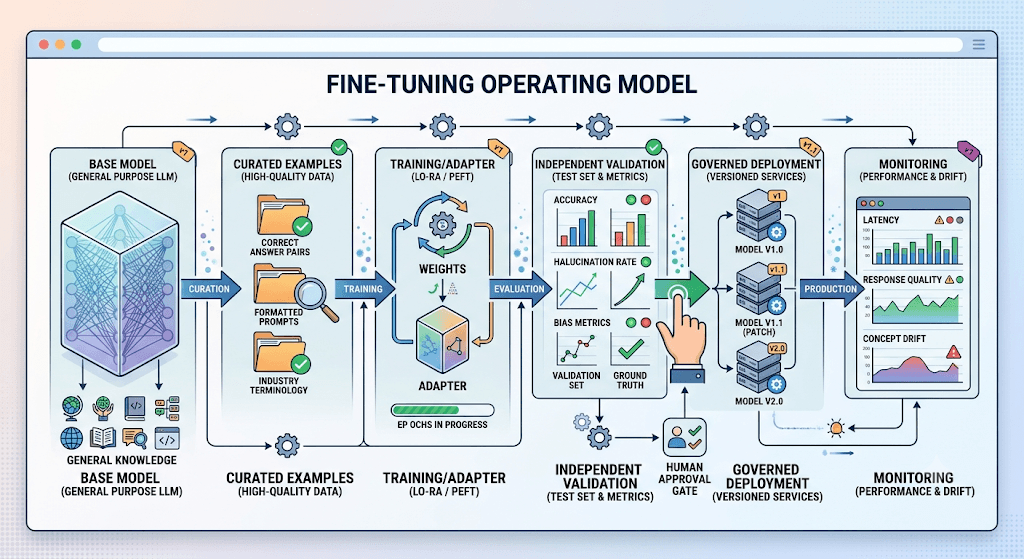
How Fine-Tuning Works
Define the target task and measurable acceptance criteria.
Collect and legally approve representative examples.
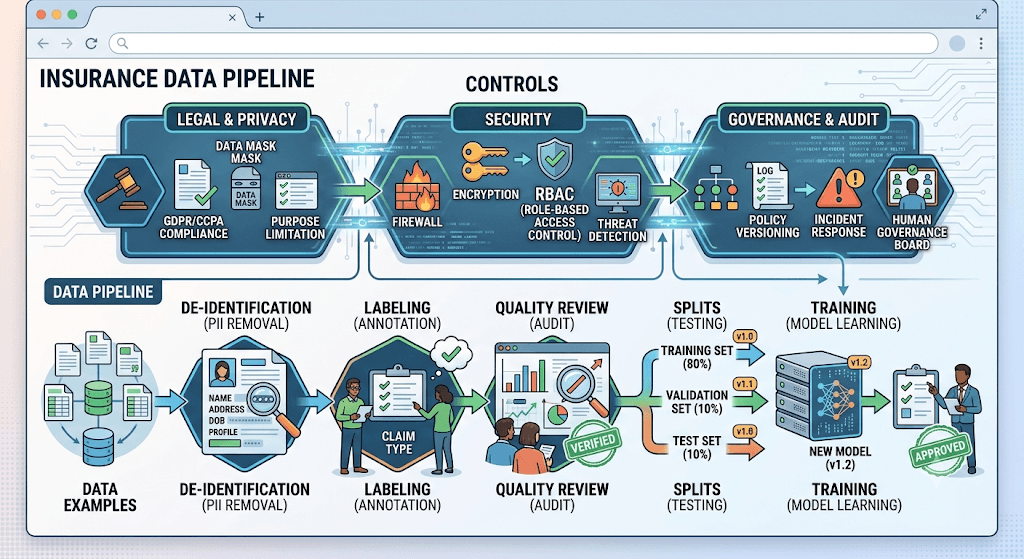
Clean, de-identify, label, and structure the training data.
Split examples into training, validation, and independent test sets.
Choose a base model and adaptation method.
Train the model or adapter while monitoring loss and overfitting.
Evaluate business quality, safety, fairness, privacy, and robustness.
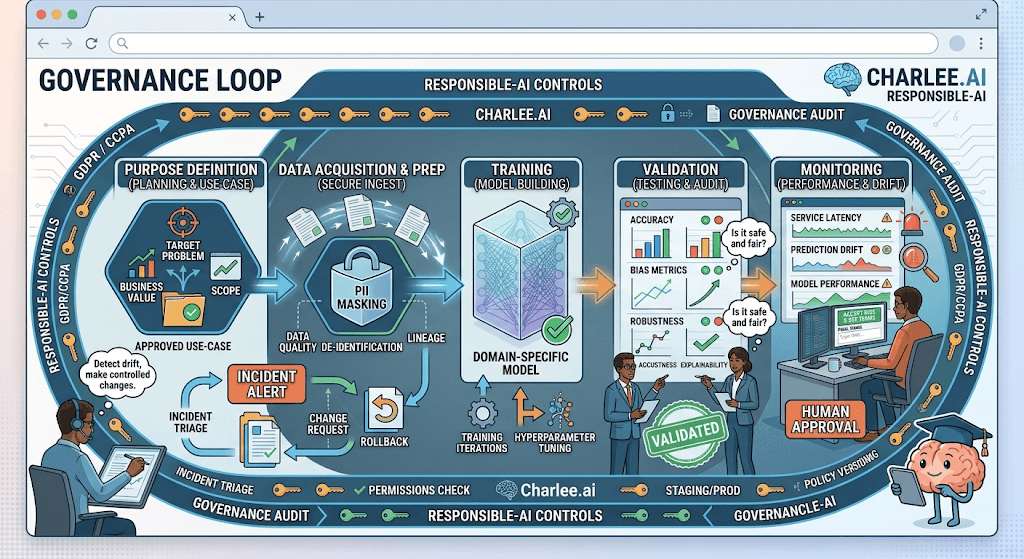
Approve, version, deploy, monitor, and retain rollback capability.
| Stage | Insurance-specific control |
|---|---|
| Task definition | Tie the model to a defined workflow and user decision—not a vague objective such as “understand claims.” |
| Dataset design | Represent lines of business, jurisdictions, claim complexity, document types, and edge cases. |
| Training | Use approved environments, access controls, encryption, and reproducible configurations. |
| Evaluation | Include independent reviewers and cases the model has never seen. |
| Deployment | Log model version, prompt, retrieved evidence, output, reviewer action, and final disposition. |
METHODS
Major Fine-Tuning Approaches
| Approach | What changes | Best insurance use | Considerations |
|---|---|---|---|
| Full fine-tuning | Most or all model weights | Highly specialized controlled environments with substantial data and infrastructure | Highest cost and governance burden; greater risk of capability drift |
| Supervised fine-tuning (SFT) | Model learns from approved input/output examples | Classification, extraction, summarization formats, structured drafting | Quality depends heavily on labels and demonstration consistency |
| Instruction tuning | Model learns to follow task instructions across examples | Standardized enterprise assistant behaviors | Requires diverse, carefully written instructions |
| Preference tuning | Model learns preferred outputs from comparisons or ratings | Tone, prioritization, refusal behavior, explanation quality | Reviewer preferences may encode inconsistency or bias |
| LoRA / adapters | Small trainable parameter modules | Cost-efficient domain or workflow adaptation | Operationally simpler, but still requires full validation |
| QLoRA | Quantized base model plus low-rank adapters | Resource-constrained experimentation or private deployments | Efficiency gains must not replace production-grade evaluation |
CHOOSING THE RIGHT CONTROL
Fine-Tuning vs. Prompting vs. RAG
| Technique | Primary purpose | Strength | Limitation |
|---|---|---|---|
| Prompt engineering | Direct the model for a specific interaction | Fast, low-cost, transparent, easy to revise | May be inconsistent for complex or repeated behavior |
| RAG | Provide current, authorized, source-linked context | Strong for policies, claim documents, manuals, regulations, and account facts | Retrieval quality and source governance are critical |
| Fine-tuning | Change recurring behavior, format, vocabulary, or task performance | Can improve consistency, efficiency, and specialized execution | Does not ensure current facts or source evidence |
| Rules / workflow | Enforce deterministic business controls | Clear, auditable, reliable for fixed logic | Brittle when language or context varies |
DECISION RULE
Start with the least invasive technique that can meet the requirement. Use prompts for instruction, RAG for knowledge, rules for hard controls, and fine-tuning when repeatable behavioral adaptation remains necessary after those methods are tested.
TRAINING DATA
Data Preparation and Labeling
Fine-tuning data is a business asset and a risk surface. In insurance, examples may contain protected personal information, medical information, attorney communications, proprietary policy language, confidential business data, or outcome signals that reflect historical inequities. Data preparation must therefore be jointly owned by business, data, legal, privacy, security, and governance teams.
- Define permitted data sources, purposes, retention periods, and downstream uses.
- De-identify or tokenize sensitive information unless identity is essential to the approved task.
- Create labeling guidelines with examples, counterexamples, and escalation rules.
- Measure inter-rater agreement and adjudicate disagreements.
- Balance frequent cases with rare but high-consequence scenarios.
- Prevent leakage between training and test sets, including near-duplicate documents.
- Preserve lineage from source record through transformation, label, dataset version, and model release.
QUALITY PRINCIPLE
More examples do not compensate for inconsistent labels. A smaller, representative, carefully adjudicated dataset can outperform a larger collection of noisy demonstrations.
P&C CLAIMS
Claims Applications
| Application | Fine-tuned behavior | Human responsibility |
|---|---|---|
| Document classification | Route demand letters, medical records, legal notices, estimates, and correspondence into approved categories | Confirm ambiguous or high-impact classifications |
| Claim chronology | Convert multi-document events into a standardized timeline format | Validate dates, causality, and missing evidence |
| Exposure signal extraction | Identify attorney representation, surgery, comorbidities, treatment escalation, liability disputes, or property complexity | Assess significance and determine action |
| Triage support | Generate consistent risk summaries from structured and unstructured inputs | Select assignment, escalation, and handling strategy |
| Referral drafting | Prepare litigation, SIU, medical, or authority referrals in approved format | Approve content and exercise authority |
| Quality review | Flag missing documentation, inconsistent notes, or unresolved tasks | Determine whether findings are material and correct the file |
A claims fine-tuning program should optimize for decision usefulness, not elegant prose. A structured output that reliably identifies five exposure signals and cites the relevant file evidence is often more valuable than a polished narrative summary.
BODILY INJURY
Claims Case Study
Scenario
A carrier receives thousands of bodily injury documents each week. General-purpose models can summarize them, but formats vary and key escalation signals are inconsistently surfaced. The carrier defines a target output containing document type, event date, medical development, representation status, demand details, reserve-relevant signals, confidence, and source references.
Fine-tuning design
- Claims experts create and adjudicate representative examples across personal auto, commercial auto, and general liability.
- Examples include difficult handwriting, conflicting dates, duplicate reports, unrelated prior conditions, and attorney-generated narratives.
- The model is trained to return a controlled schema and to state “insufficient evidence” rather than infer unsupported facts.
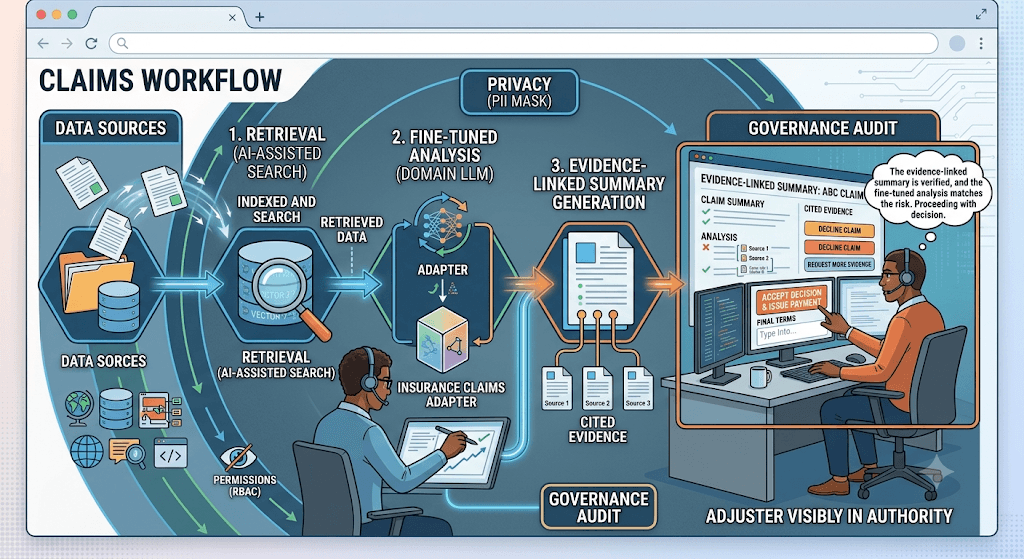
- RAG supplies the current claim documents; fine-tuning controls how the model interprets and structures the response.
- High-severity indicators and low-confidence outputs require adjuster review.
Fine-tuning design
| Measure | Pilot criterion |
|---|---|
| Critical-field recall | At least 95% for defined escalation signals |
| Unsupported assertions | Below agreed tolerance, with zero tolerance for selected critical fields |
| Schema adherence | At least 99% machine-readable output |
| Reviewer acceptance | Material reduction in edits without reduced quality |
| Operational value | Faster document review and earlier escalation where warranted |
Fine-tuning design
P&C UNDERWRITING
Underwriting Applications
| Application | Fine-tuned behavior | Human responsibility |
|---|---|---|
| Submission classification | Identify coverage lines, exposure categories, missing schedules, and document types | Confirm fit and request missing information |
| Risk narrative normalization | Convert broker narratives into consistent underwriting summaries | Interpret materiality and risk appetite |
| Appetite screening | Map descriptions to approved appetite language and referral conditions | Make selection and pricing decisions |
| Loss-run review | Extract and categorize frequency, severity, causes, and development patterns | Assess credibility and trend significance |
| Referral preparation | Draft a structured exception or authority referral | Approve recommendation and terms |
| Portfolio coding | Standardize unstructured descriptions into internal taxonomy | Validate coding and monitor drift |
COMMERCIAL PROPERTY
Underwriting Case Study
Scenario
A commercial property team receives submissions containing applications, statements of values, inspection reports, loss runs, broker emails, and schedules in inconsistent formats. Underwriters spend significant time normalizing the package before risk assessment begins.
Target behavior
The model produces a standardized submission brief: named insured, locations, occupancy, construction, protection, catastrophe exposure, valuation indicators, loss history, missing information, appetite concerns, and source citations. Fine-tuning is used for format and taxonomy consistency; RAG provides the actual submission content and underwriting guidelines.
Controls
MEASUREMENT
- No automated quote, declination, or binding authority.
- All appetite findings cite the current approved guideline passage.
- Missing or conflicting data is surfaced rather than resolved by inference.
- Performance is segmented by occupancy, geography, submission source, and complexity.
- Underwriter edits are analyzed for improvement but are not automatically reused as training data without approval.
Evaluation and Benchmarking
A fine-tuned model should be evaluated as a business system, not merely by training loss or generic benchmark scores. Test cases must reflect the actual documents, decisions, failure modes, and consequences present in the intended workflow.
| Evaluation dimension | Illustrative measures |
|---|---|
| Task quality | Precision, recall, F1, exact match, extraction accuracy, classification accuracy |
| Factuality | Supported-claim rate, citation correctness, contradiction rate, omission rate |
| Behavior | Format adherence, instruction following, refusal quality, escalation compliance |
| Calibration | Confidence reliability, error concentration, low-confidence detection |
| Fairness | Performance parity across relevant protected and operational segments |
| Robustness | Performance on poor scans, unusual wording, adversarial prompts, conflicting evidence |
| Operations | Latency, throughput, cost per transaction, reviewer time, edit distance |
| Business impact | Cycle time, early identification, consistency, leakage reduction, customer or employee experience |
TESTING RULE
Keep an independent “gold” test set that is never used for training, prompt development, or routine troubleshooting. Reuse of the same examples creates an illusion of improvement.
MODEL RISK
Risks and Failure Modes
| Risk | How it appears | Control |
|---|---|---|
| Overfitting | Excellent performance on familiar examples; poor generalization | Independent test sets, diverse cases, regularization, early stopping |
| Catastrophic forgetting | Base capabilities degrade after specialization | Capability regression tests; parameter-efficient methods; rollback |
| Label bias | Historical practices or reviewer preferences become encoded | Label governance, diverse reviewers, fairness analysis, adjudication |
| Data leakage | Test examples or confidential content contaminate training | Deduplication, lineage, access control, dataset review |
| Hallucination | Model produces confident unsupported statements | RAG, evidence requirements, abstention behavior, human review |
| Scope creep | Model is used for decisions outside its validated purpose | Use restrictions, technical controls, monitoring, training |
| Model drift | Language, documents, practices, or portfolio mix change | Performance monitoring, periodic revalidation, controlled retraining |
| Vendor dependency | Model or API changes alter behavior | Version pinning, exit planning, benchmark portability |
RESPONSIBLE AI
Governance and Compliance
Approve the use case, intended users, permitted decisions, and prohibited uses.
Document the base model, license, data rights, training method, environment, and dependencies.
Approve datasets, labels, privacy treatment, and retention.
Establish minimum performance, fairness, safety, and operational thresholds.
Conduct independent validation before production release.
Implement model registry, version control, change approvals, and rollback.
Log inputs, context, outputs, evidence, reviewer actions, and incidents as appropriate.
Monitor performance and revalidate after material changes.
Maintain human accountability for claim, underwriting, coverage, pricing, and legal decisions.
HUMAN AUTHORITY
Fine-tuning can make an output more consistent and persuasive. That makes clear accountability more—not less—important. Professionals must retain authority over consequential insurance decisions.
CONTROL ENVIRONMENT
Security and Privacy
- Use approved training environments with encryption, least-privilege access, network controls, and audit logging.
- Confirm whether training data is retained by any external provider and whether it can be used to improve third-party models.
- Prevent secrets, credentials, privileged communications, and unnecessary personal data from entering datasets.
- Test for memorization and unintended regurgitation of sensitive examples.
- Segment models, adapters, datasets, and vector stores by tenant, business purpose, and authorization boundary where required.
- Apply secure software-development, dependency, and supply-chain controls to training pipelines.
- Include prompt injection, data exfiltration, and model extraction scenarios in security testing.
- Define incident-response procedures for harmful outputs, privacy events, and unauthorized model use.
| Control artifact | Purpose |
|---|---|
| Model card | Documents intended use, limitations, training approach, and evaluation results |
| Dataset card | Documents provenance, scope, transformations, exclusions, and known limitations |
| Release record | Captures approvals, version, thresholds, dependencies, and rollback point |
| Monitoring plan | Defines metrics, frequency, owners, alerts, and response actions |
| Incident log | Preserves evidence and corrective actions for adverse events |
FROM PILOT TO PRODUCTION
Implementation Blueprint
| Phase | Key activities | Exit criteria |
|---|---|---|
| 1. Frame | Define workflow, users, decisions, risks, and baseline | Approved use case and measurable acceptance criteria |
| 2. Baseline | Test prompting, RAG, rules, and off-the-shelf model | Evidence that fine-tuning is necessary |
| 3. Prepare data | Approve, clean, label, split, and document examples | Representative dataset with acceptable label agreement |
| 4. Train | Select base model and method; run controlled experiments | Candidate versions with reproducible training records |
| 5. Validate | Business, technical, safety, fairness, privacy, and security testing | Independent approval against thresholds |
| 6. Pilot | Deploy to limited users with mandatory review and logging | Demonstrated workflow value without unacceptable harm |
| 7. Scale | Integrate, train users, monitor, and manage versions | Operational controls and support model in place |
| 8. Improve | Analyze errors, changes, and reviewer feedback | Approved updates through controlled release process |
WHAT GOOD LOOKS LIKE
Best Practices
AVOIDABLE ERRORS
- Fine-tune for a narrow, stable behavior—not for a broad promise of “insurance expertise.”
- Create a strong non-fine-tuned baseline before investing in training.
- Use RAG for current facts and source evidence even when the model is fine-tuned.
- Write labeling and review guidance before collecting examples.
- Train abstention and escalation behavior, not just correct answers.
- Measure performance by document type, line, jurisdiction, complexity, and consequence.
- Keep business acceptance criteria separate from model-training metrics.
- Retain independent test cases and perform regression testing for every release.
- Use reviewer edits as signals for analysis, not automatic truth.
- Maintain model, dataset, prompt, retrieval, and workflow versioning together.
Common Mistakes
| Mistake | Why it fails | Better approach |
|---|---|---|
| Fine-tuning too early | Prompting or RAG may solve the problem faster and more safely | Prove the gap with a baseline |
| Training on raw claim files | Noise, privacy risk, and inconsistent outputs become embedded | Curate task-specific examples |
| Using outcome labels without context | Historical outcomes may reflect handling practices, litigation, or bias | Analyze causal and operational meaning of labels |
| Ignoring retrieval | The model becomes fluent but lacks current evidence | Pair behavioral tuning with governed RAG |
| Evaluating only average accuracy | Rare high-impact failures remain hidden | Segment testing and consequence-weighted metrics |
| No rollback plan | A bad release becomes an operational incident | Version every component and retain the prior approved model |
| Allowing silent scope expansion | Users apply the model to unvalidated decisions | Enforce stated purpose through product design and policy |
SHOULD WE FINE-TUNE?
Executive Decision Guide
| Question | Proceed signal | Caution signal |
|---|---|---|
| Is the task stable and repeated? | High-volume, clearly defined workflow | One-off or rapidly changing need |
| Can quality be measured? | Objective labels and review criteria | Subjective “sounds good” evaluation |
| Is prompt/RAG performance insufficient? | Documented, persistent behavioral gap | No baseline has been tested |
| Is training data available and permitted? | Representative, approved, high-quality examples | Unclear rights, privacy, or inconsistent labels |
| Is error consequence understood? | Defined thresholds and escalation controls | Unknown harm or decision impact |
| Can the model be governed? | Owners, validation, monitoring, rollback | No lifecycle ownership or audit trail |
| Will the economics work? | Volume and value justify training and operations | Costs exceed workflow benefit |
EXECUTIVE GO / NO-GO
Proceed only when the organization can state exactly what behavior must improve, prove that simpler methods are insufficient, supply approved examples, measure the result, and govern the model throughout its lifecycle.
PEOPLE PLUS AI
Charlee.ai Perspective
In insurance, fine-tuning should support disciplined interpretation—not opaque automation. The highest value comes from combining specialized model behavior with claims and underwriting context, source evidence, explainability, workflow controls, and professional review.
A practical architecture separates responsibilities: the fine-tuned model standardizes the task behavior; retrieval supplies authorized evidence; deterministic controls enforce hard requirements; predictive models provide calibrated signals where appropriate; and experienced professionals make decisions and document rationale.
RESPONSIBLE OPERATING MODEL
Approved purpose and data → governed fine-tuning → validated AI analysis → explanation and source evidence → professional review → decision and documentation → monitoring, feedback, incident response, and controlled change.
DESIGNER-READY VISUALS
Key Takeaways
- Fine-tuning changes recurring model behavior; it does not replace current, source-linked knowledge retrieval.
- The best insurance use cases are narrow, stable, high-volume, and objectively measurable.
- Prompting, RAG, deterministic rules, and fine-tuning should be assigned distinct responsibilities.
- Data rights, label quality, privacy, representativeness, and lineage determine whether training is defensible.
- Independent evaluation must measure factuality, safety, fairness, robustness, operations, and business value—not training loss alone.
- Fine-tuned outputs can sound authoritative, so human accountability and evidence requirements are essential.
- Model versions, datasets, prompts, retrieval, workflows, and approvals must be governed as one system.
- Retraining should be controlled by measured need and formal change management.
- PRODUCTION CONTROL
Fine-tuning is the controlled process of further training a pre-trained model on curated examples so that its behavior becomes more consistent for a defined domain, task, style, or decision-support workflow. In insurance, it adapts foundation models for specialized language and tasks without confusing customization with control.
Frequently Asked Questions
Yes. It is often effective for producing consistent schemas, classifications, and standardized summaries when examples are clear.
Encoding inaccurate labels, historical bias, sensitive information, or examples that do not represent production conditions.
Retraining should be triggered by measured performance, material data or workflow change, or approved improvement—not a fixed schedule alone.
Fine-tuning does not inherently make a model explainable. Evidence, feature transparency, evaluation, logging, and human rationale remain necessary.
Potentially, but contracts and controls must address data use, retention, isolation, ownership, confidentiality, security, model rights, and deletion.
It is degradation of capabilities the base model previously had after specialization. Regression testing is needed to detect it.
Test performance, error rates, abstention, and operational effects across relevant populations and contexts, with legal and governance oversight.
At minimum, the model and dataset version, input, instructions, retrieved context, output, confidence or flags, reviewer action, and final disposition as appropriate.
Define a narrow workflow problem, establish a baseline using prompting and RAG, and document the precise behavior that remains inadequate. KNOWLEDGE CENTER NAVIGATION