Semantic Search
Semantic search retrieves information based on meaning, context, and conceptual similarity—not only exact keyword matches. In P&C insurance, it helps professionals locate relevant documents, clauses, claims, evidence, and precedents using the language they naturally use.
Publication Purpose Explain how meaning-based retrieval helps insurers find relevant claims, policy, underwriting, medical, legal, and operational information—even when users do not know the exact keywords used in the source documents.
| Series | Core AI Technology Foundations |
|---|---|
| Audience | Insurance executives, claims leaders, underwriters, data leaders, product owners, and technology teams |
| Publication Status | Production Ready |
| Editorial Principle | AI augments insurance professionals; human judgment retains authority |
Prepared for the Charlee.ai Insurance AI Knowledge Center
Executive Snapshot
Executive Definition Semantic search retrieves information based on meaning, context, and conceptual similarity—not only exact keyword matches. In P&C insurance, it helps professionals locate relevant documents, clauses, claims, evidence, and precedents using the language they naturally use.
| Dimension | Executive View |
|---|---|
| Primary purpose | Find the most relevant information even when source wording differs from the user’s query. |
| Insurance value | Reduces research time, improves consistency, surfaces overlooked evidence, and strengthens decision support. |
| Typical inputs | Claims notes, policy forms, endorsements, medical records, demand letters, inspection reports, underwriting submissions, emails, and manuals. |
| Core technologies | Embeddings, vector databases, lexical search, metadata filters, rerankers, and retrieval evaluation. |
| Best operating model | Hybrid search with access controls, citations, traceability, and professional review. |
| Primary risk | Plausible but incomplete retrieval when the system returns semantically similar content that is not legally or operationally controlling. |
| Executive mandate | Measure retrieval quality by business task, not by demo appeal. |
The Core Executive Question
Can an insurer reliably connect a professional’s question to the most relevant internal evidence—across different wording, document types, systems, and jurisdictions—while preserving security, provenance, and human accountability?
When Semantic Search Is Most Valuable
- Employees search large, fragmented repositories and do not know the exact wording used in the source material.
- Important context is buried inside narrative documents rather than normalized database fields.
- Research requires combining policy language, claim facts, medical evidence, legal materials, and internal guidance.
- Generative AI or AI agents require grounded retrieval from approved enterprise content.
- Keyword search produces too many irrelevant results or misses synonymous concepts.
Executive Summary
Property & Casualty insurers operate in document-intensive environments. Claims and underwriting decisions depend on language distributed across policy forms, endorsements, adjuster notes, medical records, legal correspondence, repair estimates, inspection reports, regulatory bulletins, underwriting manuals, and prior files. Traditional keyword search is useful when the user knows the precise phrase, form number, code, or name. It is weaker when the same concept appears under different terminology.
Semantic search addresses this gap by representing text as numerical vectors—often called embeddings—that encode aspects of meaning. A user query is converted into the same representation and compared with indexed content. The system can therefore retrieve material that is conceptually related even when exact words do not overlap. In practice, enterprise-grade systems rarely rely on semantic similarity alone. They combine lexical matching, vector retrieval, metadata filters, access controls, reranking, and source presentation.
For insurers, the opportunity is not simply “better search.” The larger value is a governed retrieval layer that supports professional research, retrieval-augmented generation, AI assistants, portfolio analysis, and workflow decision support. A claims professional might search for cases involving delayed surgery after low-speed impact. An underwriter might retrieve submissions with operational characteristics similar to a new risk. A coverage specialist might locate controlling endorsements and prior interpretations. Each use case demands different relevance criteria and different safeguards.
Successful adoption requires strong document preparation, metadata quality, chunking strategy, evaluation sets, authorization controls, and continuous monitoring. Search quality must be tested against real insurance questions. The most important result may not be the most semantically similar paragraph; it may be the controlling endorsement, latest approved procedure, jurisdiction-specific rule, or factually comparable claim. Human review remains essential whenever retrieved content informs coverage, reserving, pricing, claim strategy, or legal decisions.
Executive Principle Semantic search should make evidence easier to find—not make evidence easier to assume. The interface must show sources, dates, document authority, and the context needed for a professional to judge relevance.
Quick Facts
| Question | Answer |
|---|---|
| Is semantic search the same as generative AI? | No. Semantic search retrieves relevant information. Generative AI creates or transforms content. They are often combined in RAG systems. |
| Does it replace keyword search? | Usually not. Hybrid search commonly performs better because exact identifiers, names, citations, and form numbers still matter. |
| What is indexed? | Documents or document chunks, plus metadata such as line of business, jurisdiction, date, form number, claim type, confidentiality level, and authority. |
| How is relevance measured? | With precision, recall, ranking metrics, task success, user feedback, and business outcomes. |
| What is a common failure? | Retrieving content that is conceptually similar but not controlling for the specific policy, date, jurisdiction, or fact pattern. |
| What is the key control? | Enforce permissions and present source evidence with every result. |
| Where does it fit? | Enterprise search, RAG, AI copilots, case research, policy research, submission triage, document intelligence, and knowledge management. |
Definitions
Executive Definition
Semantic search is a meaning-based method of finding information. It interprets the intent and concepts in a query and retrieves content that is contextually related, even when the wording differs.
Technical Definition
Semantic search is an information-retrieval approach that encodes queries and indexed content into dense vector representations, calculates similarity, applies filters and ranking logic, and returns items estimated to be relevant to the user’s intent. Production systems may combine dense retrieval with sparse lexical retrieval, metadata constraints, cross-encoder reranking, and domain-specific relevance rules.
Insurance Definition
In P&C insurance, semantic search is a governed retrieval capability used to locate relevant claim evidence, policy language, underwriting information, medical or legal content, operational guidance, and comparable historical cases using meaning and context rather than exact wording alone.
What Semantic Search Is Not
- It is not a substitute for policy interpretation, legal judgment, underwriting authority, or claim-handling responsibility.
- It is not automatically accurate because results sound related.
- It is not a single model; it is an end-to-end retrieval system with data, indexing, ranking, security, and evaluation components.
- It is not equivalent to a chatbot, although a chatbot may use it behind the scenes.
Why Semantic Search Matters in Insurance
Insurance Language Is Inconsistent
The same exposure can be described differently by claimants, agents, adjusters, medical providers, attorneys, vendors, and underwriters. “Water intrusion,” “storm-created opening,” “wind-driven rain,” and “interior moisture damage” may appear in related files. Exact keyword search can miss useful material when terminology varies.
Critical Information Is Distributed
A single decision may require evidence from multiple sources: declarations, policy forms, endorsements, claim notes, photographs, invoices, correspondence, medical records, litigation documents, and external authority. Semantic search can create a unified discovery layer across repositories while leaving source systems in place.
Professionals Search by Concept
Insurance professionals often remember the issue, not the exact phrase. They may ask for “claims where a minor collision later developed into a surgical case,” “property submissions with older electrical systems and restaurant occupancy,” or “endorsements that restrict water backup coverage.” Meaning-based retrieval better matches this natural research behavior.
AI Systems Need Grounded Context
Retrieval-augmented generation and AI agents require relevant, authorized, and current source material. Semantic search is often the retrieval layer that supplies context, but it must be designed to favor authoritative content and return citations.
Knowledge Is an Operational Asset
When research is slow or dependent on individual memory, insurers lose consistency and institutional knowledge. A governed semantic search capability can make expertise more reusable without removing professional accountability.
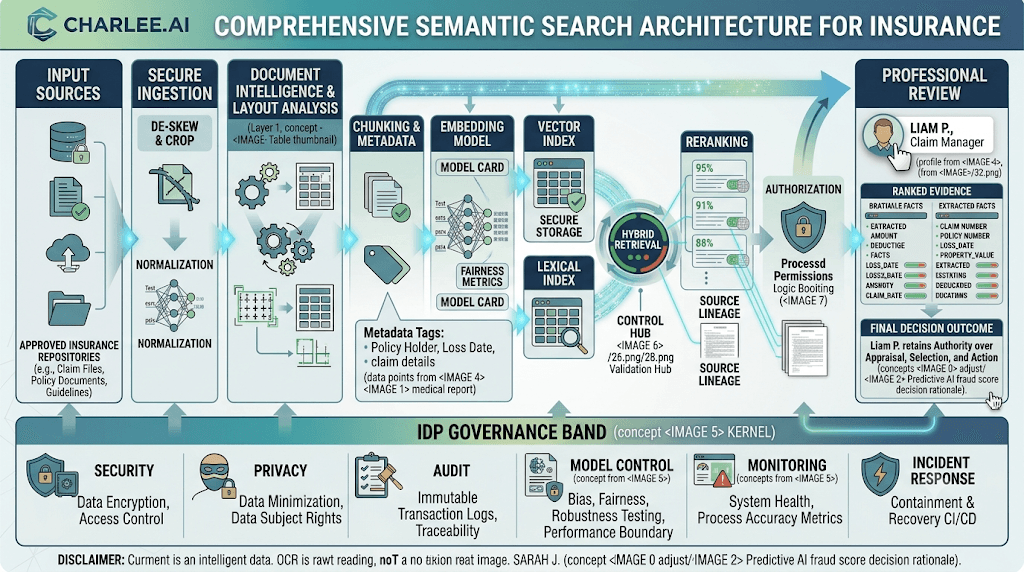
How Semantic Search Works
Step 1 — Content Ingestion
Documents are collected from approved repositories. The ingestion process identifies file type, ownership, security classification, timestamps, and source-system identifiers. Optical character recognition or intelligent document processing may be required for scanned content.
Step 2 — Parsing and Chunking
Long documents are divided into retrievable units. Chunking may follow paragraphs, sections, policy clauses, claim-note events, table boundaries, or semantic topics. The right approach depends on the business question. A chunk should contain enough context to be meaningful without becoming so large that retrieval loses precision.
Step 3 — Metadata Enrichment
Each unit is enriched with metadata such as document type, form number, jurisdiction, effective date, line of business, claim identifier, loss date, authority level, confidentiality, and retention status. Metadata is essential for narrowing retrieval and enforcing controls.
Step 4 — Embedding Generation
An embedding model converts each chunk into a vector that captures patterns of meaning. The user query is converted into a compatible vector. Similarity calculations identify candidate content located near the query in vector space.
Step 5 — Candidate Retrieval
The system retrieves candidate results using vector similarity, lexical matching, or both. Filters may exclude content that is expired, unauthorized, outside the jurisdiction, unrelated to the line of business, or otherwise ineligible.
Step 6 — Reranking
A reranker evaluates the candidate set more deeply and reorders it according to likely relevance. Domain rules may boost controlling policy forms, current procedures, jurisdiction-specific materials, or documents associated with the same claim or account.
Step 7 — Presentation and Evidence
Results should include highlighted passages, source titles, dates, authority indicators, and links to the original content. When used in RAG, retrieved passages are supplied to a language model with instructions to cite and stay within the evidence.
Step 8 — Feedback and Evaluation
User interactions and curated test questions help teams identify failure modes, tune retrieval, update metadata, and monitor drift. Feedback should not automatically change ranking without governance because clicks can reflect convenience rather than correctness.
Step 8 — Feedback and Evaluation
| Stage | Primary Output | Insurance Control |
|---|---|---|
| Ingestion | Approved source content | Repository authorization and retention rules |
| Parsing | Structured text and sections | Preserve headings, tables, clause boundaries, and source references |
| Chunking | Retrievable content units | Avoid separating qualifiers, exclusions, and definitions from the clause they govern |
| Metadata | Context and filters | Jurisdiction, effective date, authority, line of business, confidentiality |
| Embedding | Vector representation | Model suitability, versioning, privacy, and reproducibility |
| Retrieval | Candidate results | Permissions, date filters, business rules, and fallback to lexical search |
| Reranking | Prioritized results | Authority-aware and task-specific relevance |
| Presentation | Evidence for review | Citations, context windows, original-source access, and user warning labels |
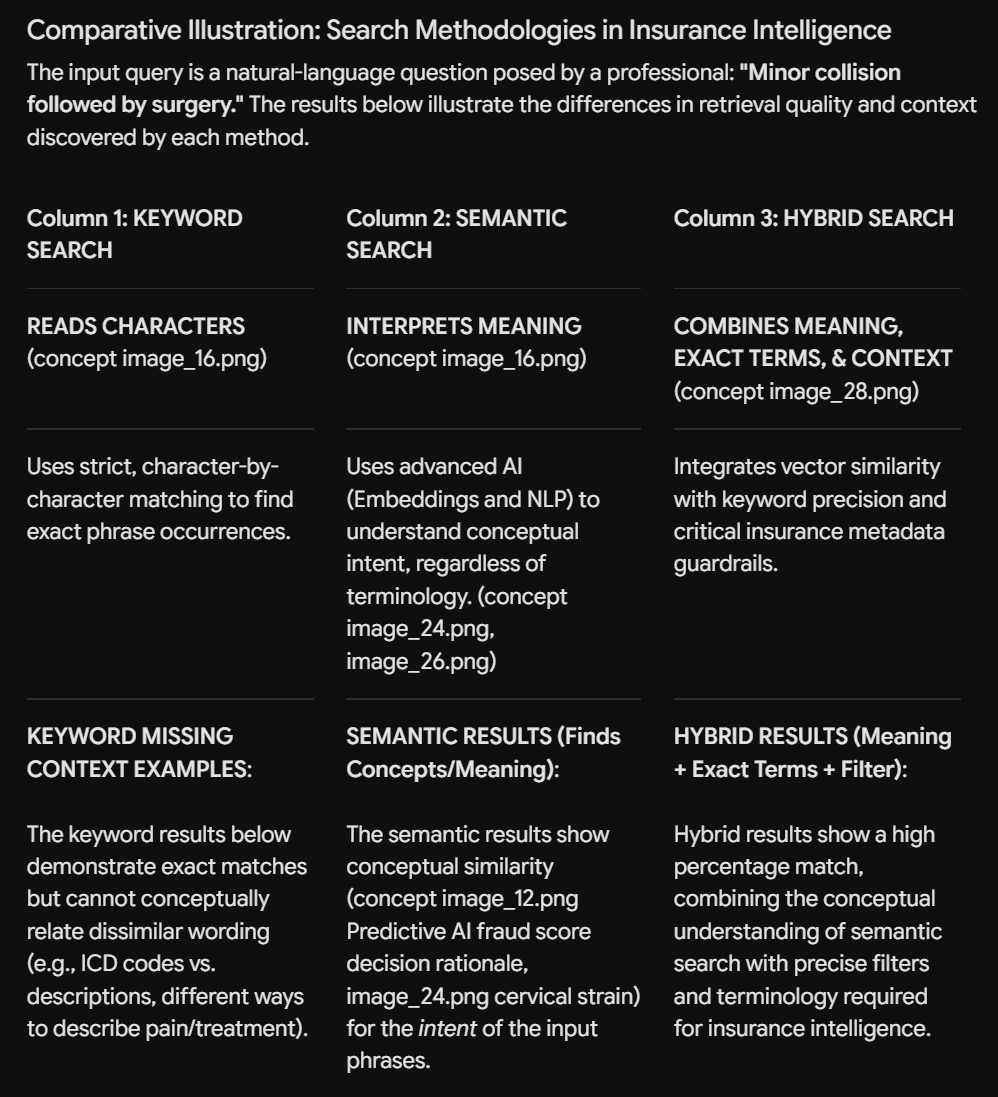
Search Approaches Compared
| Approach | Strengths | Limitations | Best Insurance Uses |
|---|---|---|---|
| Keyword / lexical search | Exact terms, names, codes, form numbers, citations, and rare identifiers | Misses synonyms and conceptually related language | Policy form numbers, claim IDs, attorney names, statutes, diagnosis codes |
| Semantic search | Finds meaning and related concepts despite wording variation | May return conceptually similar but non-controlling content | Narrative claim research, similar submissions, medical concepts, broad knowledge discovery |
| Hybrid search | Combines exact matching with semantic similarity | Requires tuning and score normalization | Most enterprise insurance search and RAG use cases |
| Filtered search | Uses structured metadata to narrow the corpus | Depends on metadata quality | Jurisdiction, effective date, line of business, claim type, confidentiality |
| Graph-enhanced retrieval | Uses relationships among entities and concepts | Higher implementation complexity | Fraud networks, party relationships, coverage hierarchies, connected claims |
| Manual expert research | High contextual judgment and authority awareness | Time intensive and hard to scale | Complex coverage, litigation, regulatory, and high-severity decisions |
Why Hybrid Search Is Often Preferred
Insurance research frequently contains both conceptual language and exact identifiers. A query about “roof damage from wind-driven rain under HO 00 03” benefits from semantic matching for the damage concept and lexical matching for the form number. Hybrid systems combine these signals and may apply task-specific weighting.
Why Hybrid Search Is Often Preferred
Practical Rule Use semantic similarity to expand discovery; use exact terms, metadata, and authority rules to constrain the answer.
Core Architecture and Components
Embedding Models
Embedding models convert text into vectors. Selection should consider domain language, document length, multilingual needs, privacy, deployment model, latency, and version stability. A general model may work well for common concepts but require testing against insurance-specific terminology and abbreviations.
Vector Index or Vector Database
The vector store supports similarity search at scale. Important capabilities include metadata filtering, access control integration, update handling, index versioning, backup, observability, and predictable latency. Some insurers use vector capabilities embedded in existing databases; others adopt specialized platforms.
Lexical Search Engine
Sparse retrieval remains critical for identifiers, names, citations, form numbers, and exact phrases. Mature systems retain lexical retrieval and blend scores with semantic results.
Reranking Models
Rerankers compare the query and candidate passages more directly than first-stage retrieval. They can improve precision but add cost and latency. Their value should be assessed by task, especially for high-consequence research.
Relevance Rules
Insurance relevance is not purely semantic. Rules may prioritize current approved materials, controlling endorsements, state-specific content, the correct policy term, or records from the active claim. These rules should be documented and tested.
User Experience
The interface should support natural-language queries, filters, result explanations, source previews, citations, and easy access to originals. Users should be able to distinguish a search result from an AI-generated answer.
Claims Applications
| Application | Example Query | Operational Value |
|---|---|---|
| Claim-file research | Find prior claims involving delayed surgery after a low-speed rear-end collision. | Surfaces comparable patterns and documentation for professional review. |
| Coverage research | Locate policy provisions and endorsements relevant to water backup and seepage. | Reduces time spent navigating multiple forms and endorsements. |
| Medical review | Find references to cervical fusion, prior degeneration, and treatment gaps across the file. | Accelerates synthesis of large medical records while preserving source evidence. |
| Litigation monitoring | Identify files with new counsel involvement, venue risk, or demand language similar to escalating claims. | Supports early attention and portfolio triage. |
| Subrogation discovery | Find indications of contractor, manufacturer, landlord, or third-party responsibility. | Helps surface recovery opportunities earlier. |
| Fraud investigation | Retrieve claims with similar narratives, parties, providers, damage patterns, or documents. | Supports investigation while requiring appropriate legal and privacy controls. |
| Catastrophe response | Find claims involving similar damage characteristics, building types, or geographic conditions. | Improves consistency and prioritization during high-volume events. |
| Adjuster guidance | Retrieve approved procedures and playbooks for the current claim type and jurisdiction. | Makes institutional guidance easier to access in workflow. |
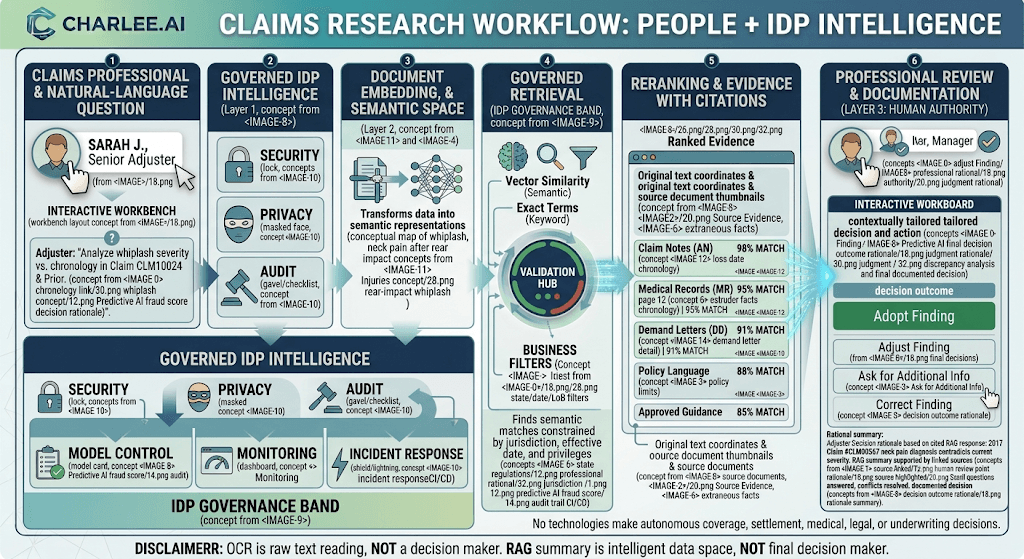
Claims Workflow Pattern
A claim event, document, or user question triggers retrieval.
The system applies claim-level permissions and metadata filters.
Hybrid search retrieves relevant passages from the active file and approved reference content.
A reranker prioritizes evidence based on the task.
The interface presents excerpts, citations, and authority indicators.
The claims professional decides how the information affects investigation, reserves, strategy, or communication.
User feedback and outcomes inform controlled evaluation and improvement.
Underwriting Applications
| Application | Example Query | Operational Value |
|---|---|---|
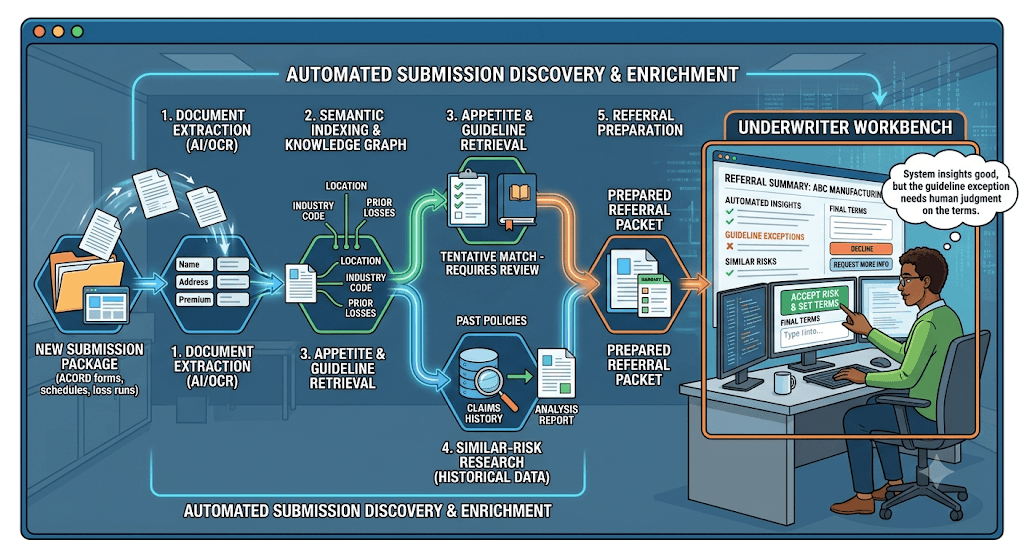
| Submission review | Find prior submissions with similar operations, locations, and loss characteristics. | Supports faster context gathering and referral preparation. |
| Appetite research | Show current guidelines for habitational risks with aluminum wiring in coastal regions. | Connects natural-language questions to approved appetite rules. |
| Loss-run analysis | Find patterns involving repeated water losses, fleet accidents, or large-liability incidents. | Helps underwriters identify relevant history despite inconsistent descriptions. |
| Document discovery | Locate limits, deductibles, named insureds, driver schedules, inspection findings, and protective safeguards. | Reduces manual search across submission packages. |
| Referral support | Retrieve comparable referrals and the rationale documented by senior underwriters. | Makes expertise more reusable while preserving authority boundaries. |
| Portfolio insight | Find accounts with exposure language similar to an emerging hazard. | Supports targeted portfolio review. |
| Policy research | Locate forms and endorsements commonly used for a class, jurisdiction, or coverage issue. | Improves consistency and reduces research time. |
Underwriting Control Principle
Retrieved historical cases should inform—not dictate—risk selection or pricing. Historical decisions may reflect prior appetite, market conditions, data limitations, or inconsistent documentation. The system should present context and dates so underwriters can judge comparability.
Policy, Coverage, Medical, Legal, and Regulatory Research
Policy and Coverage
Semantic search can help users locate related clauses across base forms, endorsements, definitions, exclusions, and conditions. However, the system must preserve document hierarchy and effective dates. A semantically similar clause from the wrong policy or state can be misleading.
Medical Content
Medical records contain synonyms, abbreviations, misspellings, and narrative descriptions. Semantic retrieval can connect related clinical concepts, treatment patterns, and prior conditions. Use cases involving protected health information require strict access controls, logging, minimization, and retention practices.
Legal and Litigation Materials
Legal research often depends on jurisdiction, authority, procedural posture, and date. Semantic similarity can improve discovery, but professionals must verify controlling authority and use approved legal research processes.
Regulatory and Operational Guidance
Insurers can index bulletins, market-conduct guidance, internal procedures, and jurisdiction-specific requirements. Metadata should distinguish current approved guidance from drafts, superseded versions, and historical archives.
Regulatory and Operational Guidance
High-Consequence Warning For coverage, legal, regulatory, medical, and high-severity claim decisions, semantic retrieval must be treated as research support. The professional remains responsible for verifying the original source and its applicability.
Detailed P&C Case Studies
Case Study 1 — Bodily Injury Claim Escalation Research
Business Situation
A claims manager wants to identify closed and open auto liability claims that began with minor impact descriptions but later developed into surgery, attorney representation, and materially higher severity.
Semantic Search Approach
- Index claim notes, medical summaries, demand letters, reserve-change narratives, and litigation documents.
- Use hybrid retrieval so exact terms such as procedure names and attorney names complement conceptual matching.
- Filter by jurisdiction, policy period, vehicle type, claim status, and data-use authorization.
- Rerank results using evidence of treatment escalation, counsel involvement, demand timing, and reserve movement.
- Present relevant passages and timelines rather than a single unexplained similarity score.
Professional Use
The claims manager reviews comparable patterns to improve monitoring criteria and coaching. The results do not establish the expected value of the active claim; they provide evidence for further review.
Key Controls
Do not expose protected information beyond authorized users. Exclude claims outside the approved analytical purpose. Validate that retrieved cases are factually comparable and not simply linguistically similar.
Business Situation
An underwriter receives a submission for a mixed-use coastal property with restaurants, older electrical systems, partial sprinkler protection, and prior water losses. The submission package uses inconsistent terminology across applications, inspection reports, emails, and loss runs.
Semantic Search Approach
- Extract and index the submission package with document type and account metadata.
- Retrieve current appetite guidance, protective-safeguard requirements, and similar prior submissions.
- Use exact filters for state, construction type, occupancy class, and effective date.
- Rerank approved underwriting guidance above informal historical correspondence.
- Allow the underwriter to inspect every source and compare relevant passages.
Professional Use
The underwriter uses the results to prepare questions, identify missing information, and determine whether referral is required. The system does not select terms or approve the risk.
Business Situation
A coverage professional needs to research whether a property loss involving repeated leakage, storm damage, and interior mold may involve multiple exclusions, exceptions, and endorsements.
Semantic Search Approach
- Index the complete policy package and preserve document hierarchy.
- Chunk by clause while retaining neighboring definitions, exceptions, and cross-references.
- Filter to the active policy term, jurisdiction, and issued forms.
- Boost controlling endorsements and exact form identifiers.
- Present source text, page references, and document authority.
Professional Use
The professional verifies the full policy language and applies established coverage-review procedures. The search system assists discovery but does not make the coverage determination.
Business Situation
An insurer wants an internal assistant that answers procedural questions using approved claims manuals and jurisdictional guidance.
Semantic Search Approach
- Index only approved, current materials and label superseded versions.
- Enforce role-based access and business-unit boundaries.
- Use hybrid retrieval and reranking to prioritize the most authoritative guidance.
- Pass retrieved passages to a language model with citation and refusal instructions.
- Log the query, retrieved sources, answer, and user feedback for audit and improvement.
Professional Use
The assistant provides concise guidance with citations. Users are directed to original materials for high-consequence actions, and the system refuses to answer when approved support is insufficient.
Business Value and Performance Measures
Potential Business Benefits
- Reduced research time across claims, underwriting, coverage, legal, medical, and operational work.
- Improved discovery of relevant evidence and institutional knowledge.
- More consistent access to approved guidance and current procedures.
- Faster document review and referral preparation.
- Better grounding for RAG, copilots, and AI agents.
- Improved portfolio review and pattern discovery.
- Lower dependence on exact terminology and individual memory.
Retrieval Metrics
| Metric | Meaning | Insurance Interpretation |
|---|---|---|
| Precision@k | Share of top results that are relevant | Are the first results useful enough for a professional to review? |
| Recall@k | Share of relevant items retrieved in the top set | Did the system find the critical evidence or controlling document? |
| Mean Reciprocal Rank | How early the first relevant result appears | How quickly can the user reach a useful source? |
| nDCG | Ranking quality with graded relevance | Are highly authoritative and strongly relevant results prioritized? |
| Hit rate | Whether at least one relevant item appears | Does the search succeed at all for the question? |
| Latency | Time to return results | Does search fit naturally within workflow? |
| Coverage | Share of business questions supported by indexed content | How much of the target workflow can the system address? |
| Task success | Whether the user completes the intended research task | Did retrieval help produce a correct, documented professional outcome? |
Business Outcome Measures
- Average research time by task and role.
- First-contact resolution for internal knowledge questions.
- Percentage of answers with verified authoritative sources.
- Reduction in duplicate document review.
- User adoption, repeat use, and satisfaction by workflow.
- Changes in referral quality, cycle time, or audit findings.
- Rate of missed critical documents or incorrect authority selection.
- Cost per successful retrieval or grounded answer.
Business Outcome Measures
Measurement Guidance Do not optimize only for click-through or similarity scores. A user may click the first result because it is convenient, not because it is correct. Use curated relevance judgments and task-level validation.
Risks, Governance, Privacy, and Security
| Risk | Why It Matters | Control |
|---|---|---|
| Semantic false positive | A conceptually similar passage may not apply to the specific policy, jurisdiction, date, or facts. | Metadata filters, authority ranking, citations, and professional verification. |
| Missed controlling content | Chunking or indexing can separate an exclusion, exception, definition, or endorsement. | Structure-aware parsing, test cases, context windows, and original-document access. |
| Unauthorized retrieval | Sensitive claim, medical, personnel, or legal information may enter results or prompts. | Retrieval-time authorization, encryption, logging, minimization, and secure caching. |
| Stale content | Superseded procedures or forms may rank highly. | Version labels, effective dates, current-status filters, and governance ownership. |
| Embedding leakage | Vectors may preserve information about sensitive source content. | Treat vectors as sensitive data; restrict access, retention, export, and reuse. |
| Bias in historical content | Historical decisions may encode inconsistent or unfair practices. | Use retrieval for evidence, not automatic replication; audit by use case and protected class risk. |
| Prompt injection in source content | Malicious or untrusted text may instruct downstream AI systems. | Content sanitization, model isolation, instruction hierarchy, and safe tool design. |
| Overreliance | Users may accept a fluent answer without reviewing sources. | Clear UX separation, citations, confidence limits, training, and human accountability. |
| Cross-border or contractual restrictions | Data residency and permitted-use terms may constrain indexing or model use. | Legal review, deployment controls, vendor diligence, and data-processing agreements. |
Governance Roles
| Role | Core Responsibility |
|---|---|
| Business owner | Defines approved use, users, outcomes, and escalation rules. |
| Content owner | Maintains source quality, authority, versioning, and retention. |
| Data/AI team | Builds ingestion, retrieval, ranking, evaluation, and monitoring. |
| Security and privacy | Approves access controls, logging, encryption, and data handling. |
| Legal/compliance | Reviews regulatory, contractual, discovery, and professional-use risks. |
| Model risk or AI governance | Challenges design, validation, change control, and monitoring. |
| End users | Verify sources, apply professional judgment, and report failures. |
Minimum Control Set
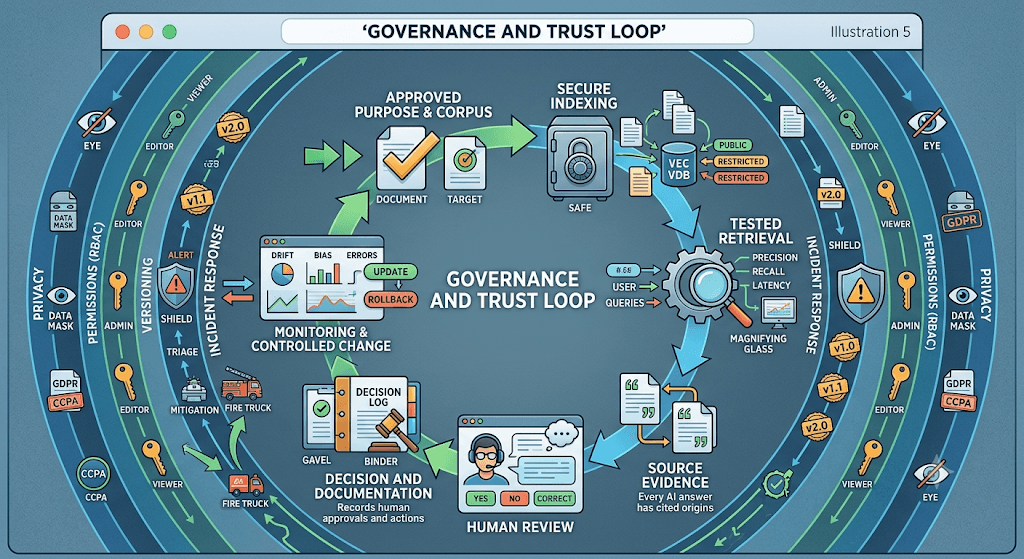
- Documented purpose and approved corpus.
- Role-based and attribute-based authorization enforced during retrieval.
- Source-level provenance, effective dates, and version status.
- Task-specific evaluation before production release.
- Human review for consequential decisions.
- Monitoring for retrieval failures, stale content, and access incidents.
- Controlled updates to embedding models, indexes, chunking, ranking, and prompts.
- Incident response and rollback procedures.
Implementation Blueprint
Phase 1 — Select the Business Problem
Choose a bounded, high-value research task with known users, approved content, measurable pain, and manageable risk. Examples include claims-procedure search, submission-document discovery, or policy-form research within one line of business.
Phase 2 — Define Relevance
Create representative questions and identify what a good result looks like. Include easy queries, ambiguous wording, exact identifiers, jurisdictional constraints, and failure cases. Relevance judgments should come from qualified business experts.
Phase 3 — Prepare the Corpus
Inventory sources, remove duplicates, identify current versions, establish authority, resolve OCR quality, and define retention and permissions. Do not index everything simply because it is available.
Phase 4 — Design Chunking and Metadata
Select chunk boundaries aligned with the document structure and user task. Define required metadata and confirm it is available, reliable, and maintained.
Phase 5 — Build a Baseline
Start with lexical search and a simple embedding-based retrieval baseline. Compare performance before adding complex rerankers or graph layers. Establish reproducible test sets and version control.
Phase 6 — Add Hybrid Retrieval and Reranking
Blend exact and semantic retrieval. Tune weights by task. Apply metadata filters and authority-aware reranking. Measure the incremental value of every component.
Phase 7 — Integrate the Workflow
Embed search where professionals work. Provide filters, source previews, highlighted passages, and original-document links. Avoid forcing users into a separate experimental interface.
Phase 8 — Validate and Approve
Conduct technical, business, security, privacy, legal, and governance review. Test access boundaries, stale content, ambiguous queries, and high-consequence scenarios.
Phase 9 — Monitor and Improve
Track quality, latency, failures, content freshness, user behavior, and business outcomes. Revalidate after model, index, corpus, chunking, or ranking changes.
Phase 9 — Monitor and Improve
| Phase | Deliverable | Exit Criterion |
|---|---|---|
| 1. Problem | Use-case charter | Approved purpose, users, scope, and outcomes |
| 2. Relevance | Gold questions and judgments | Experts agree on what constitutes useful retrieval |
| 3. Corpus | Approved source inventory | Content is current, authorized, and owned |
| 4. Design | Chunking and metadata specification | Structure preserves business meaning and controls |
| 5. Baseline | Lexical and vector benchmarks | Repeatable quality baseline exists |
| 6. Optimize | Hybrid and reranked retrieval | Material measured improvement without unacceptable cost |
| 7. Workflow | Integrated user experience | Users can inspect evidence and originals |
| 8. Validate | Approval package | Risk, security, and business acceptance complete |
| 9. Operate | Monitoring and change control | Quality and content freshness are actively managed |
Best Practices and Common Mistakes
Best Practices
- Begin with a narrow task and real insurance questions.
- Use hybrid search rather than treating semantic and lexical search as competitors.
- Preserve document hierarchy, qualifiers, definitions, and cross-references.
- Use metadata aggressively for jurisdiction, date, authority, line of business, and permissions.
- Present source evidence and original-document access.
- Test retrieval by task, role, and consequence level.
- Treat embeddings and indexes as sensitive enterprise data.
- Maintain a controlled process for corpus and model updates.
- Measure both search quality and business task completion.
- Train users to verify applicability and report failures.
Common Mistakes
| Mistake | Consequence | Correction |
|---|---|---|
| Indexing every available document | Noise, stale content, privacy exposure, and confusing authority | Curate approved corpora with ownership and lifecycle controls |
| Ignoring exact search | Poor performance on names, IDs, forms, and citations | Adopt hybrid retrieval |
| Weak chunking | Loss of context or overbroad results | Align chunks with clauses, events, and business structure |
| No metadata strategy | Inability to constrain by jurisdiction, date, or authority | Define required metadata before scaling |
| Evaluating only with demos | Unknown performance on difficult or consequential questions | Build expert-labeled test sets |
| Using similarity as truth | Overconfidence in conceptually related results | Show sources and require professional verification |
| Applying one configuration to every task | Inconsistent quality across claims, underwriting, and legal research | Tune retrieval and ranking by workflow |
| Weak authorization | Sensitive information appears in search or AI prompts | Enforce retrieval-time access controls |
| No content owner | Stale or conflicting guidance remains active | Assign business ownership and review cycles |
Executive Decision Guide
Questions to Ask Before Funding
- Which business task is slow, inconsistent, or dependent on exact terminology?
- What approved source content supports that task?
- Who decides whether a result is relevant and authoritative?
- What errors would be consequential?
- Can permissions and data-use restrictions be enforced during retrieval?
- How will the system show provenance, dates, and authority?
- What baseline are we improving over?
- What business metric will demonstrate value?
- Who owns content freshness and model changes?
- How will professional judgment remain in control?
Fit Assessment
| Condition | Strong Fit | Weak Fit |
|---|---|---|
| Information volume | Large and document-intensive | Small, easily navigated corpus |
| Language variation | Many synonyms and narrative descriptions | Mostly exact codes and identifiers |
| User behavior | Users search by concept or question | Users know precise form numbers or locations |
| Content governance | Approved sources and owners exist | No authority, lifecycle, or access model |
| Business value | Research time or missed evidence is material | Low-frequency convenience use only |
| Risk posture | Human review and citations are acceptable | Fully autonomous decisions expected |
| Data readiness | Text is extractable and metadata can be established | Poor OCR, uncontrolled duplicates, and unclear permissions |
Build, Buy, or Extend
Insurers may extend existing enterprise search, use database-native vector capabilities, adopt a specialized vector platform, or purchase an insurance-focused application. The decision should consider workflow integration, security, deployment model, model choice, observability, vendor lock-in, portability, metadata support, and the ability to evaluate retrieval independently from the user interface.
Charlee.ai Perspective
The highest-value insurance search experiences are not generic document finders. They understand the context of claims and underwriting work: the active claim or account, the relevant policy term, the line of business, jurisdiction, authority of the source, and the evidence needed by a professional.
Semantic search should be combined with document intelligence, predictive insight, workflow context, and governance. In claims, retrieval can help professionals find medical evidence, attorney signals, demand language, reserve drivers, comparable patterns, and relevant guidance. In underwriting, it can help surface exposure details, appetite guidance, prior referrals, and comparable risks. The goal is not to replace judgment. It is to make the evidence surrounding judgment more complete, timely, and usable.
Charlee.ai Responsible-AI Principle Approved purpose and data → governed retrieval → explanation and source evidence → professional review → documented decision → monitoring, feedback, incident response, and controlled change.
Key Takeaways
- Key Takeaways
- Semantic search finds conceptually relevant information even when wording differs.
- Hybrid retrieval is usually stronger than semantic or keyword search alone.
- Insurance relevance depends on metadata, authority, jurisdiction, policy term, and business context—not just similarity.
- Chunking and document structure can determine whether controlling language is preserved or lost.
- Source citations, original-document access, and professional review are mandatory for consequential use.
- Embeddings, indexes, logs, and retrieved passages should be treated as sensitive enterprise data.
- Retrieval quality must be evaluated with real insurance questions and business outcomes.
- The best role for semantic search is to make evidence easier to find while keeping professionals accountable for decisions.
Semantic search retrieves information based on meaning, context, and conceptual similarity—not only exact keyword matches. In P&C insurance, it helps professionals locate relevant documents, clauses, claims, evidence, and precedents using the language they naturally use.
Frequently Asked Questions
It is search that looks for meaning and intent, not only exact words.
Insurance documents use varied terminology and contain important information in narrative text. Meaning-based retrieval helps professionals find related evidence and guidance.
No. Most insurers benefit from hybrid search because exact names, IDs, codes, form numbers, and citations remain important.
Embeddings are numerical representations of text or other data that allow systems to compare conceptual similarity.
It is a system optimized to store and retrieve embeddings using similarity search, often with metadata filters and enterprise controls.
Semantic search retrieves relevant source material. RAG uses retrieval to provide context to a generative model before it produces an answer.
Yes, if the indexed data and permitted use support that purpose. Results should be treated as research evidence rather than automatic claim valuation.
It can help locate relevant provisions, definitions, exclusions, and endorsements, but a qualified professional must verify the full policy and applicability.
Yes, after OCR or document processing converts the image content into usable text and structure.
Hybrid search combines lexical matching with semantic vector retrieval and may add metadata filters and reranking.
Reranking is a second-stage process that evaluates candidate results more deeply and reorders them by likely relevance.
Use expert-labeled test questions, precision, recall, ranking measures, task success, latency, and business outcomes.
Unauthorized retrieval, overbroad indexing, sensitive embeddings, insecure logs, and cross-context exposure of claim or medical information.
Yes. Historical content, labels, access patterns, and relevance judgments can reflect bias. Governance and workflow review are required.
No. It means the content is mathematically similar according to the model. Business applicability still requires verification.
No. Begin with approved, owned, current content aligned to a defined use case.
Professionals should verify evidence, determine applicability, make consequential decisions, and report retrieval failures.
A bounded research problem with high document volume, clear users, approved content, measurable delay, and manageable risk.