DATA QUALITY
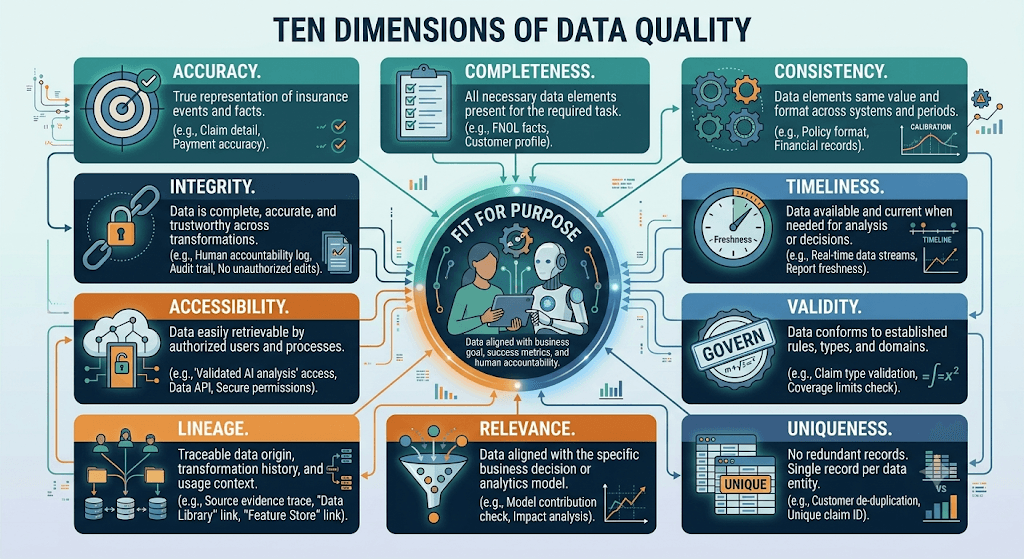
Data quality is the fitness of data for a defined business purpose. It is measured against explicit expectations for accuracy, completeness, consistency, timeliness, validity, uniqueness, relevance, lineage, and accessibility.
Reliable data is not a technical prerequisite alone. It is the operating foundation for trustworthy insurance decisions.
Executive Snapshot
Executive Definition
DATA QUALITY The degree to which data is accurate, complete, consistent, timely, valid, traceable, and fit for the specific insurance decision or workflow in which it will be used.
Data quality determines whether analytics and AI can produce dependable, explainable, and operationally useful results. In Property & Casualty insurance, quality must be evaluated in context: data that is acceptable for portfolio reporting may be inadequate for a high-severity claim decision, an underwriting referral, a customer communication, or a regulatory filing.
Executive Summary
Insurers possess large amounts of data, but volume does not equal readiness. Claims notes may be incomplete, policy fields may use inconsistent codes, loss descriptions may be duplicated, medical documents may arrive late, and key facts may remain trapped in attachments. These conditions can distort model outputs, conceal emerging exposure, slow adjusters and underwriters, and create avoidable governance risk.
Effective data quality management combines business ownership, technical controls, workflow design, lineage, monitoring, and human review. It does not attempt to make every field perfect. Instead, it identifies which data elements are critical to a decision, defines acceptable quality thresholds, detects defects early, and creates accountable remediation paths.
Quick Facts
| Question | Executive Answer |
|---|---|
| What is the core objective? | Ensure data is fit for its intended insurance use. |
| Is data quality the same as data cleanliness? | No. Cleanliness is one component; fitness, timeliness, lineage, and relevance also matter. |
| Who owns it? | Business and technology leaders jointly; data stewards and process owners manage execution. |
| Can AI fix poor data automatically? | AI can identify, standardize, and enrich data, but it cannot safely invent missing facts. |
| What is the greatest risk? | Using apparently complete data that is materially wrong, stale, biased, or disconnected from source evidence. |
| What is the best starting point? | Prioritize critical data elements tied to high-value or high-risk decisions. |
Definitions and Scope
Executive Definition
Data quality is the fitness of data for a defined business purpose. It is measured against explicit expectations for accuracy, completeness, consistency, timeliness, validity, uniqueness, relevance, lineage, and accessibility.
Technical Definition
Data quality is a multidimensional property of datasets, records, fields, documents, metadata, and derived features. It is evaluated through profiling, validation rules, reconciliation, anomaly detection, lineage analysis, source comparison, and outcome-based testing. Quality may be assessed at ingestion, transformation, storage, feature generation, model inference, and downstream use.
Insurance Definition
In insurance, data quality means that policy, exposure, claimant, medical, legal, financial, document, and workflow information is sufficiently reliable to support the intended claims, underwriting, actuarial, fraud, subrogation, compliance, or customer-service decision.
Insurance Definition
FIT FOR PURPOSE The correct question is not “Is the data good?” It is “Is the data sufficiently reliable for this specific decision, at this point in the workflow, with this level of risk?”
What Data Quality Includes
- Structured data in policy, billing, claims, underwriting, CRM, and financial systems.
- Unstructured data in claim notes, emails, demand packages, medical records, police reports, photographs, and attachments.
- Metadata such as source, timestamp, author, version, processing status, and confidence score.
- Derived data such as severity indicators, risk scores, extracted entities, embeddings, features, and model outputs.
- Reference data such as class codes, cause-of-loss codes, jurisdiction tables, provider identifiers, and vendor mappings.
Why Data Quality Matters in P&C Insurance
P&C decisions are cumulative. A missing attorney-representation date may delay litigation escalation. An incorrect vehicle-use code may distort underwriting. A stale reserve may mask exposure. Duplicate claimants may inflate counts. A misclassified document may prevent critical evidence from reaching the right professional.
| Business Area | Potential Effect of Poor Data |
|---|---|
| Claims | Delayed triage, inaccurate severity assessment, reserve errors, missed subrogation, inconsistent customer handling. |
| Underwriting | Incorrect appetite decisions, pricing errors, excessive referrals, missed risk characteristics. |
| SIU/Fraud | False positives, missed networks, weak evidence trails, inefficient investigations. |
| Actuarial/Finance | Distorted loss development, unreliable trends, reconciliation delays, reporting risk. |
| Customer Service | Conflicting communications, repeated information requests, slower resolution. |
| AI and Analytics | Biased training, unstable predictions, weak explanations, low adoption, governance failures. |
The Core Dimensions of Data Quality
| Dimension | Meaning | Insurance Example |
|---|---|---|
| Accuracy | Data correctly represents the real-world fact. | The loss date matches source documentation and the claim file. |
| Completeness | Required information is present at the needed level. | Injury type, body part, treatment status, and attorney representation are captured. |
| Consistency | The same fact agrees across systems and records. | Policy limits match between the policy administration and claims systems. |
| Timeliness | Data is available and current when the decision is made. | A new surgery recommendation reaches the severity workflow promptly. |
| Validity | Data conforms to defined formats, ranges, and business rules. | A state code, postal code, reserve amount, and coverage date are valid. |
| Uniqueness | Duplicate records are identified and appropriately resolved. | A claimant is not counted multiple times because of name variations. |
| Relevance | Data materially supports the intended decision. | Recent treatment progression matters more than an unrelated historic note. |
| Lineage | The origin and transformations of data are traceable. | An extracted medical fact links to the exact page and document source. |
| Accessibility | Authorized users and systems can retrieve data when needed. | An adjuster can access the supporting document behind an AI insight. |
| Integrity | Relationships and dependencies remain intact. | Claim, policy, exposure, party, and payment records are correctly linked. |
A quality score should not collapse these dimensions into a single unexplained number. Decision-makers need to know which dimension failed, why it matters, and whether the defect changes the permissible use of the data.
Critical Data Elements
Not every field deserves the same investment. A critical data element is a field, document, fact, or derived attribute whose failure could materially affect a decision, customer outcome, financial result, regulatory obligation, or model performance.
Examples in Claims
- Policy number, coverage status, limits, deductibles, and endorsements.
- Loss date, report date, location, cause of loss, and jurisdiction.
- Claimant identity, injury description, attorney representation, treatment progression, and work status.
- Paid, reserve, incurred, recovery, and expense values.
- Litigation events, demand amounts, settlement authority, and disposition.
- Document source, date, type, extraction confidence, and page-level evidence.
Examples in Underwriting
- Named insured, entity type, location, operations, revenue, payroll, and class codes.
- Prior losses, limits, deductibles, coverage requests, and effective dates.
- Vehicle, property, employee, exposure, and schedule details.
- Broker submissions, supplemental applications, inspection findings, and third-party data.
- Appetite-rule inputs and reasons for referral, decline, or exception.
Examples in Underwriting
PRIORITIZATION PRINCIPLE Start with the data elements that influence material decisions. Define quality expectations around their real operational use, not around abstract database perfection.
The Data Quality Lifecycle
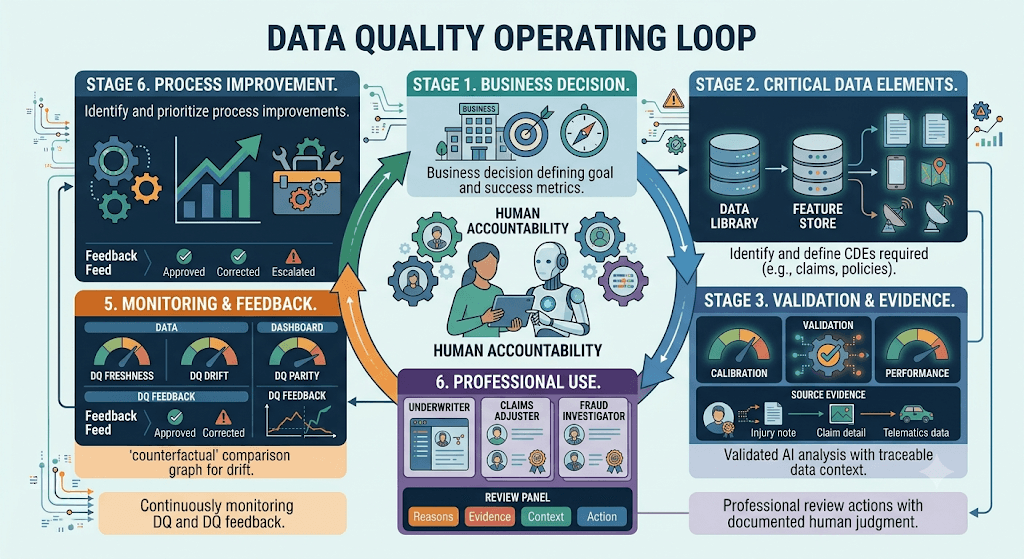
Define the business decision and the consequences of error.
Identify critical data elements and authoritative sources.
Establish quality rules, thresholds, and acceptable exceptions.
Profile current data to understand defects and variation.
Implement controls at capture, ingestion, transformation, and use.
Route exceptions to accountable owners with service levels.
Measure quality trends, business impact, and recurrence.
Improve upstream processes and retire ineffective controls.
Quality controls should be placed as close as practical to the source of the defect. Correcting a cause-of-loss code during FNOL is generally more efficient than discovering the problem during reserve analysis months later.
Data Profiling and Baseline Assessment
Data profiling reveals what is actually present before an insurer defines improvement targets. It examines field populations, null rates, distributions, uniqueness, format patterns, value frequencies, relationships, and anomalies.
| Profiling Question | Illustrative Measure |
|---|---|
| How often is a required field missing? | Null or blank rate by product, office, vendor, adjuster, or channel. |
| Are values plausible? | Range, pattern, date sequence, and business-rule violations. |
| Are categories used consistently? | Frequency and drift in cause, class, injury, or disposition codes. |
| Are duplicates present? | Potential duplicate claims, parties, providers, policies, or documents. |
| Do linked records reconcile? | Policy-to-claim, claim-to-payment, document-to-claim, and reserve-to-finance checks. |
| Is data current? | Latency from event to system availability and age since last update. |
| Can facts be traced? | Percentage of extracted or derived facts with source evidence and lineage. |
A baseline should be segmented. An enterprise-wide average can conceal severe quality problems in a particular state, line of business, data provider, claim type, or workflow.
Validation Rules and Controls
Validation rules can be deterministic, statistical, semantic, or evidence-based. Mature programs combine them.
| Control Type | Example |
|---|---|
| Required-field rule | Attorney-representation date is required when representation status is “Yes.” |
| Format rule | Policy number, postal code, and date fields follow approved patterns. |
| Range rule | Reserve and payment values cannot violate approved numerical boundaries without review. |
| Cross-field rule | Loss date cannot precede policy inception or follow claim closure. |
| Cross-system reconciliation | Coverage limits and deductible values agree across authoritative systems. |
| Statistical anomaly detection | Sudden shifts in document volume, null rate, or code distribution trigger investigation. |
| Semantic validation | Narrative content conflicts with a structured field, such as “no attorney” while notes name counsel. |
| Evidence validation | An extracted fact must link to the source page and meet a confidence threshold. |
Data Quality in Claims
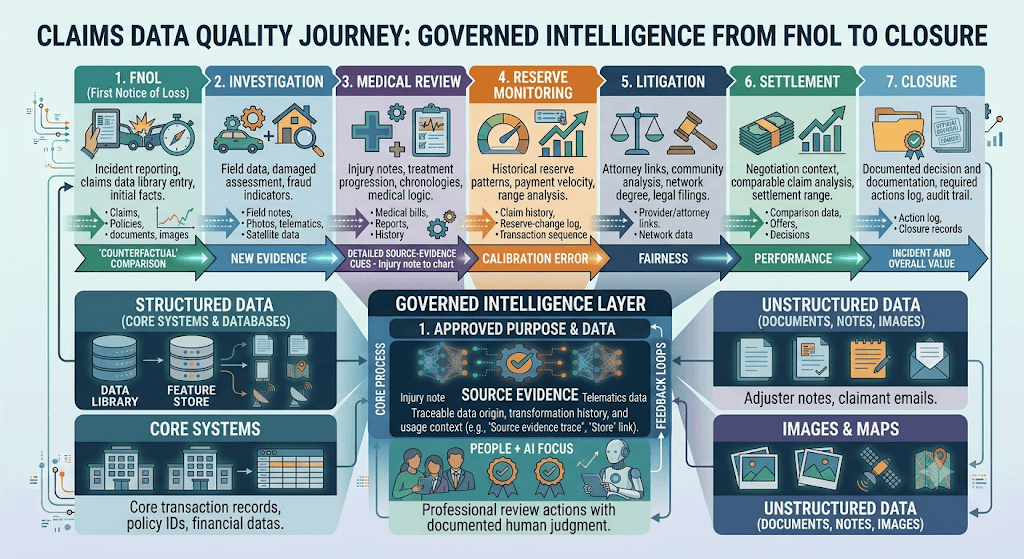
Claims data changes continuously. New documents, medical events, legal activity, reserves, payments, and notes alter the understanding of exposure. Quality therefore requires continuous validation, not a one-time intake check.
High-Value Claims Controls
- Validate coverage, policy limits, and loss dates before downstream severity analysis.
- Compare structured claim fields with adjuster notes and newly received documents.
- Track the freshness of reserves, work status, treatment status, and attorney representation.
- Identify duplicate documents, claims, providers, and claimant identities.
- Preserve source evidence for extracted medical, legal, and financial facts.
- Flag contradictory facts for professional review rather than silently selecting one version.
Claims Case Study: Missing Litigation Signals
A bodily injury claim remains coded as unrepresented, but an uploaded demand package identifies counsel and includes a filing deadline. A structured-data-only workflow misses the change. A quality-aware process compares documents with claim fields, identifies the inconsistency, links the evidence, and routes the claim to the appropriate professional. The business value comes not from “cleaning a field” but from preventing delayed escalation and improving decision timing.
Data Quality in Underwriting
Underwriting data is assembled from applications, broker submissions, schedules, inspections, prior-loss reports, third-party sources, and internal systems. The same fact may appear in several forms and at different levels of detail.
Key Controls
- Identify authoritative sources for exposure, prior losses, limits, and applicant identity.
- Reconcile schedules against application totals and detect missing locations or vehicles.
- Normalize class codes, business descriptions, and units of measure without obscuring original values.
- Measure third-party data age, coverage, confidence, and match quality.
- Require evidence for material inferred attributes and preserve underwriter override reasons.
- Separate missing data from negative findings; “not found” does not mean “no risk.”
Underwriting Case Study: Inconsistent Exposure Totals
A commercial submission lists payroll in the application, a different total in an attachment, and a third value from a prior policy. A reliable workflow surfaces all three values, identifies their sources and dates, applies a reconciliation rule, and asks the underwriter to resolve the material discrepancy. An unreliable workflow silently chooses the easiest field and creates false precision.
Unstructured Documents and Data Quality
Insurance evidence often resides in documents rather than database fields. Quality controls must therefore address document ingestion, classification, extraction, context, versioning, and provenance.
| Document Risk | Quality Control |
|---|---|
| Wrong claim or policy association | Validate identifiers, parties, dates, and source channel before attachment. |
| Incorrect document classification | Use confidence thresholds, business rules, and human review for ambiguous classes. |
| Extraction error | Preserve page-level evidence, confidence, and original text. |
| Duplicate or superseded version | Detect near-duplicates and maintain version relationships. |
| Missing pages or corrupted file | Check page counts, readability, and processing completeness. |
| Context loss | Store surrounding text, section heading, author, date, and document type. |
| Unsupported summary | Require citations to source passages and disclose uncertainty. |
SOURCE EVIDENCE For high-impact insurance use cases, a derived fact should be traceable to the original document, page, passage, extraction method, and confidence level.
Data Quality for AI and Machine Learning
AI systems transform input data into predictions, classifications, summaries, recommendations, or actions. Poor inputs can create poor outcomes, but the relationship is more complex than “garbage in, garbage out.” Models may also amplify subtle defects, learn historical process bias, or appear accurate while failing on underrepresented segments.
Training Data Quality
- Representative population and time periods.
- Accurate and consistently defined labels.
- Documented exclusions, sampling, and preprocessing.
- Sufficient coverage of rare but material outcomes.
- Controls for leakage, duplication, and post-outcome information.
- Traceable linkage between source records and training features.
Inference Data Quality
- Schema and unit consistency with training expectations.
- Freshness and availability at the moment of decision.
- Monitoring for missing fields, distribution shifts, and source outages.
- Confidence and evidence for extracted or generated inputs.
- Fallback behavior when critical data is unavailable or unreliable.
Missing Data, Imputation, and Unknowns
Missing data must be treated as information, not merely an inconvenience. It can reflect workflow timing, nonresponse, system failure, business practice, or the underlying risk itself.
| Approach | Appropriate Use | Primary Risk |
|---|---|---|
| Leave as unknown | When absence is meaningful or the fact cannot be safely inferred. | Downstream systems may mishandle nulls. |
| Rule-based default | When a documented business default is valid and transparent. | Default may be mistaken for an observed fact. |
| Statistical imputation | For analytical use where assumptions are tested and documented. | Reduces apparent uncertainty and may distort segments. |
| Model-based estimation | When validated for the use case and accompanied by confidence. | Can create circularity or hidden bias. |
| Request additional information | When the data is material to a decision. | Adds delay and operational effort. |
| Route to human review | When uncertainty and decision impact exceed tolerance. | Requires capacity and clear escalation rules. |
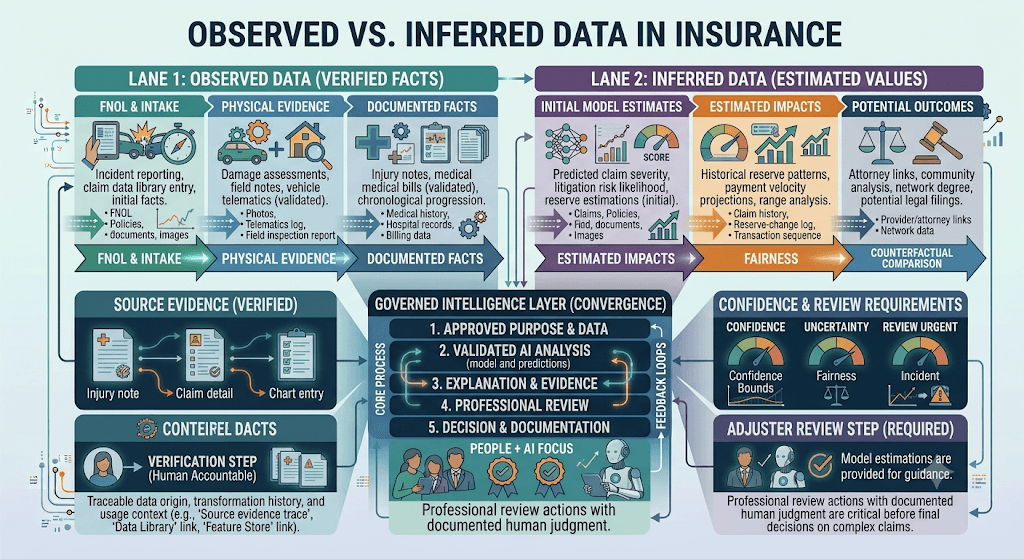
DO NOT INVENT FACTS AI-assisted enrichment may suggest likely values, but estimated or inferred data must remain distinguishable from observed, verified facts.
Third-Party and Vendor Data
Insurers often rely on external data for property attributes, vehicles, weather, litigation, medical providers, businesses, geospatial risk, sanctions, credit-related attributes, and identity resolution. Quality obligations do not transfer to the vendor.
- Define intended use and prohibited use.
- Document source coverage, update frequency, match logic, and known limitations.
- Measure match rates, false matches, missingness, and regional or segment variation.
- Require change notification for schemas, methodologies, or source providers.
- Retain the ability to trace a vendor-derived attribute to its source and date.
- Establish fallback procedures for outages or degraded quality.
- Validate vendor claims independently against insurer outcomes.
Data Lineage and Provenance
Lineage explains where data came from, how it changed, and where it is used. Provenance establishes the origin and authenticity of a specific fact, document, or derived value. Together, they support auditability, explainability, correction, and responsible reuse.
Minimum Lineage Record
| Field | Minimum Content |
|---|---|
| Source | System, document, vendor, user, or event that created the data. |
| Time | Creation, receipt, extraction, transformation, and last-update timestamps. |
| Transformation | Rules, mappings, calculations, models, or manual changes applied. |
| Identity | Record, claim, policy, party, document, page, or transaction identifiers. |
| Quality Status | Validation result, exception, confidence, and remediation state. |
| Usage | Reports, models, workflows, decisions, and downstream systems consuming the data. |
| Ownership | Business owner, steward, technical custodian, and accountable resolver. |
Roles and Accountability
| Role | Primary Responsibility |
|---|---|
| Executive Sponsor | Sets priorities, resolves cross-functional barriers, and connects quality to business outcomes. |
| Data Owner | Approves definitions, standards, thresholds, and acceptable use for a domain. |
| Data Steward | Monitors quality, manages definitions, investigates issues, and coordinates remediation. |
| Process Owner | Improves the workflow that creates or updates the data. |
| Technology Owner | Operates pipelines, controls, storage, integration, and technical remediation. |
| Model Owner | Ensures training and inference data remain appropriate for the model. |
| Business User | Reviews exceptions, supplies context, and reports defects. |
| Risk/Compliance | Challenges controls and evaluates legal, regulatory, fairness, and conduct implications. |
Data quality fails when accountability is assigned only to IT. Technology can detect defects, but business leaders must define meaning, materiality, and acceptable use.
Metrics and Management Reporting
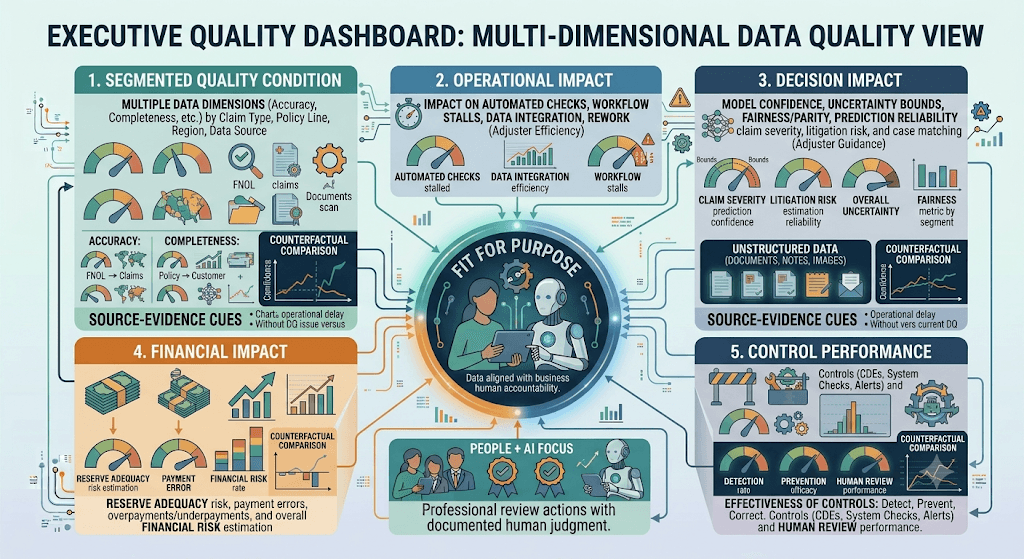
Metrics should connect technical conditions to business impact. A lower null rate is useful, but leaders also need to know whether claim cycle time improved, referrals declined, reserve decisions became earlier, or manual rework decreased.
| Metric Category | Examples |
|---|---|
| Quality Condition | Accuracy, completeness, consistency, validity, timeliness, duplication, lineage coverage. |
| Operational Impact | Rework hours, exception volume, referral rate, processing delay, document-routing errors. |
| Decision Impact | Override rate, missed escalation, pricing correction, reserve change timing, false-positive rate. |
| Financial Impact | Leakage avoided, expense reduction, recovery improvement, premium correction, loss-ratio effect. |
| Control Performance | Detection rate, time to resolution, recurrence rate, control coverage, unresolved critical issues. |
| Trust and Adoption | User confidence, evidence usage, dispute rate, workflow adoption, satisfaction. |
Quality thresholds should be risk-tiered. A field used only for exploratory analysis may tolerate more uncertainty than a field used for automated customer communication or settlement authority.
Data Quality Issue Management
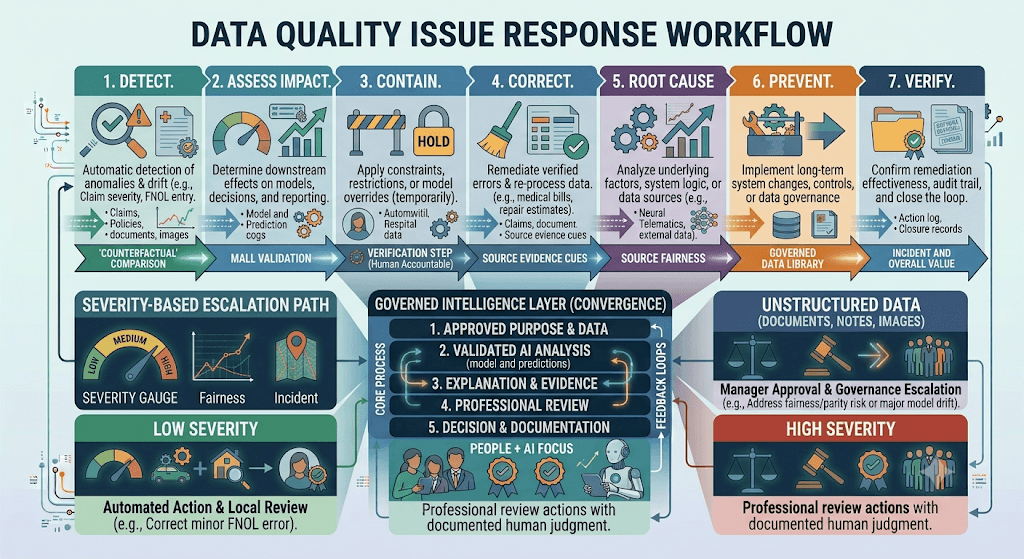
Detect and record the defect with evidence.
Assess affected records, systems, models, workflows, and decisions.
Classify severity based on business and customer impact.
Contain the issue by pausing use, applying a fallback, or adding review.
Correct affected data where appropriate and preserve audit history.
Identify root cause in the source process, mapping, vendor feed, rule, or transformation.
Implement preventive controls and verify effectiveness.
Close the issue only after downstream impacts are addressed.
Severity levels should distinguish routine defects from issues that could materially affect coverage, pricing, claim outcomes, financial reporting, fairness, or regulatory obligations.
Common Failure Modes
| Failure Mode | Why It Fails |
|---|---|
| Enterprise-wide “cleanup” without prioritization | Consumes resources without connecting effort to decisions or value. |
| Single quality score | Hides the failed dimension, materiality, and affected use. |
| Fixing downstream symptoms only | Allows the source process to recreate the defect. |
| Treating missing as “No” | Converts uncertainty into a false fact. |
| Silent overwriting | Destroys lineage and prevents users from understanding corrections. |
| Overreliance on averages | Masks failures in jurisdictions, products, vendors, or vulnerable groups. |
| Assuming third-party data is authoritative | Ignores coverage gaps, stale records, and match errors. |
| No owner for exceptions | Creates growing backlogs and recurring defects. |
| Automated enrichment without disclosure | Blurs observed and inferred data. |
| Quality measured only before deployment | Misses source changes, drift, and operational degradation. |
Best Practices
- Define quality in relation to a business decision and risk level.
- Prioritize critical data elements and high-impact workflows.
- Preserve original values and full change history.
- Distinguish observed, verified, inferred, estimated, and unknown data.
- Make source evidence visible to claims and underwriting professionals.
- Segment metrics by product, jurisdiction, channel, vendor, and user group.
- Place preventive controls near data creation and detective controls throughout the lifecycle.
- Measure operational and financial effects, not only technical defects.
- Use human review for material contradictions, low confidence, and ambiguous evidence.
- Integrate quality monitoring with AI governance, model monitoring, and incident management.
Implementation Blueprint
Phase 1: Focus and Baseline
- Select one high-value workflow, such as bodily injury triage, commercial submission intake, or document routing.
- Identify the decisions, users, critical data elements, and authoritative sources.
- Profile current quality and quantify rework, delay, or decision impact.
Phase 2: Design
- Define dimensions, rules, thresholds, exceptions, and ownership.
- Design lineage, evidence, confidence, and remediation records.
- Agree on risk-based fallback and human-review requirements.
Phase 3: Implement
- Add validation at capture, ingestion, transformation, and point of use.
- Create exception queues and service levels.
- Integrate dashboards with the operational workflow rather than creating a separate reporting exercise.
Phase 4: Prove Value
- Compare baseline and post-control results.
- Measure rework, cycle time, referrals, missed signals, and user confidence.
- Validate that improvements persist across segments and time.
Phase 5: Scale
- Reuse definitions and controls where appropriate.
- Expand by data domain and decision risk.
- Establish enterprise governance while preserving local business accountability.
Executive Decision Guide
| Executive Question | What a Strong Answer Includes |
|---|---|
| Which decisions depend on this data? | Named workflows, users, financial impact, customer impact, and risk tier. |
| Which elements are critical? | Prioritized fields, documents, derived facts, and evidence requirements. |
| What does “good enough” mean? | Dimension-specific thresholds and acceptable exceptions by use. |
| How do we know when quality degrades? | Continuous monitoring, segmentation, alerts, and ownership. |
| What happens when a defect is found? | Containment, correction, root-cause analysis, and downstream impact review. |
| Can users verify AI-supported facts? | Visible evidence, confidence, lineage, and clear distinction between observed and inferred data. |
| How is value measured? | Operational, decision, financial, control, and trust metrics. |
Charlee.ai Perspective
For insurers, data quality should not be treated as a preliminary data-engineering project that must be completed before value can begin. It should be embedded in the claims and underwriting workflows where information is captured, interpreted, and acted upon.
A practical insurance AI platform should help organizations:
The goal is not to replace professional judgment with a cleaner database. The goal is to give insurance professionals more reliable, timely, and explainable information so they can make better decisions.
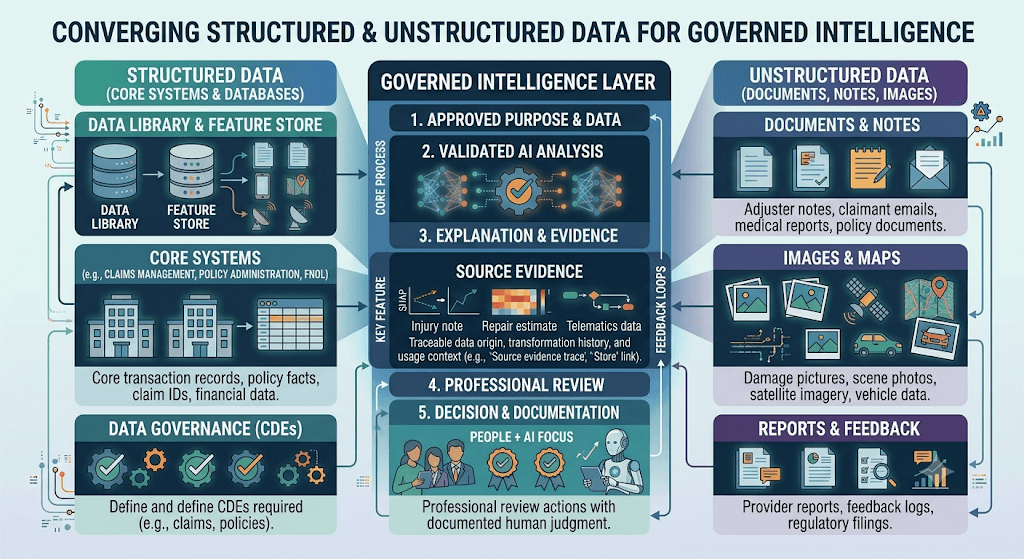
- Bring together structured and unstructured information without obscuring source differences.
- Identify missing, contradictory, stale, and low-confidence facts.
- Connect insights to supporting documents and evidence.
- Preserve human authority for material insurance decisions.
- Monitor data and model behavior over time.
- Create feedback loops that improve both data and workflow quality.
EDITORIAL POSITION Trustworthy insurance AI requires quality data, transparent evidence, accountable controls, and professional review. No single technology eliminates the need for disciplined data ownership.
External Framework Alignment
A data quality program should be aligned with the insurer’s broader governance and risk framework. Relevant reference points may include the NIST AI Risk Management Framework, NIST data and cybersecurity guidance, NAIC model bulletins and principles concerning insurer use of AI, state insurance requirements, privacy obligations, records-retention requirements, and the organization’s own model-risk, data-governance, security, and internal-control standards.
Alignment does not mean copying a framework into policy. It means translating principles into accountable controls, evidence, monitoring, and decision rights appropriate to the insurer’s products, jurisdictions, and use cases.
Key Takeaways
- Data quality is fitness for a specific purpose, not abstract perfection.
- Accuracy, completeness, consistency, timeliness, validity, lineage, and relevance must be evaluated separately.
- Critical data elements should receive the strongest controls and accountability.
- Structured and unstructured insurance data require an integrated quality approach.
- Observed facts must remain distinguishable from inferred or estimated values.
- Source evidence and lineage are essential for trustworthy AI.
- Quality ownership belongs to business and technology together.
- Metrics should connect defects to operational, decision, financial, and customer impact.
- Continuous monitoring is required because insurance data changes throughout the lifecycle.
- Human judgment remains essential when evidence is contradictory, incomplete, or material to the decision.
Data quality is the fitness of data for a defined business purpose. It is measured against explicit expectations for accuracy, completeness, consistency, timeliness, validity, uniqueness, relevance, lineage, and accessibility.
Reliable data is not a technical prerequisite alone. It is the operating foundation for trustworthy insurance decisions.
Frequently Asked Questions
Data quality is the degree to which data is fit for a defined purpose based on dimensions such as accuracy, completeness, consistency, timeliness, validity, lineage, and relevance.
No. Insurers should identify material defects, define acceptable thresholds, preserve uncertainty, and apply controls appropriate to the decision risk.
Business and technology leaders share responsibility. Business owners define meaning and materiality; technology teams implement and operate controls.
There is no universal answer. The most important dimension depends on the intended use and consequence of error.
Not necessarily. A complete but inaccurate record can be more dangerous than an explicitly incomplete one.
Treat it as unknown unless a transparent, validated method supports defaulting or estimation. Material gaps should trigger review or additional information.
Yes. AI can classify documents, extract facts, detect contradictions, normalize values, and identify anomalies. It should not silently invent missing facts.
Data lineage records the origin, movement, transformation, and use of data across systems and workflows.
It allows professionals to verify an extracted or derived fact and supports explainability, correction, audit, and trust.
It can weaken accuracy, create bias, cause instability, and make model explanations unreliable.
It can produce unsupported summaries, omit material facts, repeat stale information, or ground responses in the wrong documents.
They are fields, documents, or derived facts whose failure could materially affect a decision, customer, financial result, or obligation.
At a frequency aligned with how quickly the data and decision can change. High-impact operational data may require continuous monitoring.
A summary score can help prioritize, but it should not replace dimension-level measures, segmentation, evidence, and impact analysis.
Define use, validate match quality and coverage, monitor changes, preserve source information, and establish fallback procedures.
Changes in source data quality can cause or mimic model drift. Data and model monitoring should therefore be connected.
By the materiality of the affected decision, customer impact, financial exposure, regulatory risk, and number of records or workflows affected.
It can reduce rework, improve decision timing, increase automation reliability, strengthen recoveries, lower referral volume, and improve trust and adoption.