What AI Agents Are and Why They Matter
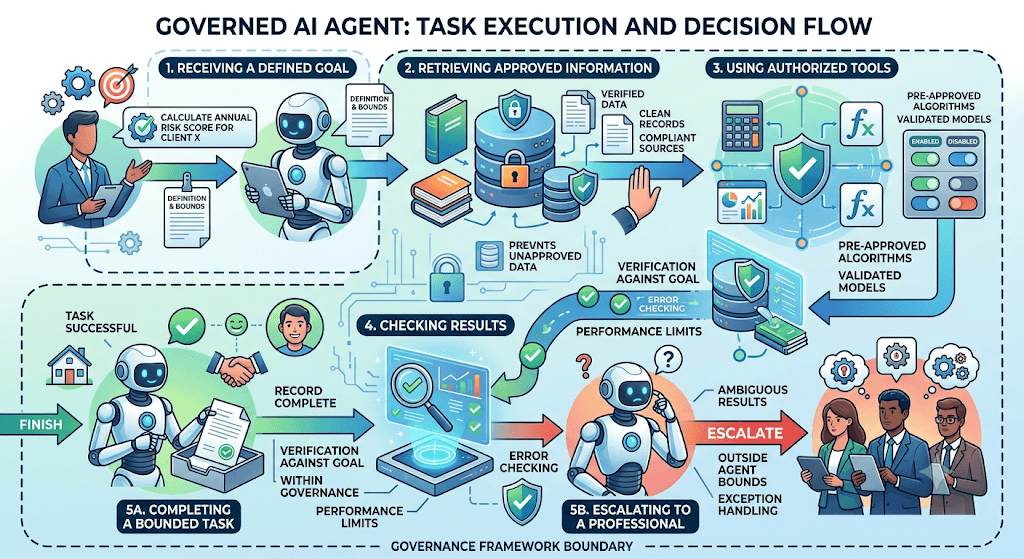
AI agents represent a shift from isolated prediction or content generation toward governed systems that can pursue a defined goal, use approved tools, maintain state, evaluate progress, and escalate when judgment is required.
Executive Definition
An AI agent is a governed software system that interprets an objective, retrieves authorized information, selects permitted tools, completes a bounded sequence of tasks, evaluates results, and involves a person when approval, judgment, or an exception is required.
Why Insurance Is Well Suited
- Insurance work is document intensive and distributed across systems.
- Many workflows require repeated context assembly and follow-up.
- Important claim, underwriting, or compliance events can emerge between periodic reviews.
- Professionals create the greatest value through judgment, relationships, negotiation, and accountability—not administrative coordination.
The Business Opportunity
AI agents can reduce coordination burden, improve preparation quality, accelerate review, and strengthen operational consistency. Their value should be measured through workflow quality and business outcomes rather than autonomy alone.
Executive Perspective
AI agents create durable value when they improve the quality, speed, and consistency of work while preserving professional authority, evidence, and accountability. The objective is not autonomy for its own sake; it is disciplined orchestration in service of better insurance outcomes.
Key Takeaways
- An agent combines goals, models, tools, state, permissions, and monitoring.
- Insurance agents should be designed as governed workflow participants.
- Consequential decisions remain with authorized professionals.
AI Agents Compared with Traditional Automation, Predictive AI, and Generative AI
CHAPTER OVERVIEW
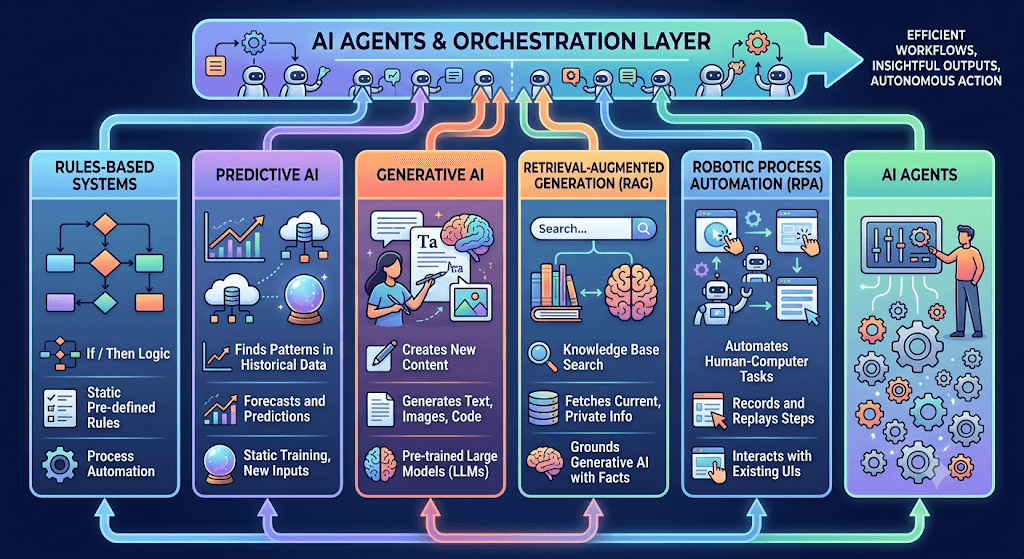
Executives need a clear understanding of where AI agents fit within the broader technology landscape.
Capability Comparison
| Technology | Primary Function | Typical Output | Key Limitation |
|---|---|---|---|
| Rules engine | Executes explicit logic | Deterministic decision or route | Limited when context is ambiguous |
| Predictive AI | Estimates likelihood or value | Score, forecast, ranking | Does not coordinate work |
| Generative AI | Creates content | Summary, draft, explanation | May not persist state or act |
| RAG | Retrieves evidence for generation | Grounded answer with sources | Is usually a component, not a workflow |
| RPA | Automates fixed system steps | Completed transaction | Brittle when conditions vary |
| AI agent | Pursues a goal using tools and controls | Completed task, escalation, audit trail | Requires strong governance and monitoring |
The Key Distinction
An agent does not merely answer. It operates inside a controlled execution loop: observe, plan, act, verify, and either continue, stop, or escalate.
Key Takeaways
- Agents orchestrate capabilities rather than replace them.
- Different technologies solve different classes of problems.
- The best architecture combines deterministic controls with probabilistic intelligence.
How AI Agents Work
CHAPTER OVERVIEW
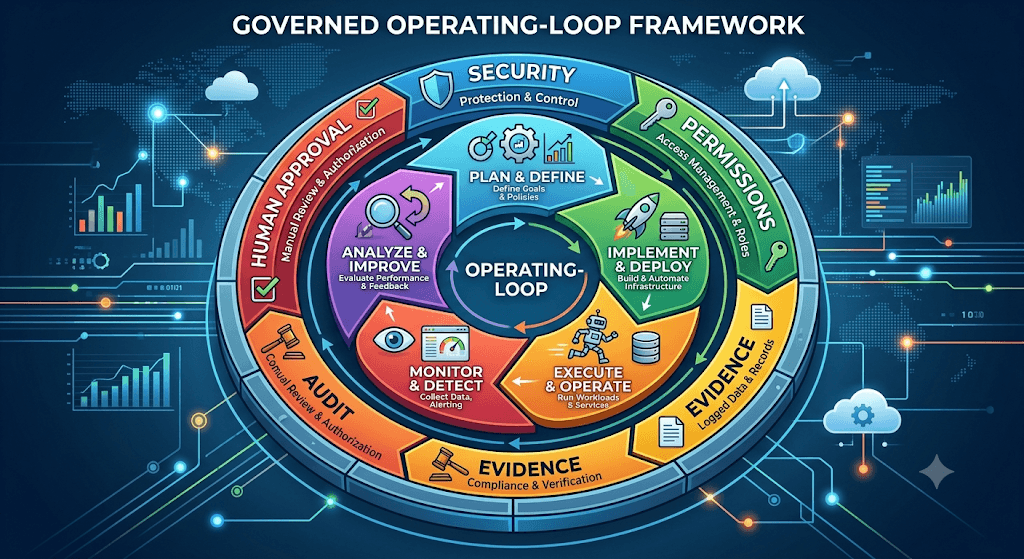
An AI agent is an architecture—not merely a language model. Reliable production use depends on coordinated components and explicit control boundaries.
The Agent Operating Loop
- Receive a goal and scope.
- Retrieve authorized context.
- Plan or follow a permitted sequence.
- Call approved tools.
- Observe the result.
- Apply policy, confidence, and completion checks.
- Complete, retry safely, or escalate.
Core Components
| Layer | Purpose | Insurance Example |
|---|---|---|
| Objective and instructions | Define mission, limits, and completion | Prepare a litigation review; do not alter reserves |
| Reasoning model | Interpret context and choose next step | Determine relevant documents and tasks |
| Knowledge and retrieval | Supply approved evidence | Policy forms, claim notes, procedures |
| Tools and integrations | Perform permitted actions | Search, extract, create task, notify |
| Memory and state | Track workflow progress | Documents reviewed and approvals pending |
| Policy and permission layer | Restrict access and authority | Read-only access and approval gates |
| Monitoring and audit | Record actions and exceptions | Tool calls, citations, timestamps, approvals |
Control Principle
The model may propose the next action, but enterprise systems—not natural-language instructions—must enforce what the agent can see, do, approve, retain, and communicate.
Key Takeaways
- Production agents require more than a model.
- Permissions must be enforced outside the model.
- Completion, failure, and escalation conditions should be explicit.
Types of AI Agents and Multi-Agent Systems
CHAPTER OVERVIEW
Insurers can deploy different agent types according to the task, consequence, and operating environment.
Agent Types
| Agent Type | Primary Role | Insurance Example |
|---|---|---|
| Assistive | Prepare information for review | Claim chronology and follow-up list |
| Workflow | Execute bounded multi-step tasks | Check completeness and route exceptions |
| Monitoring | Watch for events and conditions | Flag litigation or overdue activity |
| Analytical | Combine models and evidence | Prepare reserve-review package |
| Conversational | Provide controlled dialogue and tool access | Locate appetite guidance and submission facts |
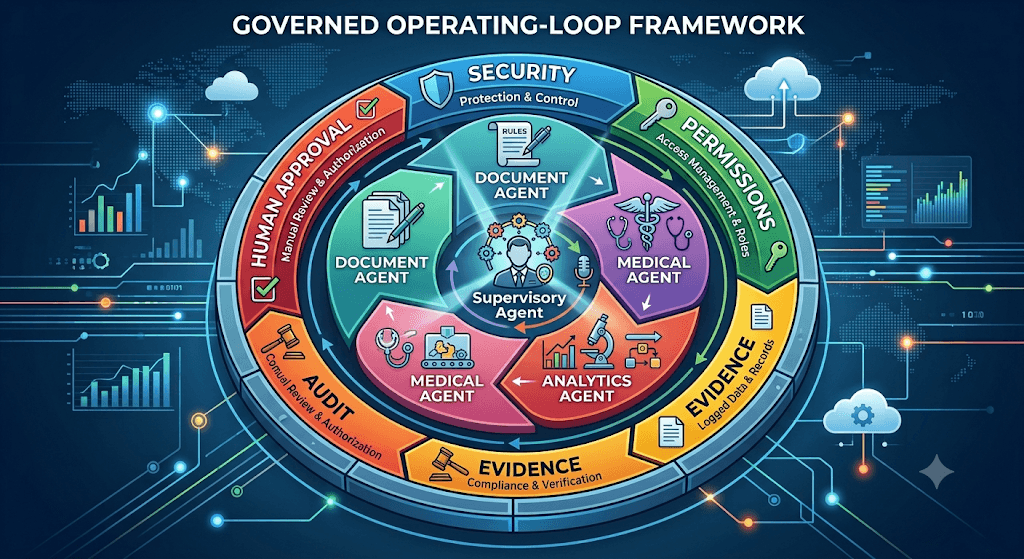
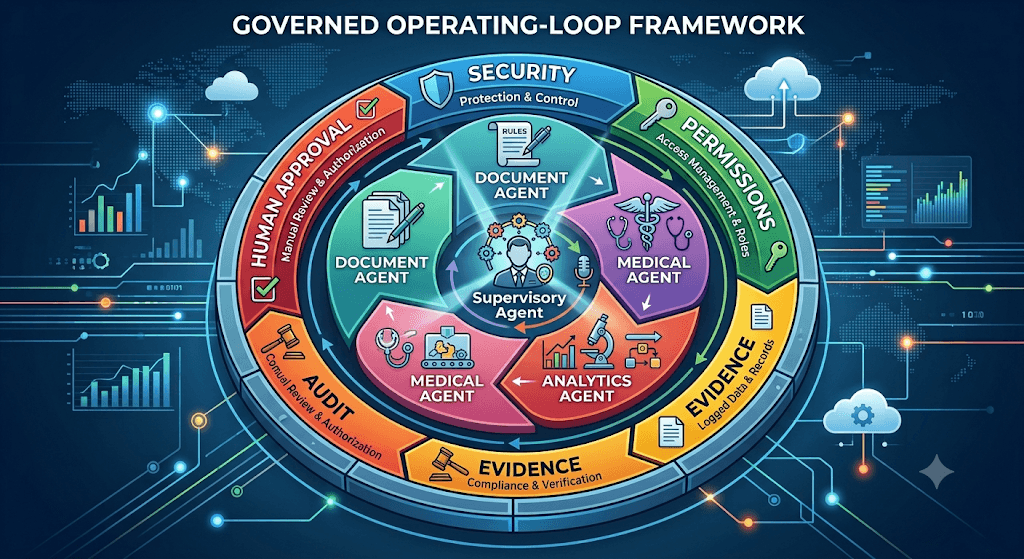
| Supervisory | Coordinate specialized agents | Manage document, policy, medical, and workflow agents |
Multi-Agent Design
Multi-agent systems can improve specialization and reuse, but they increase orchestration, security, monitoring, and failure-management complexity. A supervisory agent or deterministic workflow should control task assignment, handoffs, and final escalation.
Design Preference
Prefer small, bounded, specialized agents over one broadly empowered agent. Complexity should emerge through orchestration, not unrestricted authority.
Key Takeaways
- Agent type should match task and risk.
- Specialization improves testability and governance.
- Multi-agent systems require strong coordination and shared standards.
Human Oversight Patterns
| Pattern | When to Use | Example |
|---|---|---|
| Review before action | Material or customer-impacting action | Approve external communication or financial update |
| Review by exception | High-volume, low-risk work | Process complete intake unless inconsistency detected |
| Sampling and audit | Stable, reversible tasks | Review classification quality periodically |
| Read-only assistance | Early deployment or high-risk domain | Prepare evidence without changing systems |
| Dual control | Sensitive action requiring separation of duties | One user initiates and another approves |
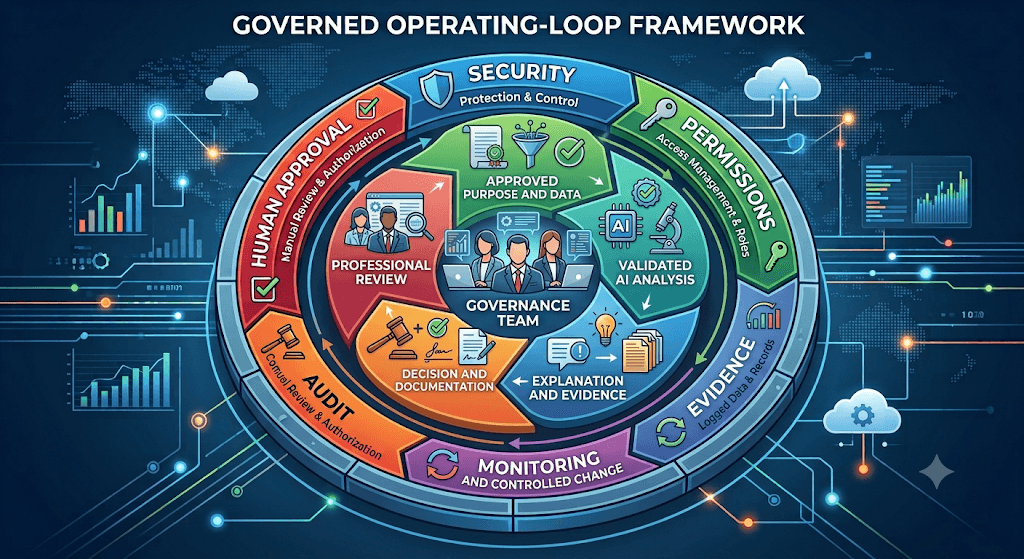
Governance Lifecycle
- Propose and classify the use case.
- Assess business, legal, data, security, privacy, model, and operational risk.
- Approve purpose, authority, controls, and evidence requirements.
- Validate with representative cases and users.
- Deploy with monitoring and fallback.
- Review changes, incidents, performance, and business value.
- Retire safely and preserve required records.
Key Takeaways
- Governance enables safe scaling.
- Meaningful review requires evidence, competence, time, and authority.
- Production approval is not permanent.
Security, Privacy, and Operational Resilience
CHAPTER OVERVIEW
Agents expand the enterprise attack surface because they retrieve data, interpret untrusted content, call tools, and may initiate actions.
Principal Risks
| Risk | Why It Matters | Core Controls |
|---|---|---|
| Excessive permissions | Agent can see or change too much | Least privilege, allowlists, environment separation |
| Prompt injection | Untrusted content manipulates instructions | Content isolation, instruction hierarchy, independent authorization |
| Tool misuse | Correct tool used with wrong parameters | Schema validation, prechecks, safe defaults |
| Automation loops | Repeated actions or excessive consumption | Step, time, and budget limits |
| Sensitive-data exposure | PII, health, or confidential data disclosed | Minimization, encryption, retention, access logging |
| Partial failure | System succeeds only in part | Idempotency, reconciliation, rollback, exception routing |
| Vendor change | Model or service changes behavior | Change notice, regression testing, exit plan |
Resilience Requirements
Production designs should include degraded-mode behavior, clear user notifications, retry limits, reconciliation, incident response, rollback, kill switches, vendor continuity, and defined ownership for recovery.
Security Principle
Treat every retrieved document, message, website, and third-party output as potentially untrusted. Models may recommend actions; trusted application controls authorize them.
Key Takeaways
- Least privilege is foundational.
- Prompt wording is not a security boundary.
- Operational failure must be observable, contained, and recoverable.
AI Agents Across the Claims Lifecycle
CHAPTER OVERVIEW
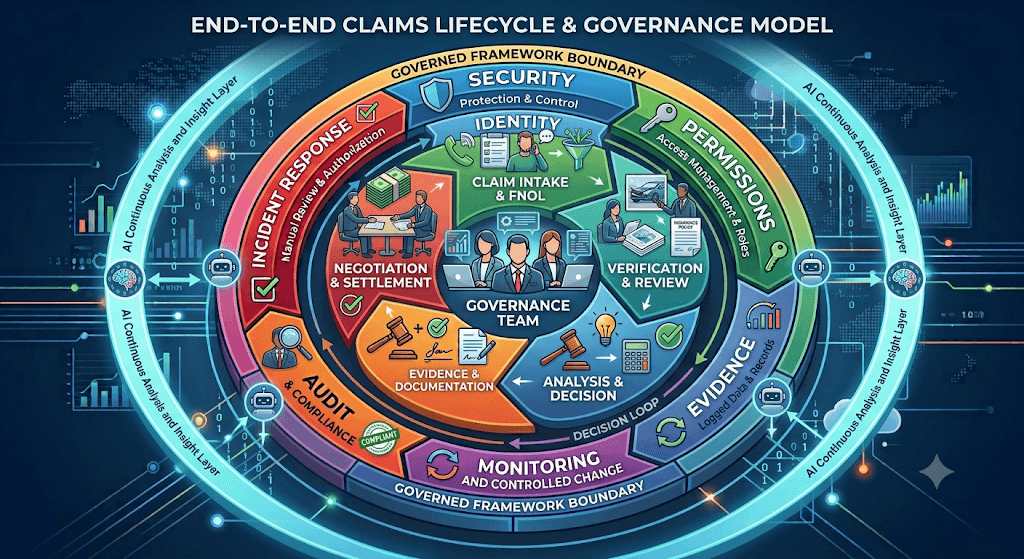
Claims agents can support professionals from FNOL through closure by continuously organizing evidence, monitoring change, and coordinating approved work.
Lifecycle Applications
| Stage | Agent Support | Human Authority |
|---|---|---|
| FNOL | Validate information, identify missing items, route complexity | Coverage and handling direction |
| Investigation | Assemble facts, tasks, photos, statements, and evidence | Liability and investigation strategy |
| Medical review | Build chronology, identify gaps, organize records | Clinical and claim judgment |
| Reserve monitoring | Surface changing severity and reserve evidence | Reserve authority |
| Litigation | Monitor counsel, filings, demands, and deadlines | Legal strategy and settlement |
| Settlement | Prepare negotiation context and documentation | Negotiation and settlement authority |
| Closure | Check documentation, recovery, and final tasks | Closure approval and quality assurance |
Continuous Monitoring
The agent should detect meaningful changes between scheduled file reviews, provide source evidence, distinguish fact from interpretation, and route the right claim to the right professional at the right time.
Claims Principle
The strongest role for AI is earlier awareness and better preparation—not autonomous claim handling.
Key Takeaways
- Agents can reduce blind spots across long-running claims.
- Every alert should show supporting evidence and change over time.
- Adjusters and managers retain claim authority.
FNOL, Triage, and Investigation Agents
CHAPTER OVERVIEW
Early claim decisions shape the entire downstream process. Agents can improve completeness, routing, and investigative preparation at the point of intake.
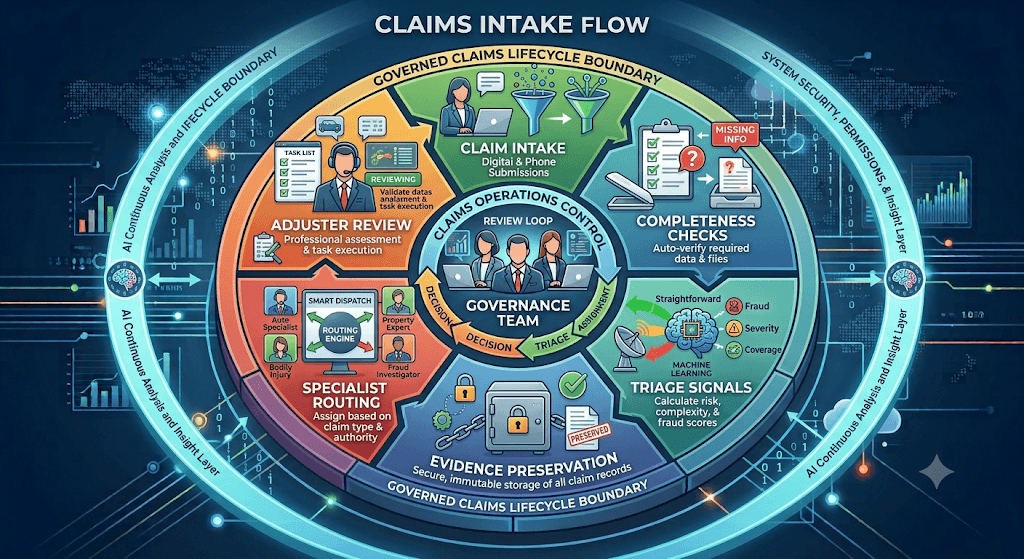
FNOL Agent Responsibilities
- Normalize information from phone, portal, email, documents, photographs, and external data.
- Identify missing or inconsistent fields.
- Detect indicators requiring priority review, specialist handling, catastrophe routing, SIU attention, or subrogation preservation.
- Create approved tasks and follow-up requests.
- Prepare a concise intake summary with source evidence.
Triage Design
Triage should prioritize professional attention without converting a score into an unsupported adverse decision. Routing logic should be tested across lines, jurisdictions, channels, claimant groups, and catastrophe conditions.
Investigation Support
Agents can build investigation plans, identify unresolved questions, track evidence, coordinate vendors, and monitor deadlines. Liability conclusions remain with authorized claim professionals.
Key Takeaways
- Better intake improves every later stage.
- Triage must be evidence-based and monitored for fairness.
- Automated routing is safer than automated claim judgment.
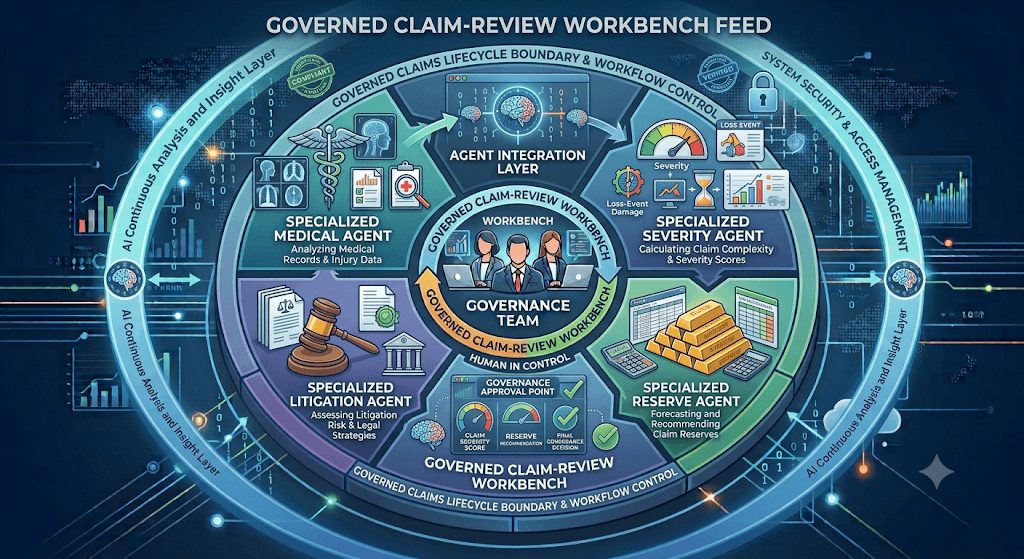
Medical, Severity, Reserve, and Litigation Agents
CHAPTER OVERVIEW
Complex claims evolve as treatment, legal representation, demand strategy, venue, and financial exposure change. Specialized agents can help professionals recognize those changes earlier.
Medical Review Agent
- Build treatment chronologies.
- Identify new procedures, specialists, diagnoses, gaps, and inconsistent records.
- Summarize causation and treatment evidence without issuing medical conclusions.
- Prepare nurse, adjuster, or physician review packages.
Severity and Reserve Monitoring
Combine structured claim data, document evidence, treatment progression, attorney involvement, venue, policy, prior decisions, and operational events. Surface changing signals and explain why the file warrants review; do not independently change reserves.
Litigation Agent
Monitor representation, filings, demands, discovery, expert activity, deadlines, venue developments, and counsel communications. Prepare evidence-centered updates for adjusters, managers, and counsel.
Measurement (Complex Claims)
- Time from material change to review.
- Evidence completeness and citation accuracy.
- Reserve-review timeliness.
- Rework, missed-event, and override rates.
- Claim outcomes evaluated cautiously against appropriate baselines.
Key Takeaways
- The value lies in timely review, not score production alone.
- Medical and legal evidence must be presented with source context.
- Reserve and litigation strategy remain professional responsibilities.
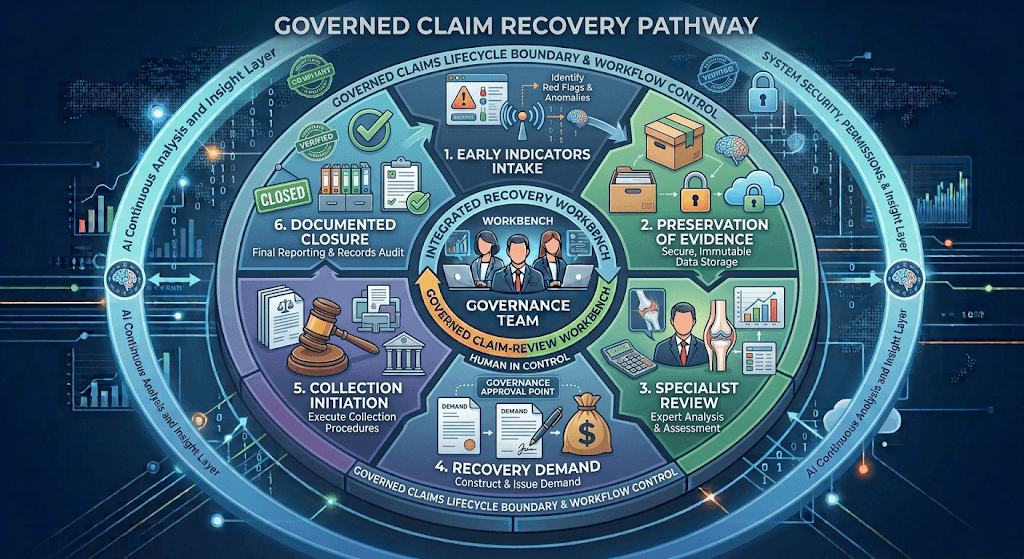
Subrogation, Recovery, and Claim Closure Agents
CHAPTER OVERVIEW
Recovery opportunities are often lost because evidence, responsible parties, or deadlines are recognized too late.
Recovery Agent Activities
- Identify potential third-party responsibility from FNOL, notes, photographs, reports, invoices, and correspondence.
- Create evidence-preservation and notice tasks.
- Track statutes, contractual deadlines, demand status, and recovery documentation.
- Organize liability and damages evidence for specialist review.
Closure Quality
Before closure, an agent can verify required documentation, pending bills, recoveries, liens, releases, regulatory notices, and outstanding tasks. Closure remains subject to the insurer’s authority and quality standards.
Control Considerations
Association does not establish liability. Recovery recommendations should show evidence, uncertainty, legal constraints, and missing information.
Key Takeaways
- Early detection protects recovery value.
- Agents can coordinate preservation and follow-up.
- Recovery and closure decisions require qualified review.
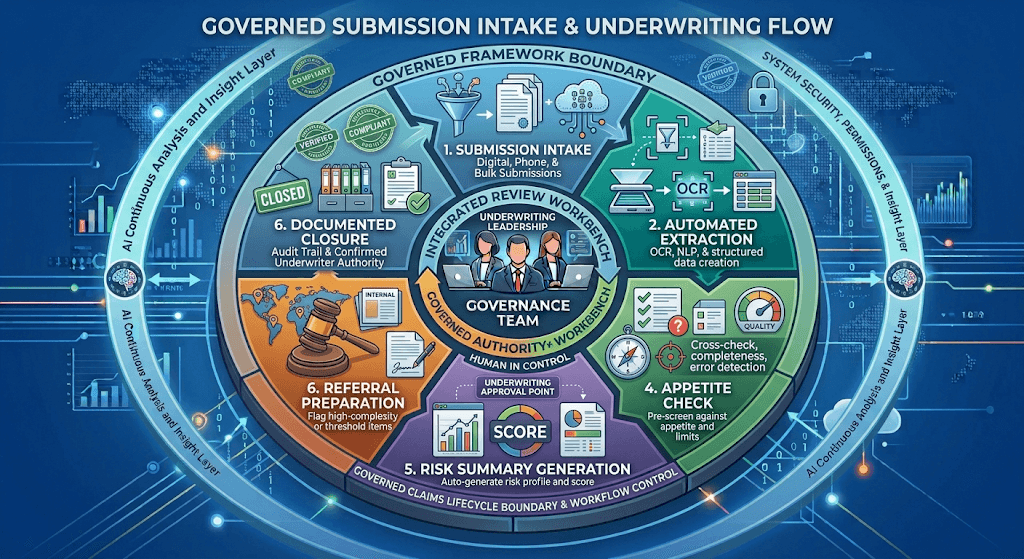
AI Agents Across the Underwriting Lifecycle
CHAPTER OVERVIEW
Underwriting agents can reduce submission preparation and portfolio-monitoring effort while preserving underwriter authority over risk selection, pricing, terms, and relationships.
Lifecycle Applications
| Stage | Agent Support | Underwriter Responsibility |
|---|---|---|
| Submission intake | Inventory documents and extract exposures | Determine relevance and quality |
| Completeness | Identify missing or inconsistent information | Decide what additional information is required |
| Appetite | Compare facts with approved guidance | Interpret appetite and exceptions |
| Risk analysis | Prepare evidence-centered risk summary | Evaluate risk and uncertainty |
| Referral | Assemble exception and authority package | Approve or escalate |
| Renewal | Summarize changes and experience | Set renewal strategy and terms |
| Portfolio | Monitor accumulation and performance | Manage capacity and portfolio direction |
The Underwriter Workbench
A strong design presents source documents, extracted facts, missing items, appetite context, predictive signals, comparable risks, and referral requirements in one review experience.
Underwriting Principle
AI should shorten preparation time and strengthen consistency without turning appetite guidance into an inflexible or opaque decision engine.
Key Takeaways
- Agents improve preparation and portfolio visibility.
- Source evidence should accompany every material summary.
- Underwriters retain risk and relationship authority.
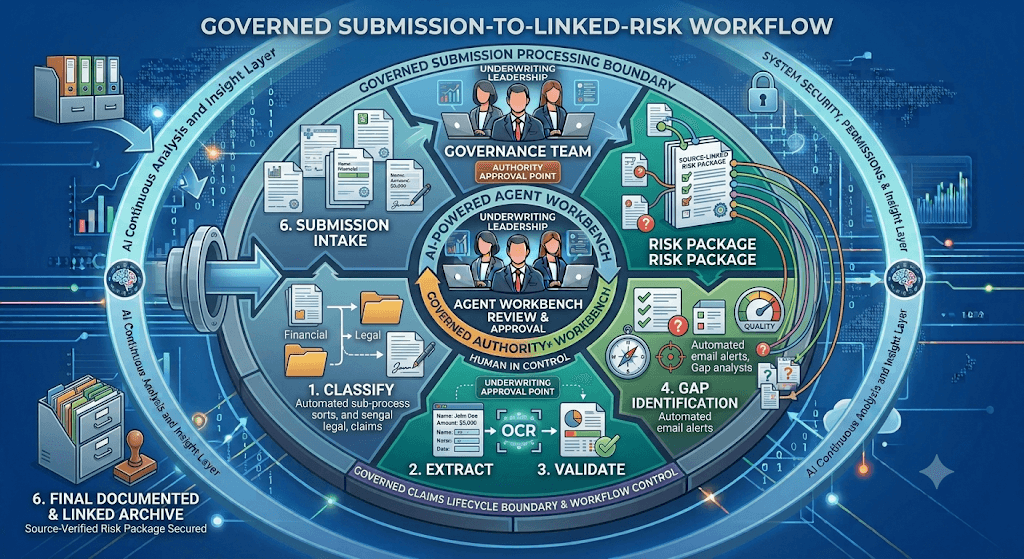
Submission Intake and Document Intelligence Agents
CHAPTER OVERVIEW
Commercial submissions arrive through fragmented documents, emails, portals, spreadsheets, and loss runs. Agents can transform this package into structured, reviewable context.
Submission Preparation
- Inventory files and versions.
- Classify documents and extract key fields.
- Resolve entities and locations.
- Identify missing schedules, statements, loss runs, inspections, or applications.
- Check internal consistency across documents.
- Create a structured summary linked to source evidence.
Document Intelligence Controls
Extraction confidence, document quality, source provenance, version control, access rights, and material-field validation should be visible. Low-confidence or conflicting fields require review.
Operational Value
Measure time to ready-for-review, completeness, extraction accuracy, rework, broker follow-up, submission abandonment, and underwriter satisfaction.
Key Takeaways
- Document intelligence is a foundation for underwriting agents.
- Conflicts and missing information should be explicit.
- The objective is a better-prepared underwriter, not automated risk selection.
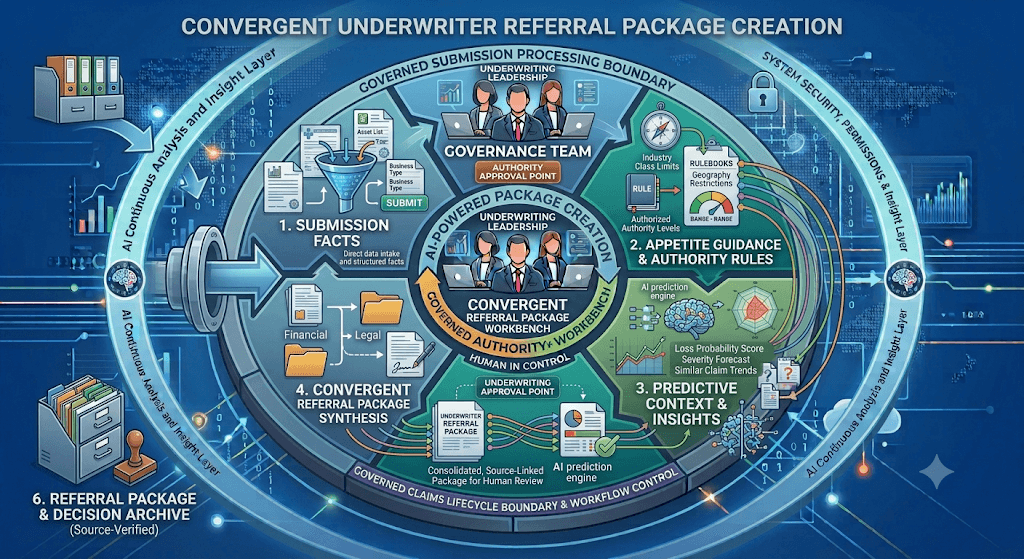
Appetite, Risk Analysis, and Referral Agents
CHAPTER OVERVIEW
Appetite and referral workflows are natural agent use cases because they combine policy, business rules, documentation, and professional judgment.
Appetite Support
Retrieve current appetite guidance, compare it with submission facts, identify apparent matches and exceptions, and cite the specific guidance. The agent should distinguish explicit rules from inferred fit.
Risk Analysis
Combine property, casualty, catastrophe, financial, loss, inspection, geospatial, and external evidence into a structured view of strengths, concerns, uncertainty, and follow-up questions.
Referral Preparation
Assemble the decision question, authority required, supporting facts, missing information, alternatives, and source evidence. Referral decisions remain with the appropriate authority holder.
Fairness and Compliance
Prohibited factors, proxy risk, data quality, adverse-impact monitoring, jurisdictional requirements, and documentation standards should be embedded in validation and governance.
Key Takeaways
- Appetite guidance should be current and traceable.
- Referral packages should make uncertainty visible.
- Agents support—not substitute for—underwriting judgment.
Renewal and Portfolio Management Agents
CHAPTER OVERVIEW
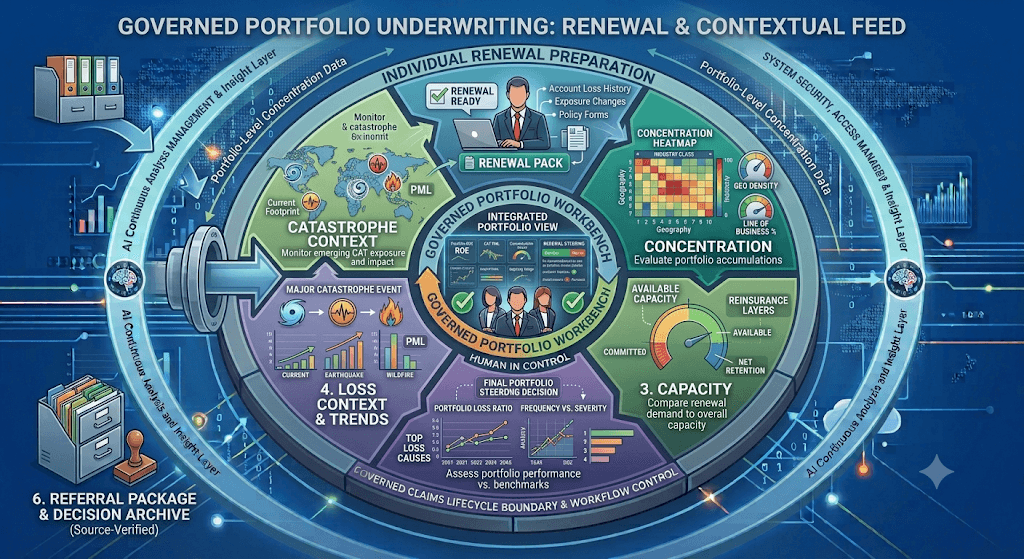
Renewal and portfolio agents help underwriters and leaders understand change over time rather than reviewing each risk or segment in isolation.
Renewal Preparation
- Summarize exposure, loss, inspection, payment, service, and policy changes.
- Identify new or unresolved recommendations.
- Compare current information with prior underwriting rationale.
- Prepare broker questions and authority requirements.
Portfolio Monitoring
- Track premium, loss, concentration, catastrophe, class, geography, broker, and capacity indicators.
- Surface emerging changes rather than only static thresholds.
- Explain the risks, segments, and data behind each alert.
Management Use
Portfolio agents can support capacity allocation and strategic review, but leadership remains accountable for appetite, concentration, capital, and market decisions.
Key Takeaways
- Time-based context is central to renewal quality.
- Portfolio alerts should connect to underlying risks and evidence.
- Management agents improve visibility without replacing strategy.
AI Agents for Insurance Fraud Detection and SIU
CHAPTER OVERVIEW
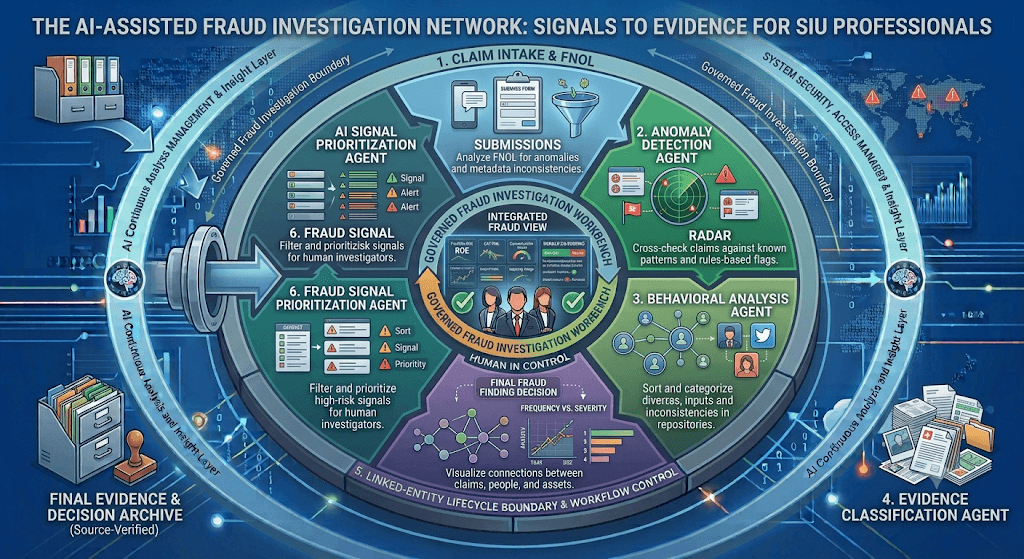
Fraud detection benefits from continuous monitoring, relationship analysis, document intelligence, and coordinated investigation—provided that AI does not convert suspicion into an unsupported conclusion.
The Fraud Agent Ecosystem
- Continuous monitoring agent
- Relationship and entity-resolution agent
- Medical-provider analysis agent
- Document intelligence agent
- Network-analysis agent
- SIU workflow coordination agent
Investigation Support
Agents can identify anomalies, connect parties, summarize prior activity, organize evidence, prepare referral packages, and track investigative steps. Investigators determine whether conduct is suspicious, material, or actionable.
Avoiding False Positives
Association is not proof. Systems should present sources, relationship paths, confidence, alternative explanations, and segment performance. Referral thresholds, sampling, overrides, and investigator outcomes should be monitored.
Success Measures
- Detection and referral timeliness
- Referral quality and false-positive rate
- Investigator preparation time
- Case cycle time
- Recovery or avoidance outcomes
- Fairness, complaints, and governance indicators
Key Takeaways
- AI should support—not accuse.
- Relationship evidence requires context and professional review.
- SIU value depends on quality referrals and disciplined workflow.
AI Agents for Customer Service and Policyholder Experience
CHAPTER OVERVIEW
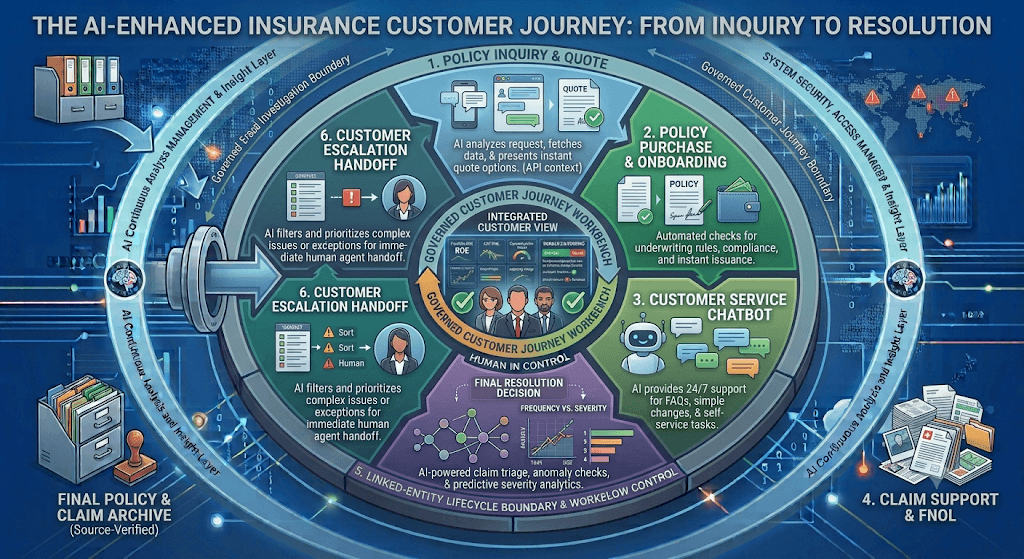
Customer-service agents can improve responsiveness and continuity across policy service, claims communication, catastrophe events, and knowledge assistance while preserving empathy and escalation.
Customer Service Ecosystem
- Policy service agent
- Claim status and communication agent
- Catastrophe response agent
- Knowledge assistance agent
- Intelligent escalation agent
- Personalization and channel-preference agent
Claims Communication
Agents can prepare status updates, explain next steps, identify missing information, and route urgent or sensitive cases. Communications should be based on verified claim status and approved language.
Balancing Automation and Empathy
Customers should know when they are interacting with AI, receive an easy path to a person, and never be trapped in automation during complex, vulnerable, disputed, or emotional situations.
Experience Measures
- Response and resolution time
- First-contact resolution
- Escalation quality
- Customer effort and satisfaction
- Complaint rate
- Accuracy and consistency
- Accessibility and channel performance
Key Takeaways
- Automation should reduce effort without reducing empathy.
- Verified status and approved content are essential.
- Escalation is a core capability, not a failure.
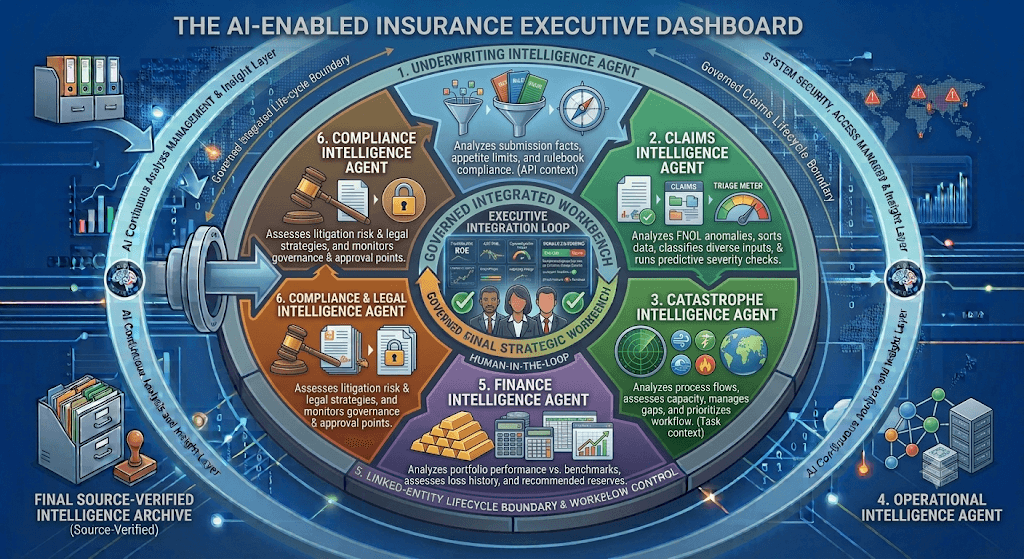
AI Agents for Insurance Management and Executives
CHAPTER OVERVIEW
Executives rarely lack information; they lack timely, prioritized, decision-ready intelligence.
Executive Agent Ecosystem
- Executive intelligence
- Claims portfolio
- Underwriting portfolio
- Operational performance
- Financial monitoring
- Catastrophe monitoring
- Compliance monitoring
- Workforce performance
- Strategic planning
- Board reporting
Executive Briefings
Agents can summarize meaningful business developments, emerging risks, operating performance, catastrophe activity, strategic initiatives, and regulatory changes. Leaders remain responsible for interpretation and action.
Portfolio and Financial Intelligence
Continuously monitor severity, litigation, reserves, growth, loss ratios, concentration, expenses, capacity, and operational bottlenecks. Show what changed, why it matters, and what evidence supports the alert.
Board and Strategy Support
Prepare consistent reporting and research while preserving executive judgment, fiduciary responsibility, and strategic accountability.
Key Takeaways
- Prioritized intelligence is more valuable than more reports.
- Executive agents should explain change and evidence.
- Leadership authority and accountability remain human.
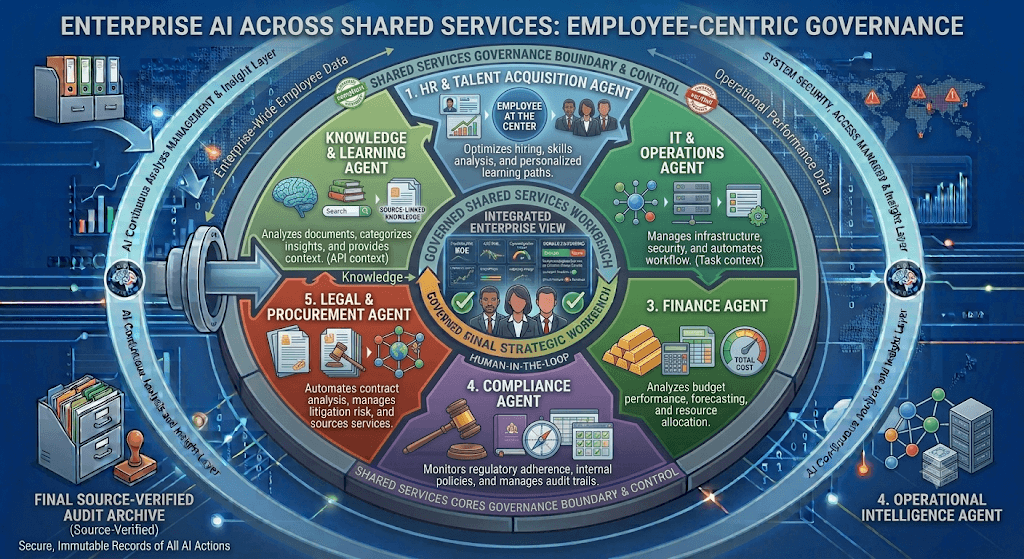
Enterprise Agent Ecosystem
- HR policy and onboarding
- IT service desk
- Finance operations
- Procurement
- Compliance
- Legal research
- Knowledge management
- Project management
- Records management
- Facilities coordination
Operating Boundaries
Sensitive employment, legal, financial, compliance, and access decisions remain with authorized professionals. Agents can retrieve, organize, route, monitor, and prepare work.
Knowledge Management
A governed knowledge agent can make procedures, training, decisions, technical documentation, and lessons learned easier to locate while respecting role-based access and content ownership.
Value Measures
- Administrative workload reduction
- Response and resolution time
- Knowledge retrieval success
- Policy compliance
- Employee satisfaction
- Operational consistency
- Cost efficiency
Key Takeaways
- Shared services can deliver broad enterprise value.
- Knowledge access should remain authorized and current.
- Professional accountability applies in every support function.
AI Agents and Legacy System Integration
CHAPTER OVERVIEW
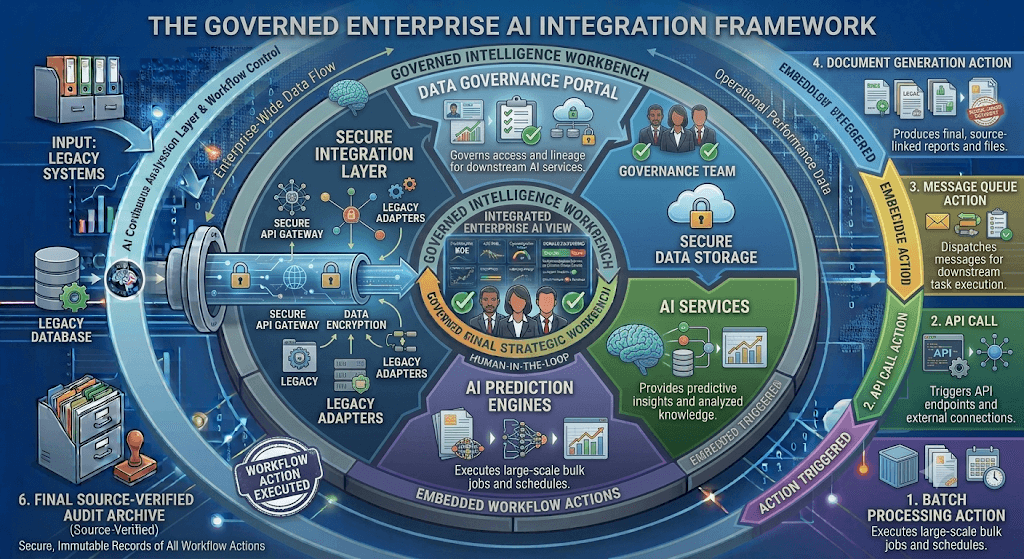
Insurers do not need to replace every core platform before realizing AI value. Agents can add an intelligent layer across existing systems while preserving systems of record.
Systems of Record and Intelligence
Claims, policy, billing, financial, and document platforms remain authoritative. Agents retrieve, analyze, coordinate, and prepare actions; they should not become an uncontrolled shadow system of record.
Integration Patterns
| Pattern | Best Fit | Control Considerations |
|---|---|---|
| API | Modern transactional access | Authentication, schemas, rate limits |
| Events | Real-time business changes | Ordering, replay, duplicate handling |
| Messaging | Asynchronous enterprise workflows | Reliability, correlation, dead letters |
| Batch | Scheduled high-volume processing | Freshness, reconciliation, restart |
| Documents | Legacy or unstructured sources | OCR, provenance, version, confidence |
| Controlled UI automation | No practical interface exists | Fragility, monitoring, limited scope |
Incremental Modernization
- Read and summarize.
- Recommend and monitor.
- Coordinate approved workflows.
- Introduce narrow write actions with approval.
- Scale reusable services and multi-agent orchestration.
Architecture Principle
Use modular, standards-based integration so models, tools, vendors, and platforms can evolve independently.
Key Takeaways
- Legacy systems remain valuable systems of record.
- Multiple integration patterns may coexist.
- Incremental modernization reduces risk.
Measuring ROI and Business Value of AI Agents
CHAPTER OVERVIEW
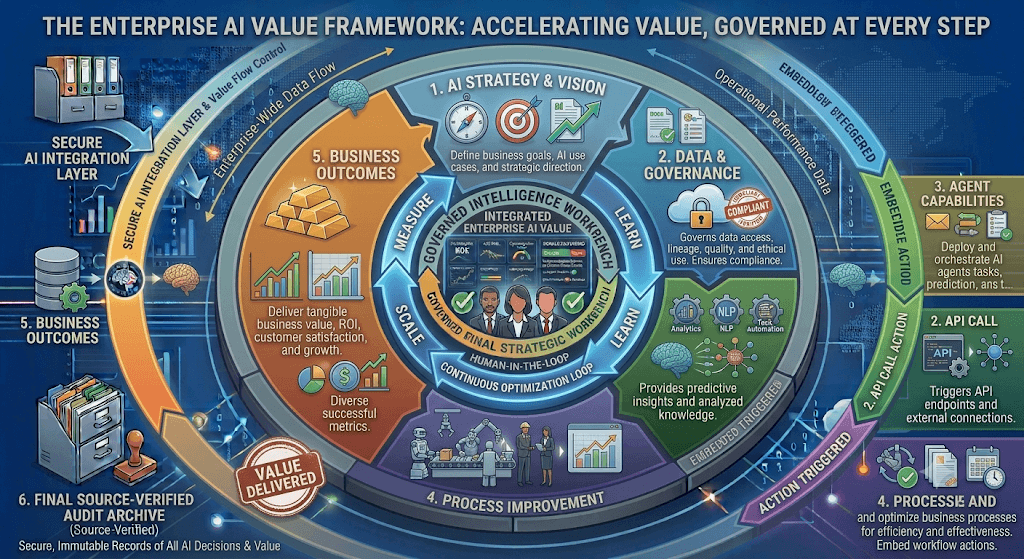
AI agents should be evaluated by business performance, workflow quality, adoption, and control effectiveness—not by technical novelty.
Enterprise Value Framework
- Productivity: less preparation, retrieval, and coordination effort.
- Decision quality: more complete evidence and earlier awareness.
- Operational excellence: improved cycle time, SLA, consistency, and capacity.
- Financial performance: reduced leakage and expense, stronger loss and portfolio outcomes.
- Customer experience: faster, clearer, more responsive service.
Balanced Scorecard
| Dimension | Illustrative Metrics |
|---|---|
| Claims | Cycle time, preparation time, reserve-review timeliness, litigation rate, quality, rework |
| Underwriting | Ready-for-review time, quote turnaround, referral quality, retention, portfolio performance |
| Fraud/SIU | Referral quality, false positives, investigation time, recoveries |
| Customer | Resolution time, effort, satisfaction, complaints, escalation quality |
| Adoption | Active use, acceptance, overrides, confidence, training |
| Control | Citation accuracy, unauthorized attempts, incidents, fallback, audit completeness |
Measurement Discipline
Establish baselines before deployment, define the decision or behavior expected to change, compare like workflows, account for quality and risk, and avoid attributing all outcome movement to the agent.
Continuous Improvement
Review results through executive dashboards, business scorecards, governance committees, and controlled releases.
Key Takeaways
- Technical metrics support but do not replace business metrics.
- Adoption and control performance belong in the ROI model.
- Value should be measured continuously.
Implementing AI Agents in an Insurance Organization
CHAPTER OVERVIEW
Implementation is an organizational transformation involving business strategy, governance, process design, workforce adoption, technology, and measurement.
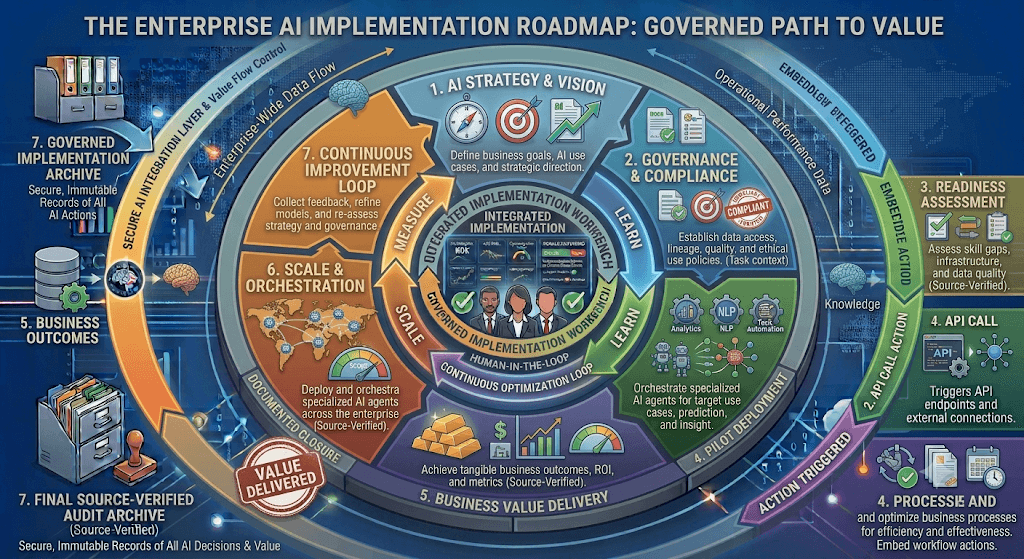
Implementation Framework
- Define the business objective and baseline.
- Assign executive sponsor and business owner.
- Establish governance and risk tier.
- Assess data, integration, security, and workforce readiness.
- Select a bounded, measurable initial use case.
- Pilot in read-only or preparation mode.
- Validate quality, security, workflow, and user experience.
- Introduce controlled actions gradually.
- Scale only after value and controls are demonstrated.
Phased Capability Model
- Assist: retrieve, summarize, answer.
- Recommend: identify trends and prepare actions.
- Coordinate: manage approved workflow steps.
- Orchestrate: connect specialized agents across functions.
Common Failure Modes
- Beginning with technology rather than a business problem.
- Attempting enterprise-wide deployment too quickly.
- Ignoring adoption and process redesign.
- Failing to define authority and exception paths.
- Measuring speed without quality, control, or outcome.
Key Takeaways
- Begin with business value and authority.
- Read-only pilots reduce early risk.
- Scaling should follow demonstrated operating confidence.
Change Management and Workforce Adoption
CHAPTER OVERVIEW
The strongest technical system creates little value when employees do not understand, trust, or use it.
Why People Resist
- Job security and changing responsibilities
- Loss of autonomy or expertise
- Opaque recommendations
- Unclear expectations
- Poor workflow fit
- Insufficient training and support
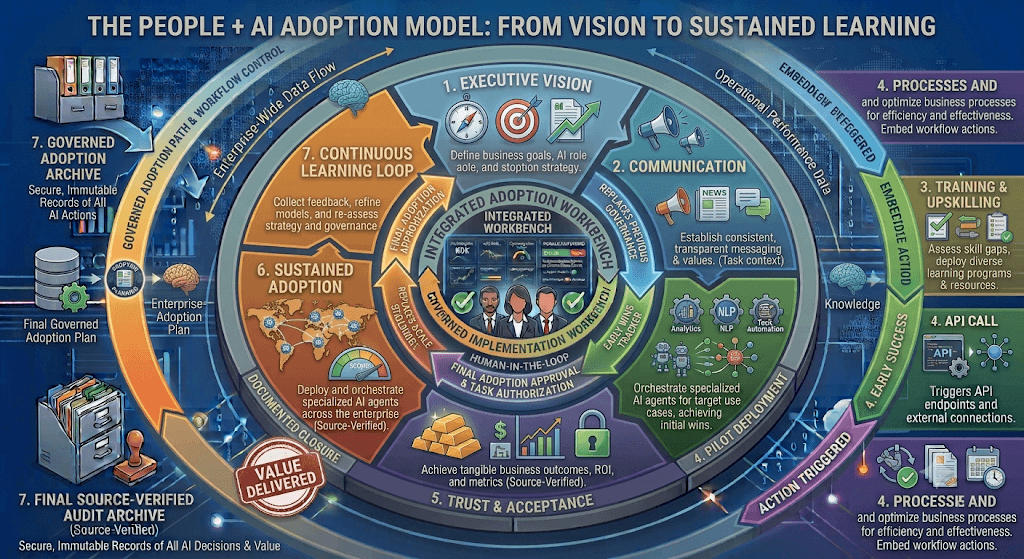
Adoption Program
- Explain why the capability is being introduced.
- Communicate what the agent can and cannot do.
- Provide role-specific training and practice.
- Show sources, limitations, and escalation paths.
- Use champions and early wins.
- Collect feedback and improve the workflow.
- Measure confidence, usage, overrides, and satisfaction.
Redesigning Work
Claims professionals can spend less time gathering documents and more time on customer interaction, investigation, negotiation, and strategy. Underwriters can spend less time assembling submissions and more time evaluating risk and advising brokers.
Leadership Responsibilities
Leaders should model responsible use, reinforce governance, address concerns, celebrate measured success, and maintain continuous learning.
Key Takeaways
- AI adoption is a people and workflow challenge.
- Trust grows through evidence, transparency, and repeated positive use.
- Professional roles are elevated when administrative burden falls.
Selecting and Prioritizing AI Agent Use Cases
CHAPTER OVERVIEW
The best starting point is a meaningful, bounded business problem with available evidence, clear authority, measurable outcomes, and manageable implementation complexity.
Strong Use-Case Characteristics
- Information intensive
- Repetitive or coordination heavy
- Supported by policies or procedures
- High administrative burden
- Clear professional review point
- Measurable baseline and outcome
- Scalable or reusable
Evaluation Framework
| Factor | Question |
|---|---|
| Business value | Will the use case improve a meaningful outcome? |
| Process stability | Is the current workflow understood? |
| Data readiness | Are authoritative sources available and usable? |
| Governance | Can authority and evidence requirements be defined? |
| Complexity | Is the initial scope manageable? |
| Adoption | Will users perceive direct value? |
| Scalability | Can services or patterns be reused? |
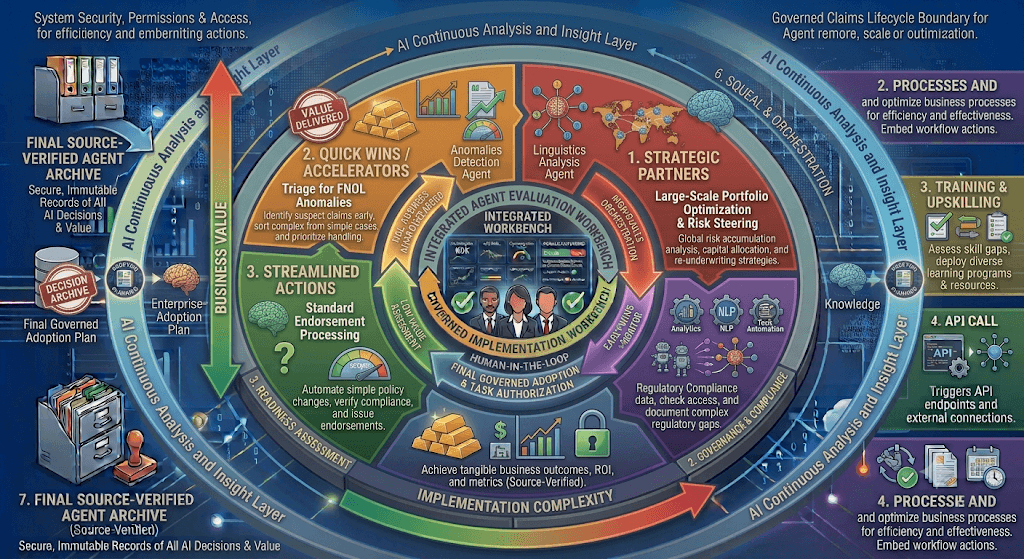
Prioritization Matrix
Implement high-value, lower-complexity opportunities first. Plan high-value, high-complexity initiatives strategically. Avoid low-value, high-complexity projects.
Portfolio Approach
Balance quick wins, strategic capabilities, operational improvements, controlled innovation, and foundational investments.
Key Takeaways
- Business problems—not technology demonstrations—should lead.
- A clear human review point is a strength.
- Portfolio management prevents fragmented pilots.
The Future of AI Agents in Insurance
CHAPTER OVERVIEW
Insurance AI will evolve from individual assistants toward coordinated ecosystems that provide continuous intelligence across the enterprise.
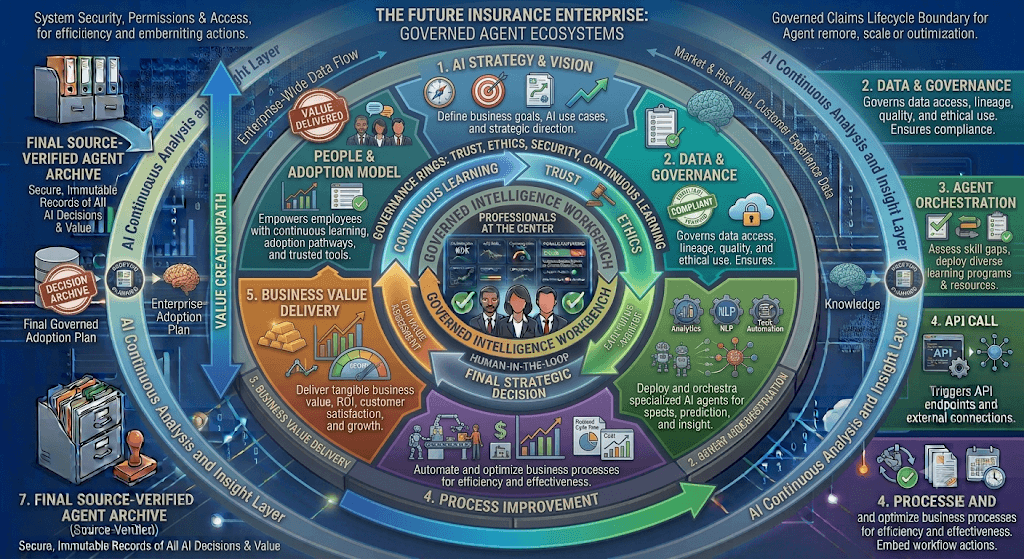
Evolution
- Predictive analytics and rules
- Generative AI and copilots
- Specialized AI agents
- Connected multi-agent ecosystems
- Adaptive enterprise workflows within governance boundaries
Future Capabilities
- Continuous portfolio and operational sensing
- More contextual and personalized service
- Governed enterprise memory
- Improved multimodal understanding
- Agent-to-agent coordination
- More sophisticated simulation and planning
Responsible Autonomy
Capability will expand faster than organizational trust. Leading insurers will increase autonomy gradually, with evidence, monitoring, reversibility, approval thresholds, and explicit accountability.
Preparing Today
- Strengthen trusted data and knowledge.
- Establish governance and inventory.
- Modernize integration patterns.
- Develop workforce capability.
- Measure outcomes and control performance.
- Design modular architecture for change.
Key Takeaways
- Agent ecosystems will become a normal enterprise capability.
- Human expertise becomes more—not less—important.
- Trust and adaptability will determine competitive advantage.
Common Myths and Misconceptions About AI Agents
CHAPTER OVERVIEW
Misconceptions can create both unrealistic optimism and unnecessary resistance.
Myths vs. Reality
| Myth | Enterprise Reality |
|---|---|
| Agents replace insurance professionals | They reduce preparation and coordination while professionals retain judgment and authority |
| Agents make independent business decisions | Authority is defined and enforced by the organization |
| AI is always correct | Outputs require evidence, validation, and monitoring |
| One agent can do everything | Specialized agents are easier to test and govern |
| AI requires replacing core systems | Agents can integrate incrementally with existing platforms |
| Bigger models always produce better results | Data, architecture, controls, and workflow fit are often more important |
| AI is mainly a cost-cutting tool | Value also includes decision quality, service, governance, and growth |
| Adoption is an IT project | Success requires leadership, process redesign, governance, and people |
Why Myths Persist
Consumer AI headlines, rapidly changing terminology, unrealistic vendor claims, and polished demonstrations can obscure the difference between a prototype and a governed production system.
Education Strategy
Use practical demonstrations, role-specific examples, clear limitations, documented authority, and measured results to build informed confidence.
Key Takeaways
- Separate capability from authority.
- Avoid both hype and fear.
- Education is a core adoption control.
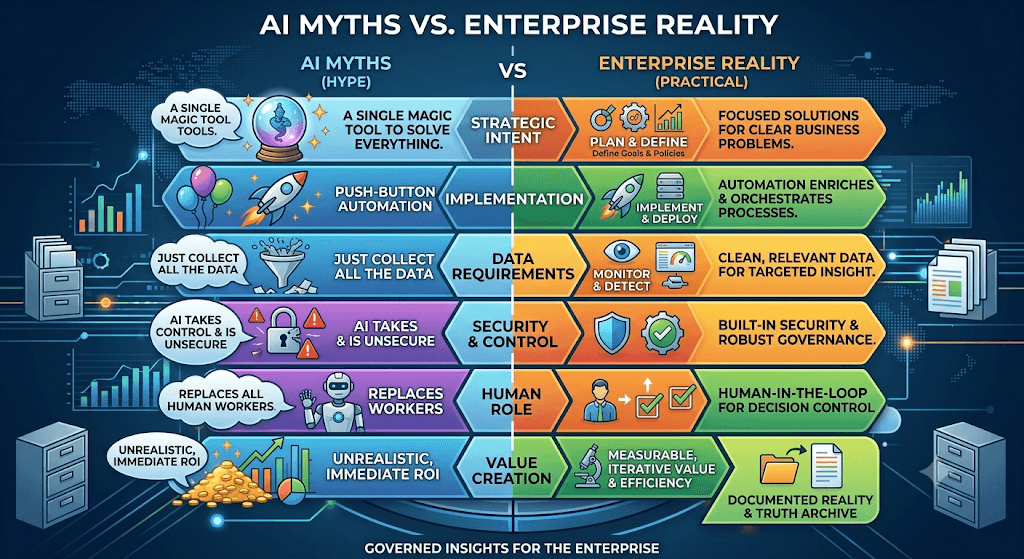
Executive Roadmap for Becoming an AI-Driven Insurer
CHAPTER OVERVIEW
AI maturity is a multi-year operating transformation, not a one-time software deployment.
Seven Stages
- Establish strategic vision and risk appetite.
- Build trusted data, governance, security, identity, and integration foundations.
- Deliver bounded early wins.
- Expand across departments using reusable standards.
- Connect specialized agents through orchestration.
- Redesign business processes around better information and fewer handoffs.
- Institutionalize measurement, learning, and controlled innovation.
Characteristics of Maturity
- Executive alignment
- Trusted and governed data
- Proportionate risk management
- Workforce adoption
- Enterprise integration
- Measurable value
- Continuous innovation and controlled change
Executive Questions
- Are initiatives aligned with strategy and owned by the business?
- Are customers, employees, and risk outcomes improving?
- Is governance keeping pace with capability?
- Are successful patterns being reused?
- Can the enterprise pause, explain, change, and retire systems safely?
Key Takeaways
- AI transformation starts with leadership.
- Early wins should build reusable capability.
- Operationalizing AI responsibly is the durable advantage.
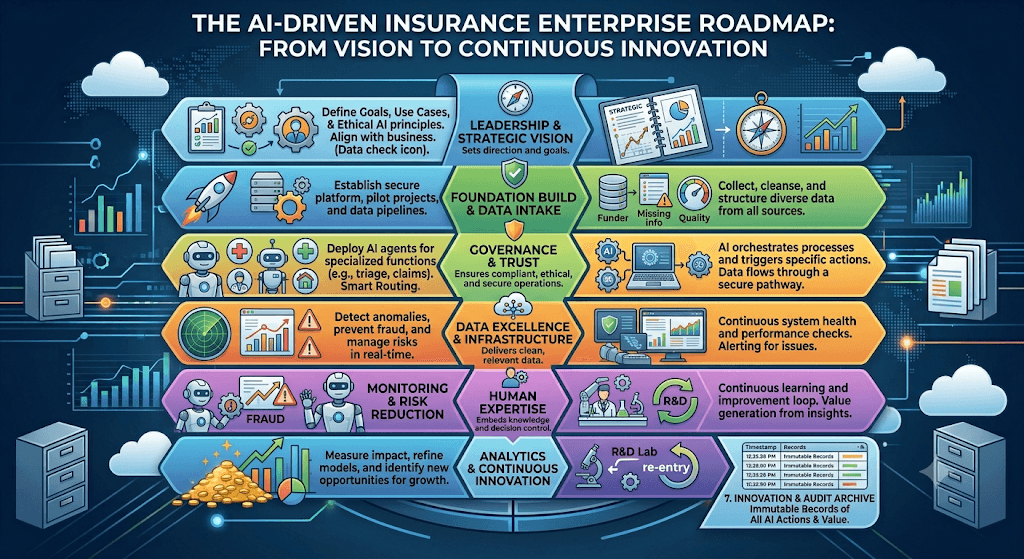
AI Agent Design Principles for Insurance
CHAPTER OVERVIEW
Common design principles help insurers build agents that are focused, governable, reusable, and maintainable.
Design Principles
- Design around one business capability.
- Define objective, scope, users, authority, completion, and escalation.
- Require evidence for factual outputs.
- Design explicit human collaboration and override.
- Apply least privilege and independent authorization.
- Prefer simple specialized agents and reusable services.
- Make actions observable and reversible where possible.
- Design failure and degraded modes before production.
- Measure continuously and manage every change.
The Agent Contract
| Element | Required Definition |
|---|---|
| Purpose | Business problem and intended outcome |
| Inputs | Authorized data, documents, events, and user context |
| Outputs | Work product, recommendation, task, or escalation |
| Tools | Permitted functions and parameter constraints |
| Authority | Read, prepare, recommend, execute, communicate |
| Evidence | Sources, citations, confidence, missing information |
| Completion | Success, stop, retry, timeout, and escalation conditions |
| Monitoring | Quality, control, adoption, cost, and outcome metrics |
Design Review
Every design should be understandable to business, technology, security, risk, and user representatives—not only AI specialists.
Key Takeaways
- Focused agents are easier to operate.
- Human collaboration belongs in the design.
- The agent contract is a primary governance artifact.
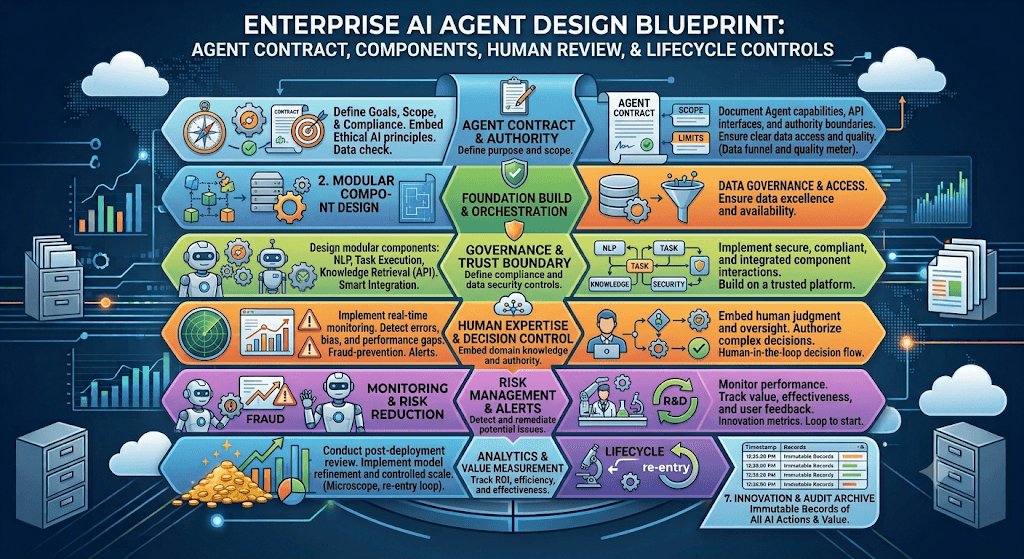
AI Agent Reference Architecture for Insurance
CHAPTER OVERVIEW
A complete reference architecture connects users, specialized agents, orchestration, enterprise services, knowledge, systems of record, security, governance, and monitoring.
Architecture Layers
- Experience layer: user workbenches, portals, communications, APIs.
- Orchestration layer: routing, plans, state, policy checks, approvals, and task coordination.
- Specialized agents: claims, underwriting, SIU, service, management, and shared services.
- Enterprise AI services: LLMs, predictive models, document intelligence, semantic search, knowledge graphs, and validation.
- Knowledge layer: approved content, metadata, embeddings, relationships, and provenance.
- Integration layer: APIs, events, messages, batch, and document adapters.
- Systems of record: claims, policy, billing, finance, CRM, document, data platforms.
- Cross-cutting controls: identity, security, privacy, governance, monitoring, audit, and change.
Architecture Principles
- Authorization outside the model
- Source systems remain authoritative
- Modular and vendor-neutral components
- Observable end-to-end execution
- Reusable services and standards
- Graceful degradation and fallback
Environment Separation
Development, testing, validation, and production should be separated. Production tools, data, permissions, secrets, and monitoring should be independently controlled.
Key Takeaways
- Architecture should make authority visible.
- The agent layer complements systems of record.
- Cross-cutting controls span every component.
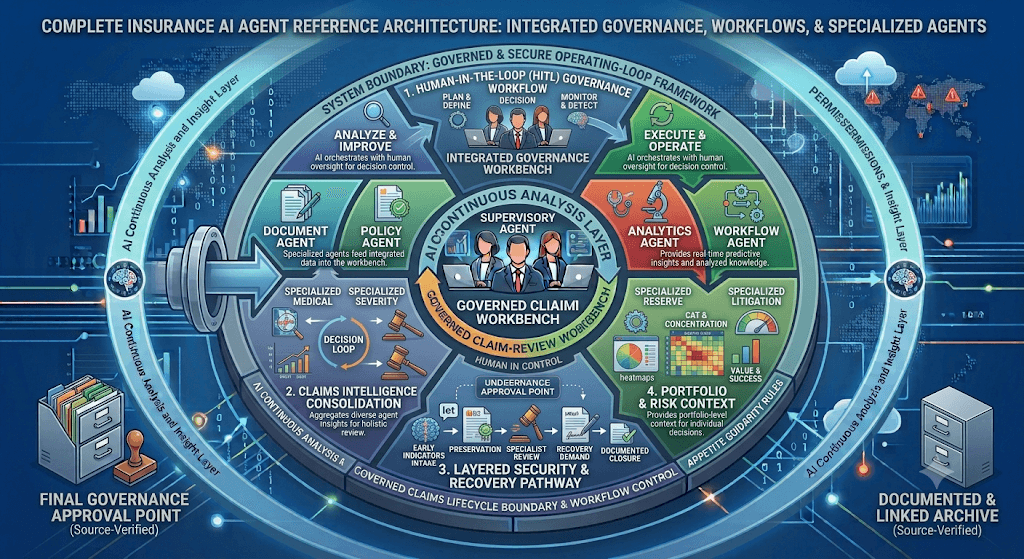
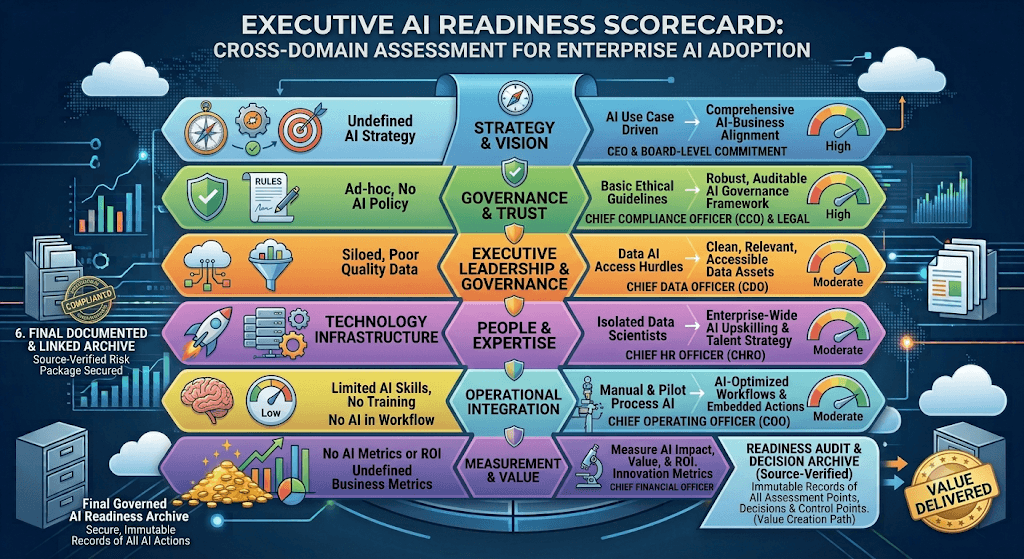
Executive Checklist for AI Readiness
CHAPTER OVERVIEW
A readiness assessment helps leadership identify the strongest starting points and the foundational gaps that could prevent safe scale.
Readiness Domains
- Strategy and sponsorship
- Governance and risk
- Data and knowledge
- Technology and integration
- Security and privacy
- Workforce and change
- Operations and support
- Measurement and value
Readiness Interpretation
| Readiness Level | Meaning | Executive Response |
|---|---|---|
| Foundational | Major ownership, control, or data gaps | Build minimum foundations before consequential use |
| Developing | Some pilots and controls, inconsistent reuse | Standardize governance, architecture, and measurement |
| Operational | Repeatable delivery and production monitoring | Expand portfolio and reusable services |
| Connected | Cross-functional orchestration and mature controls | Optimize enterprise processes and portfolio value |
| Adaptive | Continuous learning and controlled evolution | Maintain assurance while scaling innovation |
Evidence Standard
Readiness should be supported by artifacts and operating evidence—not only executive confidence or policy documents.
Key Takeaways
- Readiness is multidimensional.
- A strong pilot does not prove enterprise readiness.
- Gaps should inform sequencing, not stop appropriate innovation.
Conclusion: Building the Future Insurance Enterprise
CHAPTER OVERVIEW
Artificial Intelligence is changing how insurance professionals fulfill the industry’s enduring purpose—not the purpose itself.
From Administration to Intelligence
Insurance technology progressed from digitized transactions, to analytics, to continuous intelligence. AI agents can now monitor change, assemble evidence, coordinate approved work, and support professionals in real time.
Human Expertise Remains Central
The durable advantage comes from people who understand customers, risk, claims, markets, regulation, relationships, and strategy. AI allows those professionals to apply expertise with greater context and less friction.
Trust and Governance
Policyholders, regulators, employees, and shareholders expect transparency, fairness, security, accountability, and professional judgment. Governance is therefore both a risk discipline and a strategic capability.
Enduring Principles
- People remain accountable.
- Customers remain the priority.
- Trusted data supports trusted decisions.
- Evidence and transparency build confidence.
- Governance enables responsible innovation.
- Continuous learning sustains value.
- AI exists to amplify—not replace—professional expertise.
Key Takeaways
- The future is intelligent insurance, not autonomous insurance.
- Trust will distinguish leaders.
- The strongest enterprises combine exceptional people with governed technology.
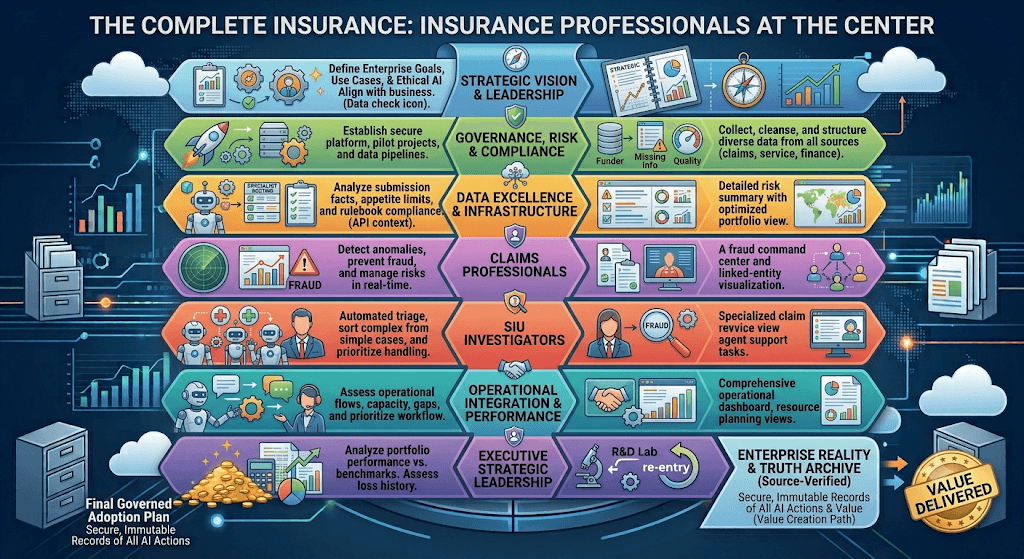
AI Governance Operating Model
CHAPTER OVERVIEW
Effective governance is a repeatable operating model of roles, decision rights, controls, evidence, and oversight—not merely a policy.
Governance Structure
| Layer | Primary Responsibilities | Typical Evidence |
|---|---|---|
| Board / executive | Risk appetite, policy, accountability, material oversight | Policy, portfolio dashboard, incident reporting |
| AI governance council | Standards, risk tiers, high-risk approvals, exceptions | Charter, decisions, standards, portfolio priorities |
| Business owner | Purpose, workflow, outcomes, authority, value | Use-case charter, process map, KPI baseline |
| Technology / AI owner | Design, integration, testing, operation | Architecture, system card, release package |
| Risk / legal / compliance | Requirements and independent challenge | Risk assessment, legal analysis, issue tracking |
| Security / privacy | Identity, data, integrations, vendor access | Threat model, privacy assessment, access design |
| Operations / users | Review evidence, decide, override, escalate | SOPs, training, overrides, incidents |
| Audit / validation | Independent assurance | Validation and audit reports |
Governance Lifecycle
- Propose
- Assess
- Approve
- Build
- Validate
- Deploy
- Monitor
- Improve
- Retire
Three Lines of Accountability
Business and technology own operation; risk functions set standards and challenge; audit or independent assurance evaluates design and effectiveness.
Governance Principle
Well-designed governance accelerates innovation by making expectations, authority, evidence, and escalation clear before teams invest heavily.
Key Takeaways
- Governance should integrate with existing enterprise controls.
- Risk tiers make requirements proportionate.
- Operating evidence matters more than policy existence.
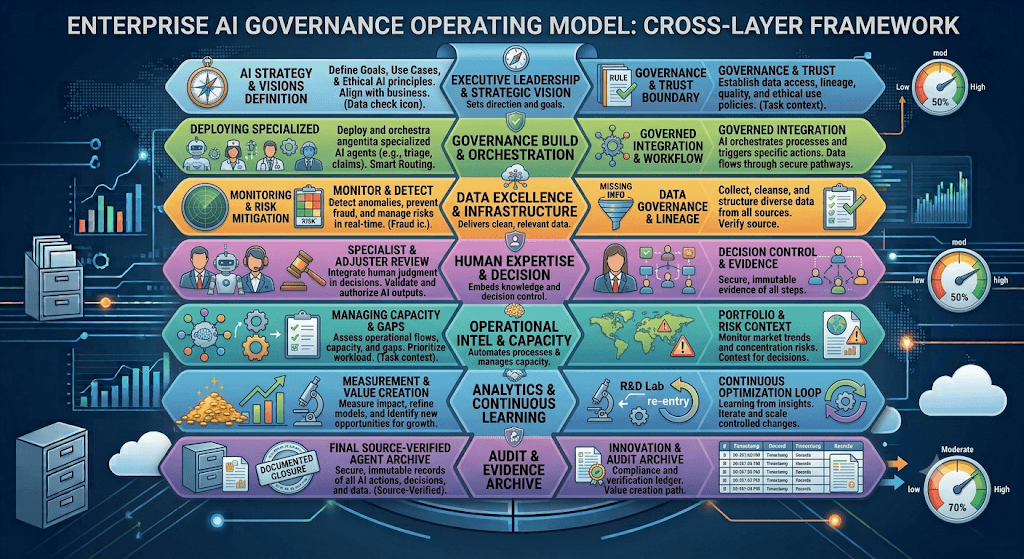
AI Risk Management Framework
CHAPTER OVERVIEW
The objective of AI risk management is not zero risk. It is informed, proportionate, monitored, and accountable use.
Risk Categories
- Strategic
- Operational
- Model and output quality
- Data and knowledge
- Cybersecurity
- Privacy
- Fairness and conduct
- Legal and regulatory
- Third-party and concentration
- Reputational
- Financial and customer impact
Risk Process
- Identify the decision, people, data, systems, and actions affected.
- Assess likelihood, impact, detectability, reversibility, scale, and affected populations.
- Design preventive, detective, corrective, and recovery controls.
- Validate controls and residual risk before deployment.
- Monitor changes, incidents, complaints, overrides, and performance.
- Reassess after material change.
Risk Matrix Guidance
Higher-impact and less-reversible uses require stronger evidence, independent validation, approval gates, human authority, auditability, and fallback.
Risk Ownership
The business owner owns the use case and its outcomes. Technology owns implementation. Risk, legal, compliance, privacy, security, and model-governance functions provide requirements and challenge.
Key Takeaways
- Risk treatment should reflect consequence and reversibility.
- Risk is managed across the whole system, not only the model.
- Residual risk requires explicit acceptance.
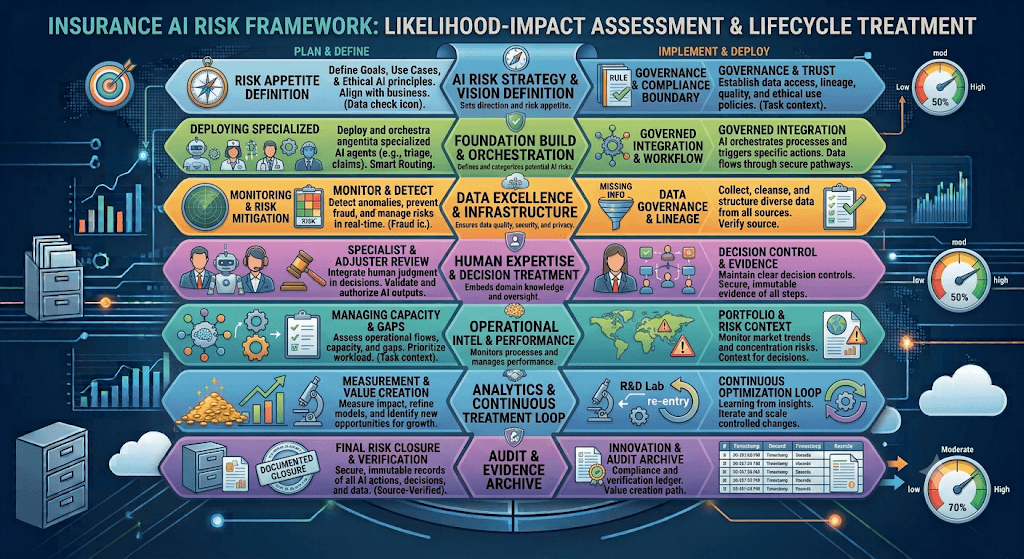
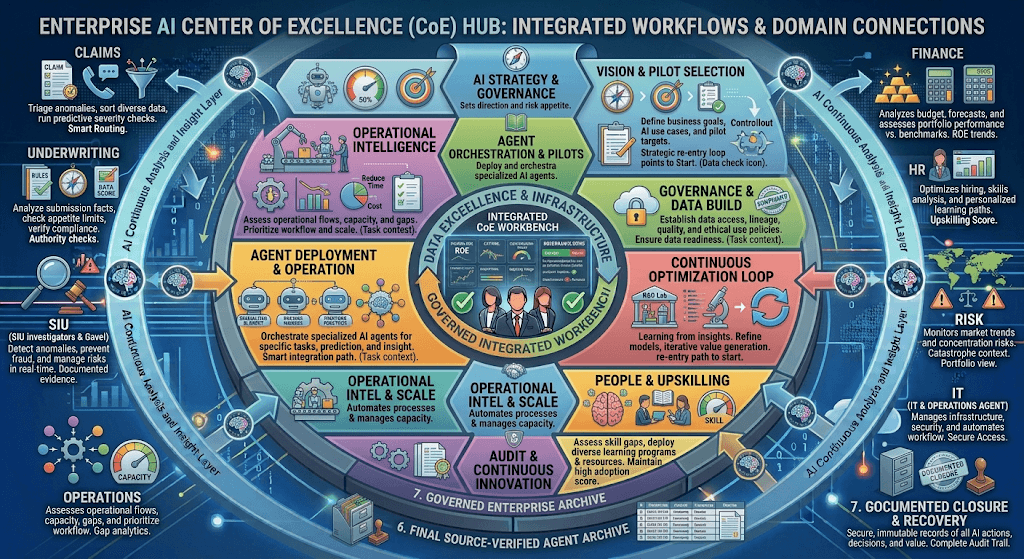
Enterprise AI Center of Excellence
CHAPTER OVERVIEW
A Center of Excellence helps insurers scale expertise, standards, reuse, governance, and workforce capability without centralizing every business decision.
CoE Mission
- Develop enterprise standards and reusable patterns.
- Support governance and risk-tier implementation.
- Provide architecture and engineering expertise.
- Accelerate use-case delivery.
- Build education and communities of practice.
- Measure portfolio value and adoption.
Operating Model
The CoE should work as a hub-and-spoke capability. Business units retain ownership of objectives, workflow, adoption, and outcomes; the CoE supplies shared methods, assets, expertise, and assurance support.
Core Functions
| Function | Representative Outputs |
|---|---|
| Strategy | Roadmap, portfolio prioritization, investment guidance |
| Architecture | Reference designs, integration and security patterns |
| Governance | Standards, templates, risk tiers, review support |
| Delivery | Methods, reusable services, pilot acceleration |
| Education | Role-based training, champions, community |
| Measurement | Value dashboards, adoption, quality and control metrics |
Success Conditions
Clear mandate, executive sponsorship, strong business participation, reusable assets, transparent funding, and measurable impact.
Key Takeaways
- The CoE enables rather than owns every initiative.
- Business units remain accountable for outcomes.
- Reuse and shared learning accelerate responsible scale.
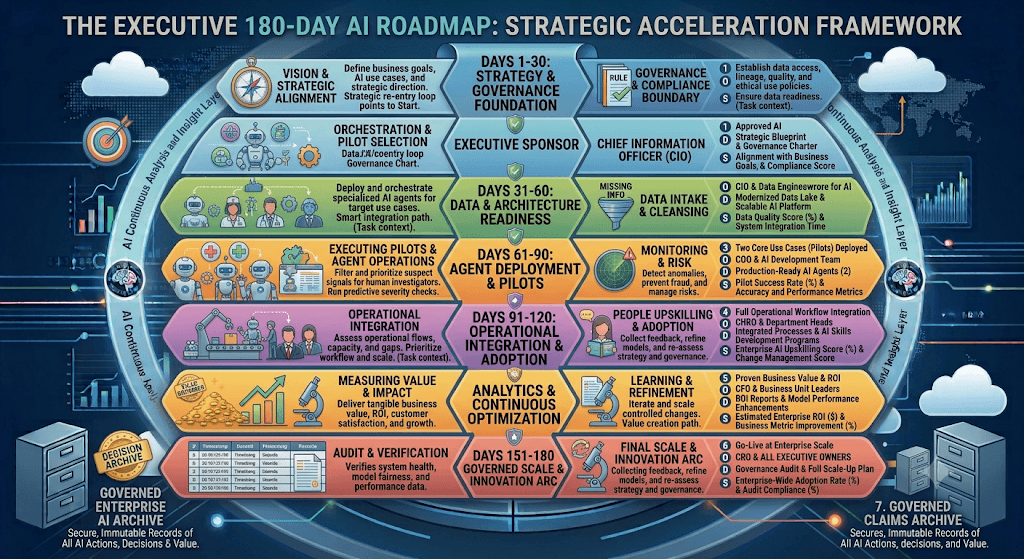
Executive Action Plan: The First 180 Days
CHAPTER OVERVIEW
The first six months should establish vision, governance, confidence, and repeatable capability rather than maximizing the number of agents deployed.
Days 1–30
- Define executive vision and business outcomes.
- Assign sponsor and accountable leadership.
- Inventory current AI initiatives and vendor capabilities.
- Form governance and working teams.
- Identify priority business problems.
Days 31–60
- Assess data, integration, security, privacy, and workforce readiness.
- Select bounded pilot use cases.
- Define authority, risk tiers, KPIs, and baseline.
- Approve architecture and vendor approach.
Days 61–90
- Launch read-only or preparation-focused pilots.
- Train users and establish support.
- Create monitoring and executive reporting.
- Test difficult, incomplete, adversarial, and out-of-scope cases.
Days 91–120
- Measure quality, adoption, controls, and business effect.
- Collect user feedback and redesign workflow.
- Remediate gaps and improve governance templates.
- Decide whether to expand, hold, or retire pilots.
Days 121–180
- Scale successful implementations carefully.
- Establish reusable architecture and a CoE or equivalent capability.
- Publish the enterprise roadmap and next-wave portfolio.
- Standardize lifecycle evidence and executive scorecards.
Key Takeaways
- The first 180 days should build repeatability.
- Early pilots should prove operating value and control.
- Scaling follows evidence—not enthusiasm alone.
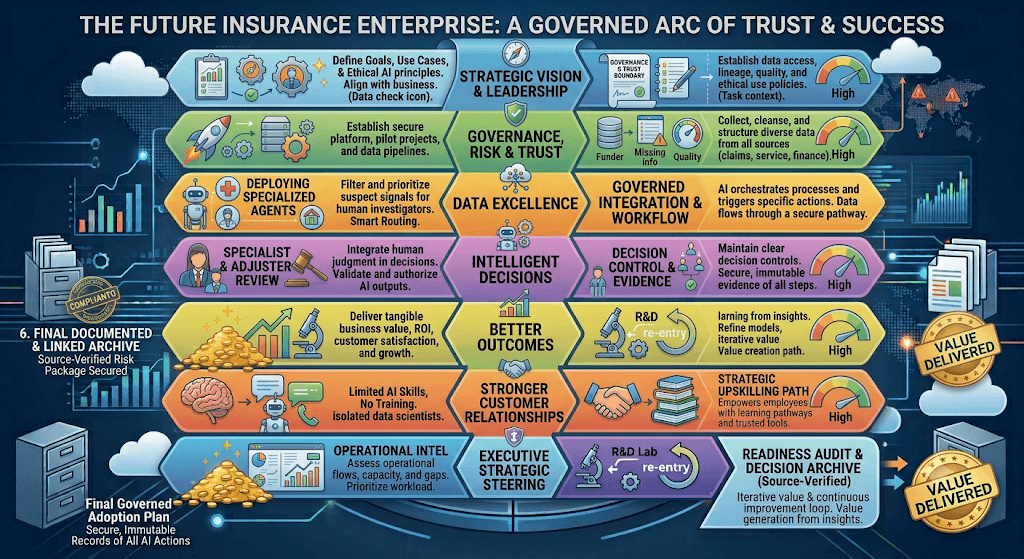
Closing Outlook: The Future Insurance Enterprise
CHAPTER OVERVIEW
The future insurance enterprise will be defined by the partnership between experienced professionals and intelligent systems operating within trust, governance, and accountability.
The Enduring Mission
Insurance exists to help individuals, families, businesses, and communities manage uncertainty and recover from loss. AI does not change that mission; it can strengthen the industry’s ability to fulfill it.
A Vision of Intelligent Insurance
Claims professionals see emerging severity earlier. Underwriters begin with complete, source-linked risk context. SIU teams receive better referrals. Customers receive faster, clearer service. Executives manage through continuous intelligence. Every material decision remains under accountable human authority.
Leadership Imperative
Technology cannot establish vision, ethics, culture, accountability, empathy, or customer commitment. Leaders determine whether AI becomes a controlled enterprise capability or another fragmented technology initiative.
Final Statement
The future will not belong to insurers with the most artificial intelligence. It will belong to insurers that most effectively combine human judgment, trusted data, responsible governance, and intelligent technology in service of policyholders.
Key Takeaways
- AI changes how insurance work is performed—not why it is performed.
- Trust, governance, and human expertise remain timeless advantages.
- The future has already begun.
Illustration
APPENDIX A
Insurance AI Agent Glossary
AI agent. A software system that interprets a goal, uses approved information and tools, evaluates progress, and completes or escalates a bounded task.
AI copilot. An assistive AI experience designed to help a user perform work while the user remains in control.
AI governance. The operating framework of roles, policies, decision rights, controls, evidence, monitoring, and accountability for AI.
AI inventory. A controlled record of AI systems, owners, purposes, data, models, vendors, risk tiers, approvals, monitoring, changes, and status.
AI orchestration. Coordination of models, agents, tools, data, workflows, approvals, and state to complete an end-to-end process.
AI red teaming. Structured testing intended to find misuse, security, safety, control, and failure vulnerabilities.
Agent contract. A controlled definition of an agent’s purpose, inputs, outputs, tools, authority, evidence requirements, completion criteria, and monitoring.
Agentic AI. AI designed to pursue goals through planning, tool use, state, and action within defined boundaries.
Allowlist. A controlled list of approved tools, actions, data sources, destinations, or parameters.
Auditability. The ability to reconstruct inputs, evidence, models, prompts, tool calls, approvals, outputs, actions, and changes.
Autonomous agent. An agent that can complete some actions without immediate human approval; autonomy should remain bounded and proportionate to risk.
Business rule. Explicit logic that produces a deterministic result or constraint.
Chain of thought. Internal intermediate reasoning used by some models; production governance should rely on observable evidence and action logs rather than hidden reasoning.
Confidence. A task-specific indicator of reliability or uncertainty; it should be calibrated and not treated as proof.
Context window. The amount of information a model can process in one interaction.
Continuous monitoring. Ongoing observation of performance, data, outputs, actions, incidents, adoption, and business outcomes.
Decision support. Information, analysis, or recommendations provided to a qualified decision-maker.
Embeddings. Numeric representations used to compare semantic meaning or similarity.
Enterprise memory. Governed state or historical context available to an agent across steps or sessions.
Entity resolution. The process of determining when records refer to the same person, organization, asset, provider, location, or event.
Explainable AI. Methods and evidence that help people understand, challenge, approve, and document AI-supported work.
Foundation model. A broadly trained model that can be adapted to multiple tasks.
Generative AI. AI that creates new text, images, code, structured data, or other content.
Goal drift. A situation in which an agent’s behavior moves away from the approved objective or boundaries.
Guardrail. A policy, technical control, workflow constraint, or monitoring mechanism that keeps AI within approved limits.
Hallucination. A plausible but unsupported or incorrect AI output.
Human-in-the-loop. A design in which a person reviews, approves, corrects, overrides, or decides at defined points.
Human-on-the-loop. A design in which a person supervises operation and can intervene, pause, or override.
Idempotency. A property that allows an action to be safely repeated without creating duplicate effects.
Instruction hierarchy. The precedence of system, enterprise, workflow, user, and untrusted-content instructions.
Knowledge graph. A connected representation of entities, relationships, events, evidence, and provenance.
Large language model. A model trained to understand and generate language and related representations.
Least privilege. Granting only the minimum data and action access required for the approved purpose.
Machine learning. Methods that learn patterns from data for prediction, classification, generation, or decision support.
Memory. Stored working state or approved historical context used by an agent.
Model drift. A material change in data, relationships, performance, or operating conditions that weakens fitness for purpose.
Multi-agent system. An architecture in which specialized agents coordinate under shared controls.
Natural language processing. Techniques for interpreting, extracting, classifying, and generating human language.
Orchestrator. The component that coordinates tasks, agents, state, controls, and handoffs.
Permission boundary. The independently enforced limit on what an agent may access or do.
Predictive AI. AI that estimates outcomes, probabilities, scores, rankings, or future values.
Prompt. Instructions and context provided to a model.
Prompt engineering. The disciplined design, testing, versioning, and governance of prompts.
Prompt injection. An attempt by untrusted content to manipulate AI instructions, tools, or data access.
Provenance. Evidence showing where information came from, how it changed, and how it was used.
Retrieval-augmented generation. A method that retrieves approved sources and supplies them to a generative model to improve grounding.
Risk tier. A classification that determines the strength of governance and controls based on impact, autonomy, data, scale, and reversibility.
Semantic search. Meaning-based retrieval using embeddings and related ranking methods.
System of intelligence. An analytical and orchestration layer that transforms data into insight and coordinated work.
System of record. The authoritative platform for official business data or transactions.
Tool calling. A model request to invoke an approved function through a controlled application layer.
Vector database. A platform optimized to store embeddings and retrieve semantically similar items.
Workflow agent. An agent that executes a bounded sequence of approved tasks across systems.
Zero trust. A security approach that continuously verifies identity, access, context, and action rather than assuming trust.
APPENDIX B
AI Governance Checklist
Strategy and Ownership
☐ Executive sponsor assigned
☐ Business owner and process owner named
☐ Purpose, users, expected outcomes, and prohibited uses documented
☐ Risk appetite and materiality defined
☐ Use case included in enterprise AI inventory
Data and Knowledge
☐ Authoritative sources identified
☐ Lineage, ownership, quality, freshness, and retention defined
☐ Access controls enforced at retrieval
☐ Sensitive and prohibited data reviewed
☐ Conflicting, missing, and low-quality evidence handled
Technology and Security
☐ Architecture and data-flow diagram approved
☐ Least privilege and independent tool authorization implemented
☐ Prompt injection and adversarial testing completed
☐ Secrets, environments, and network access controlled
☐ Logging, reconciliation, rollback, pause, and kill mechanisms available
Validation
☐ Representative test set approved
☐ Factual and citation accuracy tested
☐ Tool success and parameter validation tested
☐ Fairness and segment performance evaluated
☐ Human-use and workflow testing completed
☐ Failure, degraded, and out-of-scope behavior tested
Operations
☐ Monitoring owners and thresholds assigned
☐ Incident, complaint, and exception procedures approved
☐ Vendor and model changes trigger review
☐ Support and business continuity plans tested
☐ Retirement and records-preservation plan defined
Appendix C — Measurement
☐ Baseline established
☐ Quality, control, adoption, cost, and outcome KPIs defined
☐ Value attribution assumptions documented
☐ Executive review cadence established
☐ Continuous-improvement backlog maintained
APPENDIX C
Insurance AI Agent Evaluation Scorecard
Score each category from 1 (weak) to 5 (strong). Apply organization-specific weights. A high total score does not override a material governance or legal concern.
| Category | Evaluation Standard | Weight |
|---|---|---|
| Strategic alignment | Supports a named business objective and accountable sponsor | 10% |
| Business value | Measurable improvement with credible baseline | 15% |
| Process readiness | Workflow, exceptions, and authority are understood | 10% |
| Data readiness | Authoritative, accessible, representative, and governed sources | 10% |
| Technical fit | Tools, integrations, reliability, and scalability are feasible | 10% |
| Governance | Risk tier, approval, evidence, and oversight are clear | 15% |
| Security and privacy | Least privilege, threat model, privacy, and vendor controls | 10% |
| Human adoption | Workflow fit, training, trust, and support are strong | 10% |
| Measurement | Quality, control, adoption, and outcome metrics are available | 5% |
| Maintainability | Versioning, monitoring, support, and exit are practical | 5% |
Decision Guidance
APPENDIX D
- Proceed to design when the business value, authority, data, and control model are clear.
- Proceed only as read-only assistance when consequence is high or controls are immature.
- Hold when authoritative data, permissions, monitoring, or ownership are unavailable.
- Reject when the purpose is prohibited, the value is weak, or residual risk is unacceptable.
Sample Enterprise AI Policies
IMPORTANT
These sample provisions are educational starting points and should be reviewed by legal, compliance, privacy, security, human resources, model-risk, and business leadership under applicable laws, regulations, contracts, and organizational policy.
Responsible AI Policy
The organization will design, acquire, deploy, and use AI for approved business purposes in a manner that is reliable, fair, secure, privacy-conscious, explainable, accountable, and subject to proportionate human oversight.
Human Oversight Policy
Consequential insurance decisions require accountable professional authority. AI outputs must provide sufficient evidence and time for meaningful review, challenge, correction, override, or escalation.
Acceptable Use Policy
Users may use approved AI services only for authorized purposes and data. They may not input restricted information into unapproved services, bypass controls, conceal AI use when disclosure is required, or rely on unverified output for consequential action.
AI Security Policy
AI systems must use approved identity, least privilege, environment separation, secure secrets, authorized tools, input isolation, logging, monitoring, incident response, and change control.
Data and Privacy Policy
AI use must follow data minimization, purpose limitation, access, retention, deletion, cross-border, consent, and sensitive-data requirements. Retrieval must enforce source permissions.
AI Procurement Policy
Third-party AI requires due diligence, contractual controls, data-use restrictions, subprocessor transparency, validation rights, change notice, incident notice, continuity, audit, and exit planning.
Model and Agent Change Policy
Material changes to purpose, model, prompt, retrieval, tool, data, vendor, workflow, user population, jurisdiction, or autonomy require impact assessment, regression testing, approval, documentation, and monitored release.
Incident and Suspension Policy
The organization may pause or restrict AI when quality, fairness, privacy, security, data, integration, monitoring, or authority controls fail. Evidence must be preserved and affected operations reconciled.
Records and Audit Policy
Required inputs, sources, versions, tool calls, approvals, outputs, actions, incidents, and changes must be retained according to risk, law, contract, and records policy.
APPENDIX E
AI Risk Assessment Workbook
| Assessment Field | Response |
|---|---|
| Use-case name | |
| Business owner | |
| Executive sponsor | |
| Purpose and expected outcomes | |
| Users and affected parties | |
| Decisions or actions influenced | |
| Data and knowledge sources | |
| Models, vendors, and tools | |
| Authority and human review | |
| Risk tier and rationale | |
| Validation evidence | |
| Monitoring and thresholds | |
| Fallback, pause, and recovery | |
| Residual risk owner and approval |
Risk Register
| Risk | Scenario | Inherent | Controls | Residual | Owner |
|---|---|---|---|---|---|
| Strategic | Low / Med / High | ||||
| Operational | Low / Med / High | ||||
| Model/output quality | Low / Med / High | ||||
| Data/knowledge | Low / Med / High | ||||
| Cybersecurity | Low / Med / High | ||||
| Privacy | Low / Med / High | ||||
| Fairness/conduct | Low / Med / High | ||||
| Legal/regulatory | Low / Med / High | ||||
| Third-party | Low / Med / High | ||||
| Financial/customer | Low / Med / High | ||||
| Reputational | Low / Med / High |
Appendix F — Risk Register
APPENDIX F
Enterprise AI Maturity Model
| Level | Operating Model | Governance | Technology | People | Measurement |
|---|---|---|---|---|---|
| 1. Experimentation | Individual tests and uncoordinated tools | Limited or informal | Ad hoc access | Enthusiasts | Technical demonstrations |
| 2. Department Pilots | Bounded pilots in selected functions | Project-level controls | Point integrations | Role-based pilot training | Workflow and quality metrics |
| 3. Operational AI | Repeatable production use | Risk tiers and lifecycle gates | Standard services and monitoring | Formal support and adoption | Business and control scorecards |
| 4. Connected Ecosystems | Cross-functional agents and orchestration | Enterprise portfolio governance | Reusable architecture and knowledge | Communities of practice | Enterprise value and risk |
| 5. Adaptive Enterprise | Continuous intelligence and controlled evolution | Integrated assurance and rapid reassessment | Modular, resilient, enterprise-scale platform | AI fluency and redesign culture | Sustained outcomes and learning |
Advancement Rule
An organization should advance only when the current level is supported by operating evidence: named ownership, repeatable controls, representative validation, production monitoring, user adoption, incident capability, and demonstrated business value.
APPENDIX G
Executive AI Readiness Assessment
Strategy
☐ Is there an approved AI strategy linked to corporate objectives? Score: 1 2 3 4 5
☐ Are executive sponsor and business owners assigned? Score: 1 2 3 4 5
☐ Is the AI portfolio prioritized by value and risk? Score: 1 2 3 4 5
☐ Are prohibited or restricted uses defined? Score: 1 2 3 4 5
☐ Is funding aligned to multi-year capability building? Score: 1 2 3 4 5
Governance
☐ Is every AI use case inventoried and risk-tiered? Score: 1 2 3 4 5
☐ Are lifecycle approval gates defined? Score: 1 2 3 4 5
☐ Are authority and meaningful review standards documented? Score: 1 2 3 4 5
☐ Are incidents, exceptions, and changes governed? Score: 1 2 3 4 5
☐ Is independent validation or audit available? Score: 1 2 3 4 5
Data and Knowledge
☐ Are authoritative sources and owners known? Score: 1 2 3 4 5
☐ Can access be enforced during retrieval? Score: 1 2 3 4 5
☐ Are lineage, freshness, quality, and retention measurable? Score: 1 2 3 4 5
☐ Are documents, metadata, and entities prepared for AI? Score: 1 2 3 4 5
☐ Can conflicting and missing evidence be surfaced? Score: 1 2 3 4 5
Technology
☐ Are APIs, events, messages, batch, or document adapters available? Score: 1 2 3 4 5
☐ Can tool authorization be enforced outside the model? Score: 1 2 3 4 5
☐ Are environments, secrets, and monitoring controlled? Score: 1 2 3 4 5
☐ Is the architecture modular and vendor-neutral? Score: 1 2 3 4 5
☐ Are fallback and recovery tested? Score: 1 2 3 4 5
People and Process
☐ Are workflows and exceptions documented? Score: 1 2 3 4 5
☐ Do users understand AI capability and limitations? Score: 1 2 3 4 5
☐ Is role-specific training available? Score: 1 2 3 4 5
☐ Are champions, support, and feedback channels established? Score: 1 2 3 4 5
☐ Are jobs and responsibilities being redesigned thoughtfully? Score: 1 2 3 4 5
Readiness Assessment — Measurement
☐ Are baselines available? Score: 1 2 3 4 5
☐ Are quality, citation, tool, adoption, risk, and outcome metrics defined? Score: 1 2 3 4 5
☐ Can benefits be distinguished from broader process changes? Score: 1 2 3 4 5
☐ Are scorecards reviewed by business and governance owners? Score: 1 2 3 4 5
☐ Are underperforming systems improved, restricted, or retired? Score: 1 2 3 4 5
Measurement Scoring
SCORING
Average each domain. Scores below 3 indicate foundational work. Scores from 3 to 4 support bounded production use. Scores above 4 may support broader scale when no material control gap remains.
Appendix H — Measurement
APPENDIX H
Insurance AI Reference Architecture
The reference architecture is intentionally vendor-neutral. Each layer may contain multiple products or services, and organizations may adopt it incrementally.
| Layer | Representative Capabilities |
|---|---|
| Users and channels | Adjuster, underwriter, investigator, manager, customer-service representative, executive, portal, API |
| Experience layer | Role-based workbenches, conversational interfaces, dashboards, notifications, embedded actions |
| Orchestration | Task routing, state, policy checks, approvals, sequencing, retries, exception handling |
| Specialized agents | Claims, medical, litigation, underwriting, SIU, service, management, shared services |
| AI services | LLMs, predictive models, IDP, OCR, semantic search, knowledge graph, validators |
| Knowledge layer | Approved content, metadata, embeddings, ontology, entities, provenance, freshness |
| Integration layer | APIs, events, messages, batch, document adapters, controlled UI automation |
| Systems of record | Claims, policy, billing, finance, CRM, DMS, data warehouse/lakehouse |
| Cross-cutting controls | Identity, security, privacy, governance, model risk, monitoring, audit, change, resilience |
Reference Flow
User or event → authenticated request → orchestration and policy check → authorized retrieval → model or specialized service → validated output → approval or approved action → system-of-record update → audit and monitoring → feedback and controlled improvement.
APPENDIX I
AI Implementation Playbooks
Claims Playbook
| Element | Guidance |
|---|---|
| Objective | Reduce preparation and monitoring burden |
| Prerequisites | Claim and document access; authority map; quality baseline |
| Recommended Agents | Summary, chronology, monitoring, litigation, reserve-review agents |
| Primary KPIs | Cycle time, citation accuracy, rework, review timeliness |
| Critical Guardrail | Do not automate coverage, liability, reserve, or settlement authority. |
| Typical Sequence | Baseline → read-only pilot → user validation → controlled actions → monitored scale |
Underwriting Playbook
| Element | Guidance |
|---|---|
| Objective | Accelerate ready-for-review and referrals |
| Prerequisites | Submission sources; appetite guidance; extraction validation |
| Recommended Agents | Intake, completeness, appetite, risk summary, referral, renewal agents |
| Primary KPIs | Ready-for-review time, completeness, referral quality, quote turnaround |
| Critical Guardrail | Avoid rigid or opaque appetite decisions. |
| Typical Sequence | Baseline → read-only pilot → user validation → controlled actions → monitored scale |
Fraud/SIU Playbook
| Element | Guidance |
|---|---|
| Objective | Improve referral quality and investigation preparation |
| Prerequisites | Entity resolution; relationship evidence; investigator outcomes |
| Recommended Agents | Monitoring, network, provider, document, case-coordination agents |
| Primary KPIs | Referral precision, false positives, preparation time, recoveries |
| Critical Guardrail | Association is not proof; avoid automated accusation. |
| Typical Sequence | Baseline → read-only pilot → user validation → controlled actions → monitored scale |
Customer Service Playbook
| Element | Guidance |
|---|---|
| Objective | Improve response, resolution, and transparency |
| Prerequisites | Verified policy/claim status; approved content; escalation |
| Recommended Agents | Policy service, claim status, knowledge, catastrophe, escalation agents |
| Primary KPIs | Resolution, effort, satisfaction, complaints, escalation |
| Critical Guardrail | Preserve empathy, disclosure, accessibility, and easy human access. |
| Typical Sequence | Baseline → read-only pilot → user validation → controlled actions → monitored scale |
Enterprise Operations Playbook
| Element | Guidance |
|---|---|
| Objective | Reduce administrative effort and improve knowledge access |
| Prerequisites | Policies, procedures, identity, workflow integration |
| Recommended Agents | HR, IT, finance, procurement, compliance, knowledge agents |
| Primary KPIs | Response time, resolution, compliance, employee satisfaction |
| Critical Guardrail | Keep sensitive employment, legal, and financial authority with professionals. |
| Typical Sequence | Baseline → read-only pilot → user validation → controlled actions → monitored scale |
Executive Management Playbook
| Element | Guidance |
|---|---|
| Objective | Provide continuous, prioritized enterprise intelligence |
| Prerequisites | Trusted KPI sources, portfolio definitions, executive ownership |
| Recommended Agents | Claims, underwriting, finance, catastrophe, compliance, briefing agents |
| Primary KPIs | Decision speed, visibility, forecast quality, action completion |
| Critical Guardrail | Avoid unverified summaries and automated strategy. |
| Typical Sequence | Baseline → read-only pilot → user validation → controlled actions → monitored scale |
Appendix J — Executive Management Playbook
APPENDIX J
Vendor Evaluation Framework
| Category | Weight | Evidence to Request |
|---|---|---|
| Insurance domain fit | 10% | Relevant workflows, data, terminology, controls, references |
| Architecture and integration | 10% | APIs, events, batch, documents, modularity, interoperability |
| Agent orchestration | 10% | State, tools, approvals, retries, multi-agent control |
| Evidence and explainability | 10% | Citations, provenance, confidence, limitations, traceability |
| Security and privacy | 15% | Identity, least privilege, encryption, isolation, testing, incident response |
| Governance and lifecycle | 15% | Inventory, risk tiers, validation, monitoring, changes, audit, retirement |
| Performance and reliability | 10% | Representative testing, availability, latency, recovery, observability |
| Data rights and vendor controls | 10% | Training restrictions, subprocessors, location, retention, deletion, audit |
| Operating model and support | 5% | Implementation, training, support, SLAs, roadmap |
| Commercial and exit | 5% | TCO, portability, continuity, termination, data return/deletion |
Mandatory Questions
APPENDIX K
- Will insurer, claimant, policyholder, employee, or partner data be used to train or improve shared models?
- What changes can occur without prior notice?
- Can the insurer independently test, monitor, audit, restrict, pause, and export the solution?
- How are tools authorized and actions reconciled?
- What evidence supports performance on representative insurance workflows?
- What happens during vendor outage, material change, acquisition, or termination?
Sample AI Agent Catalog
| Agent | Users | Inputs | Outputs | Reviewer | Integrations | Metrics |
|---|---|---|---|---|---|---|
| Claim Summary | Adjusters, managers | Claim notes, documents, structured data | Source-linked summary | Adjuster | Claims, DMS, RAG | Accuracy, time, rework |
| FNOL Intake | Intake, adjusters | Notice, forms, media, policy | Complete intake and exceptions | Adjuster | FNOL, policy, workflow | Completeness, routing, cycle |
| Medical Chronology | Adjusters, nurses | Medical records and bills | Treatment chronology and gaps | Qualified reviewer | DMS, OCR/IDP | Citation accuracy, time |
| Litigation Monitoring | Adjusters, counsel | Legal docs, notes, deadlines | Change summary and tasks | Adjuster/counsel | Claims, legal, workflow | Event-to-review time |
| Reserve Review | Adjusters, managers | Claim, financial, medical, legal | Evidence package and scenarios | Reserve authority holder | Claims, analytics | Review timeliness, quality |
| Subrogation | Recovery specialists | FNOL, reports, photos, invoices | Opportunity package and tasks | Recovery specialist | Claims, DMS, workflow | Early referrals, recovery |
| Submission Intake | Underwriters | Applications, schedules, loss runs | Inventory, extraction, gaps | Underwriter | Email/portal, DMS, PAS | Ready-for-review time |
| Appetite Screening | Underwriters | Submission facts, guidance | Matches, exceptions, citations | Underwriter | Knowledge, PAS | Referral quality |
| Renewal Preparation | Underwriters | Policy, losses, inspection, service | Change and risk summary | Underwriter | PAS, claims, CRM | Preparation time |
| SIU Referral | Investigators | Claims, parties, providers, networks | Evidence-centered referral | SIU investigator | Claims, graph, external | Precision, false positives |
| Customer Service | Service representatives | Policy, claim, approved knowledge | Answer, task, escalation | Service professional | CRM, PAS, claims | Resolution, satisfaction |
| Executive Briefing | Executives | Portfolio, finance, operations | Prioritized briefing | Executive owner | BI, finance, claims, PAS | Decision speed, usefulness |
APPENDIX L
Recommended Reading and Industry Resources
AI and Risk Management
- NIST AI Risk Management Framework and companion resources
- ISO/IEC 42001 Artificial Intelligence Management System
- ISO/IEC 23894 Artificial intelligence risk management
- OECD AI Principles and policy resources
Insurance and Regulation
- National Association of Insurance Commissioners AI principles, bulletins, model guidance, and state resources
- State insurance department guidance applicable to AI, data, unfair discrimination, claims, underwriting, and consumer communications
- ACORD data and process standards
- The Institutes and CPCU Society educational resources
Security and Privacy
- NIST Cybersecurity Framework
- NIST Privacy Framework
- ISO/IEC 27001 information security management
- SOC 2 Trust Services Criteria
- OWASP guidance for LLM and generative-AI application security
Enterprise Architecture and Integration
- The Open Group Architecture Framework (TOGAF)
- OpenAPI Specification
- OAuth 2.0 and OpenID Connect
- Cloud-provider architecture and security documentation
Data and Model Governance
- DAMA-DMBOK
- Model risk-management guidance applicable to the organization
- Documentation practices for model cards, system cards, data sheets, lineage, and validation
Change and Transformation (References)
- Prosci ADKAR model
- Kotter change-leadership methods
- Lean and continuous-improvement practices
- Human-centered design and workflow research methods
Change and Transformation (Current-State Caution)
CURRENT-STATE CAUTION
AI laws, regulations, standards, and vendor capabilities evolve rapidly. Before external publication or implementation, confirm the current version and applicability of every legal, regulatory, standards-based, and technical resource.
AI agents represent a shift from isolated prediction or content generation toward governed systems that can pursue a defined goal, use approved tools, maintain state, evaluate progress, and escalate when judgment is required.