Quick Facts
Definitions and Essential Vocabulary
- Reinforcement learning learns from consequences rather than only from labeled historical answers.
- The output is a policy: a strategy for selecting actions given the current state.
- Rewards can be immediate or delayed, making credit assignment a central challenge.
- Exploration is essential for learning but can be inappropriate or unsafe in live insurance operations.
- Offline reinforcement learning attempts to learn from historical interaction data without uncontrolled live experimentation.
- Simulators, digital twins, and constrained sandboxes are often prerequisites for responsible insurance use.
Executive Definition
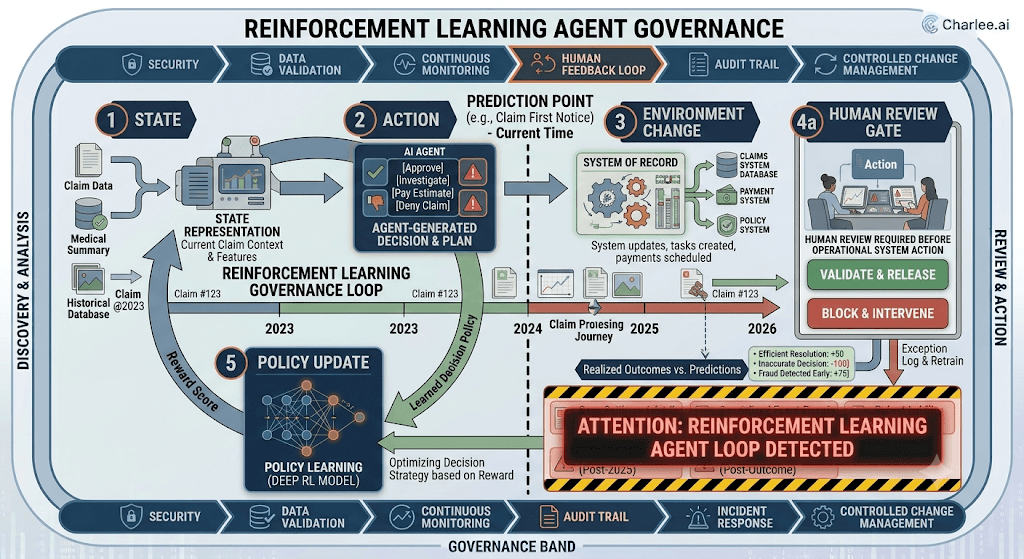
Reinforcement learning is a method for improving sequential decisions by learning from feedback. The system observes a situation, chooses an action, receives a consequence, and updates its strategy so that future actions are more likely to support a defined long-term objective.
Technical Definition
Reinforcement learning formalizes decision-making as an interaction between an agent and an environment. At each time step, the agent observes a state, selects an action according to a policy, receives a reward, and transitions to a new state. The learning objective is typically to maximize expected cumulative discounted reward while respecting operational, legal, safety, and business constraints.
Insurance Definition
In Property & Casualty insurance, reinforcement learning can be viewed as a controlled method for learning how a sequence of operational actions may influence a longer-term outcome. Examples may include selecting the timing of a claim review, routing work to available expertise, sequencing outreach, or allocating investigative resources. The system should support—not replace—professional judgment in material decisions.
| Term | Meaning | Insurance example |
|---|---|---|
| Agent | The decision-making system. | A workflow recommendation engine. |
| Environment | The setting in which actions produce consequences. | A claims operation with changing files, staff capacity, and incoming evidence. |
| State | The information available at a decision point. | Claim status, severity indicators, treatment activity, workload, and elapsed time. |
| Action | A choice available to the agent. | Recommend supervisor review, schedule follow-up, or defer action. |
| Reward | A numerical signal representing desired or undesired consequences. | Timely resolution, reduced delay, quality score, or compliance penalty. |
| Policy | The learned strategy mapping states to actions. | Which workflow step to recommend under each set of conditions. |
| Episode | A complete sequence of interactions. | The lifecycle of a claim or underwriting submission. |
| Value function | Expected long-term return from a state or action. | Estimated future value of intervening now versus later. |
WHY IT MATTERS
Sequential Decisions Are Different from Predictions
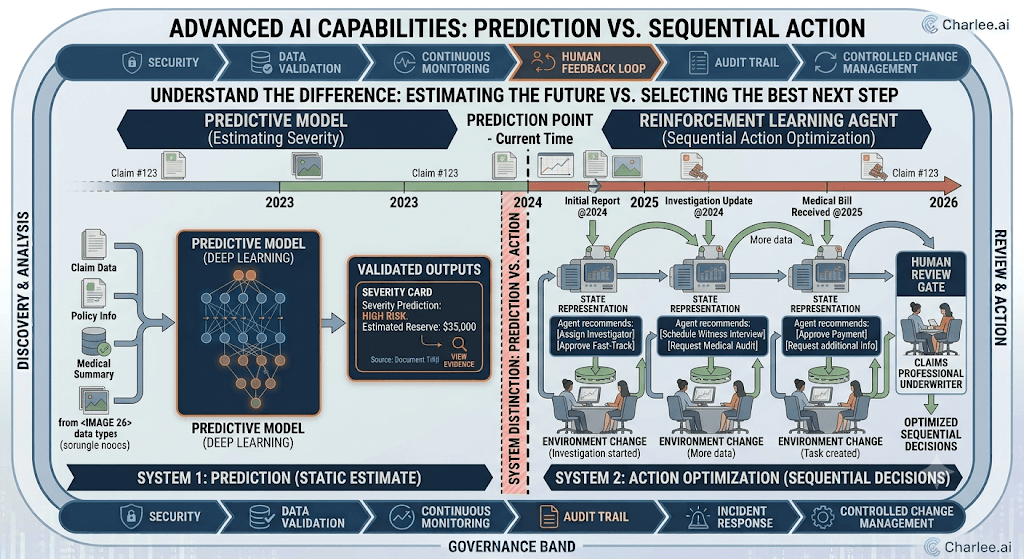
Many insurance AI applications ask a predictive question: Will this claim become severe? Is litigation likely? What is the expected loss? Reinforcement learning asks a different question: Given what is known now, what action should be recommended, and how might that action affect what happens next?
This distinction matters because actions change the environment. A claim review may uncover missing information. Earlier outreach may alter the timing of treatment coordination. Routing a submission to a specialist changes capacity for other work. The decision cannot always be evaluated independently from the sequence in which it occurs.
| Analytical approach | Primary question | Typical output | Example |
|---|---|---|---|
| Supervised learning | What outcome is likely? | Probability, class, or numerical estimate. | Probability of litigation within 90 days. |
| Optimization | What is the best allocation given known inputs and constraints? | Recommended allocation or schedule. | Assign claims to adjusters based on skill and capacity. |
| Reinforcement learning | What action strategy performs best as conditions evolve? | Policy for sequential action selection. | When to recommend review as a claim develops. |
| Rules engine | What action is required when explicit conditions are met? | Deterministic rule outcome. | Escalate when incurred loss exceeds a threshold. |
Important distinction Reinforcement learning is not simply “prediction plus automation.” It requires a formal representation of actions, consequences, delayed outcomes, uncertainty, and constraints. If the business problem can be solved reliably with rules, supervised learning, or conventional optimization, those simpler approaches may be preferable.
Why Insurance Problems Are Hard
MECHANICS
How Reinforcement Learning Works
- Outcome s may take months or years to mature.
- Many actions and external factors contribute to the final result.
- Historical data reflect prior policies, staffing, and business practices rather than all possible actions.
- Legal, regulatory, contractual, and ethical constraints restrict experimentation.
- Human decisions are part of the environment and cannot be treated as noise.
- Catastrophes, inflation, social trends, and jurisdictional changes can alter the environment.
Define the decision process
Specify the decision unit, timing, available actions, observable state, terminal conditions, and who retains authority.
Define the objective
Translate business goals into rewards, penalties, and constraints without encouraging undesirable shortcuts.
Build or identify an environment
Use a simulator, digital twin, historical interaction dataset, or tightly controlled operational setting.
Select a learning approach
Choose online, offline, model-based, model-free, contextual bandit, or another method appropriate to the problem.
Train and evaluate policies
Compare candidate policies against baselines using simulation, counterfactual evaluation, and stress testing.
Apply safety constraints
Block prohibited actions, impose limits, require human approval, and define fallback behavior.
Deploy gradually
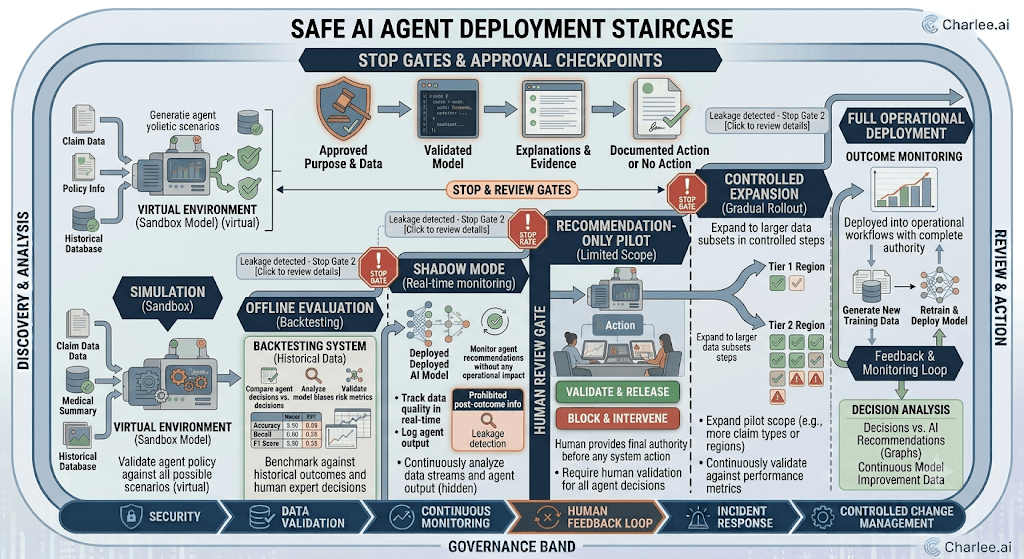
Use shadow mode, recommendation-only pilots, narrow scope, and staged expansion.
Monitor outcomes and behavior
Track reward, quality, fairness, stability, overrides, incidents, drift, and unintended incentives.
The Interaction Loop
| Stage | What happens | Insurance interpretation |
|---|---|---|
| Observe | The agent receives the current state. | Current file facts, workflow status, staff capacity, and recent events. |
| Act | The policy selects or recommends an action. | Recommend review, outreach, assignment, or no action. |
| Transition | The environment changes. | New evidence arrives, the file develops, or capacity changes. |
| Reward | The system receives evaluative feedback. | Quality, timeliness, outcome, cost, or penalty signal. |
| Learn | The policy is updated or evaluated. | Future recommendations adjust based on accumulated evidence. |
METHODS
Major Reinforcement Learning Approaches
| Approach | What it does | Potential insurance fit | Primary caution |
|---|---|---|---|
| Contextual bandits | Chooses among actions based on the current context, without modeling long sequences. | Selecting among approved communication or routing options. | Still requires careful exploration and reward design. |
| Value-based RL | Learns the expected value of actions or states. | Sequential workflow recommendations with discrete actions. | Can be unstable and difficult to interpret. |
| Policy-gradient methods | Directly optimize a parameterized action policy. | Complex action spaces or stochastic policies. | Data hungry and sensitive to reward specification. |
| Actor-critic methods | Combine a policy learner with a value estimator. | Advanced sequential control problems. | Higher complexity and governance burden. |
| Model-based RL | Learns or uses a model of the environment to plan. | Simulation, scenario testing, and resource planning. | Errors in the environment model can compound. |
| Offline RL | Learns from historical logged interactions. | Insurance settings where live exploration is inappropriate. | Historical data may not cover alternative actions. |
| Constrained RL | Optimizes reward subject to explicit safety or policy limits. | Regulated workflows with non-negotiable constraints. | Constraints must be complete and correctly implemented. |
| Multi-agent RL | Multiple agents learn while interacting. | Complex market or resource simulations. | Very high complexity and emergent behavior risk. |
Practical starting point For many insurance organizations, a contextual bandit, constrained recommender, or conventional optimization approach may deliver most of the value with less operational risk than full reinforcement learning. Start with the simplest method that matches the decision structure.
Online vs. Offline Learning
Online reinforcement learning improves through interaction with a live environment. This is common in games and robotics but can be inappropriate in insurance because exploration may expose real people or decisions to unproven actions. Offline reinforcement learning instead learns from previously recorded interactions, but it introduces a different risk: the historical data may contain only the actions chosen under the old policy, making alternative actions difficult to evaluate reliably.
OBJECTIVE DESIGN
Rewards, Penalties, and Constraints
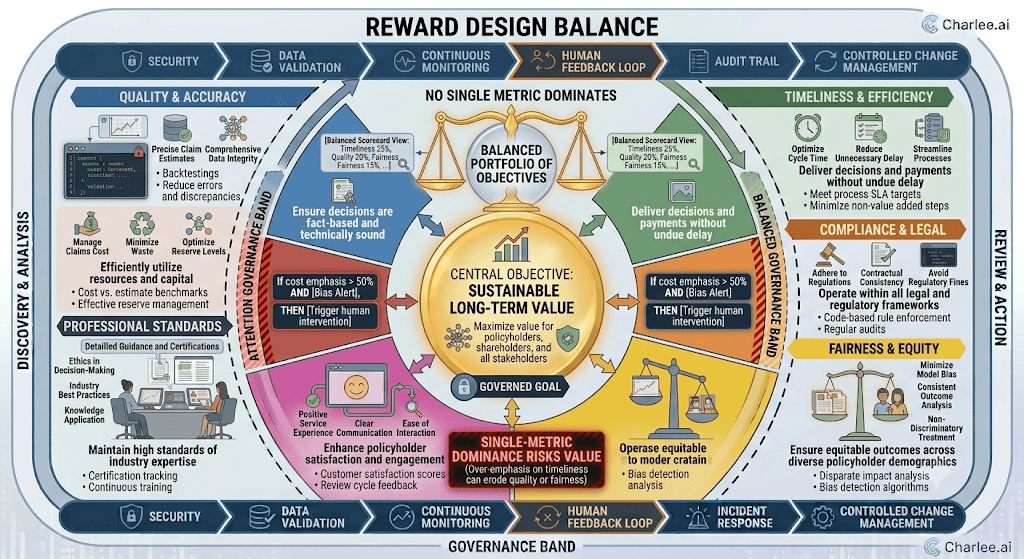
The reward function is the operating definition of success. It can also become the source of the most serious failure. A system will optimize what is measured—not necessarily what leadership intended. Insurance objectives are multidimensional, and a single financial measure rarely captures quality, fairness, compliance, customer impact, professional standards, and long-term consequences.
| Objective element | Illustrative signal | Design concern |
|---|---|---|
| Timeliness | Reduction in avoidable processing delay. | Fast handling must not reduce investigation quality. |
| Quality | File quality score or completeness measure. | Scores must be reliable and not encourage superficial documentation. |
| Outcome | Resolution quality or recovery success. | Outcome can be influenced by factors outside the agent’s control. |
| Customer or claimant experience | Service measures or complaint reduction. | Proxy measures may not represent all populations equally. |
| Compliance | Penalty for prohibited or late actions. | Some constraints should be hard blocks, not soft penalties. |
| Cost | Operational cost or external expense. | Cost reduction must not override obligations or appropriate care. |
| Human workload | Balanced assignments and reduced overload. | Optimization must respect expertise, continuity, and labor rules. |
Reward-hacking risk A policy may discover behavior that increases the measured reward while undermining the true business objective. Examples include deferring difficult work, overusing easy-to-measure actions, or shifting workload in ways that improve one metric while harming another. Reward design requires cross-functional review and continuous challenge.
Hard Constraints vs. Soft Penalties
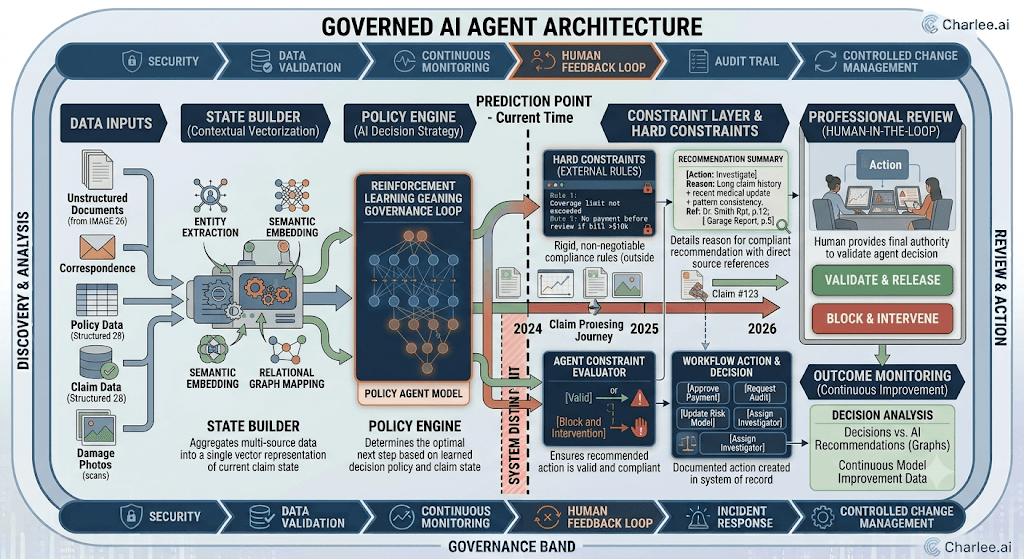
A hard constraint makes an action unavailable. A soft penalty discourages an action but still permits it if the model believes the overall reward is higher. Legal prohibitions, protected-class restrictions, authorization limits, and mandatory human approvals should generally be represented as hard constraints outside the learning policy.
INSURANCE APPLICATIONS
Where Reinforcement Learning May Add Value
Dynamic claim review recommendations
Learn when an open claim may benefit from a supervisor, clinical, legal, or specialty review as evidence changes.
Adaptive workflow sequencing
Recommend the next approved workflow step based on claim state, dependencies, and prior outcomes.
Resource allocation
Balance workload, expertise, urgency, and changing capacity across claims or submissions.
Investigation planning
Recommend a sequence of approved investigative activities while respecting cost and authorization limits.
Customer communication timing
Select timing and channel among approved options to improve responsiveness and completion.
Underwriting referral routing
Adaptively route submissions based on complexity, appetite, expertise, and capacity.
Portfolio intervention simulation
Evaluate alternative strategies in a simulated environment before operational use.
Catastrophe operations planning
Support dynamic resource deployment under rapidly changing volumes and constraints.
Fraud investigation prioritization
Allocate limited investigative resources across evolving cases, subject to strict fairness and compliance controls.
Fraud investigation prioritization
Boundary condition Reinforcement learning should not be used to bypass underwriting authority, claims professional judgment, statutory duties, contractual obligations, or required documentation. In high-impact settings, the appropriate role is usually recommendation, simulation, or resource support under human control.
Fraud investigation prioritization
CLAIMS SCENARIO
Detailed Case Study: Adaptive Claim Review Timing
A workers’ compensation carrier wants to improve the timing of supervisory and clinical review. Existing rules trigger review at fixed intervals or after specific events. The carrier believes that some claims would benefit from earlier attention while others do not require repeated review at the same cadence.
The proposed reinforcement learning system does not make claim decisions. It recommends one of several approved actions: review now, schedule review within a defined period, request a specific information check, or take no additional action. The state includes claim age, recent medical activity, work status, attorney signals, prior review results, jurisdiction, complexity indicators, and adjuster workload. The environment is first represented in a simulator built from historical process data and expert rules.
Fraud investigation prioritization
| Design element | Illustrative implementation |
|---|---|
| Decision point | Weekly review opportunity for eligible open claims. |
| Actions | No action; adjuster review; supervisor review; clinical review; legal consultation recommendation. |
| Reward | Timely identification of meaningful change, improved file quality, and reduced avoidable delay. |
| Hard constraints | No reserve change, denial, settlement, treatment authorization, or legal strategy action by the agent. |
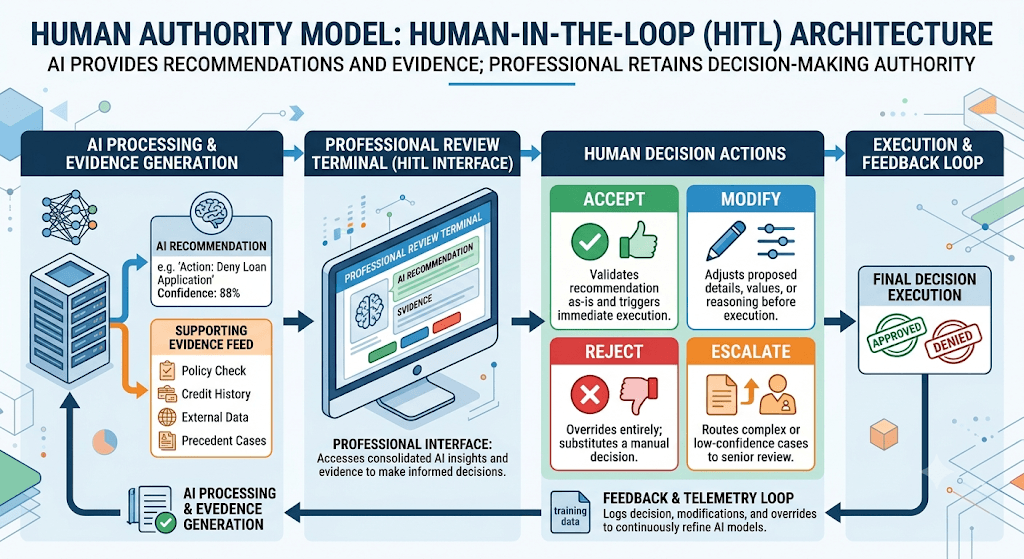
| Human authority | Professionals accept, modify, or reject recommendations and document significant decisions. |
| Evaluation | Compare against rules and expert baselines using shadow mode and controlled pilots. |
| Monitoring | Review performance, override patterns, subgroup effects, workload shifts, and unintended incentives. |
Illustrative Operating Sequence
The policy observes the current claim state and recent developments.
It recommends a review action and provides the factors supporting that recommendation.
The adjuster or supervisor decides whether the recommendation is appropriate.
The accepted action and resulting file development are recorded.
Quality and outcome measures are evaluated over time, not immediately assumed from the recommendation.
The learning process occurs under controlled change management rather than unrestricted live self-modification.
Case-study lesson The value is not autonomous claim handling. The value is learning a better recommendation strategy for when scarce expertise should engage, while professionals retain authority and governance controls prevent the model from taking prohibited actions.
UNDERWRITING SCENARIO
Detailed Case Study: Adaptive Submission Routing
A commercial insurer receives submissions with varying complexity, completeness, appetite fit, and urgency. Static routing rules create bottlenecks because they do not fully account for changing team capacity or the fact that different underwriters have different specialties.
A constrained decision policy recommends assignment among approved underwriting queues. The system considers submission characteristics, required expertise, service commitments, current workload, and historical completion patterns. It does not select risk, determine price, set terms, or approve coverage.
| State information | Permitted action | Professional control |
|---|---|---|
| Line of business, jurisdiction, account complexity, completeness, broker priority, requested effective date. | Recommend an approved queue or specialist. | Underwriting operations may override assignment. |
| Current capacity, service-level exposure, and skill availability. | Recommend reassignment when bottlenecks emerge. | Managers define capacity limits and continuity rules. |
| Historical processing outcomes and referral patterns. | Adjust routing strategy within approved constraints. | Underwriters retain all risk selection and terms authority. |
What Success Would Mean
RISK AND GOVERNANCE
Why Reinforcement Learning Requires Stronger Controls
- Reduced avoidable queue delay without lowering underwriting quality.
- More consistent use of specialized expertise.
- Improved service-level performance across submission segments.
- No unacceptable concentration, fairness, or continuity effects.
- Clear explanations and complete routing audit trails.
| Risk | How it can appear | Required control |
|---|---|---|
| Misaligned reward | The system improves a metric while harming quality or fairness. | Multi-objective review, hard constraints, and independent challenge. |
| Unsafe exploration | The system tries unproven actions in live operations. | Offline learning, simulation, shadow mode, and restricted action sets. |
| Feedback loops | Prior recommendations change the data used for future learning. | Policy logging, causal analysis, monitoring, and controlled updates. |
| Hidden state | Important information is unavailable to the agent. | State-quality review, uncertainty handling, and human escalation. |
| Distribution shift | The environment changes after deployment. | Drift detection, stress testing, and fallback policies. |
| Bias or disparate impact | Rewards or historical behavior encode unequal treatment. | Fairness assessment, protected-attribute controls, and subgroup monitoring. |
| Lack of explainability | Users cannot understand why an action was recommended. | Reason codes, evidence, policy constraints, and human review. |
| Reward gaming | Users or the system learn to manipulate measured outcomes. | Metric triangulation, audit, anomaly monitoring, and governance review. |
| Self-modification risk | A live policy changes without approved validation. | Version control, gated retraining, release approval, and rollback. |
Governance principle A reinforcement learning policy is a controlled production system, not an experiment that continues indefinitely. Every deployed version should be identified, validated, approved, monitored, and reversible. Learning does not eliminate change management.
HUMAN OVERSIGHT
Human-in-the-Loop Operating Model
Human oversight should be designed into the decision process rather than added after model development. The professional needs sufficient information, time, authority, and workflow support to challenge a recommendation. A nominal approval click is not meaningful oversight if the user cannot understand the rationale or consequences.
| Control layer | Purpose | Examples |
|---|---|---|
| Action design | Limit what the agent can propose. | Approved action catalog; prohibited-action list. |
| Decision rights | Define who may accept or execute each action. | Adjuster, underwriter, supervisor, clinical reviewer, or manager. |
| Explanation | Support informed review. | Reason codes, state summary, source evidence, uncertainty. |
| Override | Permit professional correction. | Accept, modify, reject, or escalate with documented rationale. |
| Quality review | Evaluate recommendation and human response. | Sampling, peer review, supervisor review, and audits. |
| Change control | Prevent uncontrolled policy updates. | Versioning, validation, approvals, release notes, rollback. |
| Incident response | Contain harmful behavior. | Kill switch, fallback policy, triage, investigation, and remediation. |
Minimum Evidence Presented to the User
EVALUATION
How to Measure a Reinforcement Learning Policy
Evaluation must extend beyond the average reward. Insurance organizations need to know whether the policy behaves safely, consistently, fairly, and usefully across realistic conditions. Because policy actions influence future observations, conventional predictive validation is not sufficient by itself.
- The recommended action and available alternatives.
- The most relevant current-state factors.
- Any important missing data or uncertainty.
- The constraints that limited the action set.
- The expected operational purpose of the recommendation.
- A clear statement that the professional retains decision authority.
| Evaluation dimension | Questions |
|---|---|
| Policy value | Does the policy improve the defined long-term objective relative to rules, expert practice, or optimization baselines? |
| Safety | How often does the policy approach constraints, propose prohibited actions, or require fallback? |
| Stability | Does behavior change materially under small input changes or across time periods? |
| Coverage | Are recommendations reliable across the full range of states, including rare conditions? |
| Fairness | Do action rates, outcomes, or error patterns differ meaningfully across relevant groups? |
| Human use | Are recommendations accepted appropriately, overridden thoughtfully, and integrated into work? |
| Operational impact | Does the policy improve timeliness, quality, capacity, or outcomes without shifting harm elsewhere? |
| Robustness | How does the policy behave under catastrophes, volume spikes, missing data, and regime change? |
Counterfactual Evaluation
Offline evaluation attempts to estimate how a new policy would have performed using data generated by a prior policy. This is difficult because the data reveal outcomes only for actions actually taken. Techniques such as importance sampling, doubly robust estimation, causal modeling, and simulation can help, but each depends on assumptions that must be documented and challenged.
Baseline requirement A reinforcement learning policy should be compared against credible alternatives: existing rules, human practice, supervised prediction plus workflow logic, and conventional optimization. A new method is justified only if it produces material, reliable improvement after accounting for complexity and risk.
IMPLEMENTATION
A Responsible Insurance Implementation Blueprint
Phase 1 — Problem qualification
Confirm that the decision is sequential, actions affect future states, and a simpler method is insufficient.
Phase 2 — Governance design
Define decision rights, prohibited actions, reward review, fairness requirements, documentation, and accountable owners.
Phase 3 — Data and environment
Create a reliable interaction dataset or simulator with complete action, state, timing, and outcome logs.
Phase 4 — Baselines and prototypes
Build rules, supervised, and optimization baselines before advanced reinforcement learning.
Phase 5 — Offline validation
Evaluate candidate policies through simulation, counterfactual analysis, stress testing, and expert review.
Phase 6 — Shadow mode
Generate recommendations without influencing operations; compare behavior and investigate anomalies.
Phase 7 — Recommendation-only pilot
Expose a narrow user group to recommendations with mandatory human approval and detailed logging.
Phase 8 — Controlled expansion
Expand scope only when evidence supports value, safety, fairness, and operational readiness.
Phase 9 — Continuous monitoring
Track policy behavior, outcomes, overrides, drift, incidents, and the continuing validity of rewards and constraints.
DATA READINESS
The Reinforcement Learning Data Contract
Phase 9 — Continuous monitoring
| Data element | Required definition |
|---|---|
| Decision unit | Claim, claimant, exposure, submission, account, task, or portfolio. |
| Decision cadence | Event-driven, daily, weekly, or another defined interval. |
| State variables | Information available at the moment of action selection. |
| Action log | Every available action, chosen action, actor, timestamp, and override. |
| Reward components | Timing, source, scale, direction, and business interpretation of each signal. |
| Constraints | Legal, policy, authorization, fairness, and operational limits. |
| Outcome maturity | How long until meaningful consequences can be measured. |
| Missingness | How unavailable data are represented and handled. |
| Policy identity | Which rule, model, or human process generated each historical action. |
| Change history | System, process, staffing, and policy changes that alter the environment. |
Data Quality Warning Signs
BEST PRACTICES
What Good Looks Like
- Actions are not logged consistently or timestamps are unreliable.
- The available action set changed without documentation.
- Outcome s are immature or measured differently across units.
- Human overrides are missing or indistinguishable from model actions.
- Rewards rely on proxies that are easy to manipulate.
- Historical behavior reflects policies that are no longer allowed.
Start with a decision, not an algorithm
Define the user, action, timing, constraints, and business consequence before selecting a method.
Use the simplest viable approach
Test rules, supervised learning, and optimization before full reinforcement learning.
Separate hard constraints from rewards
Do not ask the model to trade off non-negotiable obligations.
Build a safe environment
Invest in simulation, offline evaluation, and shadow testing before operational influence.
Expose evidence and uncertainty
Users need more than a recommended action; they need context and limitations.
Version everything
Policies, rewards, constraints, data definitions, and environment models must be controlled artifacts.
Monitor behavior, not only outcomes
Investigate unusual action patterns even when headline metrics appear positive.
Plan for rollback
Maintain tested fallback rules and the ability to stop recommendations immediately.
Common Mistakes
EXECUTIVE DECISION GUIDE
Should Your Organization Use Reinforcement Learning?
- Calling any adaptive workflow “reinforcement learning.”
- Using live operations as an uncontrolled exploration environment.
- Optimizing a single cost or speed metric.
- Ignoring delayed consequences and outcome maturity.
- Assuming historical data contain reliable information about unchosen actions.
- Allowing policy updates without formal validation and approval.
- Using human approval as a substitute for explanation and accountability.
| Question | Proceed when… | Pause when… |
|---|---|---|
| Is the problem sequential? | Current actions materially affect future decisions and states. | Each case can be scored independently. |
| Are actions controllable? | The permitted action set is explicit and enforceable. | Actions are ambiguous or cannot be constrained. |
| Is the objective defensible? | Rewards represent quality, compliance, fairness, and long-term value. | Success is reduced to a narrow proxy. |
| Can learning occur safely? | Simulation, offline data, shadow mode, and fallback are available. | Live exploration would expose material decisions. |
| Is there enough interaction data? | States, actions, timing, outcomes, and policy identity are logged. | Historical logs are incomplete or inconsistent. |
| Are simpler methods insufficient? | Baselines have been tested and leave a material gap. | Rules or optimization can solve the problem adequately. |
| Is governance mature? | Owners, approvals, monitoring, incident response, and audit are established. | The organization cannot control model changes or explain behavior. |
Executive recommendation Treat reinforcement learning as an advanced capability for a narrow class of problems—not as a default AI strategy. A successful program begins with disciplined problem selection, controlled experimentation, strong simulation, clear human authority, and measurable evidence that the method outperforms safer alternatives.
Board and Executive Questions
CHARLEE.AI PERSPECTIVE
Practical Responsible AI for Insurance Workflows
The most valuable role for advanced AI in insurance is to improve the timing, completeness, and relevance of information available to professionals. Reinforcement learning can contribute when decisions occur in sequence and when an organization has the discipline to define actions, feedback, constraints, and accountability clearly.
For most claims and underwriting use cases, the appropriate progression is to establish reliable document intelligence, structured data, predictive signals, explanations, and governed workflow support before introducing an adaptive decision policy. The foundation matters: a reinforcement learning agent cannot compensate for weak source data, unclear process ownership, inconsistent labels, or missing outcome measurement.
- What actions can the system recommend, and which actions are prohibited?
- How was the reward function approved, and what undesirable behavior could it encourage?
- How is the policy tested without exposing customers or claimants to unsafe exploration?
- What evidence shows improvement over current rules and human practice?
- How are fairness, compliance, and professional standards represented?
- Who can stop the system, and how quickly can operations revert to a safe fallback?
People-plus-AI principle AI may recommend, prioritize, simulate, or help allocate attention. Claims professionals, underwriters, medical experts, legal professionals, and managers remain responsible for material decisions and documentation. Human judgment is not an exception path; it is part of the operating model.
A Maturity Path
| Stage | Capability | Governance expectation |
|---|---|---|
| 1. Observe | Reliable data, documents, and event history. | Data definitions, lineage, quality, and access controls. |
| 2. Predict | Risk signals and expected outcomes. | Validation, calibration, explanations, and monitoring. |
| 3. Recommend | Rules or optimization suggest actions. | Decision rights, constraints, audit, and overrides. |
| 4. Adapt | A controlled policy learns sequential recommendations. | Simulation, offline evaluation, gated updates, safety monitoring, and rollback. |
ILLUSTRATION BRIEFS
Illustrations
Key Takeaways
- Reinforcement learning learns sequential action strategies from feedback.
- It is fundamentally different from predicting an outcome or applying a static rule.
- Insurance use cases must begin with explicit actions, constraints, rewards, and decision rights.
- Live exploration is often inappropriate; simulation, offline learning, and shadow mode are central safeguards.
- Reward design must represent quality, compliance, fairness, and long-term value—not only cost or speed.
- Professionals should retain authority for material claims and underwriting decisions.
- Simpler approaches should be tested first and used when they are sufficient.
- Every policy version must be validated, approved, monitored, auditable, and reversible.
Final perspective The question is not whether an AI system can learn to take actions. The question is whether the organization can define the right objective, constrain the action space, evaluate consequences safely, preserve professional authority, and govern change over time. In insurance, those operating disciplines determine whether reinforcement learning becomes a useful decision-support capability or an unacceptable source of risk.
SEO AND AEO
Publication Metadata
| Field | Recommended content |
|---|---|
| Primary keyword | reinforcement learning in insurance |
| Secondary keywords | reinforcement learning for claims; reinforcement learning underwriting; insurance AI agents; sequential decision AI; offline reinforcement learning insurance |
| SEO title | Reinforcement Learning in Insurance: Definition, Uses, Risks, and Governance |
| Meta description | Learn how reinforcement learning works in Property & Casualty insurance, where it may add value, how it differs from predictive AI, and why strong governance is essential. |
| Suggested URL | /insurance-ai-dictionary/reinforcement-learning |
| H1 | Reinforcement Learning in Property & Casualty Insurance |
| Search intent | Educational, executive decision support, and implementation guidance. |
| Featured-snippet definition | Reinforcement learning is a machine learning approach in which an agent learns a strategy for choosing actions by receiving rewards and penalties as it interacts with an environment. |
| AEO question | What is reinforcement learning in insurance? |
Definitions and Essential Vocabulary
- Reinforcement learning learns from consequences rather than only from labeled historical answers.
- The output is a policy: a strategy for selecting actions given the current state.
- Rewards can be immediate or delayed, making credit assignment a central challenge.
- Exploration is essential for learning but can be inappropriate or unsafe in live insurance operations.
- Offline reinforcement learning attempts to learn from historical interaction data without uncontrolled live experimentation.
- Simulators, digital twins, and constrained sandboxes are often prerequisites for responsible insurance use.
Frequently Asked Questions
No. Supervised learning learns from examples with known target labels. Reinforcement learning learns a strategy for selecting actions from feedback over a sequence of decisions.
No. It can produce recommendations, support simulation, or operate within tightly constrained workflows. In insurance, recommendation-only use is often the responsible starting point.
A numerical feedback signal representing part of the desired objective. Rewards must be designed carefully because the agent will optimize what they encode.
Exploration involves trying actions to learn their consequences. Uncontrolled experimentation may be inappropriate when actions affect coverage, claims, pricing, treatment, legal strategy, or customer outcomes.
It learns from historical interaction data rather than through unrestricted live experimentation. Its reliability depends on the coverage and quality of the historical actions and outcomes.
A simplified reinforcement learning setting that selects among actions using the current context, usually without modeling a long sequence of future states.
A policy is the strategy used to choose an action given the current state.
It occurs when the system finds a way to increase the measured reward without achieving the intended real-world objective.
It should not independently set or change reserves. It may support simulation or recommend review, while qualified professionals retain authority and documentation responsibility.
Not by default. It may support routing, capacity allocation, or simulation, but risk selection, pricing, terms, and coverage authority remain governed professional decisions.
Through policy-value estimation, simulation, counterfactual methods, stress testing, safety testing, fairness analysis, human-use measures, and controlled pilots.
Not always, but a reliable simulator or controlled environment is often important because live experimentation may be unsafe or unacceptable.
It optimizes a reward while respecting specified limits. In insurance, some limits should also be enforced outside the model as hard system controls.
Reinforcement learning can be one method used to improve an agent’s action policy. Many AI agents do not use reinforcement learning and instead rely on rules, planning, retrieval, and supervised models.
Reliable state, action, timing, outcome, policy, constraint, and override data are needed. Missing action logs are a major obstacle.
Updates should occur through controlled, validated releases—not uncontrolled continuous learning in production.
A narrow, reversible, recommendation-only workflow with approved actions, strong logging, measurable feedback, and low consequence if the recommendation is rejected.
Avoid it when the problem is not sequential, rewards are ambiguous, exploration cannot be made safe, historical interactions are poorly logged, or simpler methods are adequate. REFERENCE Related Terms and Knowledge Center Connections