Executive Snapshot
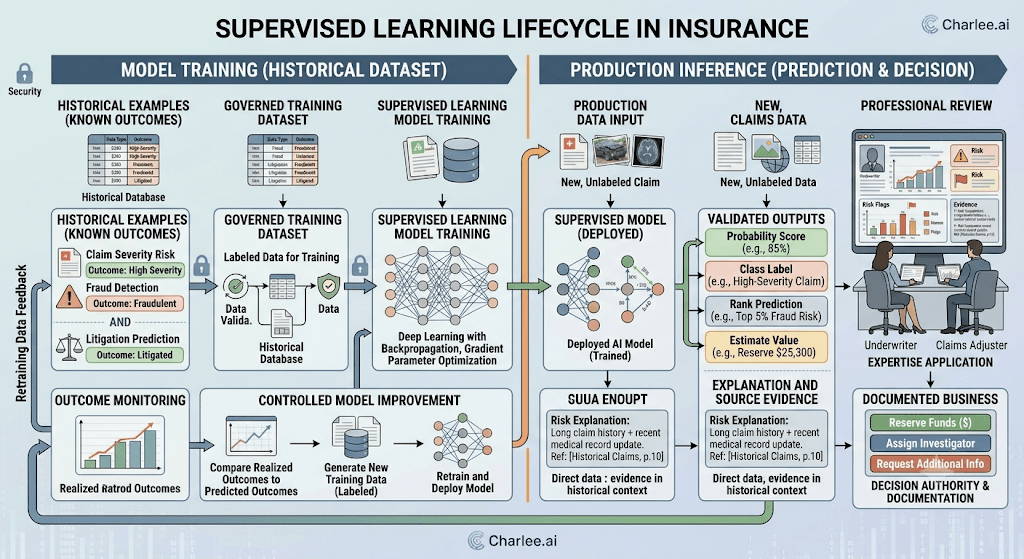
Two-minute definition Supervised learning is a machine learning approach in which a model learns from historical examples that already include the correct outcome or label. In insurance, those labels may be claim severity, litigation, fraud referral, subrogation recovery, policy conversion, or another business result. The model learns relationships between available information and the known outcome, then applies those relationships to new cases.
| Business question | Supervised learning contribution | Human responsibility |
|---|---|---|
| Which new claims may become severe? | Estimate severity probability or expected loss from labeled claim history. | Validate evidence, prioritize activity, and make claim decisions. |
| Which submissions fit appetite? | Classify or score submissions based on known underwriting outcomes. | Select risk, set terms, and document rationale. |
| Which claims warrant SIU review? | Estimate fraud or anomaly risk using labeled investigations and outcomes. | Investigate, corroborate, and determine disposition. |
| Which files may litigate? | Predict attorney involvement or litigation from prior claim outcomes. | Review signals, engage strategy, and manage the claim. |
Executive decision point Supervised learning is appropriate when the organization has a clearly defined business outcome, enough representative historical examples, reliable labels, and a workflow in which predictions can prompt a useful human action. It is not appropriate when the target outcome is ambiguous, labels are inconsistent, or no operational response has been defined.
Executive Summary
Supervised learning is the most widely used form of machine learning for predictive insurance applications. It learns from examples in which both the input information and the historical outcome are known. A model may review claim attributes, policy data, medical information, notes, documents, and prior activity, while the corresponding label indicates whether the claim became severe, litigated, produced a recovery, or resulted in another defined outcome.
The strength of supervised learning is its direct connection to a business question. The model is not simply looking for interesting patterns; it is learning to estimate a specific target. This makes supervised learning especially useful for classification, probability estimation, ranking, and numerical prediction across claims and underwriting.
Its limitations are equally important. A model can only learn from the quality, consistency, and representativeness of the historical labels it receives. Poor labels can encode operational inconsistencies, outdated practices, or bias. Production use therefore requires strong data governance, independent validation, explainability, workflow integration, human review, and ongoing performance monitoring.
Charlee.ai Insight The most valuable supervised learning programs do not stop at a score. They deliver the score at the right moment, explain the evidence that influenced it, route it to the right professional, and measure whether the resulting action improves the business outcome.
Quick Facts
| Topic | Production-ready guidance |
|---|---|
| Definition | Learning from labeled examples in which the desired outcome is already known. |
| Primary tasks | Classification, probability estimation, ranking, and regression. |
| Insurance examples | Severity prediction, litigation prediction, fraud scoring, reserve support, underwriting risk scoring, and subrogation identification. |
| Core requirement | Reliable historical labels aligned with the business target. |
| Typical output | Class, probability, ranked priority, or predicted numerical value. |
| Key risks | Label leakage, class imbalance, bias, overfitting, drift, and weak workflow adoption. |
| Human oversight | Required for material insurance decisions and exceptions. |
| Success measure | Model performance plus measurable workflow and business improvement. |
Definitions
Executive Definition
Supervised learning is a method for using known historical outcomes to estimate what is likely to happen in a new case. It enables insurers to apply lessons from prior claims, policies, and decisions consistently across a current portfolio.
Technical Definition
Supervised learning trains a mathematical model on paired observations: input variables, often represented as a feature vector X, and an associated target y. The learning algorithm estimates a function that maps X to y while minimizing a defined loss on training data and maintaining generalization performance on unseen validation and test data.
Insurance Definition
In insurance, supervised learning connects historical policy, claim, document, behavioral, environmental, and operational information to a known business outcome. The model then estimates the probability, category, priority, or expected amount associated with a new claim, submission, account, or portfolio exposure.
The meaning of a label
A label is the historical answer the model is asked to learn. Examples include whether litigation occurred, whether a claim exceeded a severity threshold, whether SIU accepted a referral, whether subrogation produced a recovery, or the ultimate incurred loss. Labels must be defined consistently, derived at the correct point in time, and documented so that users understand exactly what the model predicts.
Why Supervised Learning Matters in P&C Insurance
Property and Casualty insurers make repeated decisions under uncertainty. At FNOL, many facts are incomplete. During underwriting, the carrier must evaluate risk before future experience is known. Supervised learning helps convert accumulated historical experience into earlier and more consistent decision support.
| Insurance challenge | Why traditional review is difficult | Supervised learning value |
|---|---|---|
| Large claim volumes | Professionals cannot compare every file with thousands of historical examples. | Consistently estimates risk across the entire portfolio. |
| Early uncertainty | Important outcomes emerge after weeks or months. | Uses early signals linked to known historical outcomes. |
| Unstructured evidence | Key facts are distributed across notes, reports, and documents. | Combines extracted document information with structured data. |
| Inconsistent prioritization | Workload and experience may cause similar cases to receive different attention. | Provides a common risk signal while preserving professional judgment. |
| Changing conditions | Medical, legal, repair, and catastrophe patterns evolve. | Can be monitored and retrained as conditions change. |
Business principle A prediction has no operational value unless it changes a decision, priority, investigation, intervention, or allocation of expertise. Every supervised learning use case should define the action that follows the prediction before model development begins.
How Supervised Learning Works
Define the decision and target
Specify the business question, decision point, prediction horizon, target label, intended user, and operational action.
Assemble historical examples
Create a representative dataset containing only information that would have been available at the intended prediction time.
Create and validate labels
Apply consistent outcome definitions, resolve ambiguous cases, and document label sources and timing.
Prepare features
Transform structured and unstructured information into model inputs while controlling missing values, leakage, and prohibited attributes.
Split the data
Separate training, validation, and test data, often using time-aware or entity-aware splits to prevent contamination.
Train candidate models
Fit algorithms that learn the relationship between features and outcomes using an appropriate loss function.
Evaluate and calibrate
Assess discrimination, error, calibration, subgroup performance, stability, and operational thresholds.
Deploy into workflow
Present predictions, explanations, and source evidence at the point where a professional can act.
Monitor and improve
Track data drift, performance drift, user response, business outcomes, incidents, and controlled retraining.
The Supervised Learning Data Contract
A production model should operate under a documented data contract that defines what each input and label means, when it becomes available, how it is sourced, and what quality controls apply. This prevents silent changes in data from undermining model performance.
| Contract element | Questions to answer |
|---|---|
| Prediction unit | Is the model predicting at the claim, exposure, claimant, policy, account, document, or portfolio level? |
| Prediction time | At FNOL, after initial investigation, at renewal, or continuously during the lifecycle? |
| Target label | Exactly what event or amount constitutes the outcome? |
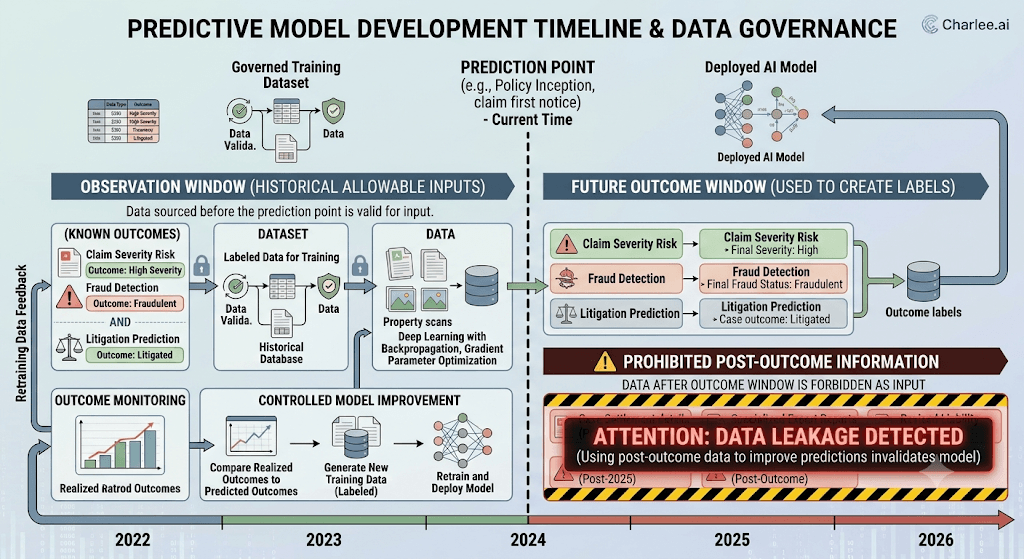
| Observation window | Which information may be used before the prediction is made? |
| Outcome window | How long after the prediction is the result measured? |
| Exclusions | Which cases, attributes, or data sources are prohibited or inappropriate? |
| Refresh cadence | How often are inputs, labels, and derived features updated? |
| Ownership | Who is accountable for data definitions, quality, approvals, and changes? |
Classification and Regression
Classification
Classification predicts a category or probability. Binary classification may estimate whether litigation will occur. Multiclass classification may assign a claim to one of several routing categories. The probability output is often more useful than a hard yes-or-no result because the organization can establish thresholds aligned with capacity and risk tolerance.
Regression
Regression predicts a numerical value, such as expected ultimate loss, expected treatment duration, repair cost, or recovery amount. Because insurance outcomes are often skewed and volatile, regression models require careful treatment of outliers, censored outcomes, inflation, and development maturity.
Regression
| Task | Illustrative insurance target | Example output |
|---|---|---|
| Binary classification | Will attorney representation occur within 90 days? | 0.72 probability |
| Multiclass classification | Which claim handling segment is most appropriate? | Complex bodily injury |
| Ranking | Which open files should a supervisor review first? | Ordered priority list |
| Regression | What is the expected ultimate incurred loss? | $185,000 estimate with range |
| Ordinal prediction | What severity tier is most likely? | Tier 4 of 5 |
Common Supervised Learning Algorithms
| Algorithm family | Strengths | Insurance considerations |
|---|---|---|
| Linear and logistic models | Transparent, efficient, and often well calibrated. | Useful baselines and strong choices where explainability is critical. |
| Decision trees | Easy to visualize and capture nonlinear rules. | Single trees can be unstable and may overfit. |
| Random forests | Robust nonlinear modeling with limited tuning. | Less transparent than a single tree; probability calibration may be needed. |
| Gradient boosting | Often strong performance on structured insurance data. | Requires careful tuning, drift monitoring, and explanation tooling. |
| Neural networks | Powerful for complex, high-dimensional, text, image, and multimodal inputs. | Higher data, validation, governance, and computational demands. |
| Support vector machines | Effective in some high-dimensional classification settings. | May be harder to scale and explain for large operational datasets. |
Model selection principle The most complex model is not automatically the best model. Selection should balance predictive performance, calibration, explainability, stability, latency, maintenance cost, and the materiality of the insurance decision.
Core Insurance Applications
Claims severity prediction
Learn from prior claim outcomes to identify files likely to exceed defined loss or complexity thresholds.
Litigation prediction
Estimate the likelihood of attorney involvement, suit, or escalated legal activity.
Reserve decision support
Predict expected loss ranges or the probability that current reserves will become inadequate.
Fraud and SIU prioritization
Estimate the probability that a referral will be accepted, substantiated, or produce recoverable value.
Subrogation identification
Classify claims with recovery potential using known historical recovery outcomes.
Medical escalation
Predict treatment complexity, duration, or cost escalation from early medical and claim signals.
Underwriting risk scoring
Estimate loss propensity, severity, retention, or another defined underwriting outcome.
Submission triage
Classify submissions by appetite, complexity, completeness, or referral need.
Customer and operational analytics
Predict churn, complaint escalation, service need, or workflow delay.
Detailed Claims Scenario: Early Severity Identification
A workers compensation carrier receives a claim involving a lower-back strain. At FNOL, the claim appears routine. The supervised learning model evaluates information available at that moment: occupation, mechanism of injury, jurisdiction, prior claim history, reporting delay, claimant age band, employer characteristics, initial treatment, wage information, and language extracted from the first report.
The model returns a 0.68 probability that the claim will enter the carrier's high-severity segment within twelve months. It also identifies the most influential evidence: a physically demanding occupation, delayed reporting, prior related injury, escalating treatment language, and a jurisdiction with longer disability duration. The system does not change the reserve or claim strategy automatically.
The adjuster reviews the explanation and source information, contacts the employer, validates work restrictions, confirms the treatment plan, and schedules an earlier clinical review. A supervisor monitors the file because the risk remains elevated. As new documents arrive, the model updates the risk signal. Human professionals decide whether and how to intervene.
| Lifecycle point | Model contribution | Professional action | Control |
|---|---|---|---|
| FNOL | Initial severity probability and evidence. | Validate data and prioritize outreach. | No automated adverse decision. |
| Day 14 | Updated probability using treatment and note information. | Review progress and barriers to return to work. | Source evidence available. |
| Day 45 | Risk increases after specialist referral and attorney signal. | Escalate claim strategy and reserve review. | Supervisor approval documented. |
| Quarterly | Portfolio monitoring identifies similar development patterns. | Adjust staffing and targeted review. | Performance and drift monitoring. |
Case study lesson The business value does not come from predicting that a claim may become severe. It comes from identifying the risk early enough for an experienced professional to take an appropriate action and then measuring whether that action improves the outcome.
Detailed Underwriting Scenario: Submission Triage
A commercial insurer receives hundreds of submissions each week. Historical submissions include known outcomes such as declined, quoted, bound, referred, and loss experience after binding. A supervised model estimates appetite fit and referral need using application data, exposure attributes, document-derived information, prior account history, and broker submission quality.
The model places each submission into a prioritized queue and provides the factors behind the recommendation. An underwriter reviews the source documents, confirms material facts, considers current appetite and capacity, and retains authority over risk selection and terms. The model supports consistency and speed; it does not replace underwriting judgment.
Evaluation: Measuring More Than Accuracy
Accuracy alone can be misleading, especially when the outcome is rare. A model that predicts every claim as non-litigated may appear accurate in a portfolio where litigation is uncommon, while providing no practical value. Evaluation should match the use case and operational consequences.
| Measure | What it indicates | Insurance interpretation |
|---|---|---|
| Precision | How often positive predictions are correct. | Important when reviews are costly or capacity is limited. |
| Recall / sensitivity | How many actual positive cases are identified. | Important when missing a high-risk case has material consequences. |
| Specificity | How well negative cases are excluded. | Helps manage false alerts and unnecessary intervention. |
| AUC / discrimination | How well the model ranks higher-risk above lower-risk cases. | Useful for triage and prioritization. |
| Calibration | Whether predicted probabilities match observed frequencies. | Critical when probabilities influence thresholds and resource allocation. |
| MAE / RMSE | Magnitude of numerical prediction error. | Common for cost, duration, or loss regression. |
| Lift | Improvement over random selection in a priority segment. | Shows value for targeted review capacity. |
| Stability | Consistency across time, segments, and changing conditions. | Supports reliable production use. |
Thresholds and capacity
A model probability does not determine the operating threshold by itself. The threshold should reflect business capacity, cost of review, cost of missed cases, risk tolerance, and the action available. Thresholds may vary by line, jurisdiction, claim stage, or operational team, but they should be governed and documented.
Data Leakage and Temporal Integrity
Data leakage occurs when training includes information that would not have been available at the prediction time or that directly reveals the outcome. Leakage can create impressive test results that collapse in production. Insurance data is particularly vulnerable because claim files develop over time and later notes, payments, reserves, attorney information, and closure codes may reveal the target.
| Leakage example | Why it is invalid | Control |
|---|---|---|
| Using a litigation flag recorded after suit was filed to predict litigation at FNOL. | The model is learning the answer, not an early signal. | Apply event-time cutoffs and field-level availability rules. |
| Using ultimate loss values in a feature for early severity prediction. | The outcome is embedded in the input. | Separate target construction from feature generation. |
| Randomly splitting repeated claims from the same account across train and test. | Closely related examples contaminate evaluation. | Use entity-aware or time-aware data splits. |
| Using post-decision underwriter notes to predict the underwriting decision. | The text may state the decision directly. | Restrict documents to those available before decision time. |
Class Imbalance and Rare Events
Many important insurance outcomes are rare: large losses, substantiated fraud, severe escalation, or litigation within a short horizon. Class imbalance can cause a model to favor the majority class. Production design may use class weighting, resampling, ranking objectives, anomaly signals, threshold tuning, and carefully chosen metrics. Rare-event models should be evaluated using realistic prevalence and tested for alert volume, precision, and operational utility.
Explainability and Source Evidence
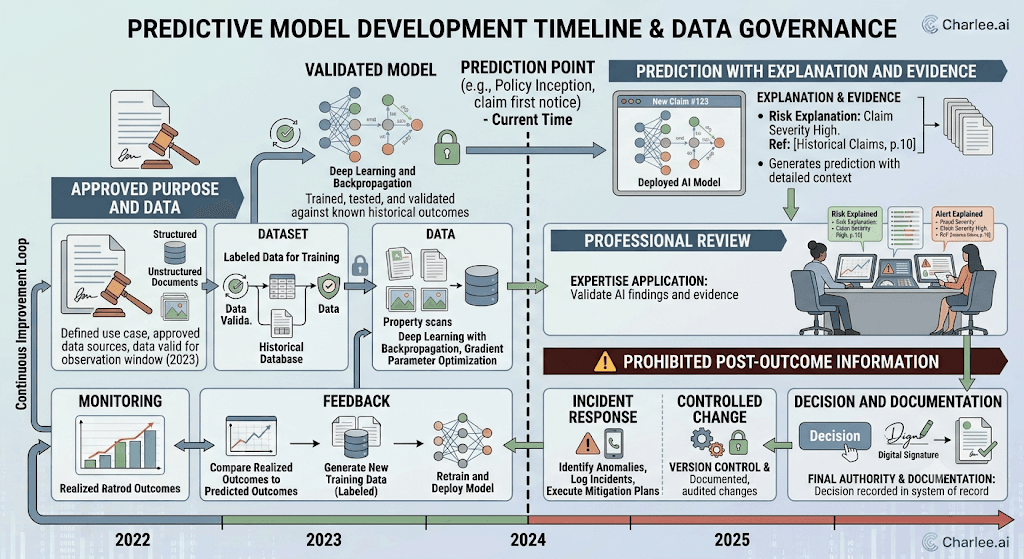
Insurance professionals need to understand why a case was prioritized and which information supports the prediction. Explainability may include global feature importance, local contribution values, reason codes, comparable historical patterns, and links to source documents. Explanations should be stable, understandable, and appropriate to the user; they should not imply causal certainty when the model has learned only association.
Responsible explanation A reason code should help a professional review the file, not become an automatic justification for a business decision. The underlying evidence must remain available, and users should be able to disagree with or override the recommendation.
Risks and Governance Controls
| Risk | Potential effect | Production control |
|---|---|---|
| Poor or inconsistent labels | The model learns operational noise or historical inconsistency. | Label definitions, sampling review, adjudication, and quality monitoring. |
| Bias and unfair impact | Performance or outcomes differ across protected or sensitive groups. | Feature governance, subgroup testing, fairness review, and human oversight. |
| Overfitting | Strong development results do not generalize. | Independent test data, regularization, cross-validation, and conservative model selection. |
| Model drift | Performance declines as claim, legal, medical, or economic patterns change. | Data and outcome monitoring, thresholds, review cadence, and controlled retraining. |
| Automation bias | Users over-rely on model output. | Training, explanations, override pathways, and decision accountability. |
| Security and privacy | Sensitive insurance information is exposed or misused. | Access control, encryption, minimization, logging, retention, and vendor controls. |
| Weak change management | Users do not trust or consistently use the capability. | Workflow design, pilot testing, champions, feedback, and adoption measures. |
| Uncontrolled retraining | Model changes without adequate validation or approval. | Versioning, validation gates, approvals, rollback, and documentation. |
Human-in-the-Loop Operating Model
The model evaluates a new claim, submission, or account using approved data available at the defined decision point.
The system presents a probability, class, rank, or estimate with explanation and source evidence.
The insurance professional validates the information, considers context outside the model, and decides what action is appropriate.
The decision and rationale are documented within the normal workflow, including any override or disagreement.
Outcome s, user feedback, incidents, and model performance are monitored to support controlled improvement.
Authority principle Supervised learning can recommend, prioritize, and inform. Claims professionals, underwriters, managers, and authorized decision-makers retain responsibility for material business decisions and documentation.
Implementation Roadmap
| Phase | Primary objective |
|---|---|
| Phase 1 - Business design | Define the decision, target, action, user, risk, and expected value. |
| Phase 2 - Data and label readiness | Assess availability, quality, timing, representativeness, and legal or governance constraints. |
| Phase 3 - Model development | Build transparent baselines, compare candidate models, and document assumptions. |
| Phase 4 - Independent validation | Test performance, calibration, stability, subgroup behavior, leakage, and operational thresholds. |
| Phase 5 - Workflow pilot | Deploy to a limited population, train users, capture feedback, and measure actionability. |
| Phase 6 - Controlled scale | Expand with monitoring, incident response, change control, and executive reporting. |
| Phase 7 - Lifecycle management | Review performance, drift, business value, labels, and retraining decisions on a defined cadence. |
Business Value and KPIs
Model metrics should be connected to operational and business measures. A model can be statistically strong but commercially weak if users do not act, alerts arrive too late, or interventions do not change outcomes.
| Value dimension | Illustrative KPI | Interpretation |
|---|---|---|
| Earlier insight | Median days from FNOL to risk identification. | Measures whether the model creates usable lead time. |
| Prioritization quality | Lift or precision in the top review segment. | Shows whether scarce expertise is focused effectively. |
| Workflow adoption | Review rate, action rate, and documented override rate. | Indicates whether professionals use the capability appropriately. |
| Claims outcome | Severity, duration, litigation, recovery, or leakage improvement. | Measures impact after controlling for portfolio mix. |
| Underwriting outcome | Turnaround, hit ratio, referral consistency, loss ratio, or retention. | Connects decision support to underwriting performance. |
| Financial value | Avoided cost, recovered value, productivity benefit, and risk-adjusted ROI. | Supports executive investment decisions. |
| Governance | Drift incidents, validation findings, overrides, and control completion. | Measures operational safety and control health. |
ROI discipline
ROI analysis should compare a governed baseline and treatment population where feasible, account for implementation and operating costs, and distinguish correlation from causal impact. Benefits should be measured over a period long enough for insurance outcomes to mature.
Best Practices
- Start with a precise business decision and action, not with an algorithm.
- Create label definitions with business owners, data owners, and model-risk stakeholders.
- Use time-aware data preparation so the model sees only information available at the prediction point.
- Build a transparent baseline before selecting a more complex model.
- Evaluate calibration, subgroup performance, stability, and operational alert volume in addition to discrimination.
- Provide explanations and links to supporting source evidence.
- Pilot inside the real workflow with the professionals who will use the output.
- Document decision authority, override pathways, incident response, and controlled change.
- Monitor both model performance and whether model-informed actions produce value.
- Retrain only through approved, reproducible, and validated processes.
Common Mistakes to Avoid
- Using inconsistent closure codes or operational outcomes as if they were objective truth.
- Allowing future information to leak into training features.
- Optimizing a single metric without considering business costs and capacity.
- Treating model probability as a final decision.
- Ignoring claims development, censoring, and outcome maturity.
- Assuming historical data represents future catastrophe, legal, medical, or economic conditions.
- Launching a model without user training, workflow integration, or feedback mechanisms.
- Failing to monitor drift, overrides, subgroup performance, and incidents.
- Changing labels, data sources, thresholds, or models without governance and version control.
Executive Decision Guide
Questions to ask before approving a use case
- What exact outcome is being predicted, and why does it matter?
- At what point in the insurance lifecycle will the prediction be made?
- What action can a professional take because of the result?
- Are historical labels reliable, representative, and mature?
- What information is available at prediction time, and how is leakage prevented?
- How are performance, calibration, fairness, stability, and business value evaluated?
- How are explanations and source evidence presented to users?
- Who owns the model, data, workflow, validation, and final decision?
- How will drift, incidents, retraining, and retirement be governed?
Vendor evaluation questions
| Area | Evidence to request |
|---|---|
| Data and labels | Target definition, observation windows, label quality process, exclusions, and lineage. |
| Model performance | Independent test results, prevalence, calibration, threshold analysis, subgroup results, and stability. |
| Explainability | User-facing reason codes, source evidence, documentation, and known limitations. |
| Integration | Supported APIs, batch and event options, document sources, workflow actions, and audit logging. |
| Governance | Model cards, validation artifacts, change control, monitoring, incident response, and version history. |
| Security and privacy | Hosting, access, encryption, retention, tenant isolation, subprocessors, and deletion controls. |
| Value realization | Pilot design, adoption measures, business KPIs, baseline methodology, and references. |
Charlee.ai Perspective
Supervised learning is foundational to predictive claims intelligence because it connects early claim information to known outcomes such as severity, litigation, attorney involvement, reserve development, and recovery opportunity. Its value increases when structured data is combined with document intelligence that identifies relevant facts from medical reports, demand packages, claim notes, police reports, and other unstructured sources.
Charlee.ai's people-plus-AI philosophy places the professional at the center of the workflow. Predictive signals should be timely, explainable, connected to source evidence, and embedded in existing claim or underwriting processes. The objective is not to automate professional judgment. It is to help professionals see important signals earlier, focus attention, and make better-informed decisions.
Charlee.ai Insight The quality of a supervised learning model is determined not only by its algorithm, but by the quality of its labels, the timing of its inputs, the clarity of its explanations, the strength of its governance, and the usefulness of the human action it enables.
Key Takeaways
- Supervised learning learns from historical examples that include a known outcome or label.
- It is foundational to predictive claims, underwriting, fraud, reserve, litigation, and subrogation applications.
- Production performance depends heavily on label quality, prediction timing, representative data, and prevention of leakage.
- Accuracy alone is insufficient; calibration, precision, recall, lift, stability, fairness, and business value must also be evaluated.
- Predictions should include explanations and source evidence and should be embedded in a workflow where professionals can act.
- Human authority, governance, monitoring, security, controlled retraining, and incident response are essential.
- The greatest value comes from earlier insight that enables better professional action—not from a score by itself.
Two-minute definition Supervised learning is a machine learning approach in which a model learns from historical examples that already include the correct outcome or label. In insurance, those labels may be claim severity, litigation, fraud referral, subrogation recovery, policy conversion, or another business result. The model learns relationships between available information and the known outcome, then applies those relationships to new cases.
Frequently Asked Questions
No. Supervised learning is one major type of machine learning. Machine learning also includes unsupervised, self-supervised, reinforcement, and other approaches.
The training examples include a known target or label. The model learns the relationship between input information and that historical outcome.
A label is the outcome the model is trained to estimate, such as litigation, high severity, SIU acceptance, subrogation recovery, or ultimate loss.
There is no universal minimum. Requirements depend on outcome prevalence, data quality, model complexity, segment diversity, and the performance needed. Rare outcomes usually require more examples and careful validation.
Yes. NLP and document intelligence can extract structured features or representations from medical reports, demand letters, claim notes, applications, and other documents.
No. Accuracy may be misleading for imbalanced outcomes. Evaluation should include precision, recall, calibration, lift, stability, subgroup performance, and business impact.
Leakage occurs when training uses information that would not have been available at the prediction time or that directly reveals the target. It produces unrealistic performance.
Many models can provide reason codes, feature contributions, and source evidence. The depth and reliability of explanation vary by model and implementation.
No. It supports prioritization and analysis. Authorized professionals remain responsible for material decisions, exceptions, and documentation.
Techniques include class weighting, resampling, ranking, threshold tuning, specialized losses, and evaluation metrics designed for low-prevalence outcomes.
Retraining should be driven by governed evidence such as drift, new data, changing business conditions, or performance decline—not by an arbitrary schedule alone.
Calibration measures whether predicted probabilities correspond to observed frequencies. Among cases scored near 20%, roughly 20% should experience the event over time if the model is well calibrated.
Yes, using regression or related methods, but insurance costs require careful treatment of skew, inflation, development, censoring, and extreme losses.
Review the target, label quality, time integrity, independent validation, calibration, stability, fairness, explanation, workflow action, governance, and measured business value.
A score is a model output. A decision incorporates the score with source evidence, policy, context, professional judgment, authority, and documentation.
Yes. Bias can enter through data, labels, features, sampling, and historical practices. Organizations need testing, governance, and human review.
The relationship between inputs and outcomes may drift. Monitoring should identify changes and trigger investigation, threshold adjustment, retraining, or model retirement.
A production-ready use case has a defined target and action, representative data, reliable labels, independent validation, workflow integration, explanations, monitoring, security, governance, and accountable human decision-making.