Executive Premise
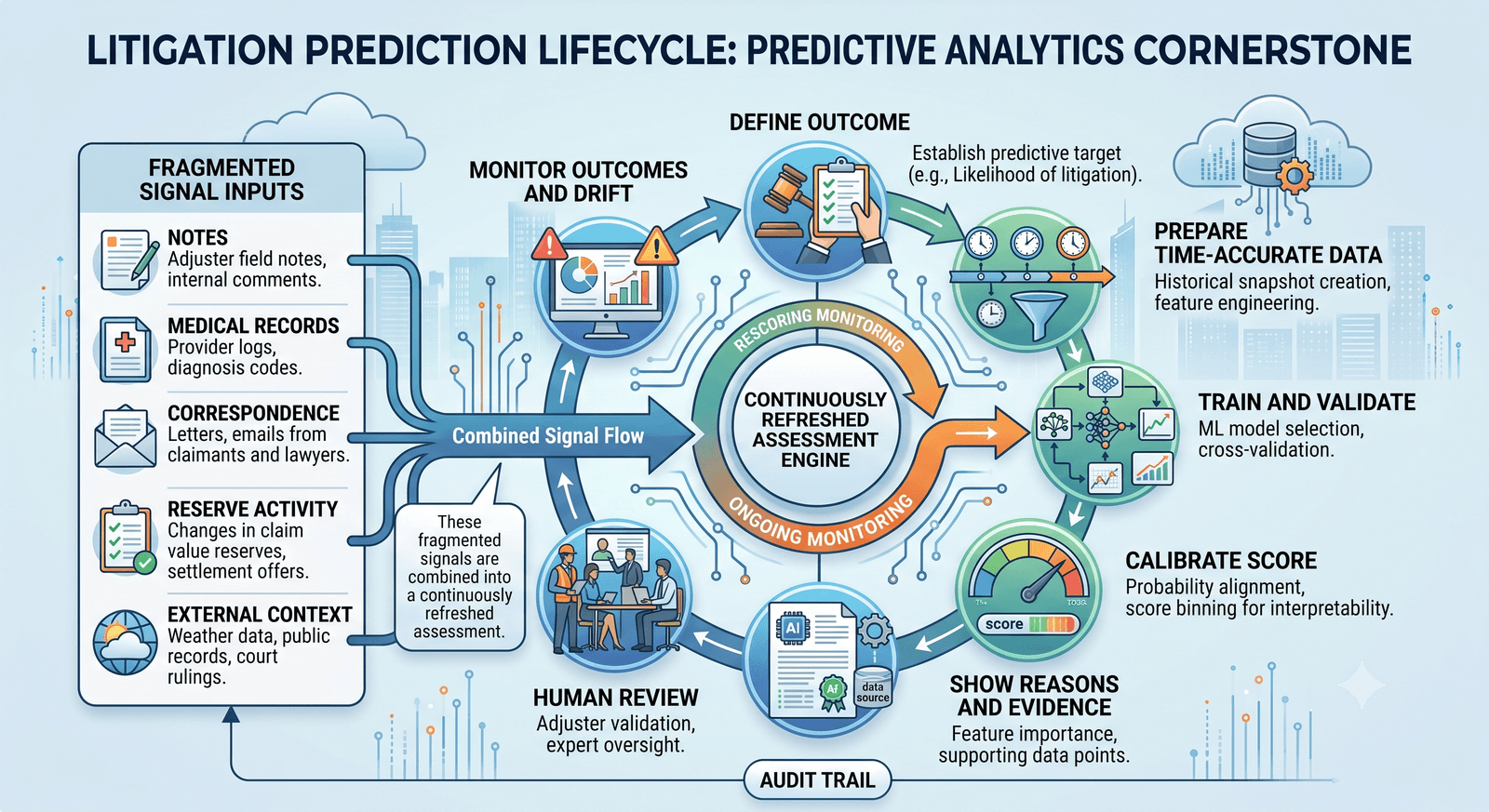
Claims organizations often possess the information needed to recognize litigation risk, but the signals are distributed across claim fields, notes, medical records, correspondence, reserve activity, and external context. AI creates value by converting those fragmented inputs into a continuously refreshed, explainable assessment that can be used in daily claims operations.
Executive Summary
AI predicts litigation risk through an end-to-end process that begins with a defined outcome, prepares historical claim data, extracts signals from documents, trains and validates predictive models, delivers a calibrated risk assessment, and connects that assessment to human review. The process must account for incomplete information, changing claim conditions, class imbalance, false positives, and model drift. The strongest programs close the loop by measuring interventions and returning reliable outcomes to the model-development process.
Learning Objectives
After reading this chapter, you should be able to:
- Understand the end-to-end litigation-prediction lifecycle.
- Recognize how data, models, explanations, and workflows work together.
- Understand why calibration, thresholds, and feedback loops matter.
- Identify executive controls needed from development through production.
Executive Framework
The prediction process is best understood as a chain of dependent capabilities. Weakness at any stage can reduce the accuracy, usability, or defensibility of the final recommendation.
| Stage | Primary Activity | Output | Key Risk | Executive Question |
|---|---|---|---|---|
| Outcome definition | Specify attorney or litigation event | Reliable target label | Ambiguous business definition | What exactly are we predicting? |
| Data preparation | Join, clean, and time-align claim information | Training dataset | Leakage or immature claims | Is the history representative? |
| Model development | Train and compare algorithms | Candidate model | Overfitting or imbalance | Does it generalize? |
| Validation | Test accuracy, calibration, bias, and stability | Approved model | Misleading metrics | Is performance fit for use? |
| Workflow delivery | Present score, reasons, and evidence | Actionable alert | No operational response | Will anyone act? |
| Monitoring | Track drift, outcomes, and interventions | Continuous improvement | Performance decay | Is value sustained? |
Define the Outcome Before Building the Model
Define the Outcome Before Building the Model
A model cannot be evaluated until the business defines the event it is intended to predict. Attorney representation, formal litigation, escalation to panel counsel, and high defense expense are different outcomes. The target must include a time horizon and rules for claims that close, reopen, or remain immature.
Poor labels create false confidence. If litigation status is inconsistently recorded or the dataset excludes claims that have not matured, the model may learn administrative practices rather than genuine litigation patterns.
Prepare Time-Accurate, Representative Data
Training data should include only information that would have been available at the moment of prediction. Using later information, such as a court filing or a reserve change made after the filing, creates data leakage and inflates model performance.
The dataset should also reflect the intended deployment population by line, jurisdiction, claim type, and maturity. Missing values, coding changes, mergers, vendor changes, and historical workflow differences should be documented and tested.
Train Models for an Imbalanced Outcome
Litigation is often less common than non-litigation, creating class imbalance. A model can appear accurate by predicting the majority class while failing to identify the claims that matter. Evaluation should therefore emphasize precision, recall, ranking performance, calibration, and business lift rather than overall accuracy alone.
Model development may compare logistic regression, decision trees, gradient boosting, neural networks, and ensembles. The best choice is the model that delivers reliable, explainable, and stable performance for the intended workflow, not necessarily the most complex algorithm.
Convert Model Output into an Explainable Assessment
The production output should identify the risk tier or probability, the main contributing factors, supporting evidence, and the date and model version used. The distinction between probability and confidence should be clear.
Thresholds should reflect the relative cost of missed high-risk claims and unnecessary reviews. Different lines or workflows may require different thresholds, especially when operational capacity or intervention options vary.
Embed Predictions into Operational Workflows
Predictions should appear in the core claim environment, work queues, dashboards, and supervisory views. Each tier should have a defined owner, response expectation, and documentation requirement.
The organization should also define what happens when the model is unavailable, when evidence is missing, or when an adjuster disagrees. Overrides are useful feedback and should be analyzed for recurring patterns rather than treated as user resistance.
Monitor Performance and Close the Feedback Loop
Production monitoring should track model accuracy, calibration, drift, alert volume, response time, adoption, and business outcomes. Performance should be segmented by line of business, jurisdiction, claim maturity, and other relevant populations.
Intervention outcomes should be captured carefully. The model predicts risk, but human actions may change the outcome. That means completed claims and intervention histories are needed to understand whether the system identified risk, whether teams acted, and whether the action was effective.
EXECUTIVE INSIGHT
: Litigation prediction is not a single algorithm. It is an operating system that connects accurate historical labels, time-correct data, validated models, explainable outputs, and disciplined human response.
MANAGEMENT PRINCIPLE
: A model is production-ready only when its output can be understood, acted upon, monitored, and challenged.
Executive Responsibilities
Executives and accountable owners should:
- Business sponsor: Define the target outcome, use case, and value hypothesis.
- Data science: Develop, validate, calibrate, document, and monitor the model.
- Claims operations: Translate risk tiers into practical response workflows.
- Technology: Deliver reliable integrations, versioning, evidence, and auditability.
- Governance committee: Approve use, monitor risk, and require remediation when performance changes.
Executive Checklist
Use this checklist to assess readiness and control:
- Define the target event, population, and prediction horizon.
- Prevent data leakage and account for immature claims.
- Evaluate precision, recall, ranking, and calibration.
- Set thresholds based on business cost and operational capacity.
- Deliver explanations and evidence inside claim workflows.
- Capture interventions, outcomes, overrides, and model drift.
Key Takeaways
- AI predicts litigation risk through a managed lifecycle that connects outcome definitions, representative data, validated models, explainable scores, operational workflows, and continuous monitoring. The quality of the business process matters as much as the quality of the algorithm.
Applying These Concepts with Charlee.ai
These concepts become most valuable when AI is embedded in daily insurance workflows, uses structured and unstructured information, and gives professionals timely insight without removing their authority or accountability.
Charlee.ai applies document intelligence, predictive analytics, and generative assistance so teams can identify risk earlier and make more informed decisions.
Earlier Risk Identification
Document Intelligence
Predictive Insights
Adjuster Copilot
Claims organizations often possess the information needed to recognize litigation risk, but the signals are distributed across claim fields, notes, medical records, correspondence, reserve activity, and external context. AI creates value by converting those fragmented inputs into a continuously refreshed, explainable assessment that can be used in daily claims operations.
Frequently Asked Questions
Ai-based litigation prediction is the use of data, analytics, and AI to estimate or explain legal escalation risk in an insurance claim. Depending on the use case, the output may address attorney involvement, suit filing, prolonged legal activity, or elevated litigation cost. It is a risk indicator—not a legal conclusion—and should help claims professionals decide where deeper review or earlier action may be warranted.
It can create value by helping insurers act before legal positions harden and costs accelerate. Earlier visibility may support evidence preservation, improved communication, assignment of experienced resources, timely legal review, more informed reserve evaluation, and better settlement planning. The business value depends on whether the insight reaches the right professional early enough to change an outcome.
Relevant inputs may include structured data, documents, models, monitoring, and explanations. The appropriate data depends on line of business, jurisdiction, claim stage, and the exact outcome being predicted. Insurers should distinguish confirmed facts from inferred or uncertain information and maintain traceability to the underlying claim record and source documents.
Claims professionals should treat the output as decision support. A score, alert, or explanation can help prioritize review, identify missing information, and suggest the next best action, but it should not dictate settlement, reserve, coverage, or legal strategy. Users need clear explanations, supporting evidence, defined escalation paths, and authority to override or challenge the result.
Human judgment remains accountable for material claim and legal decisions. Professionals must evaluate policy language, liability, damages, credibility, jurisdiction, customer circumstances, and facts not fully represented in the data. The strongest operating model combines AI consistency and monitoring with professional context, discretion, empathy, and legal expertise.
Success should be measured with both technical and business metrics. Technical measures may include discrimination, calibration, precision, recall, stability, and segment performance. Business measures may include earlier intervention, reduced legal expense, improved cycle time, more accurate reserves, better assignment, user adoption, and realized outcome improvement compared with a credible baseline.
Key risks include calibration, transparency, workflow fit, and human review. Other common problems are inconsistent outcome definitions, incomplete or biased data, unexplained alerts, excessive false positives, weak workflow integration, and measuring model accuracy without measuring whether users acted or outcomes improved. Governance should continue after deployment through monitoring, review, and controlled change.
It should operate as part of continuous claims intelligence rather than as a one-time score. Risk can be estimated at FNOL and updated as treatment, communications, demands, representation, pleadings, reserves, and other claim events change. Integration with triage, document intelligence, severity management, reserve review, and supervisor workflows helps turn insight into coordinated action.
Next step
Request a Demonstration
See how Charlee.ai helps claims organizations identify emerging litigation signals earlier, connect those insights to the supporting claim evidence, and enable experienced professionals to act with greater confidence. Schedule a personalized demonstration.
Request a Demonstration