Executive Premise
FNOL is the earliest point at which an insurer can organize the claim, set expectations, assign resources, and begin communication. It is also the point with the least information. Litigation prediction at FNOL can improve triage, but only when the organization treats the result as an initial, uncertainty-aware assessment that will be refreshed as the claim develops.
Executive Summary
At FNOL, AI uses available loss details, injury descriptions, policy information, jurisdiction, prior claim context, communication data, and other approved inputs to estimate early litigation propensity. The prediction should support routing and proactive handling rather than determine coverage, liability, reserves, or legal strategy. Successful programs improve intake quality, communicate uncertainty, set tiered triage thresholds, avoid inappropriate proxy variables, and automatically rescore the claim when more reliable information arrives.
Learning Objectives
After reading this chapter, you should be able to:
- Understand the opportunities and limitations of FNOL litigation prediction.
- Identify the data and workflow controls needed at intake.
- Design uncertainty-aware triage and rescoring rules.
- Measure whether early prediction improves handling and customer outcomes.
Executive Framework
FNOL prediction should be designed as the first step in a sequence, not as a final conclusion. The framework connects initial data to immediate handling and later rescoring.
| FNOL Element | AI Use | Early Signal | Immediate Response | Later Validation |
|---|---|---|---|---|
| Loss facts | Assess event and claim complexity | Multi-party or disputed event | Route to appropriate adjuster | Police report and investigation |
| Injury description | Estimate medical complexity | Serious or uncertain injury | Early medical review | Records and treatment progression |
| Jurisdiction | Add venue and legal context | Higher historical propensity | Supervisor visibility | Actual representation and filing |
| Communication and intake | Evaluate completeness and service risk | Confusion, dissatisfaction, missing facts | Prompt outreach and clarification | Subsequent contact history |
| Policy and claim history | Establish coverage and operational context | Complex limits or prior patterns | Specialist review where appropriate | Coverage and claim development |
| Initial score | Assign risk tier with uncertainty | Elevated but provisional risk | Triage and monitoring plan | Continuous rescoring |
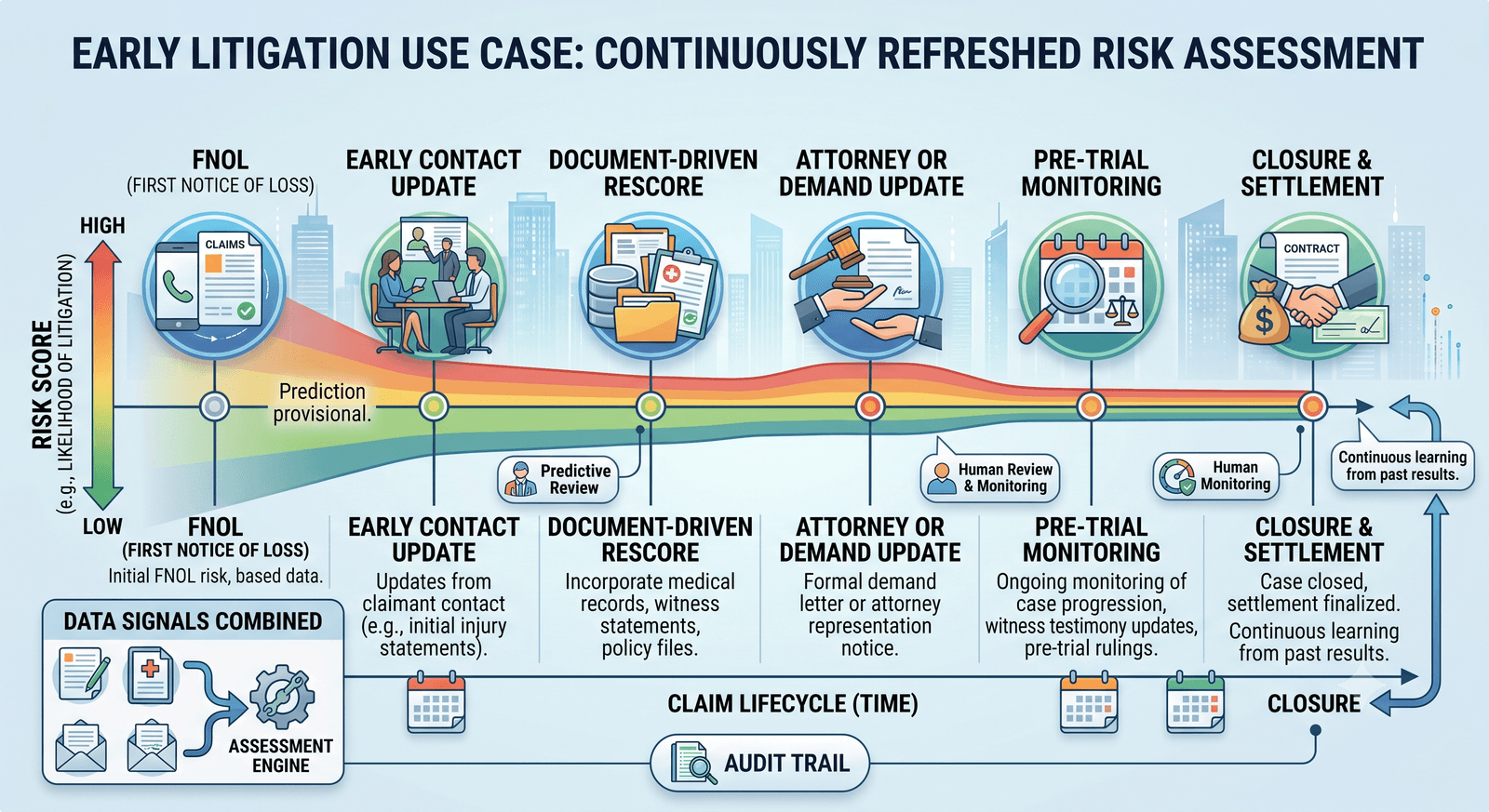
Why FNOL Has High Leverage and High Uncertainty
Why FNOL Has High Leverage and High Uncertainty
Early assignment, communication, investigation, and medical coordination can influence the entire claim. Yet FNOL information may be incomplete, self-reported, coded quickly, or later corrected.
The model should therefore present an initial probability or risk tier with clear limitations. Users should understand which inputs were available and which important facts remain unknown.
Capture Better Intake Data Without Burdening the Customer
Prediction quality depends on complete and consistent intake, but an overly complex FNOL process can slow service and frustrate claimants. The organization should identify the small number of fields that materially improve triage and can be collected appropriately.
Validation rules, guided questions, free-text capture, speech transcription, and post-intake review can improve quality. Sensitive fields should be included only when there is a defensible business and legal basis.
Use FNOL Scores for Triage, Not Final Decisions
Appropriate uses include assigning an experienced adjuster, increasing supervisor visibility, prioritizing contact, initiating investigation, or placing the claim on a closer monitoring cadence.
FNOL scores should not automatically deny coverage, set final reserves, determine settlement strategy, or label a claimant as litigious. The prediction is a prioritization aid that must be reviewed in context.
Design Thresholds Around Capacity and Service
A high-risk tier may trigger immediate review, while a medium tier may prompt enhanced monitoring. Thresholds should reflect line of business, operational capacity, expected intervention, and the relative cost of missed versus unnecessary escalations.
Routing rules should avoid creating self-fulfilling outcomes. A claim assigned to a complex-claims unit may receive different handling, so evaluation should distinguish model risk from the effect of the intervention itself.
Rescore as Better Information Arrives
The FNOL score should be replaced or supplemented when police reports, medical records, adjuster notes, representation notices, reserve changes, and demands become available. The system should show how the risk changed and which new evidence caused the change.
A practical sequence is: initial FNOL score, early-contact update, document-driven rescore, representation or demand update, and continuous monitoring through closure.
Measure Early Prediction Responsibly
Executives should measure intake completeness, initial calibration, false positives, missed claims, time to first review, routing accuracy, contact timeliness, rescoring movement, user adoption, and customer outcomes.
FNOL performance should be segmented by line, channel, jurisdiction, and catastrophe conditions. The organization should also test fairness and proxy risk because early data may contain location, demographic, or behavioral variables that require careful governance.
EXECUTIVE INSIGHT
: FNOL prediction creates value by improving the first handling decision while recognizing that the first prediction is also the least informed.
MANAGEMENT PRINCIPLE
: Use early intelligence to improve triage, then replace uncertainty with evidence through continuous rescoring.
Executive Responsibilities
Executives and accountable owners should:
- FNOL and claims operations: Define essential intake data, triage tiers, and response service levels.
- Customer experience: Ensure intake and outreach remain clear, respectful, and efficient.
- Data science: Calibrate early models, quantify uncertainty, and monitor segment performance.
- Legal and compliance: Review permissible inputs, fairness, and restrictions on automated use.
- Technology: Support low-latency scoring, versioning, rescoring, and workflow delivery.
Executive Checklist
Use this checklist to assess readiness and control:
- Define FNOL prediction as an initial, provisional assessment.
- Collect only data that improves triage and is appropriate to use.
- Use scores for routing and review—not final claim decisions.
- Set thresholds by line, capacity, and intervention value.
- Automatically rescore when more reliable evidence arrives.
- Measure calibration, routing, response time, fairness, and customer outcomes.
Key Takeaways
- Litigation prediction at FNOL helps insurers make better first assignments and begin proactive handling earlier. Its responsible use depends on high-quality intake, transparent uncertainty, limited decision scope, continuous rescoring, and accountable human review.
Applying These Concepts with Charlee.ai
These concepts become most valuable when AI is embedded in daily insurance workflows, uses structured and unstructured information, and gives professionals timely insight without removing their authority or accountability.
Charlee.ai applies document intelligence, predictive analytics, and generative assistance so teams can identify risk earlier and make more informed decisions.
Earlier Risk Identification
Document Intelligence
Predictive Insights
Adjuster Copilot
FNOL is the earliest point at which an insurer can organize the claim, set expectations, assign resources, and begin communication. It is also the point with the least information. Litigation prediction at FNOL can improve triage, but only when the organization treats the result as an initial, uncertainty-aware assessment that will be refreshed as the claim develops.
Frequently Asked Questions
Litigation prediction at fnol is the use of data, analytics, and AI to estimate or explain legal escalation risk in an insurance claim. Depending on the use case, the output may address attorney involvement, suit filing, prolonged legal activity, or elevated litigation cost. It is a risk indicator—not a legal conclusion—and should help claims professionals decide where deeper review or earlier action may be warranted.
It can create value by helping insurers act before legal positions harden and costs accelerate. Earlier visibility may support evidence preservation, improved communication, assignment of experienced resources, timely legal review, more informed reserve evaluation, and better settlement planning. The business value depends on whether the insight reaches the right professional early enough to change an outcome.
Relevant inputs may include early loss, injury, venue, communication, and claimant signals. The appropriate data depends on line of business, jurisdiction, claim stage, and the exact outcome being predicted. Insurers should distinguish confirmed facts from inferred or uncertain information and maintain traceability to the underlying claim record and source documents.
Claims professionals should treat the output as decision support. A score, alert, or explanation can help prioritize review, identify missing information, and suggest the next best action, but it should not dictate settlement, reserve, coverage, or legal strategy. Users need clear explanations, supporting evidence, defined escalation paths, and authority to override or challenge the result.
Human judgment remains accountable for material claim and legal decisions. Professionals must evaluate policy language, liability, damages, credibility, jurisdiction, customer circumstances, and facts not fully represented in the data. The strongest operating model combines AI consistency and monitoring with professional context, discretion, empathy, and legal expertise.
Success should be measured with both technical and business metrics. Technical measures may include discrimination, calibration, precision, recall, stability, and segment performance. Business measures may include earlier intervention, reduced legal expense, improved cycle time, more accurate reserves, better assignment, user adoption, and realized outcome improvement compared with a credible baseline.
Key risks include uncertainty, incomplete data, and repeated updating. Other common problems are inconsistent outcome definitions, incomplete or biased data, unexplained alerts, excessive false positives, weak workflow integration, and measuring model accuracy without measuring whether users acted or outcomes improved. Governance should continue after deployment through monitoring, review, and controlled change.
It should operate as part of continuous claims intelligence rather than as a one-time score. Risk can be estimated at FNOL and updated as treatment, communications, demands, representation, pleadings, reserves, and other claim events change. Integration with triage, document intelligence, severity management, reserve review, and supervisor workflows helps turn insight into coordinated action.
Next step
Request a Demonstration
See how Charlee.ai helps claims organizations identify emerging litigation signals earlier, connect those insights to the supporting claim evidence, and enable experienced professionals to act with greater confidence. Schedule a personalized demonstration.
Request a Demonstration