Executive Summary
At FNOL, AI can evaluate injury descriptions, damage information, policy limits, liability context, narratives, photos, location, weather, telematics, prior claims, and other available signals to estimate the range and probability of future severity. Because early information is incomplete, the output should support prioritization, specialist assignment, evidence preservation, and follow-up—not be treated as a final valuation. Models require calibration, confidence measures, ongoing rescoring, and outcome validation.
Learning Objectives
After reading this chapter, you should be able to:
- Identify severity indicators that may be available during FNOL.
- Understand the limitations of predicting ultimate severity from sparse information.
- Connect severity risk to specific first actions.
- Define governance and measurement for early severity models.
Executive Framework
Early severity intelligence is useful only when it leads to proportionate action. The framework links limited FNOL signals to controlled responses rather than premature conclusions.
| Early Signal | Possible Interpretation | Initial Action | Key Uncertainty | Measure |
|---|---|---|---|---|
| Serious injury language | Potential high medical and indemnity exposure | Senior adjuster, medical review, rapid contact | Diagnosis and treatment not yet verified | High-severity recall |
| Major property damage | Potential total loss, displacement, or business interruption | Priority inspection and specialist routing | Damage extent may be incomplete | Estimate-to-ultimate development |
| Coverage and limits | Potential exposure constraint or complexity | Early coverage review | Facts and policy application unresolved | Coverage review timeliness |
| Liability complexity | Multiple parties or disputed facts | Preserve evidence and expand investigation | Responsibility not established | Investigation quality |
| External event context | Catastrophe, telematics, weather, or location signal | Enrich and reprioritize | External data may be inaccurate or stale | Data-source accuracy |
| Multiple weak signals | Combined elevated risk despite no single decisive fact | Increase monitoring and follow-up | False-positive risk | Calibration and intervention value |
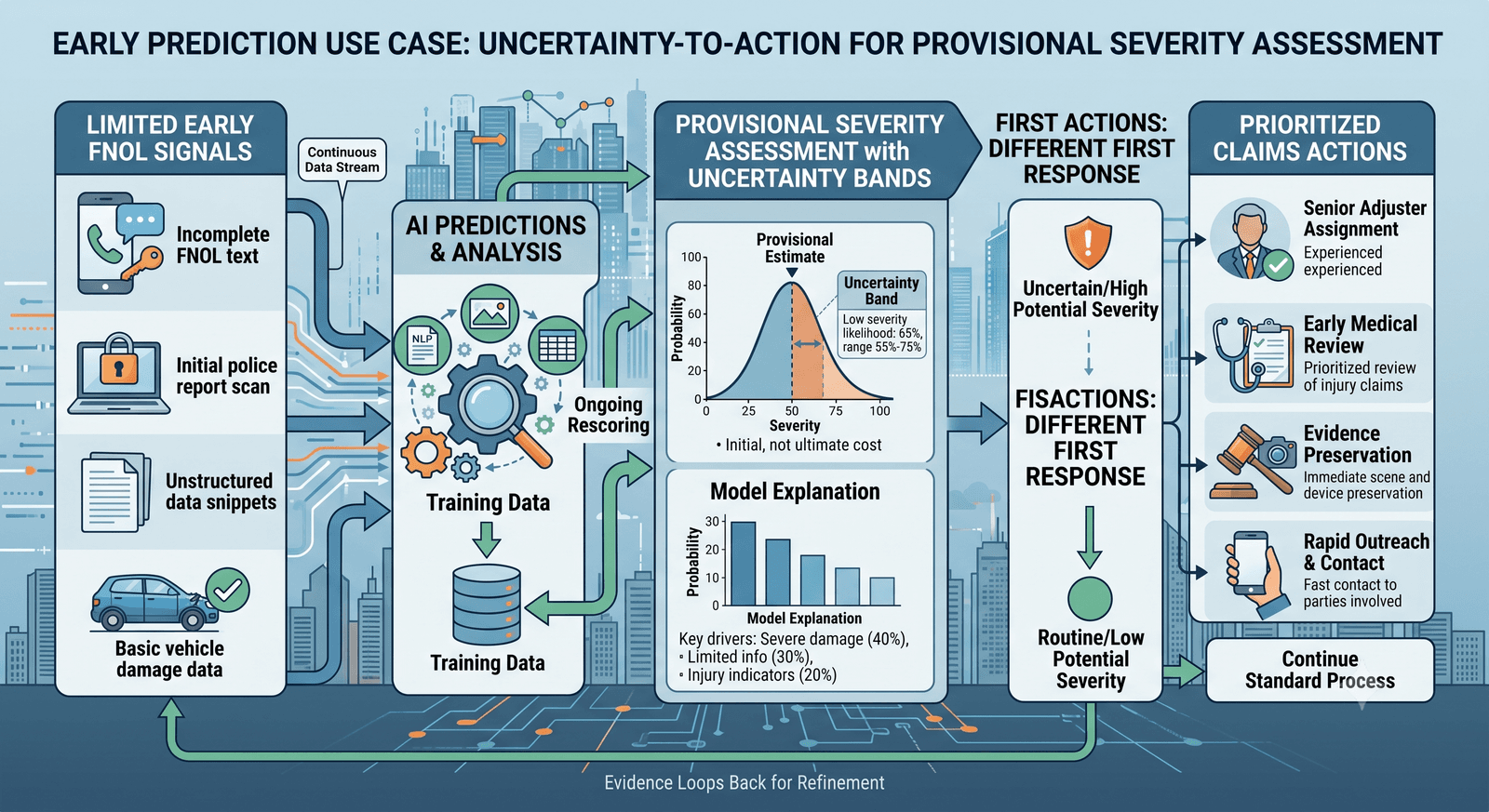
Can claim severity be predicted accurately at FNOL?
Can claim severity be predicted accurately at FNOL?
FNOL can support useful risk stratification, but exact ultimate cost is rarely knowable at the first report. A well-designed model estimates probability, range, or relative priority and is calibrated to the information available. Accuracy should be assessed by claim maturity and segment, not against an unrealistic expectation of perfect early valuation.
What severity indicators are available early?
Indicators may include injury mechanism, body part, hospitalization, vulnerable claimant, vehicle intrusion, fire or structural damage, business interruption, multiple claimants, policy limits, liability complexity, location, catastrophe conditions, and language suggesting escalating treatment or loss. The relevance of each signal varies by line of business.
How should sparse and uncertain information be handled?
The model should distinguish reported facts from inferred or externally sourced information. Missing fields should not automatically mean low risk. Confidence, data completeness, and contradiction indicators should accompany the score so the recommended action reflects uncertainty.
What actions should an elevated severity signal trigger?
Appropriate actions may include senior assignment, early customer contact, medical or engineering expertise, evidence preservation, coverage review, reserve attention, supervisor monitoring, or a scheduled reassessment. The response should be proportionate and should not create unsupported commitments or adverse treatment.
How should severity be reassessed after FNOL?
New medical records, estimates, liability facts, reserve changes, attorney involvement, and treatment progression can materially change expected severity. Event-driven rescoring allows escalation or de-escalation and prevents the first score from becoming a static label.
How should performance and intervention value be measured?
Measure discrimination, calibration, precision and recall at operational thresholds, false-positive burden, timing of identification, reserve development, reassignment, intervention completion, and claim outcomes. Compare claims receiving the intervention with appropriate baselines before attributing savings to the model.
EXECUTIVE INSIGHT
An early severity model is valuable when it buys the claims team time and options. It is harmful when a preliminary score is mistaken for a verified diagnosis, final exposure, or substitute for investigation.
MANAGEMENT PRINCIPLE
Use early severity to prioritize attention, not to manufacture certainty.
Executive Responsibilities
Executives and accountable owners should:
- Define severity outcomes, maturity points, and operational thresholds.
- Require confidence, completeness, and source information with scores.
- Link each threshold to an approved intervention playbook.
- Monitor calibration, false positives, and downstream burden.
- Reassess claims when material events occur.
Executive Checklist
Use this checklist to assess readiness and control:
- Use ranges or risk tiers rather than false precision.
- Separate reported facts from inferred information.
- Do not treat missing data as evidence of low severity.
- Pair elevated risk with proportionate first actions.
- Measure both model quality and intervention value.
- Maintain human authority over reserves, coverage, and handling.
Applying These Concepts with Charlee.ai
These concepts become most valuable when AI is embedded in daily insurance workflows, uses structured and unstructured information, and gives professionals timely insight without removing their authority or accountability.
Charlee.ai applies document intelligence, predictive analytics, and generative assistance so teams can identify risk earlier and make more informed decisions.
Earlier Risk Identification
Document Intelligence
Predictive Insights
Adjuster Copilot
At FNOL, AI can evaluate injury descriptions, damage information, policy limits, liability context, narratives, photos, location, weather, telematics, prior claims, and other available signals to estimate the range and probability of future severity. Because early information is incomplete, the output should support prioritization, specialist assignment, evidence preservation, and follow-up—not be treated as a final valuation. Models require calibration, confidence measures, ongoing rescoring, and outcome validation.
Frequently Asked Questions
The primary objective is identifying early indicators of injury, damage, complexity, and potential high-severity development. The capability should produce timely, decision-relevant information that improves the next professional action while preserving uncertainty, source evidence, and human accountability.
AI can combine structured claim and policy fields with narratives, conversations, documents, images, historical outcomes, and approved external context. It can extract facts, validate information, identify patterns, estimate risk, summarize evidence, recommend workflow actions, and update insights as the record changes.
Useful inputs may include policy and coverage data, claimant and insured information, loss circumstances, injuries, property or vehicle details, notes, recordings, documents, images, prior claims, operational events, and approved external data. Quality, timeliness, lineage, missingness, and permissible use should be assessed before production use.
The system should distinguish confirmed, reported, inferred, and unknown information; show confidence or missing-information indicators; preserve contradictory versions; and route low-confidence or consequential cases for review. It should never fabricate missing facts or convert an estimate into an authoritative claim conclusion.
Authorized professionals remain responsible for coverage, liability, reserving, investigation, assignment, payment, customer treatment, and other material decisions. AI should organize evidence and recommend action within approved boundaries, with clear override, correction, and escalation paths.
Measures should connect technical performance and workflow adoption to operational, customer, risk, and financial outcomes. Depending on the use case, these may include completeness, cycle time, recontact, assignment accuracy, intervention timing, customer effort, false-positive burden, downstream correction, loss outcomes, and realized benefit.
Leaders should manage poor data, unstable models, weak explanations, bias or proxy effects, privacy and security exposure, brittle integration, alert fatigue, unclear ownership, unsupported automation, vendor dependency, service failures, and measurement designs that overstate value.
Start with a defined decision, user, intervention, claim population, baseline, and benefit owner. Co-design the workflow with users, validate on representative data, integrate into the authoritative system, pilot with explicit success and risk criteria, monitor production performance, and scale only after value and control are demonstrated.
Next step
Request a Demonstration
Explore how Charlee.ai can help claims organizations apply timely, explainable intelligence to identifying early indicators of injury, damage, complexity, and potential high-severity development, while keeping claims professionals responsible for consequential decisions.
Request a Demonstration