Executive Premise
Premise Medical record intelligence converts fragmented clinical documentation into a traceable chronology of diagnoses, procedures, restrictions, treatment decisions, and change over time. Its value depends on accurate extraction, context, provenance, and qualified review.
Executive Summary
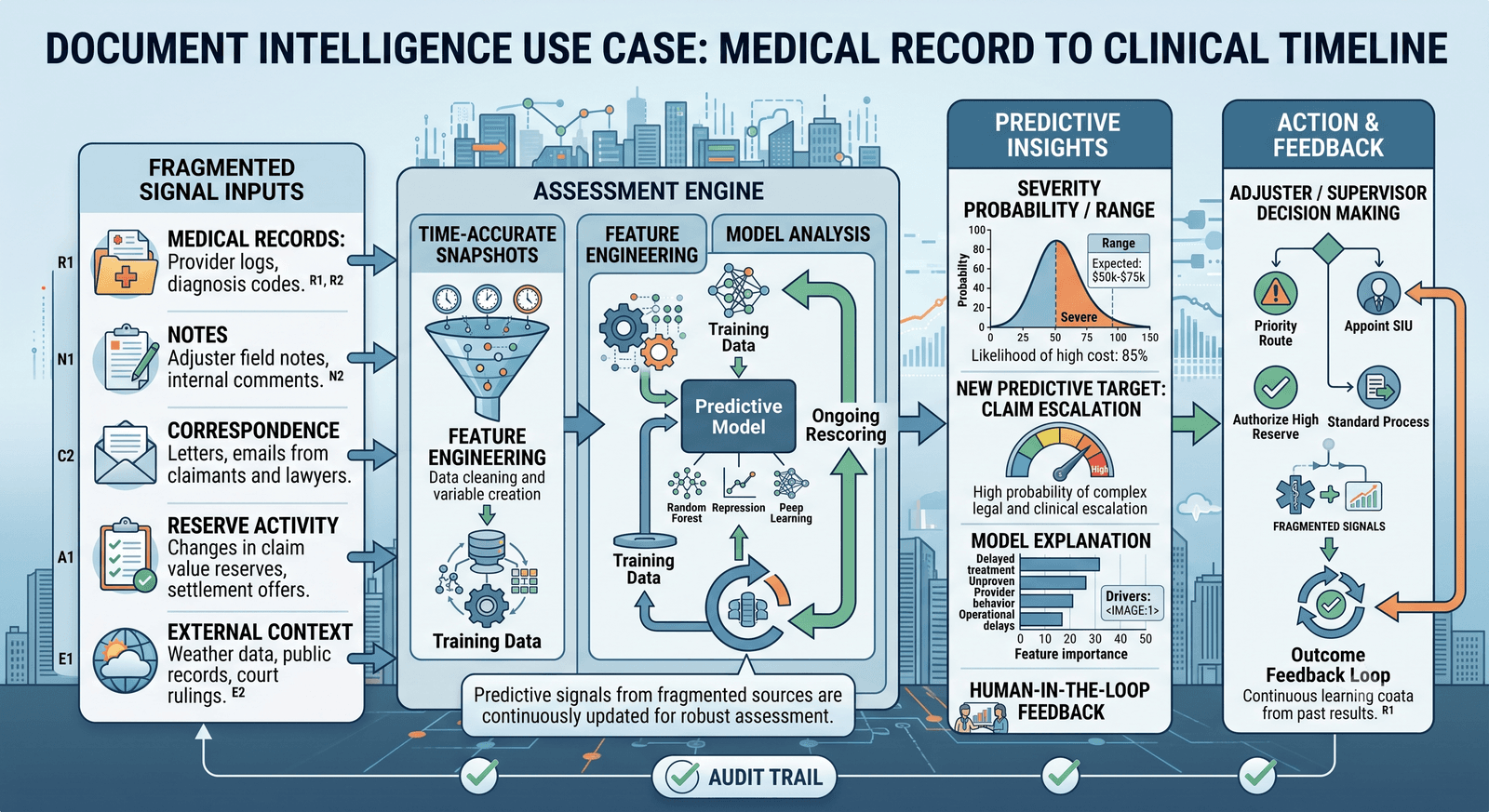
Medical records are among the richest sources of information in an injury claim, but they are lengthy, duplicated, inconsistent, and received incrementally. Document intelligence and natural language processing can classify records, perform OCR, extract clinical facts, construct timelines, summarize changes, and cite the supporting source. Production systems must distinguish current from historical conditions, detect negation, preserve document provenance, and protect protected health information. AI accelerates review; it does not replace clinical interpretation.
Learning Objectives
After reading this chapter, you should be able to:
- Understand the end-to-end medical record intelligence workflow.
- Recognize the importance of chronology, provenance, and context.
- Identify common extraction risks such as duplication, negation, and historical diagnoses.
- Integrate record intelligence into claims workflows with appropriate privacy and human review.
Executive Framework
A reliable medical record process turns documents into structured, reviewable evidence while preserving the connection to the original page and record.
| Stage | AI capability | Quality risk | Control |
|---|---|---|---|
| Ingest and classify | Identify record type, provider, date, and claim | Misfiled or unsupported documents | File validation and document routing |
| OCR and extract | Read diagnoses, procedures, medications, restrictions | Poor scans, handwriting, table errors | Confidence thresholds and review queues |
| Normalize and deduplicate | Standardize terms and remove repeated records | Loss of meaningful version changes | Version-aware duplicate handling |
| Build chronology | Order events and identify changes | Historical facts mistaken for current conditions | Temporal and negation logic |
| Summarize and cite | Highlight material developments with source references | Unsupported or hallucinated summaries | Grounded generation and page-level citations |
What is medical record intelligence?
What is medical record intelligence?
Medical record intelligence is the structured analysis of clinical documents to identify, organize, and explain facts relevant to the claim. It combines document processing, OCR, NLP, chronology construction, summarization, and source traceability.
How are records ingested and prepared?
The system should validate file type, separate document packets, classify record types, identify provider and service dates, and assess image quality. Poor scans, handwriting, fax artifacts, and mixed-document PDFs require confidence-based review rather than silent extraction.
How does AI create a medical chronology?
AI can extract diagnoses, procedures, medications, restrictions, referrals, work status, and treatment dates, then arrange them in sequence. Temporal context is essential so that historical diagnoses, ruled-out conditions, and current findings are not conflated.
Why are negation, duplication, and provenance important?
A phrase such as “no fracture” must not be interpreted as a fracture. Duplicate records should not inflate event counts, yet revised records should not be discarded. Each summary statement should preserve the provider, date, document, and page that supports it.
How should insights enter the claim workflow?
Chronologies, concise summaries, change alerts, and extracted facts can appear within the core claim system. High-impact findings should route to qualified claims or medical review, and users should be able to open the original source directly.
What privacy and governance controls are required?
Medical records contain sensitive health information. Role-based access, minimum-necessary use, encryption, audit logging, retention controls, vendor oversight, and restrictions on model training are core production requirements. Accuracy and error patterns should be monitored continuously.
Executive Insight
“Executive Insight The most valuable medical summary is not the shortest one. It is the one that accurately shows what changed, when it changed, and where the evidence can be verified.”
— Executive insight
Management Principle
“Every material medical insight should be traceable to its source.”
— Management principle
Executive Responsibilities
Executives and accountable owners should:
- Set extraction and review thresholds for clinical facts.
- Ensure page-level evidence traceability and auditability.
- Protect PHI across ingestion, processing, storage, and training.
- Monitor accuracy by document type, provider source, and use case.
Executive Checklist
Use this checklist to assess readiness and control:
- Validate and classify each incoming record.
- Use confidence-based review for low-quality documents.
- Build a chronology with temporal and negation awareness.
- Deduplicate without losing meaningful revisions.
- Cite the supporting document and page.
- Restrict access and training use of PHI.
Key Takeaways
- Key Takeaway Medical record intelligence transforms fragmented documents into a traceable clinical timeline. Production quality requires accurate extraction, contextual interpretation, source citations, privacy controls, and qualified review.
Applying These Concepts with Charlee.ai
These concepts become most valuable when AI is embedded in daily insurance workflows, uses structured and unstructured information, and gives professionals timely insight without removing their authority or accountability.
Charlee.ai applies document intelligence, predictive analytics, and generative assistance so teams can identify risk earlier and make more informed decisions.
Earlier Risk Identification
Document Intelligence
Predictive Insights
Adjuster Copilot
Premise Medical record intelligence converts fragmented clinical documentation into a traceable chronology of diagnoses, procedures, restrictions, treatment decisions, and change over time. Its value depends on accurate extraction, context, provenance, and qualified review.
Frequently Asked Questions
The primary objective is extracting and organizing diagnoses, procedures, medications, providers, timelines, gaps, complications, and treatment changes from medical records. The capability should help claims and clinical professionals act earlier and more consistently while preserving source evidence, uncertainty, and professional accountability.
AI can combine claim, policy, medical, provider, pharmacy, billing, occupational, legal, and operational information with unstructured records and notes. It can extract facts, construct timelines, identify patterns, estimate risk, summarize evidence, and recommend governed workflow actions.
Relevant inputs may include diagnoses, procedures, treatment dates, providers, medications, billing, medical records, injury details, comorbidities, work status, prior claims, reserves, notes, legal events, and outcomes. Data lineage, coding consistency, timeliness, missingness, and permitted use are essential.
The system should distinguish documented facts, reported information, model inferences, and unknowns; show confidence and missing-data indicators; preserve conflicting evidence; and route consequential or low-confidence cases to qualified professionals. It should not replace medical judgment.
Adjusters, nurses, physicians, case managers, and authorized leaders remain responsible for coverage, clinical review, care coordination, reserving, payment, investigation, and other material decisions. AI should support prioritization and evidence review within approved boundaries.
Measures may include detection lead time, referral appropriateness, intervention timing, medical cost development, reserve accuracy, treatment duration, functional recovery, return-to-work outcomes, cycle time, productivity, override rates, false-positive burden, and realized financial value.
Risks include fragmented medical data, coding variation, weak clinical context, bias or proxy effects, privacy and security exposure, unsupported medical conclusions, integration gaps, alert fatigue, unclear accountability, model drift, vendor dependency, and overstated ROI.
Start with a defined decision, target claim population, responsible users, intervention, baseline, and benefit owner. Validate with representative data and clinical review, integrate into the authoritative workflow, pilot with explicit success and risk criteria, monitor production performance, and scale only after value and controls are demonstrated.
Next step
Request a Demonstration
Explore how Charlee.ai can help claims organizations apply timely, explainable intelligence to extracting and organizing diagnoses, procedures, medications, providers, timelines, gaps, complications, and treatment changes from medical records, while keeping claims and clinical professionals responsible for consequential decisions.
Request a Demonstration