Executive Premise
AI adoption is a business change program that requires a clear purpose, redesigned workflows, aligned leadership, calibrated trust, practical training, and measures of changed behavior and outcomes.
Executive Summary
Managing Organizational Change and AI Adoption Across the Enterprise addresses how property and casualty insurance leaders can improve enterprise visibility, decision quality, coordination, and measurable performance through responsible use of artificial intelligence. The management value does not come from a model in isolation. It comes from connecting trusted evidence to a clearly owned decision, a timely business response, and a method for learning from the result.
A production approach begins with a defined business objective and baseline, establishes the data and workflow required to support the decision, sets proportionate human-review and governance boundaries, and measures whether behavior and outcomes improve. Executives should evaluate AI as an operating capability that combines strategy, people, process, data, technology, risk management, and continuous improvement.
Quick Answer
AI adoption is a business change program that requires a clear purpose, redesigned workflows, aligned leadership, calibrated trust, practical training, and measures of changed behavior and outcomes.
Learning Objectives
After reading this chapter, you should be able to:
- Explain the executive importance of enterprise AI adoption insurance.
- Identify the business decisions, information, workflow, and accountability required.
- Recognize governance, adoption, measurement, and implementation risks.
- Apply a practical framework for responsible enterprise management and measurable value.
Executive Framework
The framework connects the management dimension to the executive question, enabling practice, primary evidence, and accountable owner.
| Dimension | Executive Question | Enabling Practice | Primary Evidence | Owner |
|---|---|---|---|---|
| Purpose | What outcome or risk matters? | Define objective and accountable owner | Baseline and target | Executive sponsor |
| Leadership | What information should become visible? | Combine trusted data and evidence | Data quality and signal timeliness | Data and technology |
| Workflow | Which decision or action changes? | Embed guidance in the management workflow | Action completion and decision quality | Business leadership |
| Trust | How is responsible use protected? | Set human review and control boundaries | Exceptions, overrides, incidents | Risk and compliance |
| Capability | What proves operational progress? | Measure balanced business and risk outcomes | Realized value and customer impact | Finance and operations |
| Adoption outcomes | How will the enterprise learn? | Use feedback, monitoring, and change control | Sustained improvement | Executive governance |
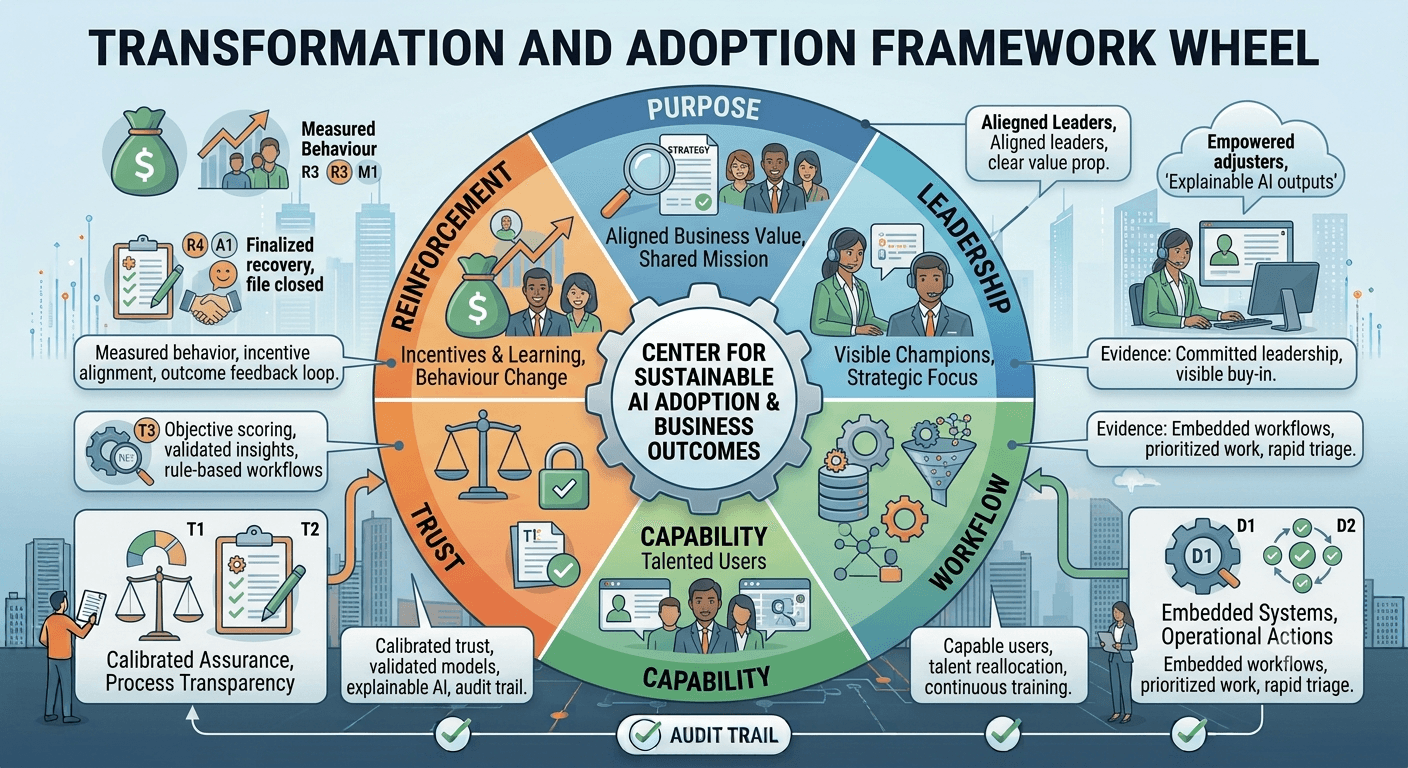
Frame adoption around the business problem
Frame adoption around the business problem
Frame adoption around the business problem is a core element of enterprise AI adoption insurance. Leaders should define the business objective, the decision or management question, the information required, the person accountable for action, and the outcome that will demonstrate value. The capability should be integrated into established operating routines rather than delivered as a separate analytical destination. Implementation should make supporting evidence, timing, confidence, assumptions, and limitations visible to the people responsible for the decision. Management should test the approach with representative lines, segments, jurisdictions, and users, document exceptions and overrides, and retain manual continuity when data or technology is unavailable.
Create visible and consistent leadership alignment
Create visible and consistent leadership alignment is a core element of enterprise AI adoption insurance. Leaders should define the business objective, the decision or management question, the information required, the person accountable for action, and the outcome that will demonstrate value. The capability should be integrated into established operating routines rather than delivered as a separate analytical destination. Implementation should make supporting evidence, timing, confidence, assumptions, and limitations visible to the people responsible for the decision. Management should test the approach with representative lines, segments, jurisdictions, and users, document exceptions and overrides, and retain manual continuity when data or technology is unavailable.
Executive practice: define the decision, evidence, owner, timing, action threshold, escalation path, and outcome measure before deployment. Review technical performance, adoption, business behavior, customer and workforce effects, financial results, and risk together before scaling.
Redesign work instead of adding another tool
Redesign work instead of adding another tool is a core element of enterprise AI adoption insurance. Leaders should define the business objective, the decision or management question, the information required, the person accountable for action, and the outcome that will demonstrate value. The capability should be integrated into established operating routines rather than delivered as a separate analytical destination. Implementation should make supporting evidence, timing, confidence, assumptions, and limitations visible to the people responsible for the decision. Management should test the approach with representative lines, segments, jurisdictions, and users, document exceptions and overrides, and retain manual continuity when data or technology is unavailable.
Treat resistance as useful implementation information
Treat resistance as useful implementation information is a core element of enterprise AI adoption insurance. Leaders should define the business objective, the decision or management question, the information required, the person accountable for action, and the outcome that will demonstrate value. The capability should be integrated into established operating routines rather than delivered as a separate analytical destination. Implementation should make supporting evidence, timing, confidence, assumptions, and limitations visible to the people responsible for the decision. Management should test the approach with representative lines, segments, jurisdictions, and users, document exceptions and overrides, and retain manual continuity when data or technology is unavailable.
Executive practice: define the decision, evidence, owner, timing, action threshold, escalation path, and outcome measure before deployment. Review technical performance, adoption, business behavior, customer and workforce effects, financial results, and risk together before scaling.
Build role-based capability and calibrated trust
Build role-based capability and calibrated trust is a core element of enterprise AI adoption insurance. Leaders should define the business objective, the decision or management question, the information required, the person accountable for action, and the outcome that will demonstrate value. The capability should be integrated into established operating routines rather than delivered as a separate analytical destination. Implementation should make supporting evidence, timing, confidence, assumptions, and limitations visible to the people responsible for the decision. Management should test the approach with representative lines, segments, jurisdictions, and users, document exceptions and overrides, and retain manual continuity when data or technology is unavailable.
Measure adoption through behavior and business outcomes
Measure adoption through behavior and business outcomes is a core element of enterprise AI adoption insurance. Leaders should define the business objective, the decision or management question, the information required, the person accountable for action, and the outcome that will demonstrate value. The capability should be integrated into established operating routines rather than delivered as a separate analytical destination. Implementation should make supporting evidence, timing, confidence, assumptions, and limitations visible to the people responsible for the decision. Management should test the approach with representative lines, segments, jurisdictions, and users, document exceptions and overrides, and retain manual continuity when data or technology is unavailable.
Executive practice: define the decision, evidence, owner, timing, action threshold, escalation path, and outcome measure before deployment. Review technical performance, adoption, business behavior, customer and workforce effects, financial results, and risk together before scaling.
Practical Insurance Example
A carrier introduces claim-severity alerts with managers and adjusters involved in workflow design. Training uses real claim examples, escalation and override rules are clear, and adoption is measured through review, action, decision quality, and claim outcomes rather than logins.
Common Misconceptions
EXECUTIVE INSIGHT
: AI adoption is a business change program that requires a clear purpose, redesigned workflows, aligned leadership, calibrated trust, practical training, and measures of changed behavior and outcomes. The executive objective is disciplined improvement, not maximum automation.
MANAGEMENT PRINCIPLE
: Connect every AI capability to a clearly owned business decision, supporting evidence, human authority, proportionate controls, and measurable outcome.
AI value is proven by technical accuracy.
value requires adoption, timely action, appropriate controls, and measurable outcomes.
Faster decisions are always better.
speed should be matched to consequence, uncertainty, and required human review.
Governance slows innovation.
clear ownership and pre-defined controls make responsible scaling faster and more credible.
Executive Responsibilities
Executives and accountable owners should:
- Approve the business purpose, baseline, decision boundaries, accountable owners, and success measures.
- Fund the complete operating model, including data, integration, workflow redesign, security, training, support, monitoring, and change management.
- Require evidence, transparency, human review, escalation, fallback, and documented override authority proportionate to the use case.
- Review adoption, operational behavior, customer and workforce effects, incidents, segment outcomes, and realized value before scaling.
Executive Checklist
Use this checklist to assess readiness and control:
- Define the enterprise objective and management decision to improve.
- Document the current-state baseline and expected value mechanism.
- Confirm data quality, lineage, access, security, and permitted use.
- Embed insight in an existing operating rhythm or workflow.
- Set human-review, override, escalation, and fallback procedures.
- Test representative products, segments, jurisdictions, and users.
- Measure technical, operational, customer, workforce, financial, and risk outcomes together.
- Assign ongoing monitoring, change control, benefit ownership, and retirement authority.
Key Takeaways
- Managing Organizational Change and AI Adoption Across the Enterprise becomes a durable enterprise capability when strategy, trusted information, workflow design, accountable human judgment, governance, and closed-loop measurement operate as one management system.
Applying These Concepts with Charlee.ai
These concepts become most valuable when AI is embedded in daily insurance workflows, uses structured and unstructured information, and gives professionals timely insight without removing their authority or accountability.
Charlee.ai applies document intelligence, predictive analytics, and generative assistance so teams can identify risk earlier and make more informed decisions.
Earlier Risk Identification
Document Intelligence
Predictive Insights
Adjuster Copilot
AI adoption is a business change program that requires a clear purpose, redesigned workflows, aligned leadership, calibrated trust, practical training, and measures of changed behavior and outcomes.
Frequently Asked Questions
Sustainable AI adoption is an operating-model change requiring clear purpose, leadership alignment, redesigned workflows, role-based capability, calibrated trust, and reinforcement. The objective is to improve a defined management decision or operating outcome—not simply to deploy another analytical tool.
The greatest value appears where leaders must interpret large volumes of changing information, identify material exceptions, coordinate action across functions, and measure whether intervention changed the result.
Use trusted operational, financial, customer, workforce, claims, underwriting, document, and external data that is relevant to the decision. Data lineage, timing, definitions, access, and limitations should be documented before deployment.
Executives and qualified professionals should define objectives, review material outputs, consider context, challenge assumptions, approve consequential actions, document overrides, and remain accountable for decisions and outcomes.
Define the approved purpose, accountable owners, decision boundaries, validation evidence, access controls, monitoring, escalation, change control, fallback procedures, and authority to suspend or retire the capability.
Measure technical performance together with adoption, response timing, decision quality, operational outcomes, customer and workforce effects, financial results, risk indicators, and persistence of benefit over time.
Avoid technology-first scope, unclear ownership, curated data that hides production reality, detached dashboards, excessive alerts, weak change management, unsupported automation, and benefit claims that lack baselines or attribution.
A mature model connects enterprise strategy, trusted evidence, integrated workflows, accountable human authority, proportionate governance, balanced metrics, and closed-loop learning. AI becomes part of normal management routines rather than a separate destination.
Next step
Request a Demonstration
See management risk and opportunity earlier. Charlee.ai helps P&C insurers turn claims and operational information into timely, explainable insights while claims professionals and executives retain responsibility for decisions.
Request a Demonstration